
On this page
Start here
Quick answer
A Danby freezer that seems not to turn off may be running longer because the temperature control is set too cold, the door is not sealing, warm food was added, the door is opened often, airflow is restricted, the unit is near heat or direct sun, or a quick-freeze function is active. First confirm that the compressor ever cycles off and that the freezer is actually maintaining cold, then check the accessible control setting, door closure, gasket, frost, load, room placement, and ventilation. If the compressor never cycles, the freezer is warming, frost rapidly returns, an abnormal noise or alarm appears, or the basic checks do not change the behavior, stop repeated testing and arrange qualified Danby service; do not open the sealed system or replace electrical parts yourself.
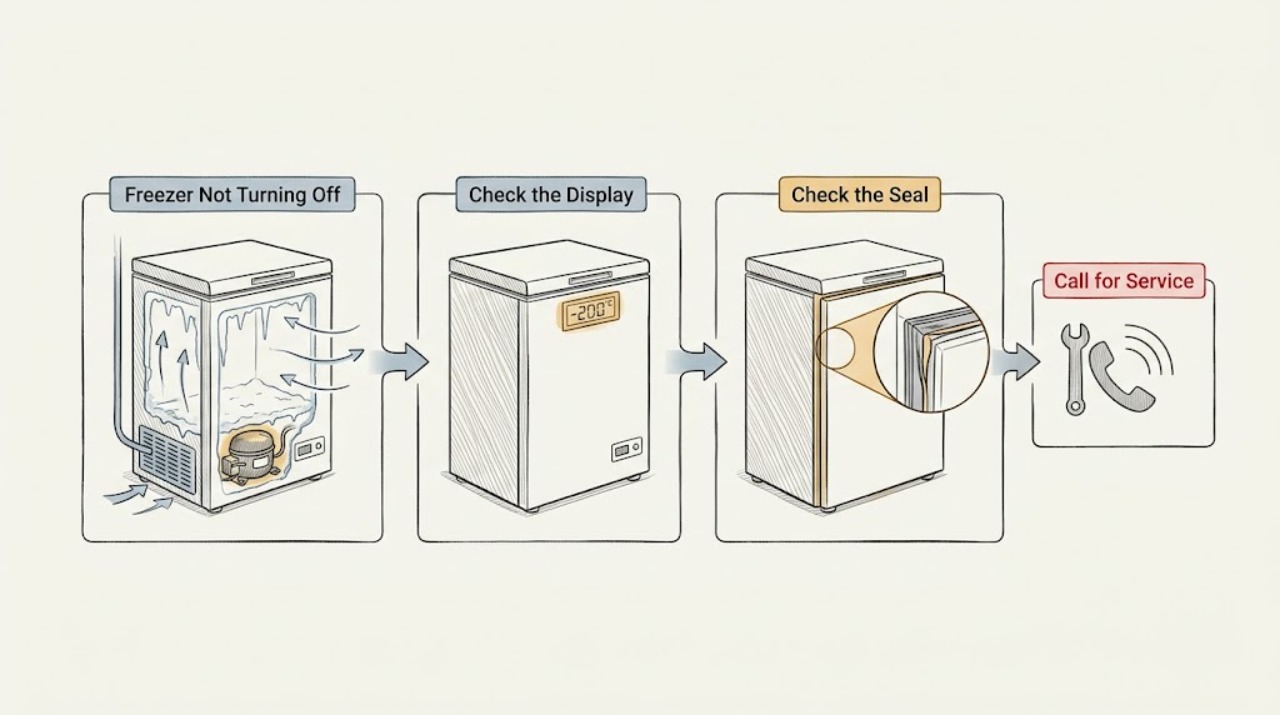
Work through in order
Diagnostic checks
Use only checks that match the exact appliance or system and its official guide.
-
Check 1
Observe whether the compressor ever stops while the door remains closed, and note whether the freezer interior is cold, warmer than usual, or warming despite the long run.
Expected result: The compressor cycles off and the contents remain cold, or it never rests and the interior is warm or worsening.
Next step: If the freezer is warming, protect the food and call qualified service promptly. If it remains cold, continue with the setting, door, frost, and airflow checks without repeatedly opening the door.
Why this matters
Why: Cycling with normal cooling can be expected after a recovery period or under a heavier load. No cycling combined with poor cooling points toward a fault rather than a simple setting.
-
Check 2
Check the accessible thermostat or electronic temperature control and confirm that a quick-freeze or fast-freeze function is not intentionally active; make only the small adjustment allowed by the exact model manual.
Expected result: The control is set unusually cold, a quick-freeze function is active, or the control is at a normal setting with no special mode.
Next step: Return the control to the model-recommended everyday setting and allow the appliance to cycle without frequent door openings. If it never rests or the temperature is abnormal, stop and arrange service; do not replace the thermostat yourself.
Why this matters
Why: Danby lists a setting that is too cold and an active quick-freeze function as causes of extended or continuous running. A normal setting with the same behavior makes door, frost, heat-source, airflow, or technical causes more likely.
-
Check 3
Check that no package, basket, or frost prevents the door or lid from closing, then inspect the gasket around the full perimeter for dirt, gaps, tears, or sections that do not contact the cabinet.
Expected result: The door was held open, the gasket is dirty or damaged, frost blocks closure, or the door closes evenly with an intact seal.
Next step: Remove only an obvious obstruction and clean or dry the accessible gasket as the manual directs. Do not glue, stretch, or force a damaged seal; arrange service if the door cannot close squarely.
Why this matters
Why: Danby manuals link an open or poorly sealed door with continuous running, frost, temperature fluctuation, and reduced efficiency. A proper seal makes this less likely but does not rule out a blocked airflow path or control fault.
-
Check 4
Inspect the interior walls, floor, and door area for heavy frost or an ice bridge that could restrict the door or internal airflow; if the exact model is manual-defrost, follow its unplugged defrost procedure and protect the floor.
Expected result: Frost is heavy or blocking closure, the freezer is frost-free with little buildup, or frost returns quickly after a complete model-approved defrost.
Next step: Defrost only as the exact manual permits and never use a knife, ice pick, or other sharp tool. If frost returns quickly, water escapes, or the model is frost-free but ices heavily, stop and call service.
Why this matters
Why: Danby explains that frost forms from warm air entering during door openings and can reduce efficiency; its guidance also identifies defrosting as a maintenance step. Rapid recurrence suggests a seal, defrost, airflow, or cooling fault.
-
Check 5
Check whether hot or recently unfrozen food was added, whether the door has been opened repeatedly, whether food blocks vents, and whether the freezer has clearance from heat, direct sunlight, and surrounding obstructions.
Expected result: The load is warming the cabinet, the door has been opened frequently, vents or clearance are blocked, or the load and placement are normal.
Next step: Rearrange only accessible contents to leave airflow, close the door promptly, and keep hot food out until cooled. If the freezer remains continuously active after recovery, arrange service rather than forcing a lower setting.
Why this matters
Why: Danby lists warm food, frequent opening, heat or sunlight, and restricted airflow among reasons the freezer runs longer. Normal load and placement make a control, seal, defrost, or cooling fault more likely.
-
Check 6
Check from outside that the power cord is fully seated, the appliance is not using an unsafe extension arrangement, the outlet is not damaged, and the freezer is stable and ventilated; do not access wiring.
Expected result: The cord or outlet is loose or damaged, the freezer was recently moved or installed, ventilation is obstructed, or the external installation appears normal.
Next step: Stop for a damaged cord, hot outlet, repeated breaker operation, or unsafe placement and call qualified electrical or appliance service. If the external installation is normal, continue to the service boundary.
Why this matters
Why: Power and placement affect compressor operation and heat removal. A damaged electrical connection or abnormal installation is a safety or service issue, not a reason to keep cycling the control.
-
Check 7
Record whether the compressor runs continuously, clicks and stops, makes a new grinding or rattling sound, or returns to normal after the control, door, frost, load, and placement checks.
Expected result: The behavior normalizes, or continuous running, abnormal noise, repeated clicking, warming, or fault indications remain.
Next step: Stop using the freezer if it is warm, noisy, leaking, or electrically abnormal, and arrange qualified Danby service. Do not remove panels or test compressor or refrigeration components.
Why this matters
Why: A return to cycling supports an operating-condition cause. Persistent abnormal behavior after external checks suggests a thermostat, sensor, fan, start, compressor, sealed-system, or defrost fault that needs diagnosis.
Use your observations
Decision map
Find the observation that best matches what you see, then follow the next safe action.
-
PATH 01Next step
What you see
The freezer runs for long periods but cycles and remains cold.
Do this next
Check the control, door seal, frost, load, clearance, and ventilation. If it continues after those conditions normalize, call service.
Why this path and its safety boundary
Why it matters: A cold setting, recent warm load, frequent opening, frost, heat source, or airflow restriction may be extending the run time.
-
PATH 02Next step
What you see
The compressor never rests and the freezer is warm or warming.
Do this next
Keep the door closed, protect food, and arrange qualified service promptly. Do not keep lowering the control or open the refrigeration system.
Why this path and its safety boundary
Why it matters: A seal, airflow, defrost, control, compressor, or sealed-system fault may be preventing temperature recovery.
-
PATH 03Next step
What you see
A quick-freeze or fast-freeze mode is visibly active.
Do this next
Cancel the mode only through the model's documented control and observe normal cycling. If it cannot be cancelled or the freezer remains abnormal, call service.
Why this path and its safety boundary
Why it matters: The appliance may be intentionally running for an extended period to lower the cabinet temperature.
-
PATH 04Next step
What you see
The door does not close fully or heavy frost blocks the gasket or interior.
Do this next
Remove only accessible obstructions and follow the exact manual's safe defrost process. Never use sharp tools; call service for a damaged gasket or recurring frost.
Why this path and its safety boundary
Why it matters: Warm air entering through the seal or door opening can cause frost and longer compressor operation.
-
PATH 05Next step
What you see
The freezer clicks repeatedly, makes a new abnormal noise, trips power, or has a hot or damaged cord or outlet.
Do this next
Stop using it and isolate power only if safe. Arrange qualified appliance or electrical service; do not repeatedly reset the breaker.
Why this path and its safety boundary
Why it matters: The appliance may have an electrical or mechanical fault outside routine temperature-setting checks.
-
PATH 06Next step
What you see
Water escapes during defrosting, the cabinet is punctured, or a sealed-system concern is suspected.
Do this next
Stop the procedure, protect the floor and food, and call qualified service. Do not puncture ice or attempt refrigerant repair.
Why this path and its safety boundary
Why it matters: Further operation or sharp-tool work can cause property damage or make a refrigeration fault worse.
Helpful context
Understand the symptom
First confirm that it is truly continuous
A freezer normally cycles its compressor and may run longer after warm food is loaded, after frequent door openings, or during recovery from frost. Listen and observe over a normal operating period without repeatedly opening the door. The key split is a unit that cycles while holding temperature versus one that never rests or is running continuously while the interior is warming.
Stay outside the sealed system
If the cord, outlet, or cabinet is hot or damaged, or there is smoke, a burning smell, or a refrigerant-line concern, stop using the freezer and isolate power only if safe. Do not puncture frost, remove sealed panels, bypass controls, alter refrigerant or compressor components, or keep resetting a breaker.
The temperature result changes the next step
A continuously running freezer that stays cold usually calls for settings, door, frost, load, heat-source, or airflow checks. Continuous running with a warm interior or frequent frost suggests a cooling, defrost, seal, or airflow fault. Compressor noise that is abnormal, repeated clicking without cooling, or an error indication should move directly to service after the safe external checks.
Only after diagnosis
Potential parts
- door gasket
Consider only if the exact model's gasket is torn, deformed, or unable to seal after an obstruction is removed.
Gaskets are cabinet- and model-specific; confirm the rating-plate model and fit before ordering. - thermostat or temperature sensor
Consider only after service confirms incorrect temperature control or sensing rather than a door, frost, load, or airflow cause.
Control parts vary by model and electrical design and require qualified diagnosis and installation. - defrost component
Consider only when recurring frost or a frost-free cooling fault is traced by a technician to a defrost component.
Defrost parts and access differ by model; do not bypass a thermal safety device. - fan, start device, or compressor component
Consider only after qualified testing confirms persistent continuous running, repeated clicking, abnormal noise, or poor cooling is caused by that component.
Refrigeration and electrical components are model-specific and require professional service; no sealed-system work is implied for the user.
When checks do not resolve it
Need a professional?
Call qualified Danby service when the freezer never cycles off, remains warm, repeatedly frosts, has an abnormal noise or alarm, or continues running after the documented setting, door, frost, load, and airflow checks., Stop immediately for smoke, burning smell, hot or damaged cord or outlet, repeated breaker operation, water near electrical parts, a damaged cabinet, or suspected refrigerant-line damage., Do not open the sealed system or replace a thermostat, sensor, start device, compressor, fan, defrost part, or wiring unless the exact fault has been diagnosed and the work is performed by a qualified technician.
Common questions
FAQ
Is it normal for a Danby freezer to run continuously?
Longer operation can occur after warm food is added, frequent door openings, frost buildup, restricted airflow, or an active quick-freeze function. If the compressor never rests, the freezer is warming, or the behavior continues after those checks, call service.
Can a door seal make a Danby freezer run all the time?
Yes. A door that does not close or a damaged gasket lets warm air enter and can cause frost and longer running. Check for obstructions and gasket damage, but arrange service for a seal that cannot close correctly.
Will quick-freeze make the freezer run longer?
Danby manuals list an active quick-freeze function as a reason an appliance can run continuously. Cancel it only through the exact model's documented control and call service if the mode cannot be cancelled or normal cycling does not return.
Can I use a knife to remove frost from a freezer that will not turn off?
No. Danby warns against sharp tools because they can damage the freezer or refrigerant lines. Use only the exact manual's safe defrost procedure, or call service for heavy or recurring ice.
When should I call for a Danby freezer that will not turn off?
Call when it never cycles, is warm, repeatedly frosts, makes abnormal sounds, trips power, or remains continuously active after the documented setting, door, frost, load, and airflow checks. Do not open the sealed system or replace internal electrical parts yourself.
Read the exact guide
Official sources
- UPRIGHT FREEZERDanby · Official Danby upright freezer manual used for continuous-running, door, temperature, airflow, installation, and service guidance; exact model manual controls
- How to Defrost a FreezerDanby Canada · Official Danby defrost guidance used for frost causes, defrost-drain distinctions, floor protection, and sharp-tool warnings
- FAQsDanby Canada · Official Danby FAQ page opened for freezer frost, door seal, temperature, airflow, and persistent cooling-support guidance
Community feedback
Share a repair observation
Share a plain-text repair observation. Accepted observations are published automatically; this page may take a moment to update.