
On this page
Start here
Quick answer
First identify the sound and when it occurs. Danby says gurgling can be normal refrigerant circulation, popping or cracking can come from parts expanding and contracting, and a louder compressor start can settle as the cycle continues. For a new or persistent rattle, unplug the freezer before removing loose items, check that the cabinet is level and stable, and inspect only accessible fan or compressor areas for debris. Do not puncture refrigerant tubing, open sealed panels, or keep using the freezer if noise comes with smoke, a burning smell, damaged wiring, loss of cooling, or repeated electrical trips; arrange qualified service.
Before you begin
Safety first
- The user may inspect only removable contents, accessible placement, leveling, ventilation, and external debris with power disconnected. Do not puncture refrigerant tubing, open sealed panels, probe live wiring, reach into a running fan, or substitute a part based only on the noise.
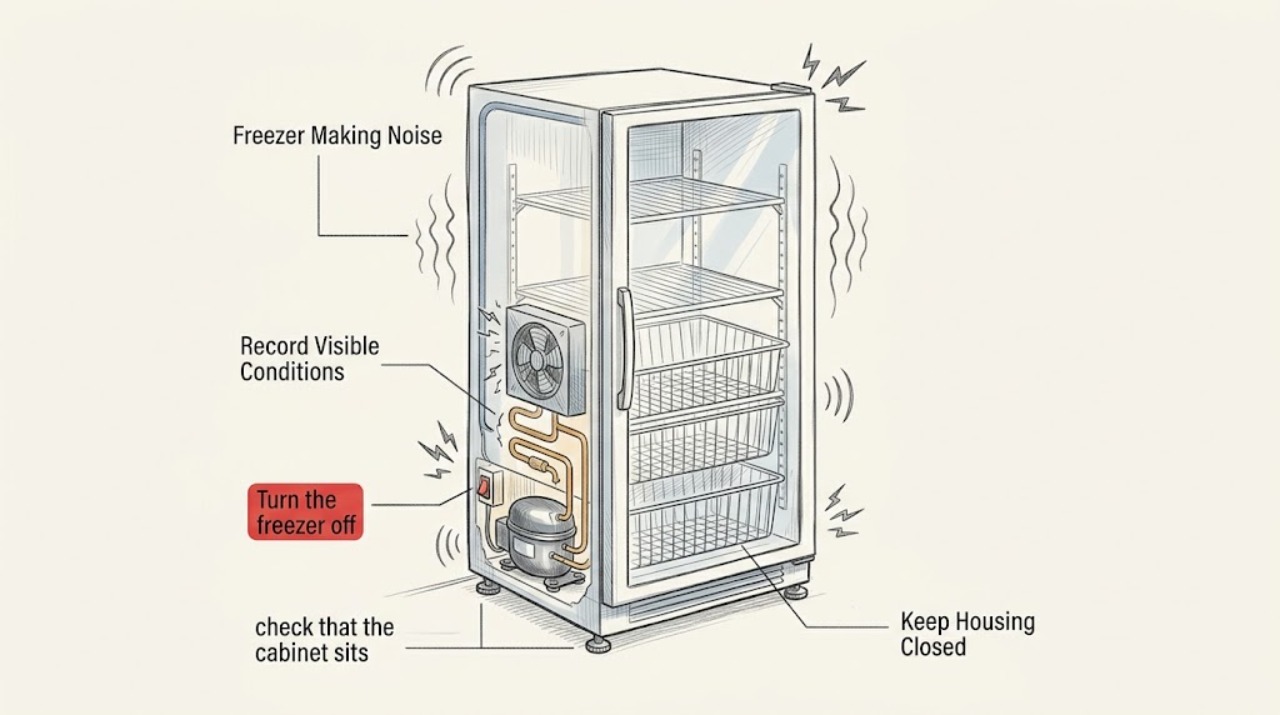
Work through in order
Diagnostic checks
Use only checks that match the exact appliance or system and its official guide.
-
Check 1
Stand beside the closed freezer and note whether the sound is gurgling, popping or cracking, a brief louder compressor start, steady humming, vibrating or rattling, scraping, or an intermittent click. Record whether it occurs at start-up, during a running cycle, after shutoff, or continuously.
Expected result: The sound matches a short cycle-related gurgle, pop or crack, or compressor start, or it is a new continuous rattle, scrape, or click.
Next step: Follow the matching branch. Keep the door closed while observing and do not place hands near a running fan or compressor.
Stop if: Stop if the noise is accompanied by smoke, a burning smell, arcing, damaged cord, leaking fluid, loss of cooling, or repeated electrical trips.
Why this matters
Why: Danby manuals describe several short refrigeration sounds as normal; a persistent or mechanical-sounding noise needs external placement and loose-object checks before any parts diagnosis.
-
Check 2
Turn the freezer off and unplug it before checking for bottles, baskets, shelves, trim, containers, or other loose objects touching the cabinet or one another; secure or reposition only removable items described by the manual.
Expected result: The noise stops or changes when a loose item is removed or repositioned, or it continues with the removable contents stable.
Next step: Restore the items without blocking ventilation and run one supervised cycle. If the noise returns with no loose contact, continue to leveling and clearance checks.
Stop if: Stop if an item is frozen into place, a shelf or basket is cracked, or access would require touching wiring, tubing, a fan, or a sealed compartment.
Why this matters
Why: A changed sound points to contact or vibration from an accessible object, while an unchanged sound shifts attention to cabinet placement or an internal component.
-
Check 3
With the freezer empty enough to move safely and unplugged, check that the cabinet sits firmly on a strong, level floor and that its adjustable foot or feet are set as the model manual describes; do not tilt a loaded appliance alone.
Expected result: The cabinet rocks, a foot is not bearing evenly, the floor is weak or uneven, or the freezer is stable and level.
Next step: Correct only the accessible leveling adjustment described in the manual, then run one cycle. If vibration persists, stop trying to shim internal parts and arrange service.
Stop if: Stop for a damaged foot, unstable flooring, a heavy loaded move, a cabinet that cannot be made stable, or any need to remove structural panels.
Why this matters
Why: Danby identifies an unlevel freezer and an uneven or weak floor as causes of vibration or rattling; a stable level installation makes a persistent internal source more plausible.
-
Check 4
With power disconnected, inspect the accessible fan and compressor area and the surrounding ventilation space for loose debris or an object contacting the cabinet; clean only the accessible area with the method in the model manual and do not remove a sealed cover.
Expected result: Loose debris or contact is present, or the accessible area is clear but the noise continues.
Next step: Restore power only after the area is clear and dry, then make one supervised observation. Arrange service if the sound persists or cooling changes.
Stop if: Stop for exposed wiring, damaged insulation, a seized or inaccessible fan, refrigerant tubing, oil or fluid, or any need to open the sealed system.
Why this matters
Why: Danby’s noise FAQ treats fan or compressor-area debris and loose objects as user checks; a clear area with continued noise does not identify whether a fan, compressor, or sealed-system part is faulty.
-
Check 5
After safe external checks, observe whether the freezer still reaches and maintains its normal cold condition while the sound occurs; do not adjust internal controls beyond the model manual or use a sound level as a substitute for temperature and safety observations.
Expected result: Cooling remains normal and the sound is brief or cycle-related, or cooling is weak, absent, intermittent, or the noise is continuously worsening.
Next step: If cooling is abnormal or the noise persists after placement checks, keep the freezer closed and arrange qualified service. Protect food according to local food-safety guidance if the unit is not maintaining temperature.
Stop if: Stop for smoke, burning smell, arcing, damaged cord, refrigerant leak signs, or any repeated breaker trip.
Why this matters
Why: Normal cooling with a documented cycle-related sound is more consistent with the normal noises described by Danby; abnormal cooling with noise raises concern for a fan, compressor, control, airflow, or sealed-system fault.
-
Check 6
Arrange qualified freezer service when a persistent noise remains after the loose-object, level, and accessible-area checks, or when the noise is accompanied by abnormal cooling; give the technician the exact model and a recording or description made from a safe distance.
Expected result: The source cannot be identified externally, the noise returns after a temporary change, or the freezer has lost cooling or shows an electrical or physical warning sign.
Next step: Keep the freezer out of service when a safety symptom or loss of cooling is present, and use Danby support or an authorized service depot for model-specific diagnosis.
Stop if: Stop using the freezer for smoke, burning smell, arcing, exposed wiring, damaged cord, repeated trips, refrigerant tubing damage, or unsafe temperature rise.
Why this matters
Why: The remaining possibilities include moving or electrical components and the sealed refrigerant system, which overlap in sound and cannot be safely assigned to a replacement part by a homeowner.
Use your observations
Decision map
Find the observation that best matches what you see, then follow the next safe action.
-
PATH 01Next step
What you see
The freezer makes a brief gurgling, popping, or cracking sound during operation or a cycle change, and cooling is normal.
Do this next
Arrange qualified service and follow the exact model guidance.
Why this path and its safety boundary
Why it matters: Treat it as a documented normal refrigeration sound, keep ventilation clear, and monitor for a change instead of replacing a part by sound alone.
-
PATH 02Next step
What you see
The compressor is louder when it starts and the sound settles as the freezer continues running.
Do this next
Arrange qualified service and follow the exact model guidance.
Why this path and its safety boundary
Why it matters: Danby describes this start-up pattern as normal in the chest-freezer guide. If it becomes continuous, harsher, or is paired with poor cooling, arrange service.
-
PATH 03Next step
What you see
The noise is vibrating or rattling and the cabinet rocks or sits on an uneven or weak floor.
Do this next
Arrange qualified service and follow the exact model guidance.
Why this path and its safety boundary
Why it matters: Unplug before moving accessible items, stabilize the cabinet using the model’s leveling guidance, and run one supervised cycle. Persistent vibration needs service.
-
PATH 04Next step
What you see
An object, loose debris, or an accessible fan or compressor-area obstruction is found.
Do this next
Arrange qualified service and follow the exact model guidance.
Why this path and its safety boundary
Why it matters: With power disconnected, remove only the accessible obstruction or reposition the loose object. Do not open sealed covers or reach into a running appliance.
-
PATH 05Next step
What you see
Noise occurs with weak, absent, or intermittent cooling, or the sound is steadily worsening.
Do this next
Arrange qualified service and follow the exact model guidance.
Why this path and its safety boundary
Why it matters: Stop using the freezer and arrange qualified diagnosis; the sound does not identify whether the cause is a fan, compressor, control, airflow, or sealed-system issue.
-
PATH 06Next step
What you see
There is smoke, a burning smell, arcing, repeated electrical trips, exposed wiring, damaged cord, or suspected refrigerant-tubing damage.
Do this next
Arrange qualified service and follow the exact model guidance.
Why this path and its safety boundary
Why it matters: Disconnect power only if it can be done without approaching a hazard, leave the freezer out of service, and obtain qualified service. Do not puncture tubing or remove safety covers.
Helpful context
Understand the symptom
Classify the sound before assuming a failed part
A brief gurgle, a pop or crack during a cycle change, and a compressor that is louder at start-up can be normal refrigeration sounds in Danby manuals. A vibration or rattle that changes when the cabinet or a loose object is stabilized points to placement or contact instead. The sound becomes more concerning when it is new, continuously loud, accompanied by loss of cooling, or paired with an electrical or refrigerant safety symptom.
Make external checks with the freezer de-energized
Before moving shelves, baskets, or loose objects, turn the control off and unplug the freezer if the model instructions allow that access. Check that the cabinet rests solidly on a strong, level floor and that ventilation openings are not obstructed. Clean only accessible exterior areas; do not remove a sealed cover, bend tubing, or reach into a running fan.
Do not diagnose the sealed system by sound alone
A compressor, fan motor, start device, thermostat, or sealed refrigerant-system issue can produce overlapping sounds. The noise alone does not prove which part is involved. Danby manuals warn against puncturing refrigerant tubing and direct servicing to authorized or qualified personnel, so document the sound and cooling behavior for service rather than ordering a part from a sound description.
Safety boundary
Stop conditions
- Smoke, arcing, a burning smell, a hot or damaged cord, or repeated electrical trips.
- Loss of cooling or an unsafe temperature rise together with the noise.
- Suspected refrigerant leak, oil or fluid, punctured tubing, or damage to a sealed system.
- A seized, inaccessible, or damaged fan, compressor, control, or other internal component.
- Any check that requires removing sealed panels, reaching into a running appliance, probing wiring, or replacing a part without model-specific diagnosis.
Only after diagnosis
Potential parts
- fan motor or fan blade
Consider this category only if a qualified diagnosis links the sound to a fan area after accessible debris and contact checks are clear.
Confirm the exact freezer model and approved fit information; the noise alone does not establish a compatible fan part. - compressor start or control component
This category is conditional on a technician identifying a start-up or control fault rather than a normal compressor-cycle sound.
Do not open the electrical compartment; model-specific diagnosis and fit confirmation are required. - leveling foot or cabinet support
Consider this category only if an accessible foot is damaged and the cabinet cannot be stabilized using the model’s adjustment guidance.
Confirm the exact model and support design before ordering; do not use an improvised support under a loaded freezer.
When checks do not resolve it
Need a professional?
Arrange qualified Danby service when the noise persists after safe loose-object, leveling, clearance, and accessible-area checks, or whenever noise is accompanied by poor cooling, electrical symptoms, physical damage, or a suspected sealed-system issue.
Safety scope: The user may inspect only removable contents, accessible placement, leveling, ventilation, and external debris with power disconnected. Do not puncture refrigerant tubing, open sealed panels, probe live wiring, reach into a running fan, or substitute a part based only on the noise.
Common questions
FAQ
Is a gurgling sound from a Danby freezer normal?
Often, yes. Danby manuals describe gurgling as refrigerant circulating and changing state. If the sound is new, continuously loud, or comes with poor cooling, arrange service rather than assuming it is normal.
Why does my Danby freezer rattle or vibrate?
Check for loose removable objects, cabinet contact, an unlevel freezer, or an uneven or weak floor with the freezer unplugged. If it remains stable and level but still rattles, qualified service should inspect it.
Why does the compressor sound louder when the freezer starts?
Danby’s chest-freezer manual says the compressor can be louder at the start of its cycle and the sound may level off as it runs. A sound that keeps worsening or is paired with cooling loss needs diagnosis.
Can I clean behind or underneath a noisy Danby freezer?
Disconnect power first and clean only accessible fan or compressor-area debris as the model instructions allow. Do not remove sealed covers, touch a running fan, probe wiring, or puncture refrigerant tubing.
When should a noisy Danby freezer be serviced?
Arrange service for persistent noise after safe placement and loose-object checks, or immediately for smoke, burning smell, arcing, damaged wiring, repeated electrical trips, suspected refrigerant damage, or abnormal cooling.
Read the exact guide
Official sources
- OWNER’S MANUAL — CONVERTIBLE UPRIGHT FRIDGE AND FREEZER — DUF140E1WDDDanby Products · Official Danby manual for the listed DUF140E1WDD convertible model; use the reader’s exact manual for controls and service details.
- CHEST FREEZERS — Owners ManualDanby Products · Official Danby chest-freezer owner manual; use the exact manual for the reader’s model and freezer type.
- The freezer is making unusual noises. How can I fix this?Danby USA · Official Danby USA FAQ for freezers; exact model manuals control model-specific access and service instructions.
- UPRIGHT FREEZER — Owner’s Manual — DUFM060B2WDB, DUFM060B2BSLDBDanby Products · Official Danby owner manual for the listed DUFM upright models; exact model instructions control for other freezers.
Community feedback
Share a repair observation
Share a plain-text repair observation. Accepted observations are published automatically; this page may take a moment to update.