
On this page
Start here
Quick answer
A Frigidaire freezer can normally hum, blow air, gurgle, or make brief popping and cracking sounds as the compressor, fans, refrigerant, and defrost system operate. First identify the sound and when it occurs, then level the freezer, keep it from touching the wall, remove vibrating items, and check that the door or lid seals and the freezer is still cold. Arrange qualified appliance service if the noise is grinding, sparking, accompanied by a burning odor or loss of cooling, or continues after these external checks.
Work through in order
Diagnostic checks
Use only checks that match the exact appliance or system and its official guide.
-
Check 1
Classify the sound by character and record when it starts, how long it lasts, and whether the freezer is cold at the same time.
Expected result: The sound is a steady hum or airflow, a brief pop or crack, a gurgle or hiss, a vibration or rattle, a buzzer, or a harsh noise that coincides with warming.
Next step: Use the matching sound branch and keep the written description for a technician if the symptom persists.
Why this matters
Why: The first group can match normal compressor, fan, refrigerant, or defrost operation. A vibration pattern points to installation or loose items. A harsh sound paired with loss of cooling is not explained by normal sound alone.
-
Check 2
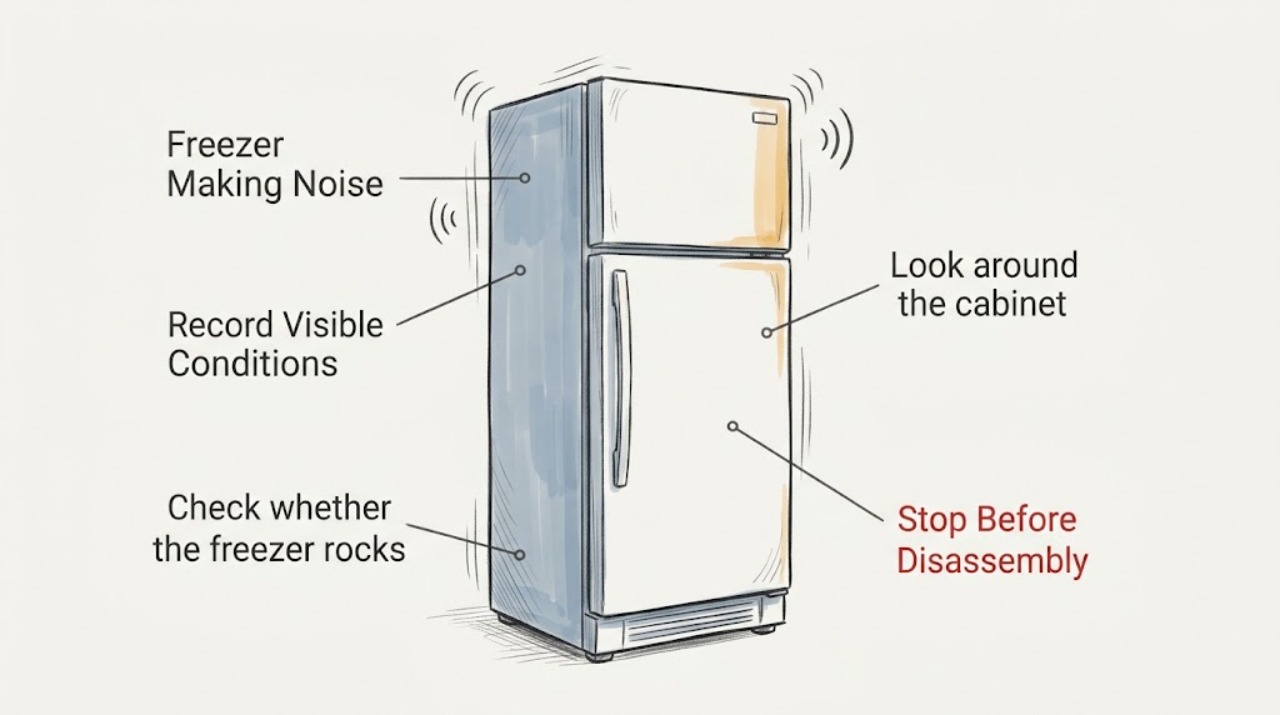
Check whether the freezer rocks on the floor and correct leveling with the model's leveling adjustment or an appropriate stable shim if the instructions permit it.
Expected result: The cabinet rocks or the vibration changes after the freezer is made stable.
Next step: Leave the unit stable and continue with wall-clearance and item checks; do not dismantle the cabinet.
Why this matters
Why: An unstable cabinet can amplify normal compressor or fan vibration into a rattle. If stability changes nothing, the sound may not be caused by the floor contact.
-
Check 3
Look around the cabinet to confirm it is not touching a wall and remove objects resting on top of the freezer.
Expected result: The cabinet or rear area touches the wall, or the sound changes after objects are removed.
Next step: Move or re-level the freezer only enough to remove contact as the installation instructions allow, then listen again.
Why this matters
Why: Contact can transfer motor vibration to the wall, and top objects can rattle even when the appliance is working normally.
-
Check 4
Check containers, shelves, baskets, and other accessible contents for contact or movement while the freezer operates.
Expected result: Items are touching the cabinet or vibrating excessively; the noise reduces after they are rearranged.
Next step: Leave clearance between loose items and the walls, then monitor whether the sound returns without the contents touching.
Why this matters
Why: Frigidaire says some vibration of items inside is normal, but excessive movement can make a normal appliance vibration sound abnormal.
-
Check 5
Check that the door or lid closes freely, the gasket is clean and continuous, and there is no visible gap around the seal.
Expected result: The door or lid is obstructed, the gasket has a gap or dirt, or it closes and seals normally.
Next step: Clear the obstruction and clean the accessible gasket with the care instructions. If the seal is damaged or the freezer remains warm, arrange service.
Why this matters
Why: A poor seal lets warm air enter, which can make the compressor run longer and may be accompanied by an alarm or louder operating cycle.
-
Check 6
Check that food is not blocking airflow openings and that the freezer is not packed so tightly that air cannot circulate.
Expected result: An airflow opening is blocked, frost is restricting circulation, or the load is obstructing vents; or airflow is clear.
Next step: Rearrange accessible contents without breaking frost from sharp tools. If heavy frost persists or cooling remains poor, stop at external checks and request service.
Why this matters
Why: Restricted airflow can make the system work longer and can contribute to temperature rise; it does not by itself prove a failed fan or compressor.
-
Check 7
Compare the sound with the freezer's operating event: cooling start, door opening, defrost, or ice-maker activity if the appliance has that feature.
Expected result: The sound is a short pop or crack when cooling starts, gurgling during cooling, hissing during defrost, or a buzz associated with ice-making.
Next step: Monitor a brief event if temperature is normal. If it is loud, continuous, worsening, or paired with a warm cabinet, move to the service boundary.
Why this matters
Why: Frigidaire describes these as possible normal sounds from metal and refrigerant movement, fans, defrost water, or ice-maker components. A new harsh sound or sound without the expected event needs more evaluation.
-
Check 8
If the freezer has an alarm, check the displayed temperature and whether the alarm stops after the door or lid is closed and the unit remains undisturbed.
Expected result: The alarm occurs on some models when temperature rises above 20°F, stops as temperature recovers, or continues while the compartment stays warm.
Next step: Keep the door or lid closed while temperature recovers. If it does not recover or the alarm returns, arrange service and protect perishable food according to local food-safety guidance.
Why this matters
Why: The buzzer can be a temperature warning rather than a mechanical noise. Continued alarm with a warm freezer suggests a cooling, sealing, power, or airflow problem.
-
Check 9
Consider whether the unit was newly installed or recently lost power before judging a longer cooling cycle as a new mechanical failure.
Expected result: The freezer is within its initial stabilization period, is recovering from an outage, or has been operating normally for longer than that period.
Next step: Keep the door or lid closed and allow the manufacturer's stated stabilization period. If it is still not cold or the noise worsens, schedule service.
Why this matters
Why: Frigidaire says a new unit can run longer during the first 24 hours and a freezer recovering from a power issue can need time to stabilize. A sound that persists with no cooling after that period is not resolved by waiting.
-
Check 10
Stop using the freezer and isolate it only by a safe accessible control or disconnect if there is sparking, a burning odor, smoke, damaged wiring, a grinding fan sound, or repeated electrical interruption.
Expected result: Any electrical or mechanical hazard is present, or the noise is severe and the freezer is no longer maintaining temperature.
Next step: Keep people away from the appliance, avoid opening panels or touching moving parts, and arrange qualified service. Do not repeatedly restart a unit that trips or smells hot.
Why this matters
Why: These signs exceed a level, clearance, gasket, or sound-identification check and may indicate a component or wiring hazard.
-
Check 11
Prepare the model identity and symptom record for service if the sound remains after the external checks.
Expected result: You can provide the sound description, timing, temperature or alarm behavior, level and wall-clearance result, seal condition, frost or airflow condition, and any recent installation or outage.
Next step: Keep the freezer closed to preserve cold air and request model-specific diagnosis rather than selecting a component from the sound alone.
Why this matters
Why: A technician can use the operating event and cooling result to distinguish normal sound transmission from a fan, compressor, defrost, airflow, or control fault.
Use your observations
Decision map
Find the observation that best matches what you see, then follow the next safe action.
-
PATH 01Next step
What you see
Brief popping or cracking occurs when the compressor starts and the freezer remains cold
Do this next
Monitor whether it levels off or disappears; seek service if it becomes harsh, continuous, or accompanies warming.
Why this path and its safety boundary
Why it matters: Frigidaire describes this as potentially normal expansion and contraction or refrigerant circulation.
-
PATH 02Next step
What you see
Steady hum, fan airflow, or refrigerant gurgling occurs while the freezer cools normally
Do this next
Check for unusual change in volume or vibration, but no part replacement is justified by the sound alone.
Why this path and its safety boundary
Why it matters: These can be signs of normal compressor, fan, and refrigerant operation.
-
PATH 03Next step
What you see
Rattle changes when the cabinet is leveled or moved clear of the wall
Do this next
Keep the freezer stable and clear of contact, following the installation instructions.
Why this path and its safety boundary
Why it matters: The installation contact or floor stability was amplifying vibration.
-
PATH 04Next step
What you see
Rattle changes after objects on top or contents inside are removed or rearranged
Do this next
Leave clearance around the cabinet and inside contents, then monitor.
Why this path and its safety boundary
Why it matters: Items were transmitting or adding vibration rather than proving an internal failure.
-
PATH 05Next step
What you see
The freezer runs loudly or often and the door or lid has a visible seal gap
Do this next
Clear the closure path and clean the gasket. Arrange service if the gasket cannot seal or temperature does not recover.
Why this path and its safety boundary
Why it matters: Warm air leakage can make the cooling system run longer.
-
PATH 06Next step
What you see
Hissing or sizzling occurs during a defrost event while cooling remains normal
Do this next
Monitor the event. If the sound becomes persistent or cooling fails, arrange service.
Why this path and its safety boundary
Why it matters: Frigidaire's noise guide identifies defrost water contacting the heater as a possible source.
-
PATH 07Next step
What you see
A buzzer sounds and the freezer temperature has risen
Do this next
Close the door or lid and check seal, power, airflow, and frost. If temperature does not recover, request service.
Why this path and its safety boundary
Why it matters: On some models the alarm warns that temperature is above 20°F; it is not necessarily a motor fault.
-
PATH 08Next step
What you see
The unit was newly installed or recently lost power and is otherwise cooling
Do this next
Allow the stated stabilization period with the door or lid closed; escalate if it remains warm afterward.
Why this path and its safety boundary
Why it matters: Longer operation during temperature stabilization can be expected.
-
PATH 09Next step
What you see
The noise is grinding, sparking, accompanied by burning odor or smoke, or paired with loss of cooling
Do this next
Stop operation, isolate power only when safe, and arrange qualified appliance service.
Why this path and its safety boundary
Why it matters: The symptom is outside normal sound guidance and may involve a mechanical, electrical, or cooling fault.
Helpful context
Understand the symptom
Start with the sound pattern, not a guessed part
Write down whether the sound is a steady hum, airflow, vibration or rattle, click, pop, crack, gurgle, hiss, buzz, or an alarm. Note whether it starts when cooling begins, during defrost, while the door or lid is open, or after ice-maker activity. Also check whether the freezer is maintaining cold food. The same word, such as buzzing, can describe different operating events, so timing and cooling performance change the next step.
Normal operating sounds
Frigidaire identifies compressor hum, fan airflow, and refrigerant gurgling as signs that the appliance is attempting to cool. Brief popping or cracking when the compressor starts can come from metal expanding or contracting or from refrigerant circulation. In a refrigerator-freezer, hissing or sizzling can occur when defrost water reaches the heater, while a compressor may hum at a higher pitch or pulse. These sounds should be judged alongside temperature and whether they are becoming harsher or persistent.
External vibration checks
A freezer that rocks, touches a wall, has objects on top, or has containers vibrating inside can transmit a normal motor vibration as a loud rattle. Correct the external contact and level condition only as the model allows; do not remove panels or reach near a fan or compressor.
When sound points to cooling or temperature trouble
A new unit or one recovering from an outage can run longer while temperature stabilizes. A door or lid left open, a poor gasket seal, blocked airflow, heavy loading, or a warm location can also make the cooling system run longer. If the noise is new and the freezer is warm, use the cooling checks and arrange service if it remains not cold after the stabilization period stated in the manufacturer guidance.
Only after diagnosis
Potential parts
Only after a technician confirms that the noise is fan-related and identifies the exact model assembly.
Only after diagnosis of a persistent abnormal hum, vibration, or cooling symptom; normal compressor sound alone does not justify replacement.
Only when inspection confirms that the exact model's gasket cannot seal after cleaning and closure checks.
Only after professional diagnosis of persistent frost, temperature rise, or a defrost-related sound outside normal operation.
When checks do not resolve it
Need a professional?
Arrange service when a harsh, grinding, or worsening sound remains after leveling, clearance, item, seal, and airflow checks., Arrange service when the freezer is not cold, an alarm persists, heavy frost restricts airflow, or a noise is paired with a cooling failure., Stop operation and obtain qualified help for smoke, sparking, burning odor, exposed wiring, repeated electrical interruption, or a damaged cabinet or cord.
Have this ready
- The full model identity and whether the unit is a standalone freezer or a refrigerator-freezer
- A description of the sound, when it begins, how long it lasts, and whether it changes with the door or lid closed
- Whether the freezer is maintaining temperature, showing an alarm, or accumulating frost
- Leveling, wall-clearance, top-item, contents, door or lid seal, and airflow observations
- Recent installation, power interruption, ice-maker activity, smoke, sparking, odor, or visible damage
Common questions
FAQ
Is a popping or cracking sound from a Frigidaire freezer normal?
It can be normal when the compressor starts. Frigidaire attributes these sounds to metal expanding or contracting with temperature changes or refrigerant circulation; have it assessed if it becomes harsh, persistent, or occurs with warming.
Why is my Frigidaire freezer vibrating or rattling?
Check that it is level, not touching the wall, has no objects on top, and has no loose contents transmitting vibration. If the sound remains after those checks, arrange diagnosis.
What does a freezer buzzer mean?
On some Frigidaire models, the alarm can sound when freezer temperature rises above 20°F. Close the door or lid and check the seal; if the temperature does not recover or the alarm persists, request service.
Should I replace the compressor because my freezer hums?
Not from the sound alone. Frigidaire describes compressor hum as a possible normal operating sound. A component decision requires model-specific diagnosis, especially if the freezer is warm or the sound is worsening.
Read the exact guide
Official sources
- Freezer Runs Too MuchFrigidaire · Applies when a freezer noise reflects longer or more frequent cooling operation; installation and environment affect run time.
- Is it normal to hear a popping or cracking sound when the freezer motor (compressor) comes on?Frigidaire · Applies to freezer popping or cracking sounds associated with compressor operation; exact sound behavior varies by model.
- Refrigerators Noise GuideFrigidaire · Sound mechanisms apply to refrigerator-freezer models; a standalone freezer can differ, so use the exact model manual for final interpretation.
- Freezer - Not Freezing or Not CoolingFrigidaire · Applies when a noise is accompanied by poor cooling, frost, blocked airflow, power, seal, or installation symptoms.
- Is it normal for my freezer to make vibrating or rattling sounds?Frigidaire · Applies to freezer or refrigerator vibration and rattling; floor, wall, and contents vary by installation.
- What does the alarm or “buzzer sound” mean?Frigidaire · Applies only to models equipped with the relevant temperature alarm; alarm thresholds and controls vary by model.
Community feedback
Share a repair observation
Share a plain-text repair observation. Accepted observations are published automatically; this page may take a moment to update.