
On this page
Start here
Quick answer
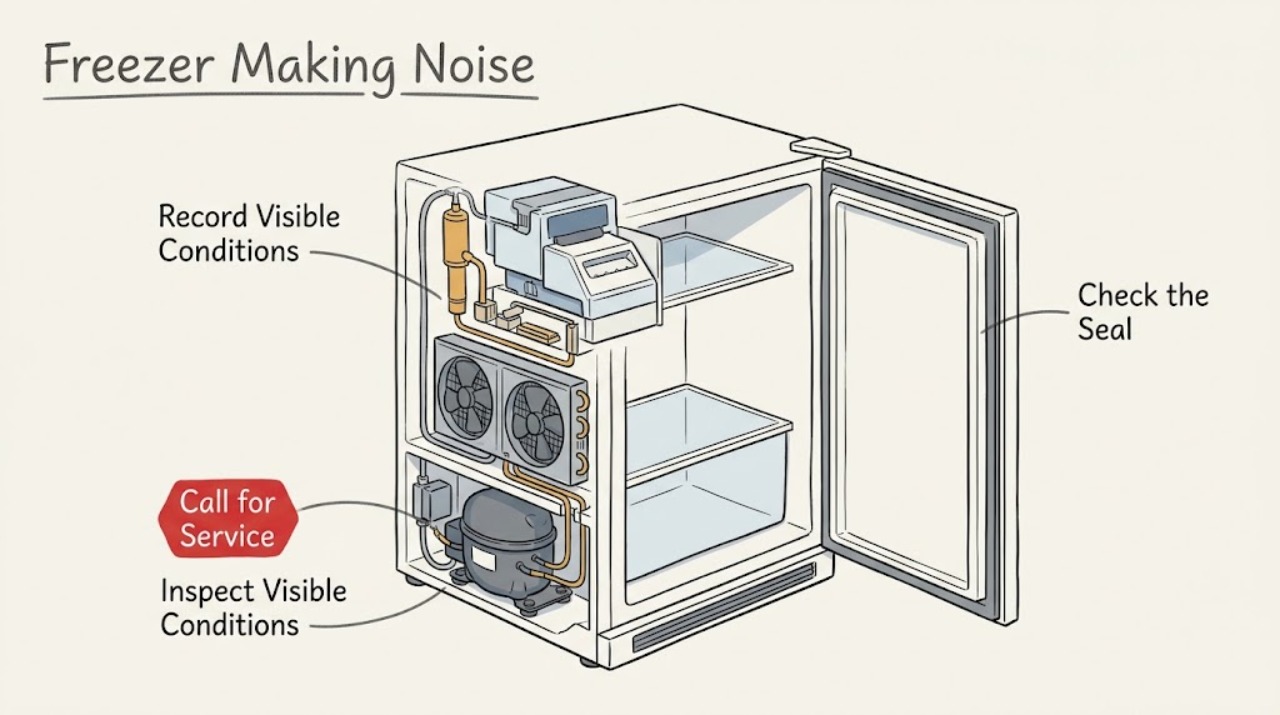
Some GE freezer noises are normal: a compressor hum or whine, refrigerant boiling or gurgling while the unit cools, brief popping or hissing during automatic defrost, and a short whoosh after opening the door or lid. First identify when and where the sound occurs, then check only accessible conditions such as a loose item, an unsecured door or lid, or an icemaker that is trying to fill without water. A sound like a fan blade hitting something, a newly persistent or rapidly worsening noise, or noise accompanied by warming, leaking, smoke, or a burning odor is not a normal sound pattern; stop using the appliance as appropriate and arrange qualified appliance service.
Work through in order
Diagnostic checks
Use only checks that match the exact appliance or system and its official guide.
-
Check 1
Listen once with the freezer closed and note whether the sound comes from the rear, the interior, the door or lid, or underneath. Record whether it is a steady hum or whine, a gurgle, a brief pop or hiss, a whoosh after opening, a regular buzz, or a scraping and impact sound.
Expected result: A steady compressor sound or refrigerant gurgle while cooling, a short door or lid whoosh, and time-limited defrost sounds match GE's normal sound descriptions. A fan-like scrape or repeated impact is a different pattern.
Next step: If the sound matches a normal pattern and the freezer is holding temperature, continue to the seal and icemaker checks only if those features apply. If it sounds like a fan blade hitting something, stop troubleshooting and use the service boundary.
Why this matters
Why: The sound profile and timing narrow the next check: normal-cycle sounds can be monitored, while a fan-impact pattern should not be treated as normal simply because the freezer still runs.
-
Check 2
Open and close the freezer door or lid once, then listen briefly as it reseals. Check that no food package, basket, or bin is preventing the closure and that the gasket is visibly seated; do not pry the gasket or force the door or lid.
Expected result: A temporary whoosh or airflow noise immediately after opening can occur as freezer pressure equalizes. A door or lid that does not close evenly, stays obstructed, or allows the noise to continue with poor cooling points to a sealing or alignment problem rather than a normal whoosh.
Next step: Remove only the accessible obstruction and close the door or lid normally, then monitor one cooling cycle. If the gasket is damaged, the door or lid is misaligned, or temperature is rising, arrange qualified appliance service.
Why this matters
Why: A brief sound associated only with opening is consistent with a tight seal. A closure problem can make the freezer run longer and can create additional operating noise, so the decision changes if the seal cannot close normally.
-
Check 3
Observe the freezer during and after a defrost event without opening panels. Compare any sizzling, popping, crackling, hissing, or occasional tapping with the defrost cycle, and note whether the sound ends before normal cooling resumes.
Expected result: GE describes sizzling, popping, crackling, and hissing during automatic defrost as normal, and describes some tapping after defrost as possible refrigerant movement. A sound that is newly persistent, grows louder, or resembles a fan blade strike does not fit that limited pattern.
Next step: If the noise ends with the defrost event and the freezer remains cold, monitor it. If it continues outside the cycle or is accompanied by loss of cooling, stop opening the appliance and schedule service.
Why this matters
Why: A short, cycle-linked defrost sound can be monitored when cooling remains normal. A continuous or newly occurring mechanical impact suggests that a technician should inspect the fan or another internal component.
-
Check 4
If the freezer has an icemaker, listen for a brief recurring buzz and check from outside whether the household water supply to the appliance is on. If the model has an icemaker on/off control or a feeler arm, turn the icemaker off or raise the arm to its stop position when the supply is intentionally off; do not open the water valve or tubing.
Expected result: A buzz recurring at intervals can mean the icemaker is requesting water while the supply is shut off. A rattle or vibration can also occur when an icemaker is on but no water is connected. If the buzz stops after the icemaker is turned off, the sound is linked to that subsystem.
Next step: Keep the icemaker off until a properly connected water supply is available, or restore the supply only if it is safe and the model instructions permit it. If the sound does not change or water is leaking, arrange qualified appliance service.
Why this matters
Why: The noise is more likely a water-fill attempt than a compressor failure when it follows the icemaker interval and stops with the icemaker disabled. A buzz that persists with the icemaker off, or any water leak, needs service diagnosis.
-
Check 5
Check that the freezer is standing firmly and that accessible containers, shelves, or items on top or beside it are not rattling against the cabinet. Make only a small external repositioning and listen again; do not remove a rear cover or reach toward a fan to chase a noise.
Expected result: If a loose external item or contact point stops rattling when moved, the cabinet or item was transmitting the sound. If the sound remains a card-like rattle underneath or an impact-like sound from the freezer area, the source may be a fan obstruction or another internal fault.
Next step: Leave the appliance stable and monitor only when the sound is clearly external and cooling is normal. For a persistent underneath rattle, fan-like impact, or noise that worsens after repositioning, stop and schedule service.
Why this matters
Why: An external resonance can be corrected without opening the appliance. A persistent internal-sounding rattle or fan strike is outside a safe user check, even if moving the freezer temporarily changes the noise.
-
Check 6
During one brief observation, confirm that the freezer continues to hold its normal temperature and check for a water leak, smoke, a burning odor, or a damaged power cord. Avoid repeatedly cycling the appliance just to reproduce a noise.
Expected result: A normal-cycle sound with stable cooling and no safety signs can be monitored. Noise combined with warming, a leak, smoke, burning odor, or a tripping circuit is an escalation condition.
Next step: If any safety sign is present, stop using the freezer as appropriate, keep people away from the affected area, and arrange qualified service or an electrician for the building circuit. If cooling is stable but the noise is new and persistent, schedule appliance service before it worsens.
Why this matters
Why: The sound is no longer an isolated noise complaint when it affects food safety or electrical or water safety. That combination raises the need for prompt professional diagnosis.
Use your observations
Decision map
Find the observation that best matches what you see, then follow the next safe action.
-
PATH 01Next step
What you see
The sound is a compressor hum or whine, refrigerant gurgle, a brief defrost hiss or pop, or a short whoosh after opening, and cooling is normal.
Do this next
Treat the pattern as a likely normal operating sound and monitor it. Use the model's owner instructions if the sound changes or the freezer stops maintaining temperature.
-
PATH 02Next step
What you see
The sound resembles a fan blade hitting something, is newly persistent, or continues outside a limited defrost event.
Do this next
Do not remove fan covers or reach into the appliance. Stop troubleshooting and arrange qualified appliance service for diagnosis.
-
PATH 03Next step
What you see
The icemaker buzzes at intervals while its water supply is off or disconnected.
Do this next
Turn the icemaker off using its control or raise the feeler arm on models that use one, and leave it off until the water supply is correctly available. If buzzing continues, arrange service.
-
PATH 04Next step
What you see
A noise occurs with warming, a leak, smoke, a burning odor, a damaged cord, or a circuit that trips again.
Do this next
Stop using the appliance as appropriate and arrange prompt qualified appliance service; use a qualified electrician for a building-circuit issue. Do not repeatedly reset a tripping circuit.
-
PATH 05Next step
What you see
A loose accessible item or external contact is the only source and the freezer remains cold.
Do this next
Reposition the item or restore stable clearance without opening the appliance, then monitor one normal cooling cycle. Escalate if the internal-sounding noise remains.
Helpful context
Understand the symptom
Separate a normal operating sound from a fault
A freezer is not silent while it is cooling. Low compressor noise and refrigerant movement often change as the cooling system cycles. A short whoosh immediately after opening the door or lid is pressure equalizing and can indicate that the seal is holding. Defrost can add temporary sizzling, hissing, popping, or crackling. The useful clues are the sound's location, its timing, whether it repeats in a cycle, and whether the freezer still maintains temperature. A scraping or impact sound from a fan, especially when it is new or continuous, deserves a service diagnosis rather than repeated listening tests.
Use a safe inspection boundary
Keep the checks external and observational. Do not remove interior fan covers, reach into a moving fan, open sealed refrigeration tubing, or perform electrical measurements. If you need to move food or an accessible bin to hear the sound more clearly, keep the door or lid open only briefly and restore the normal arrangement afterward. Stop immediately for smoke, a burning odor, a damaged cord, a water leak near electrical parts, or a freezer that is warming enough to threaten food.
When checks do not resolve it
Need a professional?
Service is appropriate when the sound does not match GE's documented normal patterns, cannot be isolated to an accessible external item or icemaker condition, or is accompanied by a loss of cooling or a safety sign.
Common questions
FAQ
Is a GE freezer humming or gurgling normally?
Often. GE identifies compressor running or whining and boiling, gurgling, or knocking while the freezer is cooling as normal sounds. If the sound is new, harsh, or accompanied by warming, use the service boundary instead of assuming it is normal.
Why does my GE freezer make a whooshing sound after I open it?
Opening the door or lid lets cold air out and warm air in. GE says the temporary pressure equalization can sound like whooshing or airflow and can indicate that the freezer is sealing tightly.
What should I do if the GE freezer sounds like a fan is hitting something?
Treat that as abnormal. Do not reach toward the fan or remove covers to investigate; GE says a fan-blade impact sound from the freezer requires service diagnosis.
Why does my GE freezer or refrigerator buzz every few minutes?
If the appliance has an icemaker and its water supply is off, the icemaker may be trying to fill. Turn the icemaker off using its control or raise the feeler arm on models that use one. If the buzz continues or there is a leak, arrange service.
Read the exact guide
Official sources
- Refrigerator - Normal Sounds and Noises MadeGE Appliances · GE's normal-noise descriptions for refrigerant, fans, defrost, icemaker filling, and an icemaker operating without a water supply.
- Refrigerators, Freezers and Icemakers Troubleshooting and SupportGE Appliances · GE's model-specific support and qualified-technician troubleshooting route for refrigerators and freezers.
- Refrigerator - Unusual NoisesGE Appliances · GE's boundaries for fan-blade impact sounds, recurring icemaker buzz with a closed water supply, and service escalation.
- Upright & Chest Freezer - Normal SoundsGE Appliances · GE's explanations of normal compressor, refrigerant, defrost, and door or lid pressure-equalization sounds in upright and chest freezers.
Community feedback
Share a repair observation
Share a plain-text repair observation. Accepted observations are published automatically; this page may take a moment to update.