
On this page
Start here
Quick answer
A Bosch freezer can make normal humming, bubbling or gurgling, clicking, cracking, and brief louder sounds during automatic defrost or an increased-freezing mode. First record the sound and when it occurs, then check from outside whether the cabinet touches a wall, the appliance is unstable, or bottles, shelves, or bins are vibrating. Do not remove the rear cover, touch the evaporator fan or refrigerant tubing, probe wiring, or force a frozen part. A new scraping or grinding sound, noise with poor cooling or an alarm, or any burning smell, sparking, damaged cord, or refrigerant damage calls for qualified appliance service.
Before you begin
Safety first
- Observation only. No cover removal, fan contact, refrigerant work, sharp-object defrosting, energized electrical inspection, heavy-appliance movement, compressor work, or guessed part replacement.
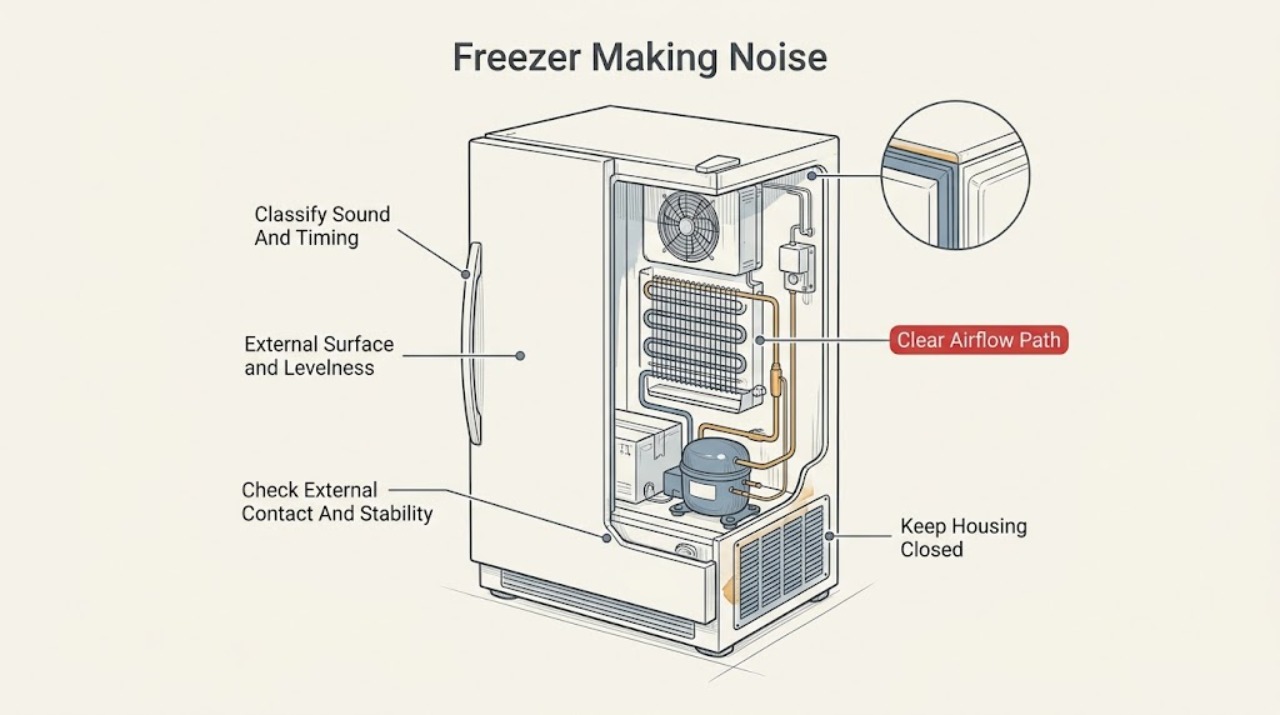
Work through in order
Diagnostic checks
Use only checks that match the exact appliance or system and its official guide.
-
Check 1
Stand clear of the appliance and record the sound in your own words—hum, buzz, click, crack, pop, bubbling, gurgling, scraping, rattling, or grinding—and note whether it happens during compressor operation, automatic defrost, door movement, ice dispensing, or an increased-freezing mode. Do not put a hand inside a running fan area.
Expected result: The sound is a brief hum, gurgle, click, crack, or pop linked to an operating event; it is a repeated rattle; or it is a new scraping, grinding, or harsh electrical sound.
Next step: Record the time, duration, frequency, and whether cooling remains normal. If the sound matches a normal operating event and there are no other symptoms, compare it with the owner's manual and monitor; use the service branch for a new or worsening sound.
Stop if: Stop for smoke, a burning odor, sparking, a shock or tingle, a damaged cord or plug, or a sound accompanied by a safety alarm.
Why this matters
Why: Bosch describes motor or fan noise, refrigerant flow, switching, and automatic-defrost sounds as normal possibilities. A repeated mechanical or harsh electrical sound is not classified by sound alone and needs the appliance's model-specific assessment.
-
Check 2
From the front and sides, look for an obvious gap problem: the cabinet or rear area appears to touch a wall or neighboring unit, the appliance rocks, or an accessible shelf, bin, or container is loose or touching another container. Do not lift, tip, or force the appliance or reach into the rear machinery area.
Expected result: The cabinet is stable and clear of nearby contact; it rocks or appears unlevel; or the noise changes when a loose, accessible container is held still or separated without reaching near moving parts.
Next step: If a light, accessible container is visibly touching another, separate or reseat it without disturbing food or shelves. If the cabinet is unstable, heavily loaded, or requires moving or leveling, document it and arrange qualified appliance or installation help instead of forcing the unit.
Stop if: Stop if the appliance could tip, the floor is wet or unstable, moving it would require lifting, or the suspected contact is behind a cover.
Why this matters
Why: Bosch lists an unlevel or non-free-standing appliance and loose or touching containers as sources of avoidable noise. A noise that changes with a container or external contact points to vibration at that location, while rocking or unknown rear contact needs safe installation assessment.
-
Check 3
With the door open only as long as needed, look at accessible freezer vents and the visible interior for blocked airflow, a heavy frost pattern, or an object that could be vibrating. Do not remove an interior panel, touch a fan blade, chip ice, use a sharp object, or introduce heat or steam.
Expected result: Vents are clear and no unusual frost or contact is visible; airflow openings are blocked by food; frost is heavy around an interior panel; or the noise seems to come from the rear freezer area.
Next step: Rearrange only loose food that visibly blocks an accessible vent, without dismantling anything. For heavy frost, a rear-area scraping sound, or an inaccessible obstruction, keep the appliance closed as practical and request qualified Bosch or appliance service; follow the exact model manual for food protection.
Stop if: Stop if removing an obstruction would require a panel, force, a tool, contact with ice or a fan, or any access to wiring or refrigeration tubing.
Why this matters
Why: Blocked vents can affect freezer operation, while Bosch places the evaporator fan at the back of the freezer and says a fan blade that does not move freely may require replacement. Heavy frost or a rear-area noise cannot safely identify whether the cause is a fan, defrost system, or another internal part.
-
Check 4
Without changing controls, note whether the freezer is maintaining its usual cold condition and whether a temperature or door alarm is present while the noise occurs. Record recent loading, a long-open door, a power interruption, or activation of an increased-freezing mode.
Expected result: Cooling and alarms are normal; the noise occurs during increased freezing or defrost; the freezer is warmer than usual; or a temperature alarm persists with the noise.
Next step: If cooling is normal and the sound is brief, keep a log and consult the exact owner's manual. If the freezer is warming, food is thawing, or an alarm persists, protect food according to the manual and arrange prompt qualified appliance service rather than repeatedly changing settings.
Stop if: Stop for burning odor, smoke, sparking, a damaged cord, refrigerant-line damage, or a rapidly worsening temperature condition.
Why this matters
Why: A short-lived increase during a documented operating mode can be normal. Noise combined with loss of cooling or a persistent alarm changes the issue from a sound-only observation to a refrigeration or control fault that cannot be confirmed externally.
-
Check 5
From a dry floor and without opening anything, inspect the accessible cord, plug, exterior, and floor area for heat damage, water, oil-like residue, a crushed line, or other visible damage. Keep away from a damaged cord, exposed wiring, or any suspected refrigerant leak.
Expected result: The exterior and cord are dry and intact; there is water or oil-like residue; the cord or plug is hot or damaged; or there is smoke, sparking, or a strong unusual odor.
Next step: Leave the appliance undisturbed, keep people away, and arrange qualified appliance or electrical service. Provide photographs, the sound recording, model identifier, cooling status, and timing; do not touch or repair the damaged area.
Stop if: Any water near electrical parts, burning smell, smoke, sparking, shock, damaged insulation, or suspected refrigerant-line breach ends the inspection immediately.
Why this matters
Why: A clean, intact exterior does not prove that an internal fan, compressor, or sealed-system component is healthy. Visible damage, leaking residue, heat, smoke, or sparking is a safety boundary, not a noise-adjustment opportunity.
Use your observations
Decision map
Find the observation that best matches what you see, then follow the next safe action.
-
PATH 01Next step
What you see
The sound is a brief hum, gurgle, click, crack, or pop that corresponds with compressor, fan, switching, defrost, or increased-freezing operation, and cooling remains normal.
Do this next
Monitor the pattern, keep a recording and timing note, and compare with the exact owner's manual. Arrange service if the sound changes, becomes continuous, or is accompanied by another symptom.
Why this path and its safety boundary
Why it matters: Bosch documents these as possible normal operating noises.
-
PATH 02Next step
What you see
The noise changes when an accessible container is separated, a loose shelf or bin is reseated, or an obvious cabinet-to-wall contact is observed.
Do this next
Correct only a light, accessible container arrangement without force. Do not lift or level a heavy appliance; request installation or appliance help if stability or clearance is uncertain.
Why this path and its safety boundary
Why it matters: The vibration may be coming from a fitting or external contact rather than the sealed refrigeration system.
-
PATH 03Next step
What you see
A new scraping or grinding noise seems to come from the rear freezer area, or heavy frost is visible around an interior panel.
Do this next
Do not reach behind the panel or chip the ice. Request qualified appliance service and provide the location, sound recording, frost observation, and cooling status.
Why this path and its safety boundary
Why it matters: Bosch identifies the evaporator fan at the back of the freezer as a possible source, but the sound does not identify whether the fan, frost, defrost system, or another internal component is involved.
-
PATH 04Next step
What you see
The noise is accompanied by a warmer freezer, thawing food, or a persistent temperature alarm.
Do this next
Protect food using the model manual's guidance and arrange prompt qualified service. Do not keep changing controls or open the cabinet to chase the noise.
Why this path and its safety boundary
Why it matters: This is a cooling-performance concern as well as a noise concern, so a compressor, fan, defrost, airflow, or control diagnosis may be needed.
-
PATH 05Next step
What you see
There is smoke, burning odor, sparking, shock or tingling, a hot or damaged cord, water near electrical parts, or visible refrigerant-line damage.
Do this next
Keep clear, avoid touching the damaged area or operating the appliance if doing so is unsafe, and obtain qualified appliance or electrical help from a safe location.
Why this path and its safety boundary
Why it matters: The immediate electrical, fire, water, or sealed-system risk is more important than identifying the sound.
Helpful context
Understand the symptom
“Making noise” is not one diagnosis. A steady hum can be a motor, a bubbling or gurgling sound can be refrigerant moving through the tubing, a click can be a switch or valve changing state, and a crack or pop can occur during automatic defrost. The useful distinction is whether the sound matches an operating event and whether cooling remains normal, not whether the sound is unfamiliar compared with an older appliance.
Keep this inspection non-invasive. You may listen, look at accessible surfaces, and document the timing without moving a loaded appliance or reaching behind covers. Do not scrape ice with a sharp object, open the refrigeration system, touch the evaporator fan, remove electrical covers, or attempt a compressor or control repair.
Safety boundary
Stop conditions
- Stop immediately for smoke, burning odor, sparking, shock or tingling, a hot or damaged cord, water near electrical parts, or a persistent safety alarm.
- Do not remove covers, reach for the evaporator fan, open refrigerant tubing, chip frost with a sharp object, add heat or steam, or probe wiring.
- Do not lift, tip, or force a loaded freezer to level it or reach its rear machinery. Arrange qualified appliance or installation help when clearance or stability is uncertain.
- A new scraping or grinding noise with poor cooling, thawing food, or heavy frost requires qualified service rather than a guessed part replacement.
Only after diagnosis
Potential parts
- evaporator fan assembly
Consider this category only when a qualified diagnosis confirms a fan fault or restricted fan movement; a noise near the freezer rear does not establish the cause.
Match the exact Bosch appliance model and fit information before ordering; internal fan access and replacement are service work. - compressor or compressor starting component
Consider this category only after qualified testing links the noise and cooling symptom to the compressor or its starting circuit.
Confirm model-specific parts and sealed-system requirements with a qualified Bosch or appliance professional. - cabinet leveling foot or vibration isolator
Consider this category only when an inspection confirms cabinet instability or vibration transfer and the exact installation can be handled safely.
Verify the model and installation design; do not lift or tip a loaded freezer to fit a part.
When checks do not resolve it
Need a professional?
Arrange qualified appliance service for a new, harsh, continuous, or worsening noise; an inaccessible fan or compressor concern; poor cooling, frost, or persistent alarms; or any damaged cord, water, heat, odor, sparking, or suspected refrigerant issue.
Safety scope: Observation only. No cover removal, fan contact, refrigerant work, sharp-object defrosting, energized electrical inspection, heavy-appliance movement, compressor work, or guessed part replacement.
Common questions
FAQ
Is a humming or clicking Bosch freezer automatically broken?
No. Bosch describes motor or fan hum, refrigerant bubbling or gurgling, switching clicks, and automatic-defrost cracking as possible normal operating sounds. The decision changes if the noise is new, harsh, continuous, or paired with cooling loss or an alarm.
Why does the freezer rattle when the compressor runs?
An accessible container, shelf, bin, cabinet contact, or unstable installation can transmit vibration. Look and listen from outside without lifting the appliance or opening covers; if the source is behind the cabinet or the freezer is unstable, arrange qualified help.
Can I reach the Bosch evaporator fan to see if it is stuck?
Do not reach behind an interior panel or touch the fan. Bosch places the evaporator fan at the back of the freezer, and a blade that does not move freely may require service. Document the location and sound and have the appliance assessed.
When is freezer noise urgent?
Stop and obtain qualified help for smoke, burning odor, sparking, shock or tingling, a hot or damaged cord, water near electrical parts, suspected refrigerant damage, or noise with a warmer freezer, thawing food, or a persistent alarm.
Read the exact guide
Official sources
- Operating Instructions — RefrigeratorBosch Home Appliances · The opened Bosch operating instructions include a freezer compartment and an operating-noises section; exact behavior and controls remain model-specific.
- Refrigerator Making Loud Noises | TroubleshootingBosch Home Appliances · Directly supports a Bosch freezer noise article because Bosch identifies the evaporator fan at the back of the freezer and recommends professional help for possible compressor problems.
Community feedback
Share a repair observation
Share a plain-text repair observation. Accepted observations are published automatically; this page may take a moment to update.