
On this page
Start here
Quick answer
First identify the sound and whether the freezer is holding temperature. Electrolux says popping or cracking when the compressor starts can be normal as metal changes temperature or refrigerant circulates, and that vibration or rattling can come from an unlevel freezer, contact with a wall, items on top, or items inside. A buzzer on some models can indicate that temperature has risen above the model's alarm threshold, so check the door closure and seal and keep the door closed. Remove only loose external or internal items that are safely reachable with the freezer stopped. If the noise is new, suddenly louder, continues with poor cooling, or comes with repeated alarm, frost blocking airflow, smoke, a burning smell, or electrical symptoms, stop experimenting and arrange qualified service.
Before you begin
Safety first
- This article covers listening, temperature and alarm observation, visible contact and level checks, door and gasket observation, and safe reporting. Compressor, fan, sealed-system, refrigerant, control, wiring, and internal electrical work require qualified service.
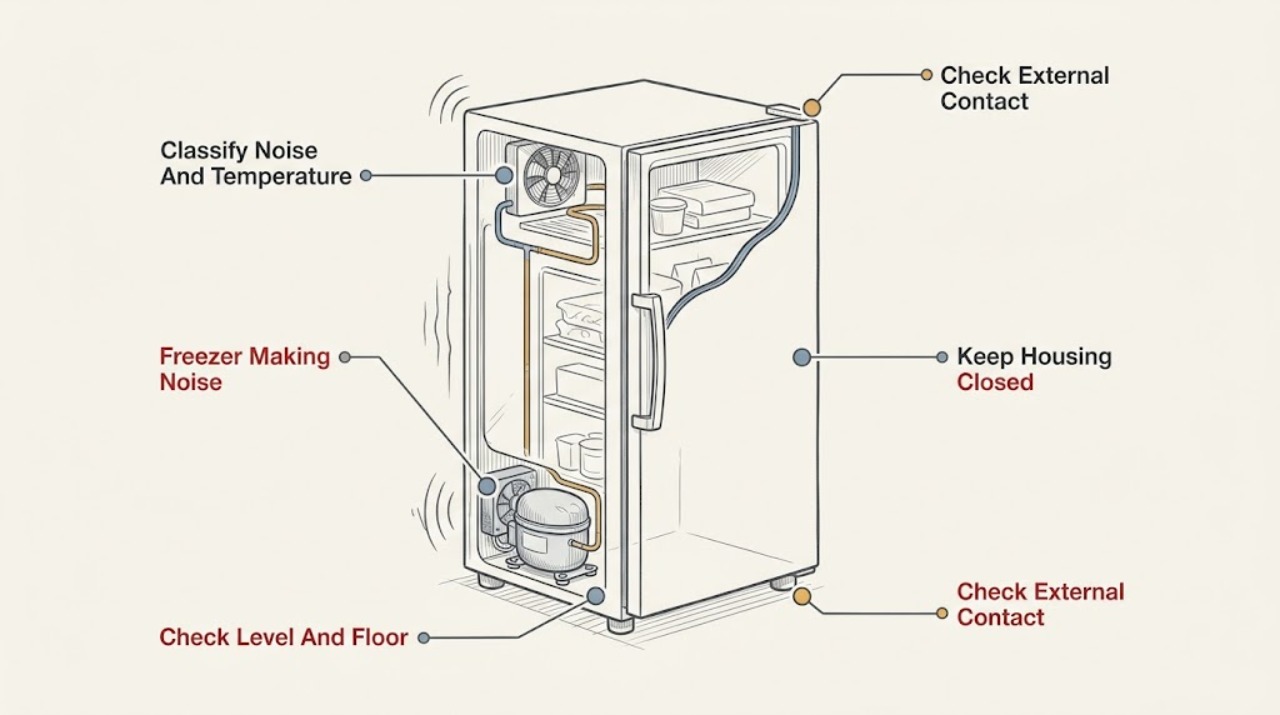
Work through in order
Diagnostic checks
Use only checks that match the exact appliance or system and its official guide.
-
Check 1
From a safe position, note the sound type, when it starts, and whether the freezer is still maintaining its normal temperature. Do not open the door repeatedly or touch moving parts to make the sound happen.
Expected result: The sound is a brief pop or crack at compressor start, a hum, gurgle, buzz, rattle, vibration, scraping, or a repeated knock, and cooling is normal or declining.
Next step: Use the matching normal-sound, vibration, alarm, or cooling branch. Record timing and temperature symptoms without opening panels or trying to reproduce the noise.
Stop if: Stop immediately for smoke, burning smell, exposed wiring, a hot plug or cabinet, liquid leak, severe shaking, or a scraping fan sound.
Why this matters
Why: Electrolux says compressor-start popping or cracking can be caused by temperature-related metal movement or refrigerant circulation. Cooling loss or a new harsh sound changes the path toward service even if the freezer still runs.
-
Check 2
With the freezer stopped, inspect whether it is touching a wall or cabinet, whether anything rests on top, and whether nearby or internal containers are touching and vibrating. Remove only loose items that are safely reachable.
Expected result: The cabinet touches a wall, an item on top vibrates, containers touch the liner, or no external contact is found.
Next step: Clear the contact and observe one normal cooling period with the door closed. If the sound remains, becomes louder, or cooling declines, continue to the service branch.
Stop if: Do not move a heavy or built-in freezer alone, pull it by the door, or reach behind it while connected.
Why this matters
Why: Electrolux links rattling and vibration with wall contact, items on top, and items inside. Removing a resonating object can change the sound without proving that the freezer itself is faulty.
-
Check 3
Check from the front and sides whether the freezer rocks on the floor and whether the floor appears able to support it. Use the model installation instructions for any leveling adjustment; do not tilt or unfasten the appliance as a quick test.
Expected result: The cabinet rocks when gently checked, a foot is not firmly down, the floor flexes, or the unit appears stable.
Next step: If the unit is safely accessible, arrange proper leveling according to the manual or ask the installer for help. If vibration persists, keep the freezer in service only if cooling and safety are normal while arranging assessment.
Stop if: Do not place improvised supports under a loaded appliance, tip it, or work under it without proper equipment and assistance.
Why this matters
Why: Electrolux says an unlevel freezer or an inadequately supported floor can produce vibration or rattling. A stable floor does not rule out a fan, compressor, or internal support issue.
-
Check 4
If the noise is a buzzer or the freezer is warming, check that the door or lid closes freely, nothing blocks it, and the gasket appears to contact evenly. Check that stored food is not packed against visible airflow areas, without removing covers or frost by force.
Expected result: The alarm is active, the door does not close or seal evenly, frost is blocking airflow, food is warming, or the door and airflow appear normal.
Next step: Close the door and leave it closed while monitoring. If the alarm persists, temperature does not recover, or frost returns or blocks airflow, stop prolonged troubleshooting and arrange service.
Stop if: Do not chip frost with a sharp tool, heat the liner with an open flame, defeat the door switch, or keep the door open to listen.
Why this matters
Why: Electrolux says some models sound an alarm when temperature rises above 20°F and recommends checking level, free door closure, and the seal. Its cooling guidance also links frost or blocked airflow with poor performance; a buzzer plus warming is not merely an acoustic issue.
-
Check 5
Without opening the cabinet, note whether a hum, fan sound, or refrigerant-like gurgle occurs while the freezer is cooling and whether the sound is brief, cyclical, or continuously harsh. Compare only with normal operation already observed; do not touch the back or fan area.
Expected result: The freezer is cold and the sound is a brief compressor-start pop, steady operating hum, fan movement, or gurgle; or the noise is new, harsh, continuous, or paired with warming.
Next step: If cooling is normal and the sound matches the model guide, monitor it. If the noise changed, persists with warming, or the freezer runs without recovering, arrange qualified service.
Stop if: Do not open the sealed system, touch a fan, add refrigerant, remove a relay cover, or perform live electrical tests.
Why this matters
Why: Electrolux describes some compressor-start sounds as normal, and its cooling guidance says compressor hum, fans, and refrigerant gurgling can show that the unit is attempting to cool. A change in sound with poor cooling can indicate a developing fault.
-
Check 6
Prepare the exact model, freezer type, sound recording from a safe position if available, timing, temperature or alarm behavior, door-seal observation, frost condition, and any recent move or installation history.
Expected result: The sound is suddenly louder or different, persists after contact and leveling checks, cooling is declining, the alarm repeats, or the freezer is newly installed.
Next step: Keep the door closed, limit unnecessary opening, and arrange qualified Electrolux appliance service or installer assessment. Provide the symptom record rather than guessing at a component.
Stop if: Stop using the freezer and seek prompt service for smoke, burning odor, electrical damage, severe vibration, or a cabinet that is hot or unstable.
Why this matters
Why: A changed or persistent sound and any loss of freezing performance cannot be cleared by an external adjustment. Installation or leveling details help the technician separate setup from a cooling or internal support fault.
Use your observations
Decision map
Find the observation that best matches what you see, then follow the next safe action.
-
PATH 01Safety boundary
What you see
A brief pop or crack occurs as the freezer compressor starts, while the freezer remains cold and the sound is not worsening.
Do this next
Monitor without opening the cabinet. Escalate if the sound becomes frequent, harsh, different, or is paired with warming, alarm, smoke, or a burning smell.
Why this path and its safety boundary
Why it matters: Electrolux says these sounds can come from metal expanding or contracting with temperature changes or refrigerant circulation and may level off as the freezer runs.
Safety stop: Do not remove the compressor cover or attempt sealed-system work to eliminate a brief normal sound.
-
PATH 02Safety boundary
What you see
Rattling or vibration changes when a wall, cabinet, item on top, or item inside the freezer is cleared.
Do this next
Keep the freezer clear of contact and observe normal operation. If vibration remains or the unit rocks, follow the leveling branch and arrange assessment if needed.
Why this path and its safety boundary
Why it matters: The contact or contents may be acting as a resonator, although a stable freezer can still have an internal fault.
Safety stop: Do not move or tip a heavy freezer without proper assistance and equipment.
-
PATH 03Safety boundary
What you see
A buzzer sounds and the freezer is warmer than expected or the door or seal is not closing correctly.
Do this next
Close the door, avoid repeated opening, and check visible obstruction or seal problems. If the alarm persists or cooling does not recover, arrange service promptly.
Why this path and its safety boundary
Why it matters: Electrolux says some models alarm when temperature rises above 20°F and recommends checking level, door closure, and the seal; continued warming can threaten frozen-food storage.
Safety stop: Do not silence a recurring alarm indefinitely, defeat the door switch, or open internal panels to find the alarm source.
-
PATH 04Safety boundary
What you see
A fan-like or scraping sound occurs with frost buildup, blocked airflow, or food that is softening.
Do this next
Keep the door closed and follow only the model manual's defrost or care instructions. If frost returns, blocks airflow, or cooling declines, arrange service.
Why this path and its safety boundary
Why it matters: Electrolux links over-frosting with reduced airflow and cooling problems; a fan noise in that setting should not be treated as a normal sound without assessment.
Safety stop: Do not chip ice, reach through vents, touch a fan, or use a heat source inside the freezer.
-
PATH 05Safety boundary
What you see
The noise started suddenly, changed character, persists after visible contact and level checks, or occurs with poor cooling.
Do this next
Keep the freezer closed and arrange qualified Electrolux service. Supply the sound timing, temperature behavior, and any alarm or frost observations.
Why this path and its safety boundary
Why it matters: A persistent changed sound can indicate a compressor, fan, support, sealed-system, control, or installation fault that cannot be diagnosed safely by listening alone.
Safety stop: Do not continue operating through grinding, scraping, burning odor, smoke, severe shaking, or electrical symptoms.
Helpful context
Understand the symptom
Sound and cooling must be assessed together
A brief pop when the compressor starts or a gentle operating hum can be normal, but a new grinding, scraping, harsh buzz, or repeated knock deserves attention. Check whether food remains frozen, whether the temperature alarm is active, and whether the noise changes with the door closed. A noise accompanied by warming is a performance problem, not just a sound preference.
Start with the outside and the load
A freezer can transmit vibration into a wall, cabinet, floor, or items placed on top. Bottles, bins, and packages can also rattle against one another or the liner. Inspect what is safely visible with the appliance stopped; do not pull out a heavy freezer or reach behind it just to locate a sound.
The sealed system is not a user repair
A sound can be produced by the compressor, fan, refrigerant movement, defrost operation, or a support that has loosened. Listening and recording timing can help a technician, but they cannot confirm a refrigerant, motor, fan, relay, or wiring fault. Keep internal and sealed-system work with qualified service.
Safety boundary
Stop conditions
- Stop and arrange prompt service for smoke, burning smell, hot electrical parts, exposed wiring, severe shaking, a hot cabinet, or a liquid leak.
- Do not open the compressor or fan area, sealed cooling system, electrical cabinet, or any internal cover.
- Do not chip frost with sharp tools, use an open flame or direct heat, or reach through vents toward a fan.
- Do not move, tip, or unfasten a loaded or built-in freezer alone; do not pull it by the door.
- Treat a changed noise with warming, repeated alarm, persistent frost, or food softening as a service condition rather than a normal operating sound.
When checks do not resolve it
Need a professional?
Arrange qualified Electrolux service when a noise is new, suddenly louder, persists after clearing visible contact and checking level, or occurs with warming, repeated alarm, frost, or food softening. Keep the door closed while waiting. Use prompt service for smoke, burning smell, electrical damage, severe vibration, or a hot or unstable cabinet. Do not work on the sealed system, fan, compressor, or internal wiring yourself.
Safety scope: This article covers listening, temperature and alarm observation, visible contact and level checks, door and gasket observation, and safe reporting. Compressor, fan, sealed-system, refrigerant, control, wiring, and internal electrical work require qualified service.
Common questions
FAQ
Is a popping sound from an Electrolux freezer normal?
A brief pop or crack when the compressor starts can be normal, according to Electrolux, because metal changes temperature or refrigerant circulates. If it becomes new, harsh, frequent, or is paired with warming or an alarm, arrange service.
Why is my Electrolux freezer vibrating or rattling?
Check whether it rocks, touches a wall, has items on top, or has containers touching inside. Electrolux lists these as possible sources. Clear only safely reachable contact and arrange service if the vibration remains or the unit is unstable.
What does a freezer buzzer mean on an Electrolux model?
On some models, Electrolux says the buzzer can sound when temperature rises above 20°F. Check that the door closes freely and the seal is even, keep the door closed, and arrange service if the alarm or warming continues.
Can a noisy Electrolux freezer still be cooling normally?
Yes. Compressor hum, fan movement, and refrigerant gurgling can indicate that the freezer is attempting to cool, and some compressor-start sounds can be normal. A changed or harsh noise with food softening, frost, or persistent alarm needs service.
When should I stop using a noisy Electrolux freezer?
Stop for smoke, burning smell, electrical heat or damage, severe shaking, a scraping fan sound, repeated alarm with warming, or noise that persists after visible contact and level checks. Do not open the compressor, fan, sealed cooling system, or electrical cabinet.
Read the exact guide
Official sources
- Freezer - Not Freezing or Not CoolingElectrolux · Official Electrolux freezer support page; it supports the cooling-performance and sound correlation checks without authorizing internal repair.
- Is it normal to hear a popping or cracking sound when the freezer motor (compressor) comes on?Electrolux · Official Electrolux freezer support page; it supports the conditional normal-sound branch only when cooling is otherwise normal and the sound is brief or stable.
- What does the alarm or buzzer sound mean?Electrolux · Official Electrolux support page applying to some freezer models; the alarm threshold is model-dependent and the exact owner guide controls.
- Is it normal for my freezer to make vibrating or rattling sounds?Electrolux · Official Electrolux support page applying to freezers and refrigerators; it directly supports the external vibration and rattle checks used here.
Community feedback
Share a repair observation
Share a plain-text repair observation. Accepted observations are published automatically; this page may take a moment to update.