
On this page
Start here
Quick answer
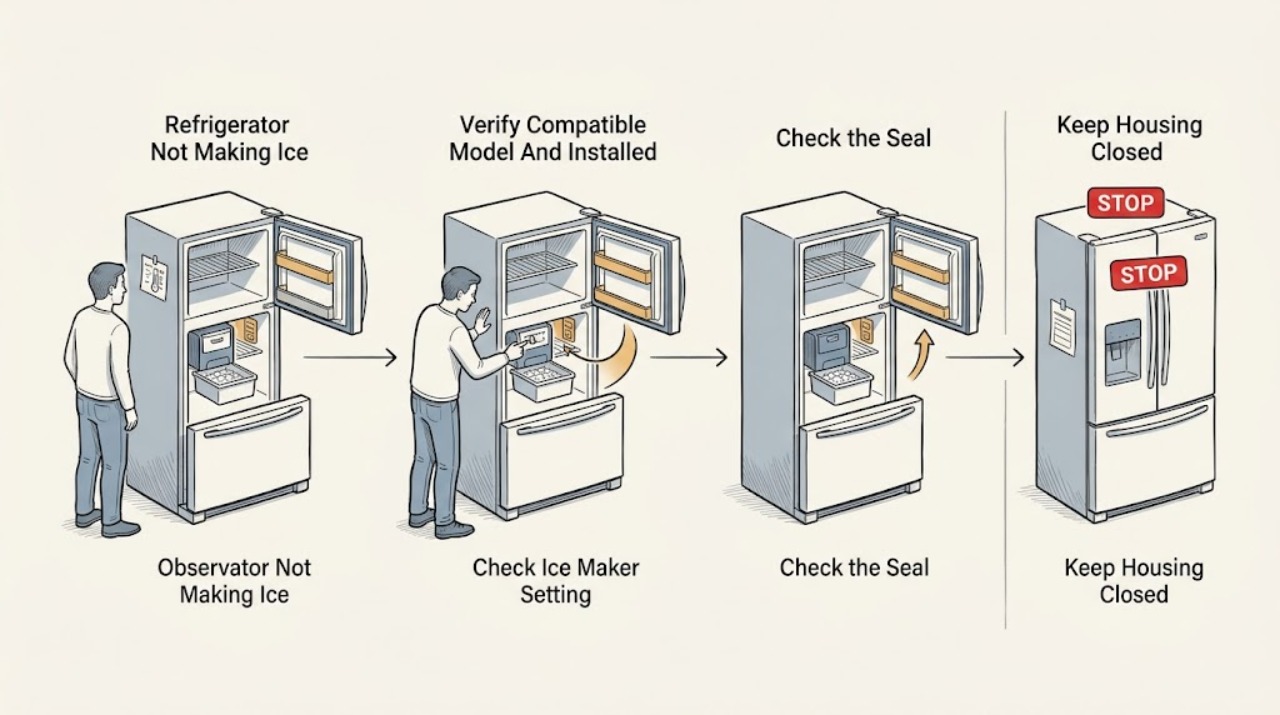
First check the exact Danby model and whether an automatic ice-maker accessory is actually installed: Danby lists DAIM224 as compatible with selected refrigerator models, including DFF180E2SSDB, and says the accessory is sold separately. A manual ice tray or an ice bucket alone is not an automatic ice-maker fault. If the accessory is present, use the exact refrigerator and accessory instructions to confirm its on/off state, startup or recovery time, freezer temperature, door closure, and any accessible bin or tray condition. If those checks are normal but the maker stays silent, does not fill, remains jammed, or shows damage, stop repeated tests and arrange Danby or qualified appliance service; do not open the mechanism or assume a part from another model fits.
Before you begin
Safety first
- The user may identify the model, read the exact controls, inspect door closure, and handle a documented removable bin or tray without force. Qualified service personnel must handle the ice-maker housing, valves, hidden tubing, motors, sensors, harnesses, controls, sealed cooling parts, and live testing.
Work through in order
Diagnostic checks
Use only checks that match the exact appliance or system and its official guide.
-
Check 1
Read the complete Danby model number from the rating label and compare it with the DAIM224 compatibility list. Without removing covers, identify whether the separate automatic ice-maker accessory is installed and whether the compartment has a manual tray or only an ice bucket. Check the exact model and accessory documentation for the documented on/off control and startup condition.
Expected result: The model is one of Danby’s listed DAIM224-compatible refrigerators and the accessory is installed; the model is listed but the accessory is absent; or the model is not in the published compatibility list.
Next step: If the accessory is absent or the model is unlisted, stop this procedure and use the model’s manual-tray instructions or Danby support. If the installed accessory and model match, continue with the documented setting and safe external checks.
Stop if: Do not install, modify, or substitute an ice maker based on a similar-looking model or an online part listing.
Why this matters
Why: Only the first pattern supports an automatic ice-maker diagnosis. A compatible cabinet without the separately sold accessory will not make ice automatically, and an unlisted model cannot be assumed to accept DAIM224.
-
Check 2
Using only the exact Danby refrigerator and DAIM224 documentation, check whether the installed maker is enabled and note whether the refrigerator was just installed, powered, or switched on. Allow the documented startup or recovery period with the freezer door closed as much as practical. Do not press an undocumented test or reset control.
Expected result: The maker is off, the documented wait has not elapsed, the maker is enabled and the wait has elapsed, or the manual does not identify a user reset or test procedure.
Next step: Enable the maker only as the exact documentation shows and wait the stated interval. If it is enabled and the interval has passed, continue with the freezer and accessible-compartment checks. If no user reset is documented, do not invent one.
Stop if: Do not repeatedly reset or test the maker, bypass a door or bin sensor, or transfer the DIM2607SSDD button sequence to the refrigerator accessory.
Why this matters
Why: An off setting or normal startup delay does not prove a failed component. A completed wait with the maker enabled shifts attention to temperature, seating, the supply path described by the exact manual, or an internal fault.
-
Check 3
Check the displayed freezer setting or a user-accessible temperature reading against the exact refrigerator documentation. From the outside, confirm the freezer door closes fully, the gasket contacts the cabinet, and packages are not blocking the door or the ice-maker area. Look for abnormal frost or a warm compartment without removing panels.
Expected result: The freezer is not reaching its documented condition, the door or gasket does not close/seal, frost is abnormal, or the temperature and closure appear normal.
Next step: Correct only an accessible loading or closure issue and allow the documented recovery period. If the freezer cannot reach its setting or frost/cooling repair is needed, arrange refrigerator service before continuing an ice-maker diagnosis.
Stop if: Do not chip frost, remove an evaporator cover, adjust the sealed system, or use a heater to force production.
Why this matters
Why: An ice maker cannot freeze water on schedule in a warm compartment or with warm air entering through a closure problem. Normal accessible temperature and sealing make an accessory supply or internal mechanism issue more likely, but do not identify a part.
-
Check 4
Inspect only the documented user-accessible ice bin, tray, or opening. Look for a full bin, loose clumps, a misseated removable part, or visible damage. If the exact refrigerator/accessory manual documents a visible water reservoir or supply connection, inspect only that accessible condition for an empty reservoir, closed shutoff, kink, or leak; do not loosen fittings or infer a connection that the documentation does not describe.
Expected result: The bin or tray is full, clumped, misseated, visibly damaged, or the documented accessible supply is empty/closed/kinked/leaking; or all accessible conditions are normal.
Next step: Remove only loose, accessible clumps and reseat a documented removable part without force. Correct only the documented user-level supply condition; for a leak, hidden line, or persistent dry mold, stop and arrange service.
Stop if: Do not force a frozen bin or tray, chip ice with sharp tools, disconnect tubing, remove a valve, or add a water connection that the exact documentation does not specify.
Why this matters
Why: A collection obstruction or documented supply interruption can stop ice output without proving an internal motor or control failure. A normal accessible path does not rule out a hidden valve, fill path, sensor, or wiring fault.
-
Check 5
Record the exact Danby model, whether DAIM224 is installed, the maker setting, elapsed recovery time, freezer condition, door and frost observations, accessible bin/tray state, any documented supply result, and whether the maker is silent, clicking, humming, stuck, or visibly damaged. Give this record to Danby support or a qualified appliance technician.
Expected result: Ice production returns after an accessible correction, or the maker remains inactive, does not fill, repeatedly jams, shows damage, or produces a persistent error after the documented conditions are normal.
Next step: Stop repeated cycles and arrange Danby or qualified appliance service. If a household water connection is documented but abnormal, use appropriate plumbing help for that portion; do not open the appliance to continue testing.
Stop if: Do not remove the accessory housing, probe wiring, perform live electrical checks, bypass sensors, or replace an ice-maker part from the symptom alone.
Why this matters
Why: Recovery after a setting, waiting, temperature, closure, collection, or documented supply correction supports that condition as the immediate cause. Persistent failure with those conditions normal makes an internal valve/fill path, motor, sensor, harness, control, or cooling fault more likely, but the symptom does not select a safe replacement part.
Use your observations
Decision map
Find the observation that best matches what you see, then follow the next safe action.
-
PATH 01Safety boundary
What you see
The exact Danby model is not in the DAIM224 compatibility list, or it is compatible but the separately sold accessory is not installed.
Do this next
Use the manual-tray or ice-storage instructions for that model, or contact Danby to confirm a documented accessory path. Do not retrofit from another model.
Why this path and its safety boundary
Why it matters: The refrigerator is not currently configured as an automatic ice maker, so no ice output does not establish a failed internal component.
Safety stop: Stop the automatic-ice-maker procedure when the feature or accessory is absent.
-
PATH 02Safety boundary
What you see
The installed compatible accessory is off, was recently powered or enabled, or has not reached the exact documentation’s startup/recovery point.
Do this next
Use the exact Danby instructions to enable it and wait the documented period with the door closed as much as practical. Do not repeatedly test or reset it.
Why this path and its safety boundary
Why it matters: The ice cycle may not have begun or completed; this pattern does not prove a failed maker.
Safety stop: Do not bypass the maker, door, or bin controls.
-
PATH 03Safety boundary
What you see
The maker is enabled, but the freezer is warm, the door or gasket does not seal, loading blocks closure, or frost is abnormal.
Do this next
Correct only an accessible closure/loading issue and arrange service for persistent cooling, frost, hinge, or gasket faults. Reassess after the documented recovery interval.
Why this path and its safety boundary
Why it matters: A temperature or air-leak problem is more likely than an ice-maker mechanism fault until the refrigerator reaches its documented condition.
Safety stop: Do not remove cooling covers, chip frost, or adjust sealed-system parts.
-
PATH 04Safety boundary
What you see
The freezer condition is normal, but the accessible bin/tray is full, clumped, misseated, or a supply/reservoir condition explicitly covered by the exact documentation is abnormal.
Do this next
Clear only loose accessible ice, reseat the documented removable part, or correct the documented user-level supply condition. Call service for leaks, hidden tubing, a dry mold with normal accessible conditions, or a stuck part.
Why this path and its safety boundary
Why it matters: Collection or documented supply conditions can stop output without proving an internal valve or motor failure.
Safety stop: Do not force parts, disconnect tubing, or invent a water-line procedure for an accessory whose documentation does not specify one.
-
PATH 05Safety boundary
What you see
The exact compatible accessory is installed and enabled, the documented wait has passed, freezer and closure checks are normal, and accessible collection/supply checks do not explain the no-ice symptom; the maker is silent, stuck, does not fill, repeatedly jams, or shows damage.
Do this next
Stop repeated tests and arrange Danby or qualified appliance service with the model and observations recorded.
Why this path and its safety boundary
Why it matters: An internal fill path, valve, motor, sensor, harness, control, or cooling fault is more likely. Noise or silence alone cannot identify which part is safe to replace.
Safety stop: Do not open the ice maker or control area, perform live tests, bypass a sensor, or substitute another model’s part.
Helpful context
Understand the symptom
Confirm that the refrigerator has the right ice-making system
This diagnosis is narrower than “a Danby refrigerator has no ice.” Danby sells the DAIM224 as a separate accessory and lists only selected refrigerator models as compatible. The DFF180E2SSDB page, for example, identifies the accessory as compatible but sold separately. Read the complete model number and inspect the feature list or the installed compartment without removing panels. If the appliance has only a manual ice tray, an ice bucket, or no ice-making feature, it cannot be diagnosed as an automatic ice-maker failure. Do not retrofit or substitute another ice maker based only on cabinet dimensions.
Separate a normal delay from a no-ice fault
A newly installed, recently powered, or newly enabled accessory may need the recovery period stated in its exact Danby documentation. Keep the freezer door closed as much as practical while it reaches the documented operating condition. Check the freezer setting and door closure from the outside, but do not borrow a test-button sequence, temperature threshold, water procedure, or cycle timing from another Danby appliance. The DIM2607SSDD manual is for a separate countertop ice maker and is useful only as a safety reminder, not as the refrigerator accessory’s operating procedure.
Use the service boundary once accessible checks are normal
A visible bin or tray that is full, clumped, misseated, or obstructed can stop collection even when the freezer is cold. Correct only a loose, documented user-removable item without force. If the accessory is confirmed, enabled, cold enough, and correctly seated but remains silent, does not fill, repeatedly jams, or has a damaged housing, the likely possibilities include an internal fill path, valve, motor, sensor, harness, or control. These require model-specific service information; do not open the ice maker, probe wiring, or run a live test.
Safety boundary
Stop conditions
- Stop immediately for smoke, burning odor, damaged wiring, water near electrical parts, a hot cord, repeated protection trips, or a refrigerant-related concern; use qualified service.
- Do not open the DAIM224 or refrigerator control/valve compartment, probe wiring, perform live electrical checks, or bypass an ice-maker, door, or bin sensor.
- Do not force a frozen bin or tray, chip ice with sharp tools, use improvised heat, or repeatedly press an undocumented test/reset control.
- Do not assume every Danby refrigerator has an automatic ice maker, that every compatible model has DAIM224 installed, or that a countertop Danby ice-maker procedure applies to a refrigerator accessory.
- If the compatible accessory remains inactive after the exact setting, waiting, freezer, closure, accessible bin/tray, and documented supply checks, stop repeated cycles and arrange Danby or qualified appliance service.
Only after diagnosis
Potential parts
- DAIM224 ice-maker accessory
Consider this only when the complete Danby model is on the manufacturer’s compatibility list and the accessory is absent or confirmed by service to be the correct replacement; no-ice output alone does not justify ordering it.
Danby lists DFF142E1SSDB/WDB, DFF180E1WDB, DFF180E2SSDB, DBM187E1SSDB, and DBM187E1WDB. Confirm the exact model, installed configuration, and current manual before ordering; do not substitute another ice maker or modify the freezer.
When checks do not resolve it
Need a professional?
Safety scope: The user may identify the model, read the exact controls, inspect door closure, and handle a documented removable bin or tray without force. Qualified service personnel must handle the ice-maker housing, valves, hidden tubing, motors, sensors, harnesses, controls, sealed cooling parts, and live testing.
Common questions
FAQ
Does every Danby refrigerator have an automatic ice maker?
No. Danby lists DAIM224 as a separately sold accessory for selected models, including DFF180E2SSDB. Confirm the complete model number and whether the accessory is installed before treating no ice as an automatic-maker fault.
Which Danby refrigerators are documented as compatible with DAIM224?
Danby’s DAIM224 page lists DFF142E1SSDB/WDB, DFF180E1WDB, DFF180E2SSDB, DBM187E1SSDB, and DBM187E1WDB. Confirm the complete model and current documentation before ordering or installing the accessory.
What should I check first when a compatible Danby refrigerator makes no ice?
Confirm that DAIM224 is installed, check the exact documented on/off state and recovery period, and inspect freezer temperature, door closure, and accessible bin or tray seating. Do not use another Danby model’s reset sequence or countertop ice-maker timing.
Can I use the Danby DIM2607SSDD manual to reset my refrigerator ice maker?
No. DIM2607SSDD is a separate countertop ice maker. Its safety instructions can reinforce the need to unplug before repair and stop for internal faults, but its buttons, indicators, reservoir steps, and cycle times do not establish the procedure for a refrigerator or DAIM224 accessory.
When should a Danby refrigerator ice-maker problem go to service?
Call Danby or a qualified appliance technician when the compatible accessory is enabled and past its documented recovery period but remains silent, does not fill, repeatedly jams, shows damage, or the freezer cannot reach its documented condition. Internal valves, motors, sensors, wiring, controls, and cooling parts are not safe user-level checks.
Read the exact guide
Official sources
- DIM2607SSDD Ice Maker Owner’s ManualDanby · General Danby ice-maker safety context only. This is a separate countertop product, so its indicators, cycle times, reservoir procedure, and controls must not be transferred to a refrigerator or DAIM224 accessory.
- Danby 18.1 cu. ft. Apartment Size Fridge Top Mount in Stainless SteelDanby · Directly applicable as a concrete model-level example of the assigned Danby refrigerator family and its DAIM224 compatibility. Its layout and settings must not be generalized to unlisted Danby models.
- Danby Ice Maker Accessory in White - DAIM224Danby · Directly applicable to the identity and compatibility boundary for this article. It establishes that DAIM224 is a separate accessory and is not installed in every compatible refrigerator.
Community feedback
Share a repair observation
Share a plain-text repair observation. Accepted observations are published automatically; this page may take a moment to update.