
On this page
Start here
Quick answer
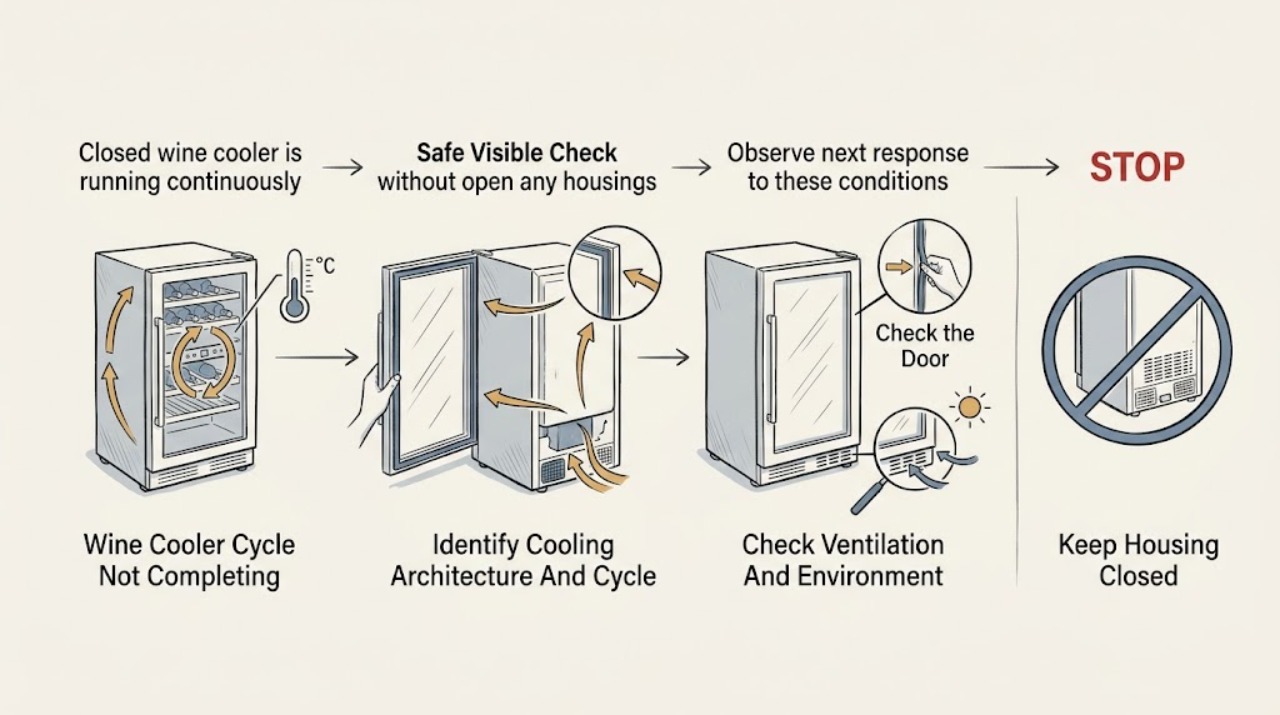
Here, “cycle” means the wine cooler’s cooling cycle, not a wash program. A cycle that seems not to complete may be normal recovery after loading warm bottles, frequent door opening, a high ambient temperature, or a setpoint that is colder than the model can readily maintain; Danby also documents normal fan cycling on some wine-cooler models. First identify the exact model and cooling architecture, then check the set temperature, door seal, bottle load, ventilation, direct heat, level, and the visible condenser area only as the manual permits. Record whether the compressor actually stays on, whether a fan is merely cycling, whether the displayed temperature changes, and whether HI/LO or another alarm appears. On Danby’s DWC057D1BSS manual, continuous operation with poor cooling is associated with door/ventilation/load/environment conditions as well as possible system leak, evaporator-fan, or compressor failure. If the unit remains outside its set temperature after the external checks, repeatedly alarms, makes abnormal noise, leaks, overheats, or needs a cover removed, stop repeated cycling and arrange qualified service; do not open the cabinet, test live power, handle refrigerant, or repair the fan, compressor, thermistor, or sealed system.
Before you begin
Safety first
- This article covers model identification, user-facing setpoint and door checks, bottle-load and environment observations, visible ventilation, model-directed accessible cleaning, and display/alarm recording. A qualified technician must handle the cabinet, compressor, fans, sensors, controls, wiring, refrigerant, sealed system, and hidden cooling components.
Work through in order
Diagnostic checks
Use only checks that match the exact appliance or system and its official guide.
-
Check 1
Record the exact model and serial information and use its owner manual to identify whether the wine cooler uses a compressor or another cooling module, single or dual zones, and a manual or auto-cycle defrost design. From outside the cabinet, note whether the fan runs, whether the compressor hums or vibrates, whether the display temperature changes, and whether “cycle not completing” means continuous running, no restart, or failure to reach the setpoint.
Expected result: The model is unknown, the fan cycles but the compressor stops normally, the compressor appears to run continuously, the display reaches the setpoint, or the cabinet remains warm with no clear cooling sound.
Next step: Use the exact manual and continue with external setpoint, door, load, and ventilation checks. If the source of the cycle cannot be distinguished without opening the cabinet, stop and arrange service.
Stop if: Do not open the cabinet, touch the compressor or fan, force a thermostat, or assume the cycle is compressor-based on every Danby wine cooler.
Why this matters
Why: The same user phrase can describe normal fan behavior, an expected recovery period, a control decision that is not reaching the setpoint, or a cooling-system failure. Without the exact model and architecture, a universal cycle time or part diagnosis is unsafe.
-
Check 2
Check the model-documented temperature setting, door closure, magnetic gasket contact, and frequency of opening. Note whether a large quantity of warm bottles was recently added, whether shelves are overloaded, and whether the setpoint is within the model’s stated range. Correct only a visible obstruction or loading issue and do not repeatedly change the control while observing recovery.
Expected result: The door is not sealing, it is opened often, many warm bottles were added, the cabinet is overloaded, the setpoint is unusually cold, or the door/load/setpoint appear normal.
Next step: Close the door, remove only a visible obstruction, and let the model recover with the setpoint unchanged. If the cooler still cannot reach or hold the setpoint, continue to the ventilation check and prepare the model record for service.
Stop if: Do not force or heat the gasket, alter the thermostat wiring, or keep running the unit indefinitely when wine is warming or the compressor is abnormal.
Why this matters
Why: Danby identifies door closure, frequent opening, warm loads, and thermostat setting as causes of poor temperature maintenance or continuous operation. A wine cooler may need extended recovery after a warm load; a normal load and seal make ventilation, ambient heat, sensor, fan, compressor, or sealed-system problems more likely.
-
Check 3
Inspect the installation from outside the unit. Confirm that the exhaust or ventilation opening is not blocked, the cooler is not tightly enclosed unless the exact model is designed for it, and it is away from direct sunlight, a stove, radiator, or other heat source. Confirm that a freestanding unit is level and not vibrating against a wall or cabinet; do not move an installed unit if doing so strains its cord or lines.
Expected result: An exhaust path is obstructed, clearance is less than the model manual requires, the unit is in a hot or humid location, direct heat or sun reaches it, the cabinet is unlevel, or the visible installation is normal.
Next step: Clear only visible obstructions, restore model-required clearance, reduce direct heat, and correct a simple visible leveling issue if safe. If the cycle remains continuous or cabinet temperature remains high under normal conditions, arrange service.
Stop if: Do not remove panels, clean a powered condenser/fan, relocate built-in equipment, or alter cabinetry or wiring to create clearance.
Why this matters
Why: Danby states that ventilation, ambient conditions, heat sources, and level affect cooling and operation. Poor heat rejection can make a compressor run longer or prevent the setpoint from being reached without proving compressor failure.
-
Check 4
Observe the cooler without opening covers. Note whether the fan cycles briefly, whether the compressor starts and stops, whether the display shows HI, LO, CL, or another alarm, and whether the cabinet or door has condensation. Compare each indicator with the exact manual; do not use a thermometer probe or service mode inside the cabinet unless the manual explicitly provides a safe user procedure.
Expected result: The fan cycles at the model-documented interval, HI follows a warm load or door opening, LO/CL persists, the compressor cycles normally, or the unit runs continuously with an alarm, abnormal sound, or poor cooling.
Next step: Allow the model’s documented recovery after closing the door or correcting the load. If an alarm persists, the display does not track cabinet temperature, or the compressor/fan pattern is abnormal, stop repeated restarts and arrange service.
Stop if: Do not silence an alarm by disconnecting sensors, touch a moving fan, scrape ice, or enter a technician test mode.
Why this matters
Why: Danby identifies some short fan cycling as normal and says HI can follow warm bottles or a door not closed tightly. Persistent LO/CL may involve low ambient conditions, a sensor, or an evaporator-temperature issue in the documented model. Continuous running with poor cooling or abnormal noise is more concerning than a normal fan cycle.
-
Check 5
With the unit safely unplugged, inspect only the user-accessible condenser area or filter described by the exact manual. Remove loose dust using the model-approved method, keep shelves and bottle spacing from blocking internal air circulation, and allow washable components to dry before reinstalling. Do not remove a grille, coil cover, fan guard, or sealed-system panel.
Expected result: The accessible condenser or filter is visibly dirty, internal bottle spacing blocks circulation, the area is clean, or cleaning would require removing a cover or reaching a powered component.
Next step: Complete only the model-approved accessible cleaning, then restore the unit and monitor the temperature trend. If the cycle still does not complete or the cooler becomes warm, arrange qualified service.
Stop if: Do not use water on electrical parts, wash a powered unit, bend fins, remove covers, or attempt refrigerant or compressor service.
Why this matters
Why: Danby recommends condenser cleaning and adequate ventilation for temperature maintenance, while the DWC044 manual explains that the compressor’s off cycle supports auto-cycle defrost on that model. A clean accessible area with persistent continuous running points toward internal fan, compressor, sensor, control, or sealed-system diagnosis.
-
Check 6
Compile the exact model, cooling architecture, setpoint, displayed temperature and alarms, door/load history, ambient and ventilation conditions, fan and compressor observations, accessible maintenance status, condensation or ice, noise, and the time pattern. Do not remove the cabinet or test electrical, refrigerant, compressor, fan, or sensor components.
Expected result: The cycle returns to normal after a visible door, load, setpoint, ventilation, or maintenance correction, or the cooler remains continuous, warm, alarmed, noisy, iced, or unable to restart.
Next step: Protect wine from unsafe temperature drift and contact Danby support or a qualified wine-cooler technician with the record and model number. Use the exact manual and authorized service path for diagnosis.
Stop if: Do not keep cycling power, open panels, bypass controls, handle refrigerant, or operate through smoke, sparking, overheating, water, or a damaged cord.
Why this matters
Why: Recovery after a visible condition supports that external cause. Persistent continuous running or failure to reach the setpoint may involve a system leak, evaporator fan, compressor, temperature sensor, control, or sealed system; the symptom cannot safely select a part.
Use your observations
Decision map
Find the observation that best matches what you see, then follow the next safe action.
-
PATH 01Safety boundary
What you see
A large warm bottle load or frequent door opening preceded the long run, the door now seals, and the displayed temperature is moving toward the setpoint.
Do this next
Keep the door closed and monitor the model’s temperature trend. If it never reaches or holds the setpoint, continue to service evaluation.
Why this path and its safety boundary
Why it matters: The cooler may be completing an extended recovery rather than failing to cycle.
Safety stop: Do not repeatedly change the setpoint or run the cooler indefinitely when contents are warming.
-
PATH 02Safety boundary
What you see
The door seal is poor, the setpoint is unusually cold, an exhaust path is blocked, or the unit is near direct heat/sun or in an unsuitable enclosure.
Do this next
Correct only the visible door, setpoint, clearance, or environment issue according to the manual and monitor recovery.
Why this path and its safety boundary
Why it matters: A user-facing temperature or heat-rejection condition can keep the cooling cycle running longer without proving an internal failure.
Safety stop: Do not force the gasket, alter wiring, move a built-in unit, or remove covers to improve airflow.
-
PATH 03Safety boundary
What you see
The fan starts and stops at the documented short interval, the display and cabinet temperature are normal, and no alarm or abnormal sound is present.
Do this next
Monitor the cabinet temperature and compressor cycle as described by the exact model manual. Arrange service only if cooling, alarms, or sounds become abnormal.
Why this path and its safety boundary
Why it matters: On applicable Danby wine coolers, the fan behavior can be normal and does not by itself mean the cooling cycle is failing.
Safety stop: Do not open the fan guard or attempt to keep the fan running continuously.
-
PATH 04Safety boundary
What you see
HI/LO/CL or another alarm persists, the displayed temperature does not recover, the cabinet is warm, or the compressor runs continuously after external conditions are normal.
Do this next
Stop repeated restart attempts and arrange qualified service with the model, alarm, temperature trend, and load/ventilation history.
Why this path and its safety boundary
Why it matters: A sensor, fan, compressor, control, ambient-condition, or sealed-system problem is more likely than a normal short fan cycle.
Safety stop: Do not enter service mode, bypass a sensor, test refrigerant, or open the cooling compartment.
-
PATH 05Safety boundary
What you see
Condensation forms on the cabinet or door, or ice appears with poor cooling, continuous operation, or an obstructed air path.
Do this next
Check only the visible seal, door, load, and ventilation conditions. Arrange service for recurring ice, poor cooling, or any hidden evaporator/fan access.
Why this path and its safety boundary
Why it matters: Door sealing, ambient humidity, restricted airflow, or an internal temperature/cooling fault is possible; visible moisture does not identify a part.
Safety stop: Do not scrape ice, apply heat, remove panels, or run the unit with water near electrical parts.
-
PATH 06Safety boundary
What you see
Door, setpoint, load, ventilation, level, and accessible maintenance are normal, but the cooler remains warm or runs continuously; abnormal compressor/fan noise, a leak, or a repeated fault accompanies it.
Do this next
Stop operation if wine or equipment is at risk and arrange Danby or qualified wine-cooler service. Provide the exact model and observation record.
Why this path and its safety boundary
Why it matters: The documented possibilities include evaporator-fan failure, compressor failure, system leak, sensor, control, or another sealed-system fault.
Safety stop: Do not open the cabinet, test live or refrigerant circuits, replace the compressor/fan/sensor, or bypass protection.
Helpful context
Understand the symptom
Define “cycle” before diagnosing it
A wine cooler’s cooling cycle is the controller’s decision to run and stop the compressor or cooling module while cabinet temperature changes. It is not a dishwasher-style program. Some Danby models use a compressor and auto-cycle defrost, while others may have a different cooling design; the exact owner manual controls the interpretation. A fan that starts and stops is not proof that the compressor is failing, and a compressor that runs for a long recovery after warm bottles is not automatically a fault. Track cabinet temperature, display behavior, fan sound, compressor vibration or hum from outside, and how long the pattern persists.
Keep sealed, electrical, fan, and compressor work professional
Unplug only through the normal plug when a safe inspection or model-permitted cleaning requires it, and keep the unit dry. Do not remove the cabinet or rear cover, touch a powered fan or compressor, probe live wiring, bypass a thermal control, add or release refrigerant, or puncture a cooling line. Stop for smoke, burning odor, sparking, a hot or damaged cord, repeated electrical trips, refrigerant concerns, severe overheating, or water near electrical parts. A wine cooler that is unplugged still requires qualified service for sealed-system, compressor, fan, sensor, control, or wiring diagnosis.
Safety boundary
Stop conditions
- Stop immediately for smoke, burning odor, sparking, a hot or damaged cord, repeated electrical trips, severe overheating, a refrigerant concern, water near electrical parts, or abnormal compressor/fan behavior.
- Do not open the cabinet or rear cover, probe live wiring, touch a powered fan or compressor, bypass a thermostat or sensor, add or release refrigerant, or puncture a cooling line.
- Do not keep cycling power to hide an alarm or warm cabinet, scrape or heat ice, or operate a unit that cannot maintain a safe condition for its contents.
- Persistent continuous running, failure to reach the setpoint, recurring alarm, abnormal fan/compressor symptom, or hidden drain/cooling access requires Danby or qualified wine-cooler service.
When checks do not resolve it
Need a professional?
Safety scope: This article covers model identification, user-facing setpoint and door checks, bottle-load and environment observations, visible ventilation, model-directed accessible cleaning, and display/alarm recording. A qualified technician must handle the cabinet, compressor, fans, sensors, controls, wiring, refrigerant, sealed system, and hidden cooling components.
Common questions
FAQ
What does it mean if my Danby wine cooler cycle never completes?
Treat “cycle” as the cooling cycle. Check the exact model’s setpoint, door seal, warm-bottle load, ventilation, heat source, level, and visible condenser area, then record whether the fan or compressor is actually running and whether the temperature changes. Persistent continuous operation with poor cooling can require service for a fan, compressor, sensor, control, or sealed system.
Is it normal for a Danby wine cooler to run continuously after adding bottles?
A large warm load or frequent door opening can extend recovery, and Danby lists both as causes of continuous operation or a HI indication on an applicable model. Close the door and monitor recovery using the exact manual. If the temperature never reaches the setpoint, arrange service.
Is a Danby wine-cooler fan cycling every few seconds a failure?
Not necessarily. Danby says fan cycling every 8–12 seconds can be normal on applicable wine coolers. Judge the behavior with cabinet temperature, compressor operation, alarms, and abnormal sounds, and use the exact model manual before treating it as a fault.
Can poor ventilation make a Danby wine cooler stay on?
Yes. Danby lists adequate ventilation, condenser condition, and clearance as checks for poor temperature maintenance, and wine-cooler manuals identify blocked exhaust or heat sources as causes of long running. Clear only visible obstructions; do not remove covers or clean a powered fan or coil.
When should I call a technician for a Danby wine cooler that will not complete its cycle?
Call when the exact setpoint, door, load, ventilation, level, and accessible maintenance checks are normal but the cooler stays warm or runs continuously, or when an alarm persists, ice/condensation returns, the fan or compressor sounds abnormal, or a leak or electrical hazard appears. Internal fan, compressor, sensor, control, wiring, refrigerant, and sealed-system work is professional work.
Read the exact guide
Official sources
- WINE COOLERDanby · Official DWC044BLP manual only; its auto-cycle defrost and electronic-control behavior are not universal to all Danby wine coolers.
- WINE COOLERDanby · Official DWC057D1BSS manual only; its controls, alarms, and troubleshooting table are not universal to every Danby wine cooler.
- The wine cooler is not maintaining the set temperature. How can I adjust it?Danby USA · Official Danby FAQ; it gives general external checks and does not authorize internal repair.
- Support CenterDanby Appliances Canada · Official Danby support hub; regional service, warranty, and parts availability varies by model and location.
- Wine Coolers FAQsDanby USA · Official Danby USA wine-cooler FAQ category; exact settings, clearance, fan behavior, and alarm meanings vary by model.
Community feedback
Share a repair observation
Share a plain-text repair observation. Accepted observations are published automatically; this page may take a moment to update.