
On this page
Start here
Quick answer
If a Danby wine cooler is not cooling, first verify that it has power and that the control is turned on and set to a cooling temperature for the correct zone. Do not assume every Danby cooler uses the same control: some manuals use a rear thermostat dial while newer models use digital or dual-zone controls, so use the exact model manual. Close the door fully and inspect the gasket, leave the internal vents clear, avoid packing bottles against the rear or adding a large quantity of warm bottles at once, and confirm the unit is in a temperature-controlled location with the model's required ventilation. A freestanding cooler must not be boxed into cabinetry unless its manual permits it; a built-in model still needs the specified airflow. Clean accessible condenser areas only with the unit safely unplugged. If the display or light works but there is no cooling, the cabinet remains warm after the setting, the fan repeatedly stalls, or the problem persists after these checks, stop before opening the cabinet: fan, thermoelectric module, compressor, sensor, control board, and sealed-system work require qualified service.
Before you begin
Safety first
- The user may verify an accessible power/control state, check the setpoint and zone, inspect and clean an accessible door gasket, rearrange removable bottles or shelves, inspect external clearance, and clean documented accessible condenser areas with power safely isolated. Cabinet disassembly, fan/module/compressor/sensor/control work, sealed-system work, refrigerant work, wiring tests, and built-in movement are for qualified service personnel.
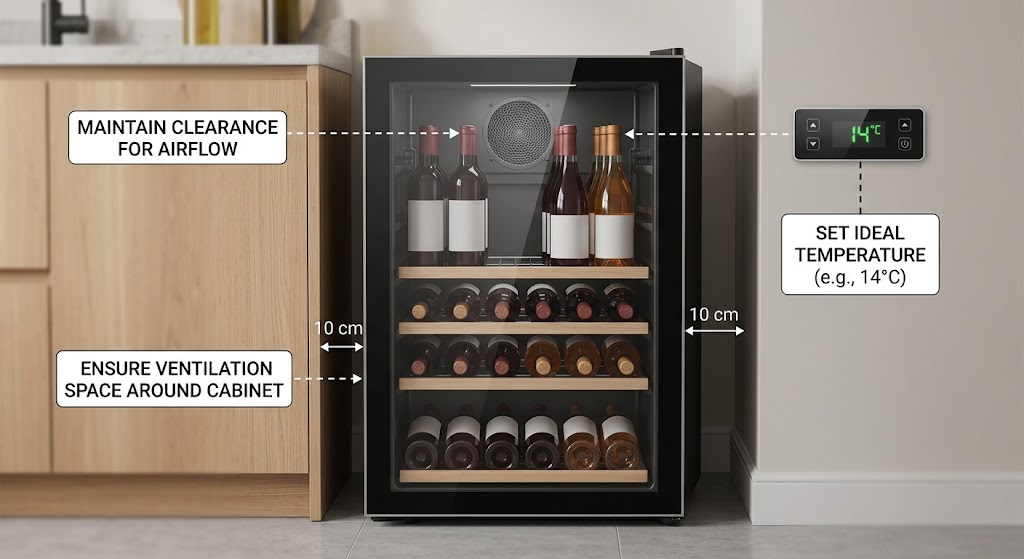
Work through in order
Diagnostic checks
Use only checks that match the exact appliance or system and its official guide.
-
Check 1
From a dry, safe position, verify that the cooler is plugged into its intended outlet, the outlet is available, and the unit's control is on. Check the exact model manual for whether it uses a rear thermostat dial, a digital temperature control, a zone selector, a lock, or a demo/off state; select a documented cooling setting without changing hidden service parameters.
Expected result: The plug or outlet is not supplying power, the control is at OFF or a non-cooling mode, the wrong zone is selected, the display shows a lock or alarm, or the unit is powered and set to cool.
Next step: Correct only an obvious control setting or use a safely reachable known-good outlet as permitted by the manual. Do not use an extension cord, bypass a control, or open the control panel. If the outlet, cord, or plug is damaged or hot, stop and arrange electrical or appliance service.
Stop if: Do not touch damaged electrical parts, repeatedly reset a tripping circuit, or probe voltage inside the cooler.
Why this matters
Why: No power or an OFF/wrong-zone setting can explain a warm cabinet without a refrigeration fault. If the unit is powered and a cooling command is active, continue to the door, load, and airflow checks rather than assuming the control board has failed.
-
Check 2
Record the displayed or dial setting, which zone is warm, and the actual temperature with a suitable independent thermometer placed where the exact manual recommends. Allow normal recovery after a setting change or warm load; do not set an unverified extreme temperature or repeatedly open the door to check it.
Expected result: The control is OFF or outside the intended range, only one zone is warm, the display setting changes but the cabinet does not respond, the reading is affected by a recent warm load, or the unit has had time to recover and remains warm.
Next step: Use the exact model manual to select the desired zone and setpoint, then keep the door closed during recovery. If the setting is correct but temperature does not trend down, continue with the gasket, bottle spacing, and installation checks; do not recalibrate or replace a sensor yourself.
Stop if: Do not remove a sensor, change service calibration, or open the control or cooling compartment.
Why this matters
Why: An incorrect setting, zone selection, or warm load is more likely when the cooler otherwise runs and the temperature trend improves. One warm zone can point to zone-specific airflow or control, while no response after recovery shifts attention toward a sensor, fan, module, compressor, or sealed system.
-
Check 3
Close the door slowly and inspect the magnetic gasket around its complete perimeter. Look for a bottle or shelf preventing closure, a fold, debris, a torn section, or a gasket that does not touch the cabinet evenly. Wipe an accessible gasket with a soft damp cloth only when the unit is safely off, and avoid forcing or heating the seal.
Expected result: The door is not fully shut, the gasket is dirty, folded, damaged, or uneven, the door is opened frequently, or the gasket closes evenly with no obstruction.
Next step: Remove only the accessible obstruction, clean and dry the gasket, and close the door for a recovery period. If the gasket remains torn or the frame is distorted, arrange model-specific service; do not glue, stretch, or reshape it with heat.
Stop if: Do not remove the glass door, hinge, gasket channel, or door frame, and do not operate the cooler with exposed wiring or a damaged glass panel.
Why this matters
Why: A door gap or poor gasket contact allows cooling loss and condensation and can make the cabinet appear not to cool. If the seal is even and openings are limited, the cause is more likely setting, load, ventilation, or a cooling assembly.
-
Check 4
Inspect bottle and shelf placement against the exact manual. Keep bottles from blocking interior vents, the evaporator or cold-air outlet if visible, and the door's closing path; avoid adding a large quantity of warm bottles at once. Note whether the entire cabinet is warm or only the area near one zone or shelf.
Expected result: Bottles are pressed against a vent or packed tightly, a shelf is blocking an air passage, many warm bottles were recently loaded, only one zone or area is warm, or the load and visible airflow path are reasonable.
Next step: Rearrange only removable shelves or bottles as the manual permits, leave the door closed, and reassess the temperature trend. Do not remove internal panels or reach behind a fan or cold plate; escalate if airflow is absent, abnormal, or still ineffective.
Stop if: Do not force shelves, insert objects into vents, or reach through a grille while a fan may start.
Why this matters
Why: Blocked airflow or a large warm load can delay recovery and can make one area warmer than another without identifying a failed part. Persistent whole-cabinet warmth after the load has stabilized makes a control or cooling-system fault more likely.
-
Check 5
Identify whether the cooler is freestanding or an approved built-in model, then inspect the exterior clearance, front grille, rear/side ventilation, surrounding heat sources, direct sunlight, and room temperature without moving a loaded or built-in appliance. Compare the layout with the exact installation manual.
Expected result: The unit is in an outdoor or non-temperature-controlled location, a freestanding unit is enclosed or has blocked sides/back, a grille is covered with dust or cabinetry, heat or sunlight is intense, or model-required ventilation is clear.
Next step: Move only a small freestanding unit safely and as the manual allows, or clear an obvious external obstruction with power isolated. Do not pull a built-in unit, alter cabinetry, or guess a clearance that is not in the model manual; use qualified installation help when access is constrained.
Stop if: Do not operate a wine cooler in an outdoor or non-temperature-controlled location, fully enclose a freestanding model, or move a heavy/built-in unit alone.
Why this matters
Why: An unsuitable room or blocked exhaust can raise cabinet temperature and overload the cooling system. A correctly installed unit in a suitable room with clear ventilation makes an internal fan, module, compressor, sensor, control, or sealed-system problem more plausible.
-
Check 6
With power disconnected from a dry, safely reachable point, clean only the accessible condenser grille or coils if the exact manual identifies them as user-maintenance items. After restoring power normally, record whether the unit runs, whether a fan cycles, whether the cabinet or exhaust area changes temperature, and whether an alarm or HI/LO indication returns; do not remove panels or perform a live test.
Expected result: Accessible dust is heavy, the fan is silent or repeatedly stalls, the unit runs without lowering the cabinet temperature, the compressor or cooling surface behaves abnormally, or cooling improves after safe cleaning and ventilation.
Next step: If the symptom persists after the documented external checks, keep the cooler off if it is overheating, leaking, making an electrical odor, or tripping protection, and arrange qualified Danby appliance service. Provide the model, setting, zone, room/installation, load, temperature trend, and run sounds.
Stop if: Do not open the cabinet, touch a condenser or fan while energized, bypass a thermostat, recharge a sealed circuit, or test refrigerant, compressor, thermoelectric, sensor, or control wiring.
Why this matters
Why: Blocked accessible airflow can contribute to poor cooling and improvement supports that branch. No cooling with a correct setting and clear airflow does not distinguish a fan, thermoelectric module, compressor, sensor, control, or sealed-system problem from the outside.
Use your observations
Decision map
Find the observation that best matches what you see, then follow the next safe action.
-
PATH 01Safety boundary
What you see
The cooler has no power, the dial is at OFF, the digital control is locked or in a non-cooling state, or the wrong zone/setpoint is selected.
Do this next
Restore only an obvious, safely accessible setting or supply condition using the exact model manual. If the cord, plug, outlet, or control behaves abnormally, stop and arrange service.
Why this path and its safety boundary
Why it matters: The symptom is explained by supply or user control state before a refrigeration assembly should be suspected.
Safety stop: Do not bypass controls, use a damaged outlet, or probe the cabinet electrically.
-
PATH 02Safety boundary
What you see
The door is not sealing, a bottle or shelf blocks an internal outlet, the door has been opened frequently, or many warm bottles were added recently, while temperature begins to improve after correction.
Do this next
Correct the accessible obstruction or gasket contamination, space the load as the manual shows, close the door, and allow recovery without repeated opening. Escalate if the door remains damaged or the cabinet stays warm after recovery.
Why this path and its safety boundary
Why it matters: Cooling loss or recovery delay is more likely than an immediate component failure; a temperature reading taken too soon can misclassify a normal recovery.
Safety stop: Do not operate with a persistent gap, broken glass, or an internal obstruction that requires panel removal.
-
PATH 03Safety boundary
What you see
The cooler is outside a temperature-controlled room, exposed to heat or sun, or a freestanding unit is enclosed or has blocked ventilation; built-in status or clearance does not match the exact manual.
Do this next
Restore the documented installation and room conditions only when safe, or use qualified installation help for a built-in or heavy unit. Reassess with the door closed; persistent warmth after proper ventilation needs service.
Why this path and its safety boundary
Why it matters: Heat rejection and ambient conditions can keep the cabinet above its setting and can mimic a failed cooling assembly.
Safety stop: Do not fully enclose a freestanding cooler, block a front exhaust, or pull a built-in unit without proper support.
-
PATH 04Safety boundary
What you see
Only one zone or region is warm, bottles or shelves obstruct a visible airflow path, or one fan/airflow symptom is present while the control and room conditions are correct.
Do this next
Reposition removable items and verify the exact zone setting, then observe the temperature trend without reaching into grilles. If airflow remains absent or the zone does not recover, arrange model-specific service.
Why this path and its safety boundary
Why it matters: Zone selection, loading, airflow distribution, or a zone-specific fan/control issue is more likely than a blanket conclusion that the compressor or sealed system has failed.
Safety stop: Do not remove cold plates, fan guards, internal panels, or zone sensors.
-
PATH 05Safety boundary
What you see
Power and settings are correct, the door seals, load and ventilation are appropriate, accessible maintenance is complete, and the cabinet remains warm or the fan/run behavior is abnormal.
Do this next
Keep the unit off if it overheats, leaks, trips protection, or has an electrical odor; otherwise avoid repeated cycling and arrange qualified Danby appliance service with the model and recorded observations.
Why this path and its safety boundary
Why it matters: An internal fan, thermoelectric module, compressor, sensor, control, or sealed-system fault is possible, but external symptoms cannot identify a safe replacement part.
Safety stop: Do not open the cabinet, handle a sealed cooling circuit, recharge refrigerant, bypass a sensor or thermostat, or perform a live electrical test.
Helpful context
Understand the symptom
First separate a wrong setting from a cooling failure
A Danby wine cooler may use a rear thermostat dial, a digital display, or independent controls for two zones. Check that the control is not at OFF, that the selected zone is the one being measured, and that the set temperature is appropriate for the wine and the model's documented range. A display or interior light can work while the cooling command is disabled, so power alone does not prove that the cooling cycle is enabled.
Bottle placement and room conditions affect recovery
Danby lists the quantity of bottles, door-opening frequency, and the introduction of warm bottles as factors in cabinet temperature. Leave the internal air path and fan openings unobstructed, close the glass door completely, and do not judge the result immediately after a large warm load. Wine coolers are not intended for an outdoor kitchen, porch, carport, garage, or another location that is not temperature controlled. Humid or hot surroundings can also make recovery slower without proving a failed compressor or module.
Ventilation is part of the diagnosis
A freestanding Danby unit needs the clearances stated in its manual; a model designed for built-in use may exhaust from the front and have different requirements. Do not fully enclose a freestanding cooler or block a front grille. With power safely isolated, clean only accessible dust from the documented condenser or grille area. A clear exterior still does not authorize cabinet disassembly or a test of a fan, thermoelectric assembly, compressor, sensor, or sealed circuit.
Safety boundary
Stop conditions
- Stop immediately for smoke, burning odor, arcing, a hot or damaged plug, repeated circuit trips, refrigerant or water leakage, damaged glass, or an overheating cabinet; isolate power only from a dry, safely reachable point and arrange qualified service.
- Do not open the cabinet, remove cooling panels, touch a fan or compressor while energized, probe wiring, bypass a thermostat or sensor, or recharge or otherwise work on a sealed cooling system.
- Do not pull a built-in or heavy wine cooler, alter cabinetry, or guess the required ventilation clearance; use the exact model manual and qualified installation help.
- Do not block interior vents, force shelves, overload the cooler with warm bottles, or keep opening the door to check recovery.
- Do not use the cooler outdoors or in a garage, porch, carport, or other location that is not temperature controlled, and stop storing wine there until the approved environment is restored.
Only after diagnosis
Potential parts
- door gasket
Consider this category only when the door remains evenly unsealed after safe cleaning and obstruction checks, and qualified diagnosis confirms the gasket is causing cooling loss.
Gasket profiles and door designs vary by Danby model; confirm the exact SKU and approved fit information before ordering. - temperature control or sensor
Consider this category only when the setting is correct but qualified diagnosis finds that the control or sensor does not regulate the documented temperature or zone.
Dial, digital, single-zone, and dual-zone systems are not interchangeable; confirm the exact model and service documentation. - condenser or evaporator fan
Consider this category only when qualified service confirms an airflow fan fault after installation, loading, grille, and accessible-cleaning causes are ruled out.
Fan position and electrical specifications vary by design; do not order from a silent-fan symptom alone. - thermoelectric cooling module or compressor assembly
Consider this category only after qualified diagnosis identifies the cooler's actual cooling technology and confirms a module or compressor fault.
Danby wine coolers use different configurations; a compressor part is not a substitute for a thermoelectric module and fitment must be model-specific. - sealed-system component
Consider this service category only when correct settings, seal, load, environment, ventilation, and airflow are verified and qualified diagnosis identifies a sealed-system issue.
Sealed-system work requires qualified equipment and model-specific refrigerant and service information; do not select a refill or component from cabinet temperature alone.
When checks do not resolve it
Need a professional?
Arrange qualified Danby appliance service when the cooler remains warm after the exact model's power, setting, door-seal, load, airflow, room, and accessible-cleaning checks; when only one zone remains warm; when a fan is silent or abnormal; or when the unit displays a recurring temperature alarm. Use qualified installation help when a built-in unit lacks its required ventilation or must be moved. Internal fan, thermoelectric module, compressor, sensor, control-board, wiring, and sealed-system diagnosis are not user-level repairs.
Safety scope: The user may verify an accessible power/control state, check the setpoint and zone, inspect and clean an accessible door gasket, rearrange removable bottles or shelves, inspect external clearance, and clean documented accessible condenser areas with power safely isolated. Cabinet disassembly, fan/module/compressor/sensor/control work, sealed-system work, refrigerant work, wiring tests, and built-in movement are for qualified service personnel.
Common questions
FAQ
Why is my Danby wine cooler running but not getting cold?
First verify the selected zone and setpoint, door seal, bottle spacing, room temperature, and model-required ventilation. If the control is correct and the cabinet remains warm after recovery, an internal fan, thermoelectric module, compressor, sensor, control, or sealed-system fault is possible and needs qualified service.
Can too many bottles make a Danby wine cooler seem not to cool?
Yes. Danby identifies the quantity of bottles and adding a large number of warm bottles as factors in cabinet temperature. Keep vents clear, stagger a warm load when the manual permits, close the door, and allow recovery without repeatedly opening it.
How do I know whether the thermostat or mode is wrong?
Check whether the model uses a rear dial or digital/zone controls and confirm that it is not OFF, locked, or set to the wrong zone. Danby models differ, so retrieve the exact manual before interpreting a display, alarm, or temperature range.
Can I put a Danby wine cooler in a cabinet or garage?
Only if the exact model is designed and installed for built-in use with its required ventilation. Danby says wine coolers are not intended for outdoor or non-temperature-controlled locations, including garages and similar spaces. Do not fully enclose a freestanding unit.
What can I safely clean when a Danby wine cooler is warm?
With power safely disconnected, clean only accessible condenser or grille areas identified by the exact manual, and wipe an accessible door gasket with a soft cloth. Do not remove panels, reach into a fan, open the control compartment, or work on the cooling circuit.
Read the exact guide
Official sources
- The wine cooler is not maintaining the set temperature. How can I adjust it?Danby USA · Brand-level guidance for correct door closure, limiting openings, thermostat setting, condenser cleanliness, and ventilation; it does not identify internal component failures.
- The wine cooler is not cooling properly. What should I do?Danby USA · Direct brand guidance for power, thermostat, door seal, condenser cleaning, ventilation, and escalation; exact model instructions still control.
- Danby 60 Bottle Built-In Wine Cooler in Stainless SteelDanby Canada · Model-specific product evidence for digital thermostat, fan-forced cooling, temperature display, built-in ventilation, upright settling after transport, and normal fan cycling; not a universal design claim.
- Owner's Use and Care GuideDanby · Model-specific example for a rear thermostat dial, magnetic gasket, leveling leg, bottle placement, freestanding clearance, and power-off cleaning; do not apply its clearances or control to other models.
- Wine Coolers FAQsDanby USA · Brand category guidance for room suitability, freestanding versus built-in ventilation, fan cycling, HI/LO after warm loading or poor closure, and maintenance; exact model manual controls.
- Product Manuals | Danby Appliances CanadaDanby Appliances Canada · Brand support page establishing that the exact model/SKU should be used to select operating, clearance, and service instructions.
- WINE COOLERDanby · Model-specific evidence for a digital/thermostat wine cooler's troubleshooting branches, including setting, door/gasket, warm-bottle loading, power, condensation, and service boundary; not universal fitment.
Community feedback
Share a repair observation
Share a plain-text repair observation. Accepted observations are published automatically; this page may take a moment to update.