
On this page
Start here
Quick answer
Check that the wine cooler is powered on, has stood upright after transport as its manual requires, and has clear ventilation. Verify the temperature setting, door seal, bottle loading, room conditions, and fan airflow. A compressor may run frequently under heat load, but a cooler that stays warm after these checks, makes repeated trips, or shows oil/leak or electrical symptoms needs service; do not open the sealed refrigeration circuit.
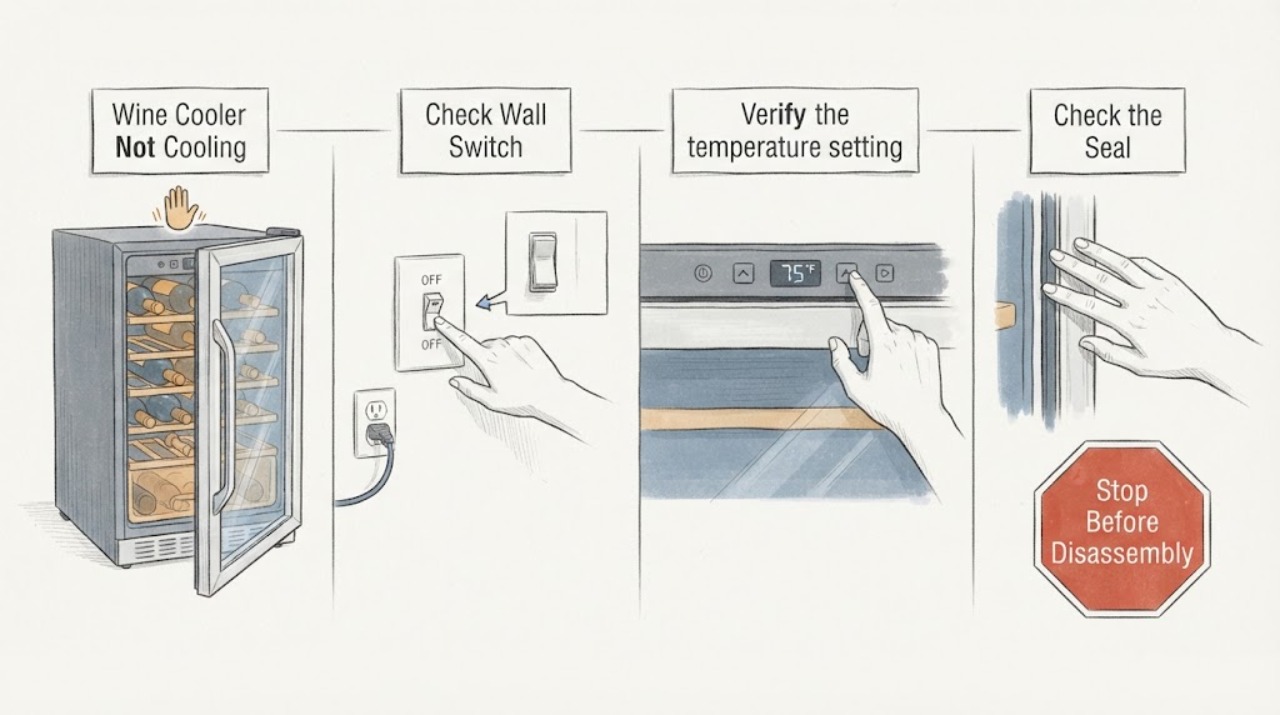
Work through in order
Diagnostic checks
Use only checks that match the exact appliance or system and its official guide.
-
Check 1
Check the outlet, plug, power switch, display, and whether the cooler was allowed to stand upright after transport.
Expected result: No power, recent transport without settling, or power and settling are normal.
Next step: Restore safe power or wait the manual’s settling period before judging cooling.
Why this matters
Why: Power loss or unsettled transport can prevent normal cooling; Danby gives model-specific upright guidance.
-
Check 2
Verify the temperature setting and allow time for a newly loaded or recently powered unit to stabilize.
Expected result: Setting is warm, many room-temperature bottles were added, or the unit remains warm at a valid setting.
Next step: Avoid rapid repeated door openings and monitor one stabilization period.
Why this matters
Why: Setting and heat load affect pull-down time; persistent warmth at a valid condition points elsewhere.
-
Check 3
Inspect the door gasket, shelves/bottles, and cabinet clearance so the door closes and air vents are not blocked.
Expected result: Door gap, dirty/damaged seal, overpacked shelves, or blocked vents are present.
Next step: Rearrange contents and clean/repair only accessible seal surfaces.
Why this matters
Why: Air leakage or blocked circulation prevents even cooling.
-
Check 4
Observe fan/compressor operation and ambient conditions without touching hot or moving parts.
Expected result: Fan runs, is silent, cycles rapidly, or the room is hot/poorly ventilated.
Next step: Restore front/side/rear ventilation per manual; do not open the sealed system.
Why this matters
Why: Ambient heat and airflow change compressor demand; silence with warmth or rapid cycling needs service context.
-
Check 5
Check temperature after external corrections and note frost, oil, abnormal noise, burning odor, or repeated breaker trips.
Expected result: Cooling returns or the unit remains warm/unsafe.
Next step: Stop for safety symptoms and arrange service.
Why this matters
Why: Recovery supports power, setting, load, door, or ventilation causes; persistent failure needs refrigeration service.
Use your observations
Decision map
Find the observation that best matches what you see, then follow the next safe action.
-
PATH 01Next step
What you see
Unit lacks power or was recently transported without upright settling.
Do this next
Correct safe setup and allow stabilization.
Why this path and its safety boundary
Why it matters: Power/transport setup is the likely first issue.
-
PATH 02Next step
What you see
Door seal or bottle loading blocks circulation.
Do this next
Correct contents/seal and monitor.
Why this path and its safety boundary
Why it matters: Heat leakage or restricted airflow prevents cooling.
-
PATH 03Next step
What you see
Compressor/fan runs but temperature does not recover.
Do this next
Arrange qualified wine-cooler service.
Why this path and its safety boundary
Why it matters: Airflow, ambient conditions, sealed-system, or control fault remains.
-
PATH 04Next step
What you see
Oil/leak evidence, burning odor, scorching, or repeated trips appears.
Do this next
Disconnect power if safe and service it.
Why this path and its safety boundary
Why it matters: Unsafe electrical/refrigeration boundary.
Helpful context
Understand the symptom
Check that the wine cooler is powered on, has stood upright after transport as its manual requires, and has clear ventilation. Verify the temperature setting, door seal, bottle loading, room conditions, and fan airflow. A compressor may run frequently under heat load, but a cooler that stays warm after these checks, makes repeated trips, or shows oil/leak or electrical symptoms needs service; do not open the sealed refrigeration circuit.
Identify the symptom before choosing a repair
When checks do not resolve it
Need a professional?
Stop for burning odor, smoke, repeated breaker trips, damaged cord, refrigerant/oil evidence, or water near electrical parts.
Common questions
FAQ
What is the safest first check?
Start with the symptom-specific external check in this guide, keep power or fuel isolated when directed, and use the exact model manual for any control or part decision.
When should I stop troubleshooting?
Stop for smoke, burning odor, hot or damaged electrical parts, leaks near electricity, repeated breaker trips, or any condition requiring opening a sealed or energized assembly.
Should I replace a part based on the symptom alone?
No. Confirm the model and diagnostic result first; a symptom can come from several causes.
Read the exact guide
Official sources
- Danby 36 Bottle Free-Standing Wine CoolerDanby · wine cooler no-cooling, power, upright settling, ventilation
- Wine Cooler Technical Service ManualCaveCool · wine cooler airflow, door, temperature, and compressor troubleshooting
Community feedback
Share a repair observation
Share a plain-text repair observation. Accepted observations are published automatically; this page may take a moment to update.