
On this page
Start here
Quick answer
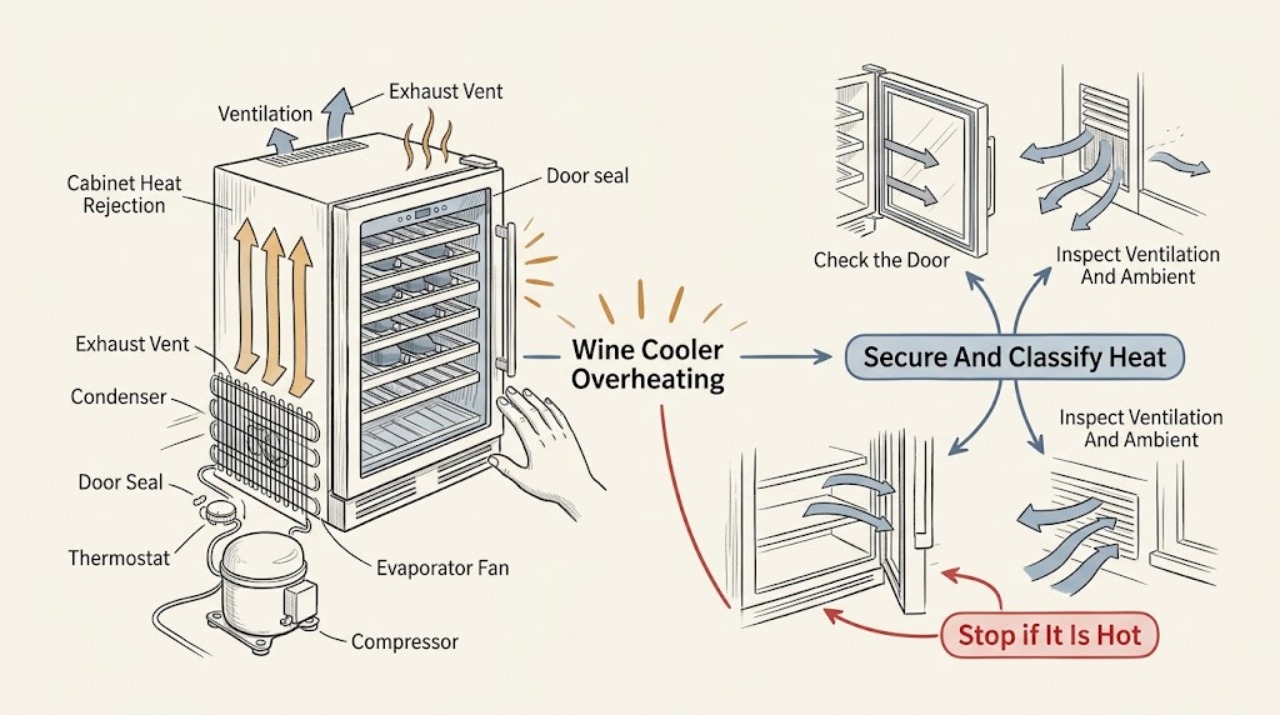
First decide whether only the outside cabinet feels warm or the wine compartment is actually above its setting, showing HI, or running continuously. A warm cabinet alone is not enough to diagnose a failure; check the wine temperature, display, door seal, airflow, ambient conditions, and recent warm-bottle load against the exact Danby model manual. Keep the exhaust vent clear, move the cooler away from direct heat or sunlight, close the door fully, avoid frequent opening, and clean only accessible condenser areas as the manual permits with power safely disconnected. Danby lists an obstructed exhaust vent, an improperly closed door, many warm bottles, heat or direct sunlight, high ambient temperature or humidity, and model-specific system, evaporator-fan, or compressor faults among the causes of insufficient cooling or continuous operation. If there is a burning smell, smoke, a hot plug or cord, arcing, or a breaker that trips, stop using the cooler and isolate it only from a safe, dry location; do not open panels or perform live tests.
Before you begin
Safety first
- The user may read the model label, observe the display and temperature, close the door, remove an obvious external obstruction, maintain model-specified clearance, and clean only accessible areas when safely unplugged and permitted by the manual. Panel removal, electrical diagnosis, fan or sensor replacement, compressor work, refrigerant handling, sealed-system repair, and live testing belong to qualified service.
Work through in order
Diagnostic checks
Use only checks that match the exact appliance or system and its official guide.
-
Check 1
Stop and assess the cooler without opening any panel. Look and smell for smoke, a burning or melting odor, a hot plug or cord, arcing, visible damage, or a breaker that has tripped. If none is present, record whether the warmth is only on the outside cabinet or whether the wine compartment is warm, the display shows HI/LO, or the unit runs continuously.
Expected result: There is a burning smell, smoke, a hot plug or cord, arcing, visible electrical damage, or repeated breaker operation; only the cabinet feels warm while the wine temperature is stable; or the wine is warm, an alarm recurs, or the unit runs continuously.
Next step: For any electrical or fire warning, stop using the cooler and isolate power only from a safe, dry location; arrange qualified appliance or electrical service. Otherwise continue with the external environment, door, and control checks.
Stop if: Do not touch a hot plug or cord, restore a tripped breaker repeatedly, remove panels, or keep operating the appliance after smoke, burning odor, arcing, or visible electrical damage.
Why this matters
Why: An electrical or fire warning is an immediate stop condition. Stable wine temperature with cabinet warmth is not the same symptom as loss of cooling. Warm wine, recurring HI, or continuous running makes a ventilation, door, ambient/load, or cooling-system problem more likely.
-
Check 2
Check the thermostat or displayed setpoint using the exact model's controls. Close the door normally and inspect the accessible gasket and frame for a fold, debris, gap, or bottle or shelf obstruction. Note whether the door has been opened frequently and whether many room-temperature bottles were just loaded; do not overfill or block the interior air path.
Expected result: The setpoint was changed or is unsuitable for the stored wine; the door does not sit flush or the gasket has a visible gap; warm bottles were recently added; or none of these conditions is present.
Next step: Restore only the model-documented setpoint, remove an obvious obstruction, close the door fully, and allow the cooler time to recover without repeated opening. If the gasket is damaged or the temperature does not recover after the external condition is corrected, arrange service.
Stop if: Do not force the door, bend the frame, remove the gasket retainer, or keep testing with the door held open.
Why this matters
Why: A wrong setting, poor door contact, frequent opening, or a warm-bottle load can explain a temporary temperature rise or HI indication without proving a failed compressor. If the setting, seal, and load are normal but the compartment remains warm, the cause shifts toward airflow, ambient conditions, or an internal fault.
-
Check 3
Read the rating label and manual to determine whether the exact cooler is freestanding or designed for built-in installation. From outside the unit, check that the specified exhaust opening and surrounding clearance are not blocked by cabinetry, a wall, dust, stored items, or a heat source. Check that the room is temperature-controlled and that direct sunlight or another appliance is not heating the cabinet.
Expected result: The exhaust vent is obstructed, the unit is enclosed contrary to its manual, clearance is unknown or inadequate, dust is visible at an accessible condenser area, the room is unusually hot or humid, or direct heat/sunlight is present.
Next step: Restore only the manual-specified clearance, remove external items, move the cooler away from direct heat if it can be done safely, and clean an accessible condenser or fan area only as the exact manual directs with the appliance safely unplugged. Do not dismantle the cabinet. If the symptom persists after the area is corrected, call service.
Stop if: Do not push a freestanding cooler into a tight enclosure, use compressed air into an unknown opening, remove panels, or clean near energized wiring.
Why this matters
Why: Restricted heat rejection or a high ambient load can cause the wine compartment to warm and the unit to run longer. Built-in and freestanding Danby models are not interchangeable for clearance assumptions; the exact manual controls.
-
Check 4
After correcting only a visible setting, door, load, or ventilation issue, observe one normal cooling period without repeatedly opening the door. Record whether the displayed temperature moves toward the setpoint, whether HI clears after the door is closed and the load settles, whether the fan cycles, and whether unusual noise, condensation, or an LO/CL indication appears. If the exact manual allows a single unplugged restart for a persistent display condition, follow that manual only.
Expected result: The compartment recovers and the alarm clears; HI returns or the unit runs continuously; the fan is unusually noisy or does not appear to operate; or LO/CL or a sensor-related indication persists.
Next step: Use the cooler only if it reaches and holds the expected temperature without a hazard. For recurring alarm, continuous running, abnormal noise, failure to cool, or a persistent model-specific display, stop troubleshooting and provide the exact model and observations to qualified service.
Stop if: Do not repeatedly unplug and restart, probe a fan, bridge a sensor, or perform live electrical measurements.
Why this matters
Why: Recovery after an external correction supports a door, load, setting, ambient, or ventilation cause. A recurring warm compartment or HI after those causes are removed makes an evaporator fan, compressor, system leak, or other model-specific fault more likely. Persistent LO/CL can point to low ambient conditions, a sensor issue, or a temperature condition that is model-specific.
-
Check 5
Document the full Danby model, installation type, setpoint and measured wine temperature, display message, room conditions, door/gasket result, recent load, ventilation and accessible dust findings, run pattern, noise, and any electrical warning. Give this record to Danby support or a qualified appliance technician rather than opening the sealed cooling or electrical sections.
Expected result: The cooler is stable after an external correction; it remains warm or runs continuously; an alarm repeatedly returns; cooling behavior changed after a move or installation change; or there is an electrical/fire warning.
Next step: Keep the unit out of service and arrange model-matched qualified appliance service for persistent cooling symptoms or any internal component concern. For smoke, burning odor, hot plug/cord, arcing, or repeated breaker operation, seek urgent qualified service and do not restore power until it is cleared.
Stop if: Do not remove the rear or control cover, access the compressor or refrigerant circuit, replace a fan or sensor without model-specific diagnosis, or run the cooler unattended to reproduce a hazard.
Why this matters
Why: A stable recovery supports the corrected external condition. Persistent warming, repeated alarms, or continuous operation after those checks makes a component or sealed-system diagnosis more likely. Electrical or fire symptoms exceed the safe user boundary regardless of cooling performance.
Use your observations
Decision map
Find the observation that best matches what you see, then follow the next safe action.
-
PATH 01Safety boundary
What you see
Only the outside cabinet feels warm, the wine compartment is at or near its setting, no HI alarm persists, and there is no odor or electrical warning.
Do this next
Keep the specified ventilation clear, avoid direct heat, and monitor the actual compartment temperature and run pattern. Call service if the wine warms or the symptom changes.
Why this path and its safety boundary
Why it matters: There is not enough evidence of an overheating fault from cabinet warmth alone; the unit may be rejecting heat while maintaining the compartment temperature.
Safety stop: Stop immediately for burning smell, smoke, hot plug or cord, arcing, or breaker operation.
-
PATH 02Safety boundary
What you see
Wine is warm or HI appears after a door was left open, a large warm-bottle load, a wrong setting, blocked vent, direct heat, high room temperature, or a visible door-seal problem.
Do this next
Correct the visible condition using the exact model manual, close the door, and allow one uninterrupted recovery period. Escalate if the alarm recurs or the compartment does not recover.
Why this path and its safety boundary
Why it matters: An external heat load, air path, setting, or door-contact condition is more likely than an immediate compressor or sealed-system failure.
Safety stop: Do not fully enclose a freestanding model, force the door, remove panels, or keep operating with an electrical warning.
-
PATH 03Safety boundary
What you see
The cooler remains warm, shows recurring HI, or runs continuously after the setpoint, door, load, ambient, ventilation, and accessible cleaning checks are normal.
Do this next
Stop part swapping and arrange qualified Danby or appliance service with the exact model, temperature record, display behavior, and run pattern.
Why this path and its safety boundary
Why it matters: An evaporator-fan, compressor, sensor, airflow, or sealed-system fault is more likely; the DWC057 manual specifically lists system leak, evaporator-fan failure, and compressor failure as possible causes, but it does not identify which part has failed from this symptom alone.
Safety stop: Do not open the cooling system, handle refrigerant, test capacitors or wiring, or perform live measurements.
-
PATH 04Safety boundary
What you see
The display persistently shows LO or CL, a sensor-related indication, or behavior not explained by the identified model's manual.
Do this next
Check only the room condition and exact model documentation. If the indication persists in an appropriate room, arrange service and provide a photo of the display.
Why this path and its safety boundary
Why it matters: Danby documents excessively low ambient temperature, sensor failure, and an evaporator temperature that is too low as possible causes for the DWC057 LO/CL condition; display meanings are model-dependent.
Safety stop: Do not bypass the sensor, change wiring, or generalize a code from another Danby model.
-
PATH 05Safety boundary
What you see
There is smoke, a burning or melting odor, a hot plug or cord, arcing, visible electrical damage, or a breaker trips again.
Do this next
Stop using the cooler, isolate power only from a safe, dry location if possible without touching the hazard, and arrange urgent qualified appliance or electrical service.
Why this path and its safety boundary
Why it matters: Shock, short-circuit, or fire risk takes priority over cooling diagnosis; the appliance is outside the safe user-check boundary.
Safety stop: Do not restore power, reset the breaker repeatedly, touch a hot cord, remove a cover, or test the cooler to reproduce the symptom.
Helpful context
Understand the symptom
Warm cabinet versus an overheated wine compartment
Heat at the outside of a cooler and warm wine inside are different observations. Record the displayed setpoint, the actual compartment temperature if you have a suitable thermometer, whether the display says HI or LO, and whether the compressor or fan seems to run almost constantly. If the wine remains at the selected range and there is no odor or electrical warning, cabinet warmth alone does not prove that the unit is overheating. If the wine is warming, the alarm recurs, or the cooler never recovers, use the checks below and the exact model manual.
Installation and load can make a healthy cooler work harder
A Danby cooler must have the ventilation and clearance specified for its model. Do not assume that a freestanding unit can be fully enclosed like a built-in model. Direct sunlight, a nearby heat source, a hot or humid room, a blocked exhaust opening, a door that is not sealing, frequent opening, or a large load of warm bottles can all make the interior temperature rise. Correct only what is visible and model-supported; do not remove the cover to reach a fan or coil.
An alarm or constant running is a decision point, not a part number
Danby says that HI can appear after many bottles are loaded or when the door has not closed tightly, and one product FAQ describes occasional HI or LO as normal while advising service when it recurs or lasts. A recurring alarm, persistent warm compartment, unusual fan noise, or continuous operation after the external conditions are corrected can indicate an evaporator fan, compressor, sensor, or sealed-system problem. Those components require model-matched service rather than a guessed replacement.
Safety boundary
Stop conditions
- Stop using the cooler for smoke, burning or melting odor, a hot plug or cord, arcing, visible electrical damage, or repeated breaker operation; isolate power only from a safe, dry location.
- Do not remove rear, bottom, or control panels, perform live electrical tests, handle refrigerant, or access the compressor, fan wiring, sensor, or sealed cooling circuit.
- Do not repeatedly reset the breaker or unplug and restart the cooler to mask a recurring alarm or continuous-running symptom.
- Do not force the door, bend the frame, fully enclose a freestanding unit, or apply another model's clearance or display-code instructions.
- Do not run the cooler unattended to reproduce a burning smell, hot cord, arcing, or other hazardous condition.
Only after diagnosis
Potential parts
- door gasket
Consider this only if the exact model is identified and the gasket is visibly torn, deformed, or unable to seal after the door and loading are corrected.
Verify the full rating-label model and manufacturer fit information; Danby gaskets are not interchangeable by brand name alone. - evaporator or condenser fan assembly
Consider this only after qualified diagnosis finds that a model-specific fan is not operating or is mechanically failed after the accessible airflow path is clear.
Confirm the exact model and service documentation before ordering; do not infer fit or test fan wiring while energized. - temperature sensor or control component
Consider this only when a persistent model-specific LO/CL or temperature-control symptom is confirmed by qualified diagnosis rather than by a warm cabinet alone.
Use the exact model manual and manufacturer fit information; sensor and control designs vary across Danby wine coolers. - compressor or sealed cooling system service
Consider service for this category only when the cooler remains warm or runs continuously after external causes are corrected and a qualified technician confirms a compressor or sealed-system fault.
Refrigerant-circuit and compressor work is not a user replacement task; model, refrigerant, and regulatory requirements must be confirmed by the service provider.
When checks do not resolve it
Need a professional?
Arrange qualified service when the wine compartment stays warm, HI recurs, the unit runs continuously, an accessible correction does not restore cooling, the gasket is damaged, a fan or compressor appears abnormal, or LO/CL or a sensor-related indication persists. Stop immediately for smoke, burning or melting odor, a hot plug or cord, arcing, visible electrical damage, or repeated breaker operation; isolate power only from a safe, dry location.
Safety scope: The user may read the model label, observe the display and temperature, close the door, remove an obvious external obstruction, maintain model-specified clearance, and clean only accessible areas when safely unplugged and permitted by the manual. Panel removal, electrical diagnosis, fan or sensor replacement, compressor work, refrigerant handling, sealed-system repair, and live testing belong to qualified service.
Common questions
FAQ
Is it normal for a Danby wine cooler cabinet to feel warm?
Cabinet warmth alone does not establish a fault. Check whether the wine compartment is holding its setting and whether there is a recurring HI alarm or continuous running. If the wine warms, the alarm persists, or the cabinet is unusually hot with an odor or electrical warning, stop and arrange service.
Can blocked ventilation make a Danby wine cooler overheat?
Restricted exhaust or incorrect enclosure can make the cooler run longer and fail to maintain temperature. Use the exact model manual for clearance and built-in versus freestanding requirements, and remove only visible obstructions with power safely disconnected.
What does HI mean on a Danby wine cooler?
Danby says HI can appear after many warm bottles are loaded or when the door has not closed tightly, and it may clear after the door is closed and the load settles. If HI returns, lasts, or accompanies warm wine or continuous operation, use the exact model manual and arrange service.
Should I replace the compressor or fan when my Danby wine cooler runs constantly?
No. Continuous running can follow a door, load, ambient, ventilation, or setting problem, but Danby also lists an evaporator-fan failure, compressor failure, or system leak as possible model-specific causes. A qualified technician should confirm the fault and exact fit before any part is selected.
What should I do if the plug is hot or I smell burning?
Stop using the cooler immediately. Do not touch a hot plug or cord or reset the breaker repeatedly; isolate power only from a safe, dry location if that can be done without touching the hazard, and arrange urgent qualified appliance or electrical service.
Read the exact guide
Official sources
- The wine cooler is not maintaining the set temperature. How can I adjust it?Danby · Brand-level guidance for set-temperature symptoms; model controls and operating limits vary.
- Wine Coolers FAQs | Danby USADanby · General Danby wine-cooler guidance; exact installation, clearance, and display behavior remain model-specific.
- DWC057D1BSS Owner's ManualDanby · The troubleshooting table and display guidance are specific to the DWC057D1BSS model; other Danby wine coolers may differ.
- Danby 35 Bottle Wine Cooler - DWC310BLDanby · Product-specific examples for DWC310BL; its FAQ is not a universal instruction for every Danby wine cooler.
- The wine cooler is not cooling properly. What should I do?Danby · Brand-level first-line checks; it does not identify a part or override the exact model manual.
Community feedback
Share a repair observation
Share a plain-text repair observation. Accepted observations are published automatically; this page may take a moment to update.