
On this page
Start here
Quick answer
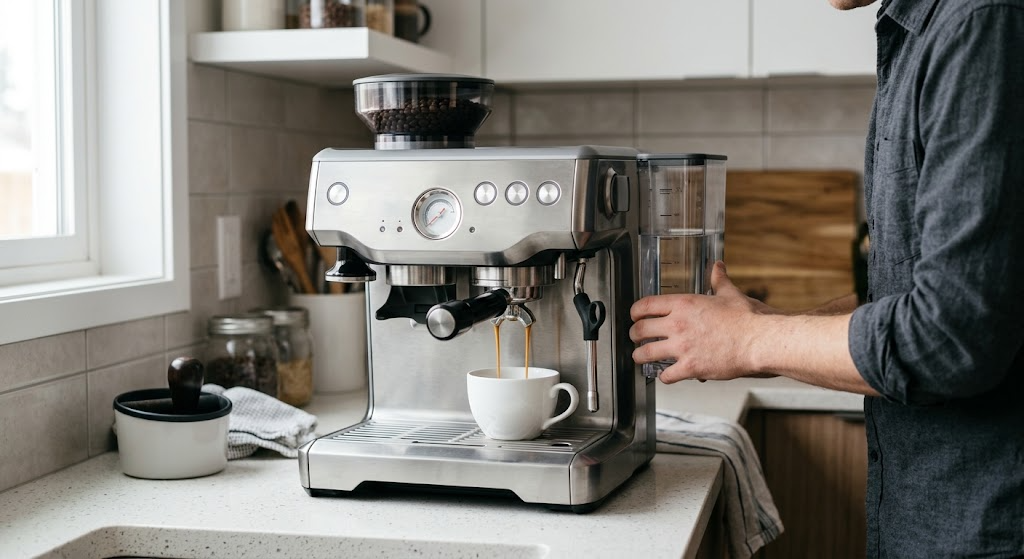
A DeLonghi coffee maker can make different sounds during grinding, pumping, rinsing, steaming, and heating, so identify when the noise starts before treating it as a failure. A brief pump hum or vibration during water delivery may be normal, but first make sure the machine is on a stable surface, the water tank is full and seated so its valve opens, and the filter, brew outlet, or coffee path is not blocked. For a bean-to-cup model, a sudden loud grinder, tapping, or buzzing sound with little or no coffee can indicate a foreign object, oily or stuck beans, a clogged funnel, or a grind/flow restriction; turn the machine off and unplug it, and do not reach into the burrs. Follow the exact model's user cleaning and descaling procedure with the specified DeLonghi descaler rather than vinegar. Stop for grinding that is scraping or jammed, a pump that screams with no water flow, steam or hot-water leakage, burning odor, arcing, a hot cord, or a noise that continues outside a normal cycle. Internal grinder, pump, boiler/heater, sensor, control, and electrical work belongs to qualified service.
Before you begin
Safety first
- The user may let hot parts cool, identify the operating cycle, stabilize the machine, fill and reseat a removable water tank, clean documented removable parts, inspect a visible hopper/funnel without entering the burrs, and run the exact model's approved descaling procedure. Pump, grinder drive/burr, heater/boiler, valve, sensor, brew mechanism, control, wiring, pressurized circuit, and live electrical work are for qualified service personnel.
Work through in order
Diagnostic checks
Use only checks that match the exact appliance or system and its official guide.
-
Check 1
Stop the current drink or steam cycle and let the group head, steam wand, hot-water outlet, and any spilled liquid cool. From a dry position, note whether the sound is accompanied by steam, hot water, a leak, smoke, a burning odor, a hot cord or plug, arcing, or a tripped protection device.
Expected result: Hot liquid or steam is escaping unexpectedly, water has reached an electrical area, the cord or plug is hot or damaged, smoke/odor/arcing is present, or the noise occurs only during a contained normal cycle.
Next step: For a hazard, stop using the machine and isolate power only from a dry, safely reachable point; arrange qualified appliance or electrical service. Otherwise place a suitable container under an outlet and continue only with cool, user-accessible checks from the exact manual.
Stop if: Do not touch hot water, steam, wet electrical parts, a damaged cord, or a machine that is smoking, arcing, or repeatedly tripping protection.
Why this matters
Why: Burn, shock, and fire risk overrides noise diagnosis. A contained cycle sound without a hazard can be classified by operation after the appliance cools.
-
Check 2
Identify whether the noise starts during grinder operation, pump/brew or rinse, hot-water or steam delivery, or when the machine is idle. With the machine off, place it on the stable, level surface specified by the manual and check that removable cups, drip tray, portafilter, and nearby items are not rattling against it.
Expected result: The noise is brief and tied to grinding, water delivery, or steam; vibration changes when the surface or removable tray is stabilized; or a new noise continues while idle.
Next step: Record the operation, duration, and whether coffee or water was delivered. Correct only an obvious loose tray or unstable placement. If the sound is idle, worsening, or accompanied by a hazard, keep the appliance off and arrange service.
Stop if: Do not shake the appliance, hold moving parts, or remove covers to locate an idle electrical or mechanical sound.
Why this matters
Why: Cycle-linked sound can come from the operating grinder, pump, or steam path; a change with the surface or loose accessory points to vibration transfer. Idle rattling, scraping, or electrical humming is not explained by a normal drink cycle.
-
Check 3
After the machine is cool and off, check the water level and reseat the removable tank exactly as the manual shows so its bottom valve can open. Inspect only the visible tank connection for a displaced tank or obvious air condition, and clean the user-accessible filter, spout, or outlet only where the model manual permits; do not open the pump or boiler.
Expected result: The tank is empty or not fully seated, the pump is loud while little or no water flows, the filter/outlet or coffee path is visibly restricted, or water flows normally with only the expected brief pump sound.
Next step: Fill and reseat the tank, clear only an accessible restriction, and use the exact model's priming or rinse instructions if provided. If the pump remains loud with correct water and no flow, stop and arrange service rather than repeatedly running it dry.
Stop if: Do not run the machine without the tank or water, remove the pump/boiler, force a valve, or work near hot water or an energized circuit.
Why this matters
Why: An empty tank, closed tank valve, air at the connector, or a restricted outlet can make a pump work noisily without proving that the pump itself has failed. Normal flow with a stable brief sound makes a pump fault less likely.
-
Check 4
For a bean model, turn the machine off and unplug it before inspecting the top of the bean hopper and the visible funnel. Look for an empty hopper, oily or coated beans, a visible foreign object, a clogged funnel, or an upper-burr part that is not seated as the exact manual shows; keep fingers, cloth, and tools out of the burrs.
Expected result: The grinder is loud but produces no grounds, tapping occurs with a visible object or clogged funnel, beans are oily/coated or absent, the electronic grinder is involved, or the grinder is quiet and delivers grounds normally.
Next step: Follow the exact model manual for safe hopper emptying and cleaning. Remove only an object that is plainly accessible without force and only if the manual permits it; otherwise leave the hopper empty, do not restart repeatedly, and arrange service.
Stop if: Do not reach between burrs, use a metal tool, force a jammed object, remove the burr carrier, or adjust the grinder while it is off unless the exact manual explicitly directs that user procedure.
Why this matters
Why: A foreign object, bean condition, or accessible funnel restriction is more likely when the noise is sudden and grinding stops. Electronic-grinder models and anything requiring burr removal are service-level; a normal dose with no abnormal noise shifts attention to the pump or another cycle.
-
Check 5
Check the exact manual or display for a descaling or cleaning request, then inspect only removable filters, brew outlets, steam-wand openings, drip tray, and grounds container for scale or residue after cooling. If descaling is called for, use the model-approved DeLonghi descaler and complete the full rinse procedure; do not use vinegar or scrape internal passages.
Expected result: A descaling indicator is active, water delivery is restricted, a removable outlet is clogged, residue is present, or the maintenance path is clear and the abnormal noise remains.
Next step: Complete only the exact model's user descaling/cleaning cycle and rinse it fully, allowing hot parts to cool between steps. If the noise continues or the machine cannot complete the cycle, stop and arrange service.
Stop if: Do not mix chemicals, substitute vinegar, bypass a cleaning alarm, open the boiler, or insert metal objects into internal passages.
Why this matters
Why: Scale or residue can restrict water flow and make a pump work harder, while a clear user-accessible path with persistent noise shifts concern toward an internal pump, heater, valve, control, or electrical fault.
-
Check 6
If the noise remains after safe external checks, record the exact model, whether it is manual espresso, automatic, or a combination machine, the cycle that triggers it, whether water/coffee flows, any display lights or alarm, and whether the sound is humming, rattling, tapping, scraping, or buzzing. Keep the machine unplugged if the sound is hazardous or occurs outside a normal cycle.
Expected result: The machine delivers normally with a brief expected cycle sound, the pump is loud with no flow, the grinder is jammed or scraping, an alarm returns, the heater/steam path is abnormal, or the noise is electrical or idle.
Next step: Monitor only a normal, brief sound with normal delivery. For persistent, worsening, hazardous, or no-flow noise, arrange qualified DeLonghi service and provide the model and recorded observations instead of opening the machine or repeating a test cycle.
Stop if: Do not operate with burning odor, exposed wiring, leaking hot water, abnormal electrical noise, a jammed grinder, or a pump that repeatedly runs without water.
Why this matters
Why: Delivery and timing separate a normal operating sound from a restriction; however, these observations cannot safely distinguish a failed pump, grinder drive, heater, valve, sensor, control, or wiring assembly.
Use your observations
Decision map
Find the observation that best matches what you see, then follow the next safe action.
-
PATH 01Safety boundary
What you see
The sound occurs only briefly during the documented grind, brew, rinse, hot-water, or steam cycle, the machine is stable, and coffee or water is delivered normally without leakage or alarm.
Do this next
Keep the machine on a stable surface, maintain the removable parts, and monitor for a change in duration, pitch, delivery, or safety symptoms. Use the exact model manual for expected cycle behavior.
Why this path and its safety boundary
Why it matters: The sound is consistent with an operating pump, grinder, or steam path rather than an established failure.
Safety stop: Stop if a normal-cycle sound becomes scraping, metallic, electrical, continuous, or is joined by heat, odor, leak, or no flow.
-
PATH 02Safety boundary
What you see
The pump is loud or vibrating and the tank is empty/not seated, air is suspected at the connector, or the filter, outlet, or coffee path is restricted while water flow is weak or absent.
Do this next
Fill and correctly seat the tank, clean only user-accessible parts, and follow the exact model's rinse or priming procedure. Arrange service if loud no-flow operation persists or the machine cannot prime without opening it.
Why this path and its safety boundary
Why it matters: The pump may be working against an empty intake or restricted path; this pattern does not establish a failed pump.
Safety stop: Do not continue running a dry pump, remove the boiler, force a valve, or perform a live pump test.
-
PATH 03Safety boundary
What you see
A sudden loud tapping, buzzing, or grinding sound comes from the bean hopper, little or no ground coffee is produced, and an object, clogged funnel, oily/coated beans, or mis-seated accessible burr part is suspected.
Do this next
Switch off and unplug, then follow the exact model's limited hopper/funnel procedure. If the object is not plainly removable without force, the model has an electronic grinder, or burr access is required, leave it for qualified service.
Why this path and its safety boundary
Why it matters: A grinder-path obstruction or bean condition is more likely than a pump issue; a hard-to-remove object can damage the burr drive.
Safety stop: Do not put hands or tools into the burrs, force the object, or restart repeatedly to make the grinder clear.
-
PATH 04Safety boundary
What you see
A descaling or cleaning indicator is active, the removable filter/outlet is scaled or clogged, and the noise is associated with slow or restricted water delivery.
Do this next
Run the exact model's approved descaling and rinse procedure with DeLonghi descaler, then reassess only after the machine cools and completes the cycle normally. Use service if the noise or no-flow condition remains.
Why this path and its safety boundary
Why it matters: Scale or residue can restrict the circuit and increase pump effort; maintenance is a supported first response, not proof that the pump or heater needs replacement.
Safety stop: Do not substitute vinegar, mix descalers, scrape internal passages, or open the boiler/heating circuit.
-
PATH 05Safety boundary
What you see
The tank, accessible path, hopper, settings, surface, and documented maintenance are correct, but the noise is persistent, worsening, idle, scraping, electrical, accompanied by no flow, or joined by heat, leak, alarm, or odor.
Do this next
Stop using the machine when a hazard or no-flow condition is present and arrange qualified DeLonghi service. Give the technician the exact model, operation, sound pattern, delivery result, maintenance history, and alarm details.
Why this path and its safety boundary
Why it matters: An internal pump, grinder drive, heater/boiler, valve, sensor, control, wiring, or other mechanical/electrical fault is possible; the sound alone cannot select a safe part.
Safety stop: Do not open the housing, remove the pump or grinder, work on the heater or boiler, bypass a sensor, or probe energized wiring.
Helpful context
Understand the symptom
Classify the sound by the operation that triggers it
A grinder sound occurs while beans are being dosed or ground; a pump sound occurs during brewing, rinsing, or hot-water delivery; steam can hiss or pulse while the steam circuit is active; and a heater may be quiet while raising the water temperature. A brief sound tied to one normal cycle is less concerning than a new scraping, rattling, electrical buzz, or noise that continues after the machine stops. Exact sound behavior varies across manual espresso, automatic, and combination models.
Start with water and coffee-path restrictions
DeLonghi manuals connect excessive pump noise with an empty or poorly seated tank, air at the tank connector, a blocked filter or outlet, and a restricted coffee path. Let hot parts cool, fill the tank with fresh water, reseat it as the exact manual shows, and clean only removable user-accessible pieces. Do not remove a pump cover, boiler, brew mechanism, or energized panel to find the restriction.
Treat grinder noise differently from pump vibration
A sudden loud tapping or grinding sound from the bean hopper, especially when no grounds are produced, can indicate a foreign object or a blocked funnel. DeLonghi permits limited accessible checks for some models after unplugging, but electronic-grinder models and any object that is not easy to remove belong with a service center. Never put fingers or tools between burrs, and do not change grind settings casually because the timing is model-specific.
Safety boundary
Stop conditions
- Stop immediately for smoke, burning odor, arcing, a hot or damaged cord/plug, repeated electrical trips, exposed wiring, or water reaching an electrical area; isolate power only from a dry, safely reachable point and arrange qualified service.
- Stop for uncontrolled hot water or steam, a leaking boiler or hose, or any part that is too hot to approach safely. Let it cool; do not open the housing or pressurised circuit.
- Do not put fingers or tools into grinder burrs, force a foreign object, remove the grinder drive, or test an electronic grinder outside the exact user manual.
- Do not remove the pump, boiler/heater, valve, sensor, brew mechanism, control board, or wiring, and do not perform a live electrical test.
- Do not keep running a loud pump without water flow, repeatedly restart a jammed grinder, substitute vinegar for the specified descaler, or scrape internal scale with metal tools.
Only after diagnosis
Potential parts
- water tank valve or tank seal
Consider this category only if the exact model's tank is correctly filled and seated but qualified diagnosis finds a damaged valve or seal causing air intake, leakage, or pump noise.
Tank shapes, bottom valves, and seals vary by DeLonghi model; confirm the exact model and approved fit information. - filter, brew outlet, or screen
Consider this category only when a user-accessible part remains damaged or restricted after the exact manual's cleaning procedure and qualified diagnosis confirms it is the cause of flow noise.
Manual espresso filters and automatic brew components are not interchangeable; verify model-specific compatibility before ordering. - coffee grinder burr or grinder assembly
Consider this category only when qualified service confirms a foreign-object impact, worn burr, or grinder-drive fault after bean and accessible-funnel causes are ruled out.
Electronic and user-accessible grinder designs differ; do not order or remove burr hardware from a noise symptom alone. - pump or pump-related valve
Consider this category only after the tank, air intake, filter/outlet, coffee path, and approved descaling checks are complete and qualified diagnosis confirms an internal pump or valve fault.
Pump pressure, connectors, and valve arrangements vary by model; internal replacement requires qualified service. - heater, boiler, sensor, or control assembly
Consider this category only when qualified service identifies an internal heating, temperature-sensing, or control fault after safe flow and maintenance checks.
These are model-specific electrical or pressurized assemblies; do not select a part from noise, temperature, or alarm symptoms alone.
When checks do not resolve it
Need a professional?
Arrange qualified DeLonghi service when noise persists after the exact model's safe tank, surface, accessible filter/outlet, hopper, and maintenance checks; when the pump is loud with no flow; when the grinder is jammed, scraping, or needs burr access; when an electronic grinder is involved; or when the sound is idle, electrical, worsening, or accompanied by a leak, alarm, heat, or odor. Internal pump, grinder, heater/boiler, valve, sensor, control, and wiring diagnosis are not user-level repairs.
Safety scope: The user may let hot parts cool, identify the operating cycle, stabilize the machine, fill and reseat a removable water tank, clean documented removable parts, inspect a visible hopper/funnel without entering the burrs, and run the exact model's approved descaling procedure. Pump, grinder drive/burr, heater/boiler, valve, sensor, brew mechanism, control, wiring, pressurized circuit, and live electrical work are for qualified service personnel.
Common questions
FAQ
Is some noise normal on a DeLonghi coffee maker?
A brief sound tied to grinding, pumping, rinsing, hot-water delivery, or steaming can be part of normal operation, and DeLonghi says some pump vibration is normal. A new idle, scraping, metallic, electrical, or continuous noise is not something to ignore, especially if delivery changes.
Why is the pump on my DeLonghi coffee maker so loud?
Check the stable surface, water level, tank seating, and user-accessible filter or outlet. DeLonghi manuals also identify air at the tank connector, restricted coffee paths, and limescale as possible causes. If it remains loud with correct water and no flow, stop running it and arrange service.
What causes a loud tapping or grinding sound from the DeLonghi grinder?
A foreign object, clogged funnel, oily or coated beans, or an upper-burr issue can cause a sudden loud grinder sound or no grounds. Turn the machine off and unplug it; inspect only the limited accessible area allowed by the exact manual, and use service if the object is stuck or burr access is required.
Can scale or a dirty filter make a DeLonghi coffee maker noisy?
Yes. A restricted filter, outlet, or water circuit can reduce flow and make the pump work harder. Clean removable parts and run the exact model's descaling cycle with the specified DeLonghi descaler; do not use vinegar or scrape internal passages.
When should I stop using a noisy DeLonghi coffee maker?
Stop for burning odor, smoke, arcing, a hot or damaged cord, repeated electrical trips, uncontrolled hot water or steam, a leak, a jammed or scraping grinder, or a pump that runs loudly without water. Let hot parts cool and arrange qualified service; do not open the machine.
Read the exact guide
Official sources
- Important SafeguardsDeLonghi · Model-specific manual evidence for tank/valve/air-bubble causes of excessive pump noise, blocked filter/outlet, limescale, cooling hot parts, cleaning, descaling, and service escalation.
- Why is the grinder of my La Specialista making a loud tapping noise?DeLonghi US · Model-family-specific evidence for bean hopper, funnel, and upper-burr cleanliness; not universal grinder disassembly or fitment guidance.
- The pump is excessively noisyDe'Longhi Coffee Machines Help Center · Model-specific official guidance to check a flat, stable surface for excessive pump noise; not a universal pump-repair instruction.
- Common Issues - Fully Automatic Coffee Machine FAQDeLonghi US · Official maintenance guidance for bean, grinder, descaling, rinsing, removable accessory, and brewing-unit practices; exact machine manual controls access.
- Issues with the Coffee Grinder in My De'Longhi Coffee MachineDeLonghi US · Direct brand guidance for a noisy grinder, foreign-object possibility, unplugging, limited accessible checks, and electronic-grinder service boundary.
- My pump espresso machine is vibrating a lot. What can I do to rectify this?DeLonghi US · Official guidance that some vibration is normal and that intact feet and first-use air-block symptoms are relevant; exact model procedure controls.
- De'Longhi Customer ServiceDeLonghi US · Brand support context for collecting product/model details and using manuals or authorized service when a safe self-check does not resolve the problem.
Community feedback
Share a repair observation
Share a plain-text repair observation. Accepted observations are published automatically; this page may take a moment to update.