
On this page
Start here
Quick answer
First identify which De'Longhi cycle stopped: a beverage brew, a short automatic rinse, a guided cleaning/descaling programme, or a manual-machine priming step. Do not force a locked part, bypass a sensor, or repeatedly restart a hot or interrupted programme. With the machine cool enough to handle and unplugged when the manual calls for it, check the water level and tank seating, empty the drip tray or grounds container when the display asks, and clear only removable coffee or milk parts that the exact model manual identifies as user-cleanable. De'Longhi's official guidance links incomplete or slow delivery to an empty or mis-seated tank, air in the water circuit, blocked filters/outlets, or limescale; its descaling guides require the complete model-specific sequence of descaler, pauses/rinses, and fresh-water rinses. A descale or cleaning cycle may legitimately pause while waiting for a tank, tray, dial, spout, or confirmation, and different machine families use different controls. Stop for a leak, steam or hot-liquid exposure, electrical smell, damaged cord, repeated failure, or a cycle that will not progress after the manual's external checks. Do not open the housing, test energized parts, dismantle the pump/valves/heater, or substitute vinegar or an unapproved chemical for the specified descaler.
Before you begin
Safety first
- The user may identify the cycle, follow the exact manual's external prompts, refill and reseat the tank or containers, and clean only permitted removable parts after cooling. Internal pump, valve, heater/thermoblock, boiler, sensor, wiring, control, pressure, and energized testing are for qualified personnel.
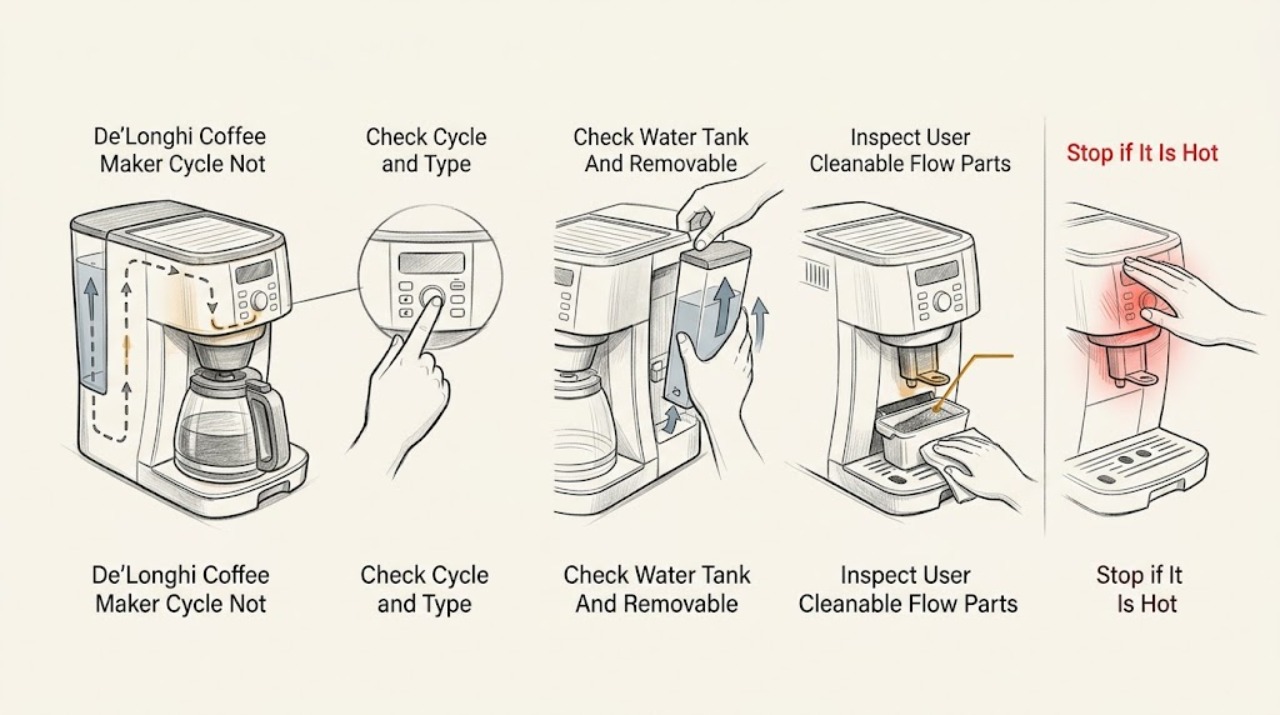
Work through in order
Diagnostic checks
Use only checks that match the exact appliance or system and its official guide.
-
Check 1
Before pressing another control, identify whether the machine stopped during a beverage brew, startup/shutdown rinse, cleaning programme, descaling programme, or manual-pump priming. Record the exact message, light pattern, selected drink, whether water or coffee was flowing, and whether the machine is waiting for a tank, tray, dial, spout, or confirmation.
Expected result: The display explicitly names a maintenance stage or water-circuit step; the machine is waiting for a user prompt; or it stopped during an ordinary drink with no prompt.
Next step: Follow the exact model manual for the named stage. If there is no prompt or the state is unclear, stop the cycle and continue with the cool, external checks below rather than trying random button combinations.
Stop if: Do not force a locked brew unit, tray, tank, portafilter, or service door, and do not bypass a sensor or interlock to make the cycle advance.
Why this matters
Why: A prompt or guided stage can be normal sequencing rather than a failed motor. An ordinary brew that stops without a prompt points first toward water supply, flow restriction, an incorrectly seated removable part, or a model-specific fault. The identity still does not prove which component failed.
-
Check 2
When the machine is safe to handle and the relevant manual permits it, check that the water tank contains fresh water and is fully seated. Empty and refit the drip tray and grounds container if the display requests it, and refit only removable spouts, milk parts, filters, or the hot-water outlet that the exact model identifies. Wipe spills and keep electrical areas dry.
Expected result: The tank was low or mis-seated, a float or tank sensor is obstructed, or a tray/grounds container/spout was not fully inserted; alternatively, all visible removable parts are correctly fitted.
Next step: Correct the external seating or fill condition once, then resume only the model's documented step. If the cycle stops again, record the message and stop; do not repeatedly pull and push parts or run the pump dry.
Stop if: Do not probe a tank valve, float, connector, or sensor, and do not continue if water has entered the base, the cord/plug is wet, or a leak cannot be contained safely.
Why this matters
Why: De'Longhi support identifies insufficient water, an incorrectly inserted tank, and the need to empty the tray/grounds container as causes of a water-circuit or interrupted-drink state. If these parts are correctly seated and the cycle still stops, a hidden flow, sensor, or internal fault becomes more plausible.
-
Check 3
After cooling and following the exact manual, remove and rinse only the user-removable filter basket/holder, coffee spouts, hot-water outlet, milk-frother nozzle, or brewing unit that your model permits. Look for compacted grounds, milk residue, or visible scale; do not insert tools into hidden passages or dismantle the machine.
Expected result: A removable outlet or filter is visibly blocked or dirty, or the accessible parts are clean but delivery remains absent, very slow, or intermittent.
Next step: Reassemble the cleaned parts exactly and make one controlled attempt using the model's documented beverage or rinse step. If a manual pump machine has been idle or newly installed, use its manual priming instruction only if the model manual calls for it; otherwise arrange service.
Stop if: Do not force a blockage, run a pump indefinitely, open the housing, or perform a live flow/voltage test. Stop if steam, scalding water, electrical odor, or leaking from the housing appears.
Why this matters
Why: De'Longhi manuals and support pages associate no delivery or slow delivery with blocked filters/outlets, dirty frother parts, limescale, or a water circuit that has not been primed. Cleanable blockage is plausible only for the accessible part; clean parts do not rule out a pump, valve, heater, sensor, or control problem.
-
Check 4
If the stopped cycle is cleaning or descaling, locate the exact model manual or official support guide before restarting. Confirm the required descaler, tank level, water filter handling, drip-tray/grounds-container state, spout position, collection-container capacity, and the number of fresh-water rinses. Keep the machine attended and allow hot liquid to cool before moving containers.
Expected result: The cycle stopped while waiting for a prompt or refill; a power interruption occurred; the tank was not filled as required for the final rinse; or the model instructions are unknown.
Next step: For a safe, model-matched interruption, resume or repeat the complete procedure exactly as the manual directs, using only the specified product. If the programme will not accept the prompt, repeatedly aborts, or the model sequence cannot be verified, leave the machine off and contact De'Longhi support or an authorized service route.
Stop if: Do not substitute vinegar or an unapproved chemical, skip a rinse, mix chemicals, touch hot acidic liquid, or force a control, tray, tank, or valve to override a maintenance stage.
Why this matters
Why: Official De'Longhi guides show that maintenance programmes differ by model and that pauses, automatic rinses, fresh-water refills, and final confirmation are part of completion. An interrupted or incomplete descale may require repeating the documented procedure, while an unknown sequence should not be guessed.
-
Check 5
After the applicable external checks, decide whether the cycle still fails in the same way. Provide service with the full model, exact stage, message/light pattern, water output, recent descaling or cleaning history, any leak or overheating, and whether the unit was new or unused for a long time.
Expected result: The cycle completes after a documented external correction; it fails again with the same model-specific prompt; the machine has no flow or only a pump hum; or it leaks, overheats, smells electrical, or behaves erratically.
Next step: Keep the machine switched off and unplugged when safe, protect against remaining hot water, and contact De'Longhi support or a qualified coffee-machine technician. Do not order an internal part until the exact model and diagnosis are confirmed.
Stop if: Do not remove covers, bypass thermal or tank sensors, test energized circuits, open a boiler or pump, or continue operating after smoke, burning odor, electrical damage, uncontrolled leak, or scalding discharge.
Why this matters
Why: A repeat failure or hazard cannot be safely reduced to a replaceable part from symptoms alone. Pump, valve, heater/thermoblock, sensor, wiring, control, or internal water-path diagnosis may be required; lack of flow after priming or descaling does not identify the failed component.
Use your observations
Decision map
Find the observation that best matches what you see, then follow the next safe action.
-
PATH 01Safety boundary
What you see
The screen or lights show clean/descale/rinse, ask for water or an empty tray/container, or wait for a dial, spout, or confirmation.
Do this next
Use the exact model guide, satisfy only the displayed prompt, and complete every required rinse. If the sequence rejects the correct prompt or repeatedly stops, call service.
Why this path and its safety boundary
Why it matters: The machine may be paused at a required maintenance stage rather than mechanically failed; De'Longhi's guides use model-specific prompts and automatic rinses.
Safety stop: Do not skip a rinse, force the stage, or expose yourself to hot acidic descaler.
-
PATH 02Safety boundary
What you see
The tank is below the required level, not fully inserted, or a tray/grounds container/removable spout is not seated.
Do this next
Refill and reseat the named part once according to the manual, then perform the documented continuation. If it stops again, keep the appliance off and escalate.
Why this path and its safety boundary
Why it matters: An external water-supply or position condition is more likely than an immediately proven internal failure.
Safety stop: Do not hold down a tank, defeat a float, or run the pump dry.
-
PATH 03Safety boundary
What you see
Water or coffee is absent, only drips, or the pump is noisy, and an accessible filter, spout, frother, or brewing unit is visibly dirty.
Do this next
Clean only the permitted removable part and, for an applicable manual pump model, follow its priming instruction. Stop if delivery does not normalize after the documented attempt.
Why this path and its safety boundary
Why it matters: A user-cleanable restriction, air after long storage, or scale is plausible; the symptom alone cannot distinguish those from an internal pump or valve fault.
Safety stop: Do not insert tools into hidden passages, dismantle the pump, or keep the machine running without water.
-
PATH 04Safety boundary
What you see
A selected drink stops partway through with no maintenance message, or the ready state never returns after the external checks.
Do this next
Stop repeated attempts, capture the exact model and display state, and arrange qualified diagnosis. Keep the appliance off if it is hot, leaking, or electrically abnormal.
Why this path and its safety boundary
Why it matters: Flow restriction, water sensing, pump/valve, heater, or control trouble is possible; the cycle label alone does not identify the part.
Safety stop: Do not open the housing, bypass a tank or temperature interlock, or perform energized measurements.
-
PATH 05Safety boundary
What you see
There is uncontrolled hot water or steam, a leak into the base, smoke, an electrical smell, damaged cord, repeated tripping, or abnormal overheating.
Do this next
Stop using the machine, keep clear of hot liquid, disconnect from a safe dry position if possible, and contact qualified service. Do not attempt to reproduce the event.
Why this path and its safety boundary
Why it matters: Safety risk takes priority over completing the drink or maintenance cycle; further operation could worsen a thermal, electrical, or pressure-related fault.
Safety stop: Do not touch wet electrical parts, remove covers, or reset and retry a hazardous machine.
Helpful context
Understand the symptom
Name the cycle before troubleshooting it
A beverage brew normally ends when the selected drink finishes and the machine returns to its ready state. A startup or shutdown rinse is a separate short water operation. A cleaning or descaling programme is usually announced by a light, message, or guided menu and can include pauses, empty-container prompts, tank refills, and more than one rinse. On a manual pump machine, a first-use or long-idle priming step may be the real issue. Photograph the display or indicator and note what was flowing, what stopped, and whether the machine is still asking for an action; do not infer that every blinking light means the same fault across De'Longhi families.
Use only the low-risk checks that match the cycle
For a brew or water-circuit stop, check fresh water, tank seating, removable drip-tray and grounds-container position, and the user-accessible filter, spout, or milk component named by the exact manual. De'Longhi's support pages also describe air in a pump circuit after new installation or a long period unused, but the priming instructions are for the applicable manual pump design. For a descale or clean programme, follow the exact on-screen or manual sequence: use the specified De'Longhi descaler where required, provide the stated containers, wait for prompts, and complete every fresh-water rinse. Do not press random buttons to skip a stage.
A stopped cycle is not permission to reach inside
Water-path restrictions and scale can often be addressed with the removable cleaning steps in the model manual, but a pump, valve, thermoblock or boiler, heater, sensor, wiring, or control fault requires service diagnosis. De'Longhi's official guidance says unsuitable descaler or incorrect descaling can cause faults, and its descaling guide warns that hot acidic liquid exits the spouts. Let hot liquid and steam cool, keep hands away from outlets, and stop rather than forcing a component or bypassing a tank, tray, door, or temperature interlock.
Safety boundary
Stop conditions
- Do not force a tank, drip tray, grounds container, brew unit, portafilter, spout, or service door, and do not bypass a sensor or interlock.
- Stop for uncontrolled hot water or steam, a leak into the base, scalding risk, smoke, electrical odor, damaged cord, repeated overheating, or abnormal noise with no water flow.
- Do not open the housing, perform live-voltage or continuity tests, or dismantle the pump, valve, heater/thermoblock, boiler, wiring, or control board.
- Do not substitute vinegar or an unapproved chemical for the model-specified descaler, mix cleaning chemicals, skip required rinses, or touch hot acidic descaler.
- Do not keep restarting a cycle that fails after its documented external checks; keep the machine off and arrange qualified service instead.
When checks do not resolve it
Need a professional?
Contact De'Longhi support or a qualified coffee-machine technician when the exact cycle cannot be identified, a brew or maintenance cycle stops again after the model's tank/container and removable-part checks, the machine has no flow after an applicable documented prime or descale, a prompt will not clear, or there is any leak, scalding discharge, electrical odor, damaged cord, smoke, overheating, or erratic control. Provide the full model, message or light pattern, cycle stage, water output, and recent maintenance history.
Safety scope: The user may identify the cycle, follow the exact manual's external prompts, refill and reseat the tank or containers, and clean only permitted removable parts after cooling. Internal pump, valve, heater/thermoblock, boiler, sensor, wiring, control, pressure, and energized testing are for qualified personnel.
Common questions
FAQ
How do I know whether my De'Longhi is stuck in brew, rinse, cleaning, or descaling?
Use the display/light pattern and what was flowing. A selected drink with coffee output is a brew; a short water operation at startup or shutdown is a rinse; a light or guided message requesting descaler, containers, tank refills, or repeated rinses is maintenance. Exact prompts vary by model, so use the model manual rather than a generic button sequence.
What should I check when the cycle stops and says the water circuit is empty?
Check that the tank has fresh water and is fully inserted, then follow the exact displayed confirmation or hot-water step for that model. If the message returns after the documented external step, stop rather than repeatedly running the pump; air, scale, a sensor, valve, or another internal fault may require service.
Can I restart a De'Longhi descaling cycle that did not finish?
Only follow the exact model guide. De'Longhi's Eletta Explore guidance says an incompletely completed descale, such as after a power failure, should be repeated, while other models use different prompts and routes. Use the specified descaler and complete the fresh-water rinses; do not improvise or skip stages.
Is vinegar a safe substitute if the cleaning or descale cycle will not complete?
Do not substitute vinegar or an unapproved chemical. De'Longhi's official maintenance guidance recommends its specified descaler and warns that unsuitable descaler or incorrect descaling can cause faults; use the exact manual and contact service when the documented cycle will not progress.
When should I stop troubleshooting and call for service?
Call when the same cycle fails after the model's tank, tray, and permitted removable-part checks, a prompt will not clear, flow remains absent after an applicable documented prime or descale, or there is a leak, steam/hot-liquid hazard, electrical smell, damaged cord, smoke, overheating, or erratic control. Internal pumps, valves, heaters, sensors, wiring, and controls are not user-level reset targets.
Read the exact guide
Official sources
- How do I descale my La Specialista Opera manual espresso machine?De'Longhi US · La Specialista Opera model; used to demonstrate manual-pump model variation, not as a universal control sequence.
- Common Issues - Fully Automatic Coffee MachineDe'Longhi US · General maintenance and symptom guidance for De'Longhi fully automatic machines; exact controls and removable parts remain model-specific.
- Message: WATER CIRCUIT EMPTY PRESS OK TO STARTDe'Longhi Coffee Machines Help Center · Dinamica Plus message and model family; used here only to illustrate that a model may require fresh water and correct tank insertion.
- Magnifica S: Descaling and CleaningDe'Longhi US · Magnifica S ECAM 22.110; demonstrates that the route can differ depending on whether the model descales through the diffuser or steam nozzle.
- Guide: Descaling | Eletta ExploreDe'Longhi Coffee Machines Help Center · Eletta Explore guided descale sequence; timing and prompts must not be generalized to other models.
- Message: Fill the tank with fresh water. Please empty drip tray and grounds containerDe'Longhi Coffee Machines Help Center · Eletta Explore prompt; not a universal display sequence for every De'Longhi model.
- De'Longhi Coffee Machines Help CenterDe'Longhi · Support routing; the exact model and market determine available articles and service options.
- Why my Espresso pump machine does not prime?De'Longhi Australia · Manual pump machines that match the described prime procedure; not a general instruction for fully automatic or drip models.
- EC885 Coffee Machine Instruction ManualDe'Longhi · EC885 manual espresso machine only; used for model-specific examples of blocked filters/outlets, limescale, and all-lights service boundary.
Community feedback
Share a repair observation
Share a plain-text repair observation. Accepted observations are published automatically; this page may take a moment to update.