
On this page
Start here
Quick answer
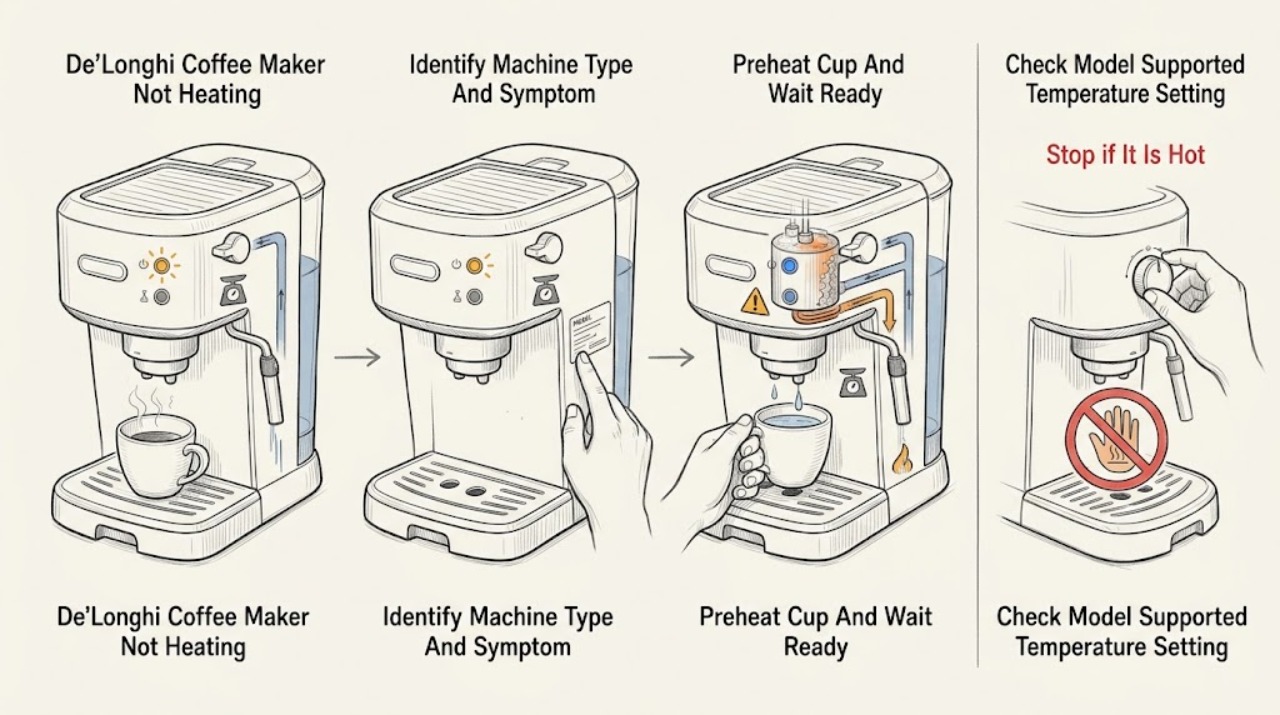
First separate a drink that cools quickly from a machine that produces no heat. De'Longhi coffee makers use different designs: a drip model may become less hot as scale restricts brewing, while pump and automatic models may need the machine's warm-up or rinse cycle, a ready/OK indication, a higher model-supported temperature setting, or a preheated cup. Check the exact model before using any button sequence. Warm the cup with hot water without touching the hot stream, wait for the machine's ready indication, and run the model's stated rinse or descale program when its guidance calls for it. If hot water or coffee remains cold after the correct warm-up and model-approved maintenance, the machine will not reach ready, trips protection, smells hot, leaks, or has damaged wiring, switch it off, unplug it only from a dry safe position, and arrange qualified De'Longhi service. Do not open the case, bypass a thermostat or safety control, or test a heater, thermoblock, boiler, pump, or wiring while energized.
Before you begin
Safety first
- The user may identify the model, preheat a cup, wait for the documented ready indication, operate a documented rinse/hot-water function cautiously, inspect cool removable parts, and run only the exact manual's maintenance cycle. Qualified personnel must handle the case, heating element, thermoblock/boiler, thermostat or sensor, pump/valves, control board, wiring, live testing, and any internal leak or electrical repair.
Work through in order
Diagnostic checks
Use only checks that match the exact appliance or system and its official guide.
-
Check 1
Record the full De'Longhi model number and classify the machine as a drip coffee maker, manual/pump espresso machine, or automatic bean-to-cup machine. Describe the symptom precisely: no power, no brewing, cold coffee, coffee that cools quickly, or hot water/steam that is also cold. Note whether a ready/OK light or display ever indicates that heating is complete.
Expected result: The machine is a drip model, pump model, or automatic model; the machine has no power, has power but never reaches ready, brews but the cup is cool, or produces no flow.
Next step: Follow the matching branch. Use only controls named for the recorded model, and do not substitute an automatic-machine rinse or temperature setting for a drip or manual pump procedure.
Stop if: Do not remove covers, guess at an error-light meaning, or continue operating a machine with smoke, burning odor, damaged cord, water in the electrical area, repeated trips, or a casing that is hot in an abnormal way.
Why this matters
Why: The same words can point to different checks. Drip support emphasizes descaling for coffee that became less hot, while automatic guidance uses an internal rinse and model-specific temperature controls; no power or failure to reach ready is a stronger service signal than a cool cup alone.
-
Check 2
For a pump or automatic model, put the cup under the correct outlet, run only the documented rinse or hot-water cycle, and wait for the model's ready/OK indication before brewing. Warm the cup with hot water or the machine's cup warmer where provided. Keep your hands away from the hot stream, spout, and escaping steam; never leave hot-water delivery unattended.
Expected result: The cup and rinse water become warm, the ready/OK indication appears, the cup remains cold, the machine never reaches ready, or hot water/steam is absent or unexpectedly cold.
Next step: If warming changes the result, preheat before the next drink. If the result does not change, continue only with the model's accessible temperature and maintenance checks; arrange service when the ready state or hot-water output is absent.
Stop if: Stop hot-water or steam delivery for splashing, uncontrolled flow, a damaged spout, or a burn risk. Do not touch the spout, open the boiler, or test a heater or pump while energized.
Why this matters
Why: A cold cup or an internal circuit that cooled between drinks can explain a low drink temperature. If the machine never reaches ready or its hot-water function is also cold after the prescribed warm-up, the symptom is less consistent with cup heat loss and more consistent with a heating, temperature-control, water-path, or electrical fault; this observation does not identify the part.
-
Check 3
With the machine idle, check the exact manual or on-screen settings for a coffee-temperature option and verify that the brew mode is not a cold, low-temperature, energy-saving, or delayed mode. Change only an accessible setting explicitly supported for the model, then make one controlled drink using the normal water and coffee quantity.
Expected result: The model has a low temperature setting or an unintended mode, the setting is already appropriate, or the model has no user temperature control; the result improves or stays cold.
Next step: Leave the model-supported setting at the desired value and recheck cup preheating. If no setting exists or the drink remains cold, move to the appropriate drip/pump/automatic descaling and flow check rather than changing hidden controls.
Stop if: Do not enter service menus, bridge a thermostat, override an error, or change an internal calibration without De'Longhi service instructions for the exact model.
Why this matters
Why: Some automatic De'Longhi models let the user change the water temperature, but this is not a universal coffee-maker control. An improvement after correcting the setting makes configuration more likely; persistent cold output with a correct setting keeps scale, water flow, heating, temperature sensing, and electrical faults in view.
-
Check 4
If it is a drip De'Longhi, inspect only the removable, cool parts: use either the permanent filter or paper filter as the model directs, ensure the carafe lid and filter-holder tab can open the drip path, and look for a slow or absent brew. If the support page, display, or manual calls for descaling, run that exact program with the specified product and complete the stated clean-water rinses before brewing again.
Expected result: Coffee flow is slow or absent, both filter types were used, the carafe lid or filter-holder mechanism is not engaging, a clean/descale indication is present, or flow is normal but coffee remains cold.
Next step: Correct a removable filter or carafe placement issue and perform the exact model-approved descale when indicated. If flow remains poor, the descale cannot be completed, or normal flow still produces cold coffee, stop troubleshooting externally and arrange service.
Stop if: Unplug and cool the machine before cleaning removable parts. Do not poke into a hot outlet, pour water into the housing, dismantle the heater, or use a live electrical test.
Why this matters
Why: De'Longhi links slow or absent drip brewing to filter misuse, the carafe-lid/filter-holder mechanism, and scale. A completed model-approved descale can address a restricted water path, but normal flow with cold output does not prove that the heating element works or fails.
-
Check 5
For a pump or automatic machine, check the accessible water tank, filter if the exact model provides one, removable outlet, and drip tray after the machine has shut down and cooled. Follow the exact manual's rinse, cleaning, or descaling sequence when prompted; do not improvise a solution or use vinegar where De'Longhi's guidance prohibits it. Observe whether hot-water delivery is steady, restricted, or absent after maintenance.
Expected result: The tank or removable outlet is incorrectly seated or restricted, a descaling prompt is present, the hot-water path improves after the model's cycle, or coffee and hot water remain cold or restricted.
Next step: Complete the manual's rinse requirements and make one normal test drink. If the machine still does not heat or reach ready, preserve the exact model and indicator information and call qualified service.
Stop if: Do not force a tank valve, insert tools into a nozzle, handle descaler on hot surfaces, run an incomplete program repeatedly, or open the case to inspect a thermoblock, boiler, pump, sensor, or wiring.
Why this matters
Why: Scale or a water-path restriction can affect temperature and delivery, and De'Longhi provides different maintenance sequences by model. Improvement after the correct cycle supports a maintenance cause; persistent cold coffee and cold hot water after normal flow keep the heating assembly, temperature control, pump, or electrical supply in the professional path.
-
Check 6
After one safe correction or one fully completed, model-approved maintenance cycle, make a single normal drink and, only if the model supports it, compare the hot-water function. Record whether the machine reaches ready, whether liquid flows, whether the cup was preheated, and whether the symptom is intermittent or constant. Do not use a consumer thermometer reading alone to select a part.
Expected result: The drink is now satisfactory, only the cup was cold, the machine flows but never heats, hot water is also cold, the machine never reaches ready, or the appliance trips, leaks, smokes, or smells burned.
Next step: Keep the appliance off if it is unsafe and arrange qualified De'Longhi service. Provide the exact model, drink mode, ready/OK behavior, flow result, maintenance performed, and any trip, leak, odor, or heat event.
Stop if: Stop immediately for smoke, burning odor, damaged cord or plug, water near electrical parts, repeated breaker/GFCI trips, uncontrolled steam or hot water, a cracked housing, or abnormal case heat. Do not restart to see whether it recovers.
Why this matters
Why: A resolved symptom supports a cup, warm-up, setting, scale, or water-path contributor. Constant cold output, no ready state, or cold hot water after correct checks makes an internal heating, temperature-sensing, pump, control, or electrical fault more likely, but the observed pattern cannot identify a replacement part safely. Hazard signs override all troubleshooting.
Use your observations
Decision map
Find the observation that best matches what you see, then follow the next safe action.
-
PATH 01Safety boundary
What you see
The machine reaches its ready/OK state and produces normal flow, but a cold cup or an immediate drink after idle is cool; a documented rinse or cup preheat improves the result.
Do this next
Preheat the cup and use the exact model's rinse/warm-up routine before brewing. If the result later becomes consistently cold despite this, continue to maintenance and service checks.
Why this path and its safety boundary
Why it matters: Cup heat loss or a cooled internal circuit is more likely than a confirmed failed heater.
Safety stop: Do not leave hot-water delivery unattended or touch a heated spout/steam outlet.
-
PATH 02Safety boundary
What you see
An automatic model has a low coffee-temperature setting or unintended accessible mode, and one normal drink improves after the documented setting is corrected.
Do this next
Keep the corrected setting and preheat the cup. If the temperature falls again or the machine cannot maintain ready state, use the exact manual's maintenance path and contact service.
Why this path and its safety boundary
Why it matters: The user setting was a plausible contributor; the setting cannot be generalized to models without that menu.
Safety stop: Do not alter service-menu values, hidden calibration, or safety controls.
-
PATH 03Safety boundary
What you see
A drip model became less hot over time and also brews slowly, stops brewing, shows a clean/descale indication, or has a removable filter/carafe-path issue.
Do this next
Correct the removable filter/carafe placement and run only the exact model's descaling program, including its required rinses. If normal flow returns but the coffee remains cold, arrange service.
Why this path and its safety boundary
Why it matters: Scale or an accessible drip-path condition is more likely than an immediately proven heater failure.
Safety stop: Do not clean hot internals, pour liquid into the housing, or test the heating circuit live.
-
PATH 04Safety boundary
What you see
A pump or automatic model has normal electrical startup and some water flow, but a model-prompted rinse or descale was incomplete, the water path is restricted, or the result improves after the exact maintenance cycle.
Do this next
Finish the model's clean-water rinses and perform one normal drink. Use the exact model's settings and service guidance if cold output returns.
Why this path and its safety boundary
Why it matters: A cooled circuit, scale, or water-path restriction remains plausible. Improvement after maintenance does not prove the internal heating assembly is healthy under every mode.
Safety stop: Do not use vinegar or an unapproved chemical when the model guidance says otherwise, force valves, or open the thermoblock/boiler area.
-
PATH 05Safety boundary
What you see
After the correct warm-up, accessible setting check, and model-approved maintenance, coffee and/or hot water remain cold, the machine never reaches ready, or the machine has no power or abnormal electrical behavior.
Do this next
Keep the machine unplugged and arrange qualified De'Longhi service. Give the technician the exact model, mode, ready/OK behavior, flow result, maintenance history, and any error indicator.
Why this path and its safety boundary
Why it matters: An internal heating assembly, thermoblock/boiler, temperature sensor/control, pump/water-path component, or electrical fault is more likely; the symptom cannot safely identify a part.
Safety stop: Do not open the case, bypass protection, measure energized wiring, or continue repeated heating attempts.
-
PATH 06Safety boundary
What you see
There is uncontrolled hot water or steam, a damaged cord/plug, smoke, a burning smell, water near electrical parts, repeated protection trips, abnormal casing heat, or visible damage.
Do this next
Stop the cycle, keep hands away from hot liquid and steam, and isolate power only from a dry safe position if this can be done without contact with water or damaged wiring. Arrange prompt qualified service.
Why this path and its safety boundary
Why it matters: The appliance presents a burn, fire, shock, or water/electrical hazard that overrides user diagnosis.
Safety stop: Do not restart, move a wet appliance, touch exposed wiring, or attempt a live test or internal repair.
Helpful context
Understand the symptom
Confirm what 'not heating' means on this coffee maker
A cold drink is not automatically a failed heater. A cup can absorb heat, an automatic machine can cool between drinks, or a user can start before the ready/OK indication. De'Longhi's public guidance is model-specific: drip support points to descaling when coffee is less hot than before, while automatic-machine support points to a rinse that warms the internal circuit. Find the model number and use the matching manual or support page before repeating a button sequence.
Preheat the cup and the machine before diagnosing heat
For a pump or automatic model, place a cup under the outlet and use only the machine's documented rinse or hot-water function; keep hands away from the stream and hot spout. Wait for the ready/OK indication where the model provides one. De'Longhi also recommends warming cups with hot water or a warming plate. If the cup is now hot but the next drink is still clearly cold, the cup was part of the symptom but not necessarily the whole cause; continue with the model-specific temperature and scale checks.
Scale can change flow and heat, but it does not identify a failed part
A drip machine that has gradually become less hot, brews slowly, or stops brewing may need the exact manual's descaling cycle and a check of the filter/carafe path. A pump or automatic machine may likewise need its own descaling program, but the procedure, indicator, water filter, and temperature menu vary by model. Use the manufacturer's instructions and product-appropriate descaler; never infer that a heater, sensor, or pump is defective from one cup or from an unverified temperature reading. Persistent cold output after correct maintenance is a service diagnosis, not a reason to open the case.
Safety boundary
Stop conditions
- Stop and isolate the appliance from a dry, safe position for smoke, burning odor, damaged cord or plug, water near electrical parts, repeated breaker/GFCI trips, abnormal case heat, or visible damage.
- Treat hot water, steam, the steam wand, and the coffee outlet as burn hazards; do not leave hot-water delivery unattended or touch a hot spout.
- Do not open the housing, test energized wiring, bypass a thermostat or safety control, or handle a thermoblock, boiler, heating element, pump, sensor, or control board internally.
- Use only the exact model's rinse, temperature, cleaning, and descaling instructions. Do not substitute another De'Longhi model's button sequence or chemical procedure.
- Do not continue repeated heating attempts when the machine never reaches ready or when hot-water output is also cold after correct maintenance; arrange qualified service.
Only after diagnosis
Potential parts
- heating assembly or thermoblock/boiler
Consider only if qualified diagnosis confirms that the exact model's heating assembly is not reaching temperature after normal flow, correct warm-up, and model-approved maintenance.
Confirm the full model and revision with De'Longhi or an authorized parts source; thermoblock and boiler designs are not interchangeable by symptom or brand alone. - temperature sensor or thermostat
Consider only when a technician's model-specific test identifies a temperature-sensing or thermal-control fault rather than a cup, setting, scale, or water-path issue.
Verify the exact model, electrical rating, and manufacturer fit information before ordering; do not bypass or substitute a thermal safety device. - pump or water valve
Consider only if qualified diagnosis finds inadequate water delivery or pressure with the tank, removable outlet, and model-approved cleaning/descaling path confirmed clear.
Confirm model-specific fit and electrical specification; a cold drink alone does not justify replacing a pump or valve.
When checks do not resolve it
Need a professional?
Safety scope: The user may identify the model, preheat a cup, wait for the documented ready indication, operate a documented rinse/hot-water function cautiously, inspect cool removable parts, and run only the exact manual's maintenance cycle. Qualified personnel must handle the case, heating element, thermoblock/boiler, thermostat or sensor, pump/valves, control board, wiring, live testing, and any internal leak or electrical repair.
Common questions
FAQ
Why is my De'Longhi coffee maker making coffee that is not hot?
Start by identifying whether it is a drip, pump, or automatic model. A cold cup or a machine that has cooled between drinks can improve after cup preheating and the model's documented rinse or warm-up. A drip model that gradually became less hot may need the exact manual's descaling cycle. If coffee and hot water remain cold after those model-specific checks, or the machine never reaches ready, arrange qualified service rather than opening the case.
Could a cold cup make a working De'Longhi machine seem broken?
Yes. De'Longhi recommends warming cups with hot water or a warming plate for pump machines, and its manuals distinguish cup preheating and machine preheating from a true cold-espresso fault. Warm the cup safely, wait for the ready/OK indication when the model has one, and compare one normal drink before concluding that the heater has failed.
Should I change the coffee-temperature setting?
Only if the exact model's manual documents a user temperature setting. De'Longhi controls and menus are model-specific, so do not assume a coffee-temperature option exists on a drip or manual pump machine. Correct an accessible setting once, then retest; do not enter service menus or change hidden calibration values.
Can descaling fix a De'Longhi coffee maker that is not heating?
It can address scale-related restriction or a gradual temperature decline on some models, but it is not a universal heater repair. De'Longhi directs drip machines that became less hot to the exact manual's descale procedure, and its pump guidance says scale can affect optimal temperature. Use the model's stated product and complete its rinse steps; if output remains cold or the machine never reaches ready, call service.
What if the coffee and hot-water function are both cold?
After the exact model's warm-up, accessible setting, and approved maintenance checks, cold coffee and cold hot water make an internal heating, temperature-control, water-path, pump, or electrical problem more likely. The symptom cannot identify a safe replacement part. Keep the machine off if it shows smoke, burning odor, water near electrics, repeated trips, or abnormal heat, and arrange qualified De'Longhi service.
Is it safe to open a De'Longhi coffee maker to test the heater?
No. The machine contains hot-water and electrical systems, and pump/automatic models may include a thermoblock or boiler, temperature controls, and a pump. Do not bypass protection or test energized wiring. Switch it off, unplug it from a dry safe position after it has stopped, and use qualified service for internal diagnosis.
Read the exact guide
Official sources
- Common Issues - Fully Automatic Coffee Machine FAQDe'Longhi US · Official general guidance for De'Longhi fully automatic machines; it is not a substitute for the exact model manual or a heating-component diagnosis.
- EC850M Pump Espresso and Cappuccino Machine Instruction ManualDe'Longhi · Official manual for the EC850M family; it supplies the hot-water burn warning and shows that rinse, descaling, thermoblock, and ready-state behavior are model-specific.
- How can I increase the temperature of my coffee when using a pump espresso machine?De'Longhi US · Official general guidance for De'Longhi pump espresso machines; it covers cup preheating and does not establish a universal heater test.
- I noticed my coffee is less hot than the first time I used La Specialista Arte, when I just purchased it. Why?De'Longhi US · Official guidance for a La Specialista Arte pump machine; the descaling and rinse advice is illustrative of that architecture and remains model-dependent.
- How do I descale my DCF6212TTC or DCF6214T drip Coffee Maker?De'Longhi US · Official procedure for the named DCF models only; the article uses it to show that drip descaling and rinse completion are model-specific.
- My coffee is not as hot as beforeDe'Longhi US · Official De'Longhi FAQ for a drip coffee maker; it supplies the descaling direction for coffee that became less hot and does not replace the exact model manual.
- The coffee is not hot | Automatic coffee makers ECAM23.420De'Longhi Coffee Machines Help Center · Official guidance for the ECAM23.420 family; its rinse-button sequence is model-specific.
- The coffee is not hot enough | Magnifica Evo ECAM29X.6Y - ECAM29X.8YDe'Longhi Coffee Machines Help Center · Official guidance for the named Magnifica Evo family; the rinse control and temperature behavior must not be copied to another family.
- Why is my drip coffee brewing slowly or not at all?De'Longhi US · Official De'Longhi FAQ for drip coffee makers; the filter, carafe, filter-holder, and descaling checks are not universal to pump or automatic models.
- Frequently asked question about Drip coffee makerDe'Longhi US · Official De'Longhi US category page used to establish the drip-coffee-maker scope and the existence of separate hot-temperature and brewing-flow support paths.
- ECO-310W Pump Espresso Machine Instruction ManualDe'Longhi · Official manual for the ECO-310W family; it supports the ready/OK and preheating distinction but does not define another model's controls.
Community feedback
Share a repair observation
Share a plain-text repair observation. Accepted observations are published automatically; this page may take a moment to update.