
On this page
Start here
Quick answer
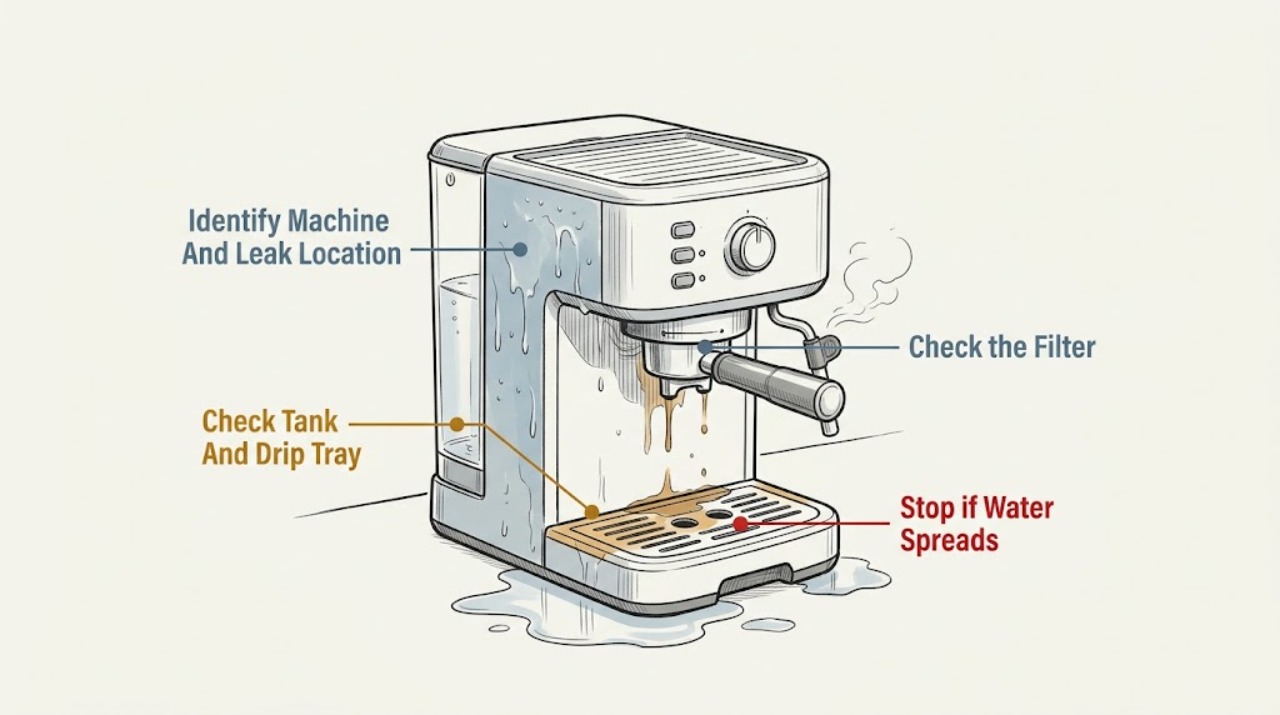
First identify the De’Longhi machine type and where the liquid begins: water tank, drip tray or grounds container, brew basket/portafilter and brew head, hot-water outlet or steam wand, or the appliance body. A full tray, tank that is cracked or not seated, loose or damaged filter-holder seal, excessive coffee grounds, a blocked filter, normal rinse water, or scale can explain some user-visible leaks. Turn the machine off with its normal control, allow the shutdown and hot parts to cool, then unplug before removing user-accessible accessories or wiping spills. Follow the exact model manual for descaling and cleaning; use only the manufacturer-approved descaler where specified and never force a tank, portafilter, infuser, or wand. If water comes from the body, a hidden hose, pump, valve, heating block, or electrical area, or if there is steam, scorching, smoke, a damaged cord, or a persistent leak, stop using the machine and arrange qualified De’Longhi service. Do not open the housing, test a powered machine, or repair internal water or electrical components.
Before you begin
Safety first
- This article covers model identification, safe leak tracing, tank/tray/accessory seating, visible filter or basket checks, cool removable outlet cleaning, and exact-manual-directed maintenance. A qualified technician must handle the housing, pump, valves, heating block, boiler/thermoblock, pressure circuit, internal hoses, gaskets, controls, and wiring.
Work through in order
Diagnostic checks
Use only checks that match the exact appliance or system and its official guide.
-
Check 1
Stop the current brew or steam operation, switch the machine off normally, wait for hot surfaces and any automatic shutdown to finish, and unplug only from a dry safe position. Place a dry towel under the machine without tilting it. Record the exact model and whether the liquid starts at the water tank, drip tray/grounds container, portafilter or brew head, hot-water outlet/steam wand, or the main body.
Expected result: The leak is clear water before operation, occurs during brewing, appears after rinsing or shutdown, occurs only with steam/hot water, begins under a removable accessory, or emerges from the sealed body.
Next step: Continue only with the user-accessible check that matches the location and machine type. If the source is the body, near electrics, or hidden behind a cover, keep the machine unplugged and arrange service.
Stop if: Do not tilt the appliance, run it to expose an internal leak, or touch hot water, steam, wet electrical parts, or internal tubing.
Why this matters
Why: Timing and location separate a tank or tray overflow from a pressurized brew-path, steam-path, automatic-rinse, or internal leak. A body leak cannot be safely traced by operating the machine with its covers removed.
-
Check 2
With the machine cool and unplugged, inspect the removable water tank, its visible gasket or valve area, the drip tray, grounds container, and tray level indicator if present. Check that the tank is not cracked, the gasket is not displaced, the tank is fully seated without force, and the tray and grounds container are not full or misaligned. Wipe only accessible surfaces and reinstall them as the exact manual shows.
Expected result: The tray is full, the tank leaks while removed, a tank or gasket is damaged, the tank is not seated, the grounds container is misaligned, or these parts are dry and correctly installed.
Next step: Empty and reseat only the user-removable tray, grounds container, or tank as the manual permits. Do not use a damaged tank or gasket. If water returns from the body or tank connection, stop and arrange service or an exact-model replacement accessory path.
Stop if: Do not force the tank, pry a valve, glue a crack, remove a housing panel, or operate with water near electrical parts.
Why this matters
Why: De’Longhi identifies a full drip tray and a broken water tank as causes of water on the counter; the official leak map also directs owners to tank gaskets and seating. A dry, correctly seated tank and tray shift attention to the brew, steam, or internal water path.
-
Check 3
For a drip brewer, inspect the filter basket, paper or permanent filter, carafe seating, and amount of grounds. For an espresso machine, inspect the portafilter, basket, brew-head seal area, and the amount and grind of coffee only after the machine is cool. Confirm the basket/holder is correctly seated and never remove a portafilter while the machine is delivering coffee or pressure.
Expected result: Coffee spills over the basket, the filter is clogged, grounds exceed the model limit, the portafilter does not seat or seal, a small drip occurs only immediately before/after brewing, or the brew area is dry but water appears below the body.
Next step: Use the exact model’s basket, dose, grind, and holder instructions; clean only removable parts and descale only as directed. If the holder still leaks around its seal, the brew head is damaged, or water appears from underneath, stop and arrange technical service.
Stop if: Do not loosen a pressurized holder, force the portafilter, replace a seal without model guidance, insert tools into the brew head, or run the machine with a body leak.
Why this matters
Why: De’Longhi’s official guidance links drip-brewer leaks with a displaced/damaged basket seal, too much coffee, a clogged permanent filter, or too-fine grounds; its espresso FAQ says a small drip immediately before or after preparation can be normal, while scale may block the machine. A body leak is not explained by basket quantity alone.
-
Check 4
If the leak occurs at the hot-water outlet or steam wand, keep the machine switched off and allow the wand and outlet to cool fully. Inspect only the visible nozzle, cap, removable tip, and model-documented external connection for milk residue or an incorrectly seated accessory. Do not open a steam valve, test pressure, or disassemble a hot-water or steam circuit.
Expected result: Drips occur only after hot-water or steam use, the wand tip is clogged with residue, the removable tip is mis-seated, steam escapes from the body or an unexpected joint, or the outlet is dry when cool.
Next step: Clean and reseat only the user-removable outlet parts as the exact manual directs, with the machine cool. If the leak persists, appears under pressure, or originates from the body, keep the machine unplugged and arrange service.
Stop if: Do not touch hot liquid or steam, insert a tool into an internal passage, force a nozzle, bypass a valve, or operate the machine to watch a steam leak.
Why this matters
Why: A removable outlet or residue issue may be user-maintainable, but unexpected steam or water from the body points to an internal valve, pump, heating block, hose, or seal. Residual drips after a hot cycle do not clear a persistent leak or electrical hazard.
-
Check 5
For a fully automatic machine, determine whether the water is normal rinse water collected in the drip tray or an overflow outside the tray. Check the model’s maintenance prompts, water filter status, and descaling instructions. If the machine has a user-removable brewing unit, switch it off and wait for complete shutdown before removing it; rinse it only as the exact De’Longhi guidance permits. Do not use vinegar or an unapproved chemical when the manufacturer specifies its descaler.
Expected result: Water appears only during automatic rinse, the tray is collecting normal discharge, scale or a maintenance prompt is present, the brew unit is dirty or stuck, or water leaks from the body despite normal maintenance.
Next step: Empty the tray and perform only the model-directed cleaning or descaling cycle. If the brewing unit will not release after the correct shutdown, do not force it; if water remains outside the normal collection path, arrange service.
Stop if: Do not remove a stuck infuser by force, run a descaling chemical outside the prescribed cycle, pour water into the housing, or operate with a body leak.
Why this matters
Why: De’Longhi describes automatic rinses and removable accessories as maintenance-related, and says limescale can contribute to filter-holder leakage. A normal rinse contained by the tray is different from water escaping the body; persistent leakage after exact maintenance suggests an internal circuit or seal issue.
-
Check 6
Record the exact model, machine type, liquid type, leak location and timing, tank/tray/basket/portafilter/wand observations, maintenance status, error messages, and any steam, odor, heat, cord, or electrical symptoms. Keep the machine unplugged if the source is hidden or persistent and provide the record to De’Longhi support or an authorized technician.
Expected result: The leak stops after an accessory is emptied or reseated, returns during pressure or steam, comes from the body or underside, appears near electrics, or is accompanied by a fault message, overheating, odor, or abnormal noise.
Next step: Stop use and arrange De’Longhi or qualified coffee-machine service for persistent, body, pressure, steam, or electrical leaks. Provide the exact model and the symptom record instead of ordering an unverified internal part.
Stop if: Do not open the housing, run the machine with covers removed, test live circuits, handle hot pressure, or replace internal pump, valve, heater, hose, seal, or electrical parts yourself.
Why this matters
Why: Recovery after a visible tray, tank, basket, or accessory correction supports that user-facing condition. A body or pressure-related leak may involve an internal pump, valve, heating block, hose, gasket, control, or wiring, none of which can be safely selected from an external puddle.
Use your observations
Decision map
Find the observation that best matches what you see, then follow the next safe action.
-
PATH 01Safety boundary
What you see
Water is present before brewing, the drip tray is full, or the removable tank leaks or is not seated.
Do this next
Empty and reseat the tray or tank as the exact manual permits; do not use a cracked tank or gasket. Arrange service or an exact accessory path if the connection still leaks.
Why this path and its safety boundary
Why it matters: A tank gasket/damage, tank seating, or tray overflow is more likely than a pressurized brew or steam fault.
Safety stop: Do not pry a valve, glue a tank, or operate with water near electrics.
-
PATH 02Safety boundary
What you see
Coffee or hot water escapes around the filter basket/portafilter or brew head during preparation.
Do this next
Use the exact dose, grind, basket, holder, and descaling instructions. Arrange technical service for a persistent edge leak, damaged seal, or any leak from the body.
Why this path and its safety boundary
Why it matters: An incorrectly seated holder, excess grounds, a blocked filter, scale, or a worn/damaged seal is more likely; a small drip immediately before or after brewing can be normal on applicable models.
Safety stop: Do not loosen a pressurized holder, insert tools into the brew head, or replace a seal without model guidance.
-
PATH 03Safety boundary
What you see
Dripping or steam occurs only at the hot-water outlet or steam wand after use, or an accessory tip is visibly dirty or mis-seated.
Do this next
Let the machine cool and clean/reseat only model-documented removable parts. Keep it unplugged and arrange service for persistent or body-originating leaks.
Why this path and its safety boundary
Why it matters: A removable outlet or residue issue is possible, but steam or water from an unexpected body joint suggests an internal valve, pump, heater, hose, or seal fault.
Safety stop: Do not touch hot parts, open a pressure circuit, or operate to observe an internal steam leak.
-
PATH 04Safety boundary
What you see
Water appears during automatic rinse or shutdown and remains contained in the designed drip tray, with no external puddle or body leak.
Do this next
Empty and clean the tray as the exact manual directs and monitor whether water remains contained. Escalate if water escapes the tray or appears in an unexpected location.
Why this path and its safety boundary
Why it matters: The water may be normal discharge rather than a failure, provided the tray is correctly seated and not overflowing.
Safety stop: Do not block the rinse path, run with a removed tray, or pour water into the housing.
-
PATH 05Safety boundary
What you see
Water or coffee comes from underneath or the sealed body, returns after tank/tray/accessory checks, or appears only under pump/steam pressure.
Do this next
Stop use, keep the machine unplugged and dry, and arrange De’Longhi or qualified coffee-machine service with the exact model and timing.
Why this path and its safety boundary
Why it matters: An internal hose, pump, valve, heating block, gasket, brew circuit, or electrical-area fault is more likely and cannot be diagnosed safely externally.
Safety stop: Do not open the housing, run with covers removed, test live circuits, or select an internal replacement part from another model.
-
PATH 06Safety boundary
What you see
Steam or hot water escapes unexpectedly, water reaches the plug or controls, the cord is damaged/hot, or smoke, scorching, burning odor, or repeated electrical trips occur.
Do this next
Stop operation and disconnect power only from a dry safe position. Keep clear, do not touch the leak or hot surface, and arrange qualified service.
Why this path and its safety boundary
Why it matters: The immediate issue is a burn, shock, fire, or electrical hazard rather than a cleaning or descaling adjustment.
Safety stop: Do not restart, test, open, or move the hot/wet machine until it has been made safe and inspected.
Helpful context
Understand the symptom
Trace the liquid before choosing a repair
De’Longhi coffee makers are not one architecture. A drip brewer has a water reservoir, filter basket, and carafe; a pump espresso machine has a portafilter, brew head, hot-water outlet, and steam wand; a fully automatic machine adds a tank, drip tray, grounds container, brewing unit, and automatic rinses. The official De’Longhi leak guide separates these paths. Identify the product number and note whether the liquid is clear water, coffee, milk residue, or hot steam before applying the matching user check.
Make the machine cool and electrically safe first
Stop brewing or steaming, switch the machine off with its normal button, allow the shutdown sequence and hot water or steam parts to cool, and unplug from a dry position before removing a user-accessible tank, tray, basket, portafilter, or infuser. Keep water away from the plug, outlet, controls, pump, heater, and wiring. Do not open the housing, run the machine to watch an internal leak, touch hot water or steam, bypass a safety control, or work on a pump, valve, heating block, boiler, or internal tube. Stop immediately for water near electrics, steam escaping from an unexpected location, smoke, burning odor, scorching, a damaged cord, or a persistent body leak.
Safety boundary
Stop conditions
- Stop immediately for water near a plug, outlet, controls, pump, heater, or wiring, or for unexpected steam, smoke, burning odor, scorching, a hot/damaged cord, or repeated electrical trips.
- Switch off normally, allow the complete shutdown and cooling sequence, and unplug before removing user-accessible accessories; do not open the housing even when unplugged if internal access is required.
- Do not run the machine to watch an internal leak, touch hot pressure, bypass a valve or safety control, probe internal passages, or repair a pump, valve, heating block, hose, gasket, or electrical circuit.
- Persistent leaks from the body, brew head under pressure, steam circuit, hidden water path, or electrical area require De’Longhi or qualified coffee-machine service.
When checks do not resolve it
Need a professional?
Safety scope: This article covers model identification, safe leak tracing, tank/tray/accessory seating, visible filter or basket checks, cool removable outlet cleaning, and exact-manual-directed maintenance. A qualified technician must handle the housing, pump, valves, heating block, boiler/thermoblock, pressure circuit, internal hoses, gaskets, controls, and wiring.
Common questions
FAQ
Why is my De’Longhi coffee maker leaking water?
Trace the source first: water tank, drip tray/grounds container, filter basket or portafilter, brew head, hot-water outlet, steam wand, or the body. Empty and reseat user-removable parts, check visible seals and filter/ground quantity, and follow the exact manual. A body or electrical-area leak requires service.
Why is my De’Longhi leaking from the filter holder?
A small drip immediately before or after coffee preparation can be normal on applicable pump machines. A persistent edge leak can relate to an incorrectly seated holder, excess grounds, a blocked filter, scale, or a seal issue. Use the exact model instructions and arrange technical service if it continues.
Why is water collecting under my fully automatic De’Longhi machine?
Check whether the drip tray or grounds container is full or mis-seated, and whether water appears during a normal rinse. A tank gasket or broken tank can also leak. If the tray is dry and correctly seated but water comes from the body, stop using the machine and arrange service.
Can limescale cause a De’Longhi coffee machine to leak?
De’Longhi notes that limescale can block a pump-espresso machine and contribute to filter-holder leakage. Run only the exact model’s approved descaling procedure and product; do not use vinegar when the manufacturer specifies its descaler. Persistent leaks need technical assistance.
When should I stop using a leaking De’Longhi coffee maker?
Stop for water near electrics, unexpected steam or hot-water escape, smoke, burning odor, scorching, a hot or damaged cord, repeated trips, or a leak from the sealed body. Switch off, let the machine cool, unplug only from a dry safe position, and arrange qualified service. Do not open the housing even after unplugging.
Read the exact guide
Official sources
- Common Issues - Fully Automatic Coffee MachineDe’Longhi US · Official De’Longhi US fully automatic FAQ; accessory layout and maintenance prompts vary by model.
- My coffee machine presents a leakage problem from the filter holder is. Why does it this happen?De’Longhi GB · Official De’Longhi GB FAQ for pump espresso machines; exact filter-holder and descaling procedures vary by model.
- Why is there some water on the surface on which my coffee machine is placed?De’Longhi US · Official De’Longhi US FAQ; it gives a basic external check and does not authorize internal repair.
- Brewing Unit: Cleaning, Maintenance and TroubleshootingDe’Longhi GB · Official De’Longhi GB FAQ; the brewing-unit position and release mechanism vary by machine.
- De’Longhi Customer ServiceDe’Longhi · Official De’Longhi US support page; contact channels and warranty terms vary by region.
- 〖コーヒー共通〗水やコーヒーが漏れるDe’Longhi Japan · Official De’Longhi Japan FAQ; the categories are broad but exact controls and parts depend on the model and regional manual.
Community feedback
Share a repair observation
Share a plain-text repair observation. Accepted observations are published automatically; this page may take a moment to update.