
On this page
Start here
Quick answer
For a leaking Breville coffee maker, first stop the cycle and identify where the water begins: an overfilled or poorly seated tank, a full or mis-seated drip tray, a normal purge into the tray, a portafilter or brew-head seal, a steam-wand purge, or water escaping from the base are different problems. On Breville pump-espresso models, the manuals say to lock the tank into place, keep the drip tray firmly seated and emptied, and check the portafilter and shower-screen seal; a short purge from the wand or into the tray can be normal. On a Breville drip model, the tank fill limit and basket or door arrangement are model-specific. Do not run the machine to chase a leak if water reaches the cord, outlet, controls, or base, or if hot water or pressurized steam is escaping unexpectedly. Unplug only from a safe, dry position and leave internal pumps, thermocoils, valves, tubing, wiring, and persistent leaks to Breville or qualified service.
Before you begin
Safety first
- The user may stop the machine, let it cool, dry and reseat accessible removable parts, empty a drip tray, follow the exact manual's cleaning or purge instructions, and observe the leak from outside. Internal valves, pumps, thermocoils, heaters, tubing, wiring, pressure or thermal devices, housing seals, and inaccessible wand or group-head repairs are for qualified service personnel.
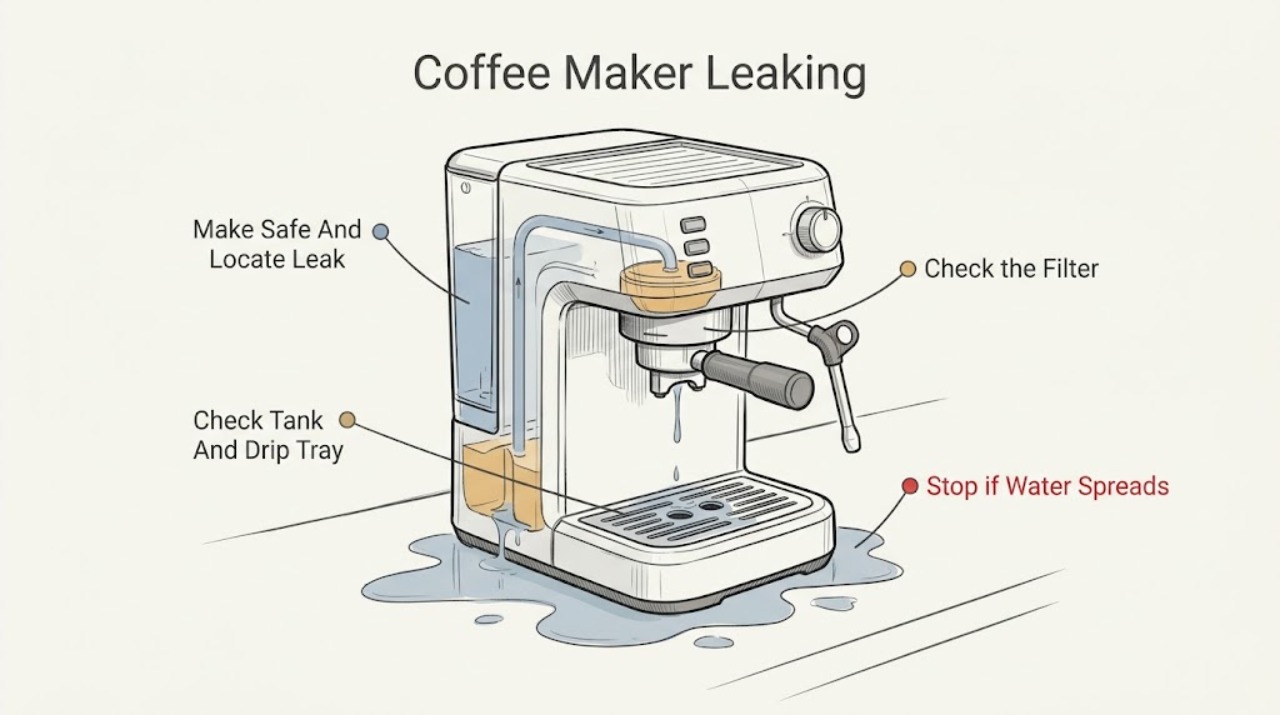
Work through in order
Diagnostic checks
Use only checks that match the exact appliance or system and its official guide.
-
Check 1
Stop brewing or steaming, keep clear of hot water and steam, and wait until the accessible exterior and removable parts are cool. From a safe, dry position, look for the first wet point: the water-tank area, front drip tray, brew group or portafilter rim, steam-wand tip, rear of a drip brewer, or underneath the machine. Do not tilt the machine, remove panels, or reach into a hot area.
Expected result: Water is only in the drip tray after a purge, water starts at the tank or rear fill area, water escapes around the portafilter, water drips from the wand, or water appears under/inside the base.
Next step: Follow the matching tank/tray, brew-group, or steam-wand check below only when the area is cool and dry. If the source is the base, controls, cord, outlet, or an inaccessible panel, stop and arrange qualified service.
Stop if: Do not power the machine again merely to make a hidden leak appear, and do not touch water near energized electrical parts.
Why this matters
Why: The location separates a normal discharge or removable-part seating issue from a pressurized brew seal, wand-valve, overflow, or internal-circuit problem. Water under the base or near electrics is not a user-repair branch.
-
Check 2
For a removable-tank espresso model, check from outside that the tank is not cracked, is not above its marked limit, and is pressed down fully into its dock so it locks. Re-seat the removable drip tray and empty it; check that its grille, cover, float or indicator, when fitted, is assembled as the exact manual shows. For a BDC650-style drip brewer, do not exceed that model's stated tank maximum; do not apply its cup limit to another Breville model.
Expected result: The tank was above its mark or not locked, the tray was full or not fully pushed in, water spilled from the rear of a drip brewer after overfilling, or the parts are seated and the leak returns.
Next step: Empty and dry the tray, correct only the obvious fill or seating issue, and observe during the next normal use if there is no safety hazard. If the tank, valve, tray, or surrounding housing is cracked, or the leak returns after correct seating, stop using the machine and request model-specific service.
Stop if: Do not force a tank into its dock, glue a crack, remove a tank valve, or use a damaged tray or tank near the electrical base.
Why this matters
Why: A tank seating or model-specific overfill condition can send water outside the intended path, while a full or mis-seated tray can look like a machine leak. A correctly seated tank and tray with fresh water still appearing points toward a damaged seal, valve, tray, or internal circuit.
-
Check 3
On a pump-espresso model, with the machine off and cool, inspect the accessible portafilter rim and group-head area for loose coffee grounds or an obviously incomplete lock. Clean only loose residue from the removable basket and rim as the manual allows, then insert and rotate the portafilter fully until resistance is felt. Do not remove the shower screen or seal unless the exact manual expressly provides that maintenance procedure.
Expected result: Water runs around the portafilter edge during extraction, grounds sit on the basket rim, the handle was not fully rotated, the leak is from the group head, or the portafilter is correctly locked but water still escapes.
Next step: Correct the accessible loading or locking issue once and stop if leakage persists. A seal or group-head leak that remains after a clean rim and correct lock needs the exact model's documented service or a qualified technician; do not increase force or improvise a gasket.
Stop if: Do not brew with a loose portafilter spraying hot liquid, and do not open the brew group or replace a seal without confirming the model procedure and part fit.
Why this matters
Why: Breville manuals associate edge leakage with an incorrectly inserted portafilter, grounds on the basket rim, excess dose, or a worn silicone seal around the shower screen. This diagnosis applies to pump-espresso models, not a conventional drip brewer.
-
Check 4
If water appears in the drip tray immediately after espresso, hot-water, or steam use, compare it with the model's documented auto-purge behavior. If water comes from the steam wand, keep the tip pointed into the drip tray and away from people, and use only the model's documented purge. Once cool, wipe the wand and clean an accessible blocked tip as directed; do not remove the wand valve or open the machine.
Expected result: The water is a short purge into the tray or a few pulses from the wand, the wand drips continuously while idle, the tip is blocked, or water leaks from the wand joint/body rather than its outlet.
Next step: Treat only the documented short purge as normal and keep the tray emptied. If the wand continues to drip when it should be closed, leaks at its joint, or releases uncontrolled hot water or steam, stop using the steam function and arrange service.
Stop if: Pressurized steam may remain after switch-off; never hold the tip, place a hand over it, or dismantle the wand while hot.
Why this matters
Why: Breville documents auto-purge and condensed-water discharge as normal on certain espresso models. A continuous idle drip, a joint/body leak, or uncontrolled hot water is different and may involve a valve, seal, or internal tube; a blocked tip can also affect steam behavior but does not justify internal repair.
-
Check 5
If the leak returns with the tank and tray correctly seated, or water appears from the underside, side seam, cord area, controls, or a non-removable panel, switch the machine off. Unplug only if the plug and outlet are dry and safely reachable; otherwise turn off the appropriate supply without touching water, and keep the machine out of use. Record the model, where the first wet point appeared, whether it leaks while idle or only during brewing, and whether hot water or steam was involved.
Expected result: The leak is persistent or internal, the machine has been exposed to water near electrics, the cord or plug is damaged, the breaker trips, or the leak stops after a clearly documented seating or overfill correction.
Next step: For persistent, internal, electrical, or hot-pressurized leaks, leave the machine disconnected and contact Breville or a qualified appliance service professional. Provide the exact model and symptom record; do not run repeated tests or order a generic part.
Stop if: Do not remove the housing, test live voltage, bypass a thermal or pressure device, or attempt internal plumbing, pump, thermocoil, valve, or wiring repair.
Why this matters
Why: Persistent or inaccessible leakage can involve the pump, thermocoil, valve, tubing, wiring, or a structural seal that cannot be safely identified from outside. Breville's safety instructions treat damaged appliances and maintenance beyond cleaning as service work; a one-time corrected overflow still needs monitoring for recurrence.
Use your observations
Decision map
Find the observation that best matches what you see, then follow the next safe action.
-
PATH 01Safety boundary
What you see
Water appears only in the drip tray directly after espresso, hot-water, or steam use, or the tray is full and correctly catches the discharge.
Do this next
Keep the tray firmly seated and empty it as the exact manual directs. If water escapes outside the tray or appears while the machine is idle, use the leak-source checks and arrange service if it persists.
Why this path and its safety boundary
Why it matters: A documented auto-purge may be normal on pump-espresso models. A full tray can overflow even when the machine's water path is working normally.
Safety stop: Do not assume every tray puddle is normal when it contains fresh water from a crack, misalignment, or an unknown source.
-
PATH 02Safety boundary
What you see
Water begins at the tank dock or rear fill area, the tank was not locked down, or a BDC650-style drip brewer spills from the back after filling.
Do this next
Empty to the marked limit, dry the exterior, and seat the tank as the exact model manual shows. If the tank, valve, dock, or housing still leaks, stop using it and request model-specific service.
Why this path and its safety boundary
Why it matters: Tank seating or a model-specific fill limit is more likely than a brew-group seal. The BDC650 manual specifically attributes rear leakage to an overfilled tank; other Breville models may use different limits and tank designs.
Safety stop: Do not apply the BDC650 cup maximum to another model or use a cracked tank.
-
PATH 03Safety boundary
What you see
On a pump-espresso machine, water sprays or runs around the portafilter edge during extraction, especially when grounds are on the rim or the handle was not fully rotated.
Do this next
Stop the shot, let the group cool, clean only the accessible basket rim, and lock the portafilter correctly once. A recurring leak requires the exact model's seal procedure or professional service.
Why this path and its safety boundary
Why it matters: An incomplete seal, excess residue or dose, or a worn shower-screen silicone seal is more likely than a tank overflow.
Safety stop: Do not hold a loose portafilter in place or continue a shot that sprays hot water.
-
PATH 04Safety boundary
What you see
Water or steam comes from the wand during a documented purge, but the wand also drips while closed, leaks at the joint, or releases uncontrolled hot fluid.
Do this next
Stop using the steam function, keep clear of the hot tip, and arrange qualified service if the leak is not limited to the documented purge.
Why this path and its safety boundary
Why it matters: The short purge may be normal, while continuous or uncontrolled leakage is more consistent with a wand tip, valve, seal, or internal circuit problem.
Safety stop: Do not touch, cap, unscrew, or dismantle a hot or pressurized wand.
-
PATH 05Safety boundary
What you see
Water appears beneath the machine, inside a side seam, around the cord or controls, or the leak persists after accessible tank, tray, and brew-group checks.
Do this next
Leave the machine out of use and arrange Breville or qualified appliance service. Isolate power only from a safe, dry position and provide the model and leak pattern to the technician.
Why this path and its safety boundary
Why it matters: An internal water circuit, electrical component, structural seal, pump, heater, or valve may be involved; the source cannot be safely localized by a user inspection.
Safety stop: Do not open the housing, perform live tests, or operate the machine to reproduce an internal leak.
Helpful context
Understand the symptom
Locate the first wet point before choosing a fix
A puddle at the rear tank, water collected in the front drip tray, liquid around the portafilter, a few pulses from the steam wand, and water under the machine do not identify the same part. Dry the accessible exterior after the machine is off and cool, then note where fresh water reappears without opening the housing. Breville sells both pump espresso machines and drip coffee makers, so use the exact model manual for tank limits, controls, and cleaning instructions.
Water and heat change the stop decision
Coffee water, the brew group, and the steam wand can be hot, and Breville warns that pressurized steam can remain after switch-off on some models. Keep hands and face away from the wand and outlets, let the machine cool, and point a documented purge into the drip tray and away from people only when the model instructions call for it. If water is near the power cord, plug, outlet, controls, or base, stop using the machine and isolate power only from a safe, dry position. Do not immerse the appliance, open its housing, probe live parts, or work on internal plumbing or wiring.
Model scope matters
The BES840 Infuser, BES880 Barista Touch, and BES450 Bambino manuals cover pump-espresso layouts with a tank, drip tray, group head, portafilter, and steam wand. The BDC650 Grind Control manual covers a different drip-coffee layout and specifically describes rear overflow from an overfilled tank. These examples support the diagnostic pattern, not a universal button sequence or part fit; confirm the model number before removing any component or ordering a replacement.
Safety boundary
Stop conditions
- Stop immediately for water near the plug, cord, outlet, controls, or base; isolate power only from a safe, dry position and keep the machine out of use.
- Stop for uncontrolled hot water or pressurized steam, a continuous idle steam-wand leak, a spray from a loose portafilter, or a leak that returns after seating and fill checks.
- Do not immerse the machine or power parts, tilt it to chase water, or use it with a damaged tank, tray, cord, plug, or housing.
- Do not open the housing or diagnose or replace the pump, thermocoil, heater, valve, tubing, wiring, thermal device, or internal seal yourself.
- Do not order a generic replacement part from the symptom alone; Breville coffee-maker and espresso-model parts are model-specific.
Only after diagnosis
Potential parts
Water starts at a correctly seated tank or its dock after the fill level and visible damage checks pass.
Water escapes around a tray that is empty, correctly assembled, and firmly seated, or a removable tray is visibly cracked.
A pump-espresso model leaks around the portafilter after the rim is clean and the portafilter is fully locked according to its manual.
The wand continues to drip while closed or leaks at the joint/body rather than only during a documented purge.
Water appears under the base or inside the housing, or the leak persists after all accessible model-specific checks.
When checks do not resolve it
Need a professional?
Arrange Breville or qualified appliance service for a leak from the base, side seam, controls, cord area, or a non-removable component; a damaged tank, tray, cord, plug, or housing; repeated breaker trips; uncontrolled hot water or steam; a continuous wand leak; or a portafilter/group-head leak that remains after the exact model's accessible cleaning and seating checks.
Safety scope: The user may stop the machine, let it cool, dry and reseat accessible removable parts, empty a drip tray, follow the exact manual's cleaning or purge instructions, and observe the leak from outside. Internal valves, pumps, thermocoils, heaters, tubing, wiring, pressure or thermal devices, housing seals, and inaccessible wand or group-head repairs are for qualified service personnel.
Common questions
FAQ
Why is my Breville coffee maker putting water in the drip tray?
On Breville pump-espresso models, a purge into the drip tray immediately after espresso, hot-water, or steam use can be normal. Keep the tray firmly seated and empty it as the exact manual directs. Water escaping around the tray, a full tray overflowing, or water appearing while idle needs a source check rather than being dismissed as purge water.
What should I check if water is leaking from the Breville water tank?
With the machine off and cool, check the marked fill level and press the tank down fully so it locks into its dock. If it still leaks, or the tank, inlet valve, or dock is cracked, stop using the machine and arrange model-specific service. A drip brewer such as the BDC650 also has a model-specific maximum fill limit, so do not use another model's limit.
Why does my Breville espresso machine leak around the portafilter?
On pump-espresso models, the portafilter may not be fully inserted, coffee grounds may be on the basket rim, the dose may be excessive, or the shower-screen silicone seal may need model-specific replacement. Stop a spraying shot, let the group cool, clean only accessible residue, and have a recurring leak serviced rather than forcing the handle.
Is water from the Breville steam wand always a leak?
No. Some Breville espresso models intentionally purge condensed water or residual milk through the wand or into the drip tray. Point the wand into the tray and away from people only for the documented purge, and remember that pressurized steam can remain hot after switch-off. A continuous drip while the wand is closed, a joint leak, or uncontrolled hot water or steam requires service.
What if water is leaking from underneath my Breville coffee maker?
Stop using it. If the plug and outlet are dry and safely reachable, unplug from a dry position; otherwise isolate power without touching water. Water under the base or near controls can involve internal tubing, a pump, heater, valve, seal, or wiring and is not a safe do-it-yourself diagnosis.
Read the exact guide
Official sources
- the Barista Touch Instruction Manual (BES880)Breville · Pump-espresso model example; model-specific automatic steam-wand purge, water-leak, portafilter, tank, drip-tray, and safety details must not be generalized to other Breville models.
- Espresso machine problems and fixesBreville · General Breville espresso guidance; exact controls and repair boundaries remain model-specific.
- the Infuser Instruction Manual (BES840)Breville · Pump-espresso model example; tank, drip-tray, group-head, portafilter, steam-wand, safety, and water-leak troubleshooting details apply to the covered BES840 model, not automatically to every Breville coffee maker.
- the Grind Control Instruction Manual (BDC650)Breville · Drip-coffee model example, not a pump-espresso layout; its rear-overflow and tank-fill guidance must not be applied to an unidentified espresso machine.
- the Bambino Instruction Manual (BES450)Breville · Pump-espresso model example; its manual purge, tank seating, steam-wand cleaning, and thermal-cut-out instructions are model-specific.
Community feedback
Share a repair observation
Share a plain-text repair observation. Accepted observations are published automatically; this page may take a moment to update.