
On this page
Start here
Quick answer
First identify when the sound occurs and which Breville architecture is involved. Pulsing during espresso extraction or steaming, water being released during an automatic purge, and a short winding sound while a Grind Control chute moves can be normal on models that have those functions. A loud pump with little or no water points first to an empty or poorly seated tank, scale, or a blocked brew path; a loud grinder racket or no grounds points to a foreign object, moisture, or a blocked hopper/chute. Turn the machine off and unplug it when the model manual calls for cleaning. Do not run a jammed grinder, open the case, perform live electrical checks, force a burr, or continue using the appliance for scraping/grinding sounds at idle, burning odor, hot or damaged wiring, repeated trips, or a noise that persists after a safe correction.
Before you begin
Safety first
- The user workflow is limited to model-authorized controls, visible tank/basket/portafilter/steam-tip checks, and unplugged cleaning of specified removable grinder or chute parts. Qualified service personnel must handle internal hydraulic, steam, heating, motor, control, wiring, and safety-device work.
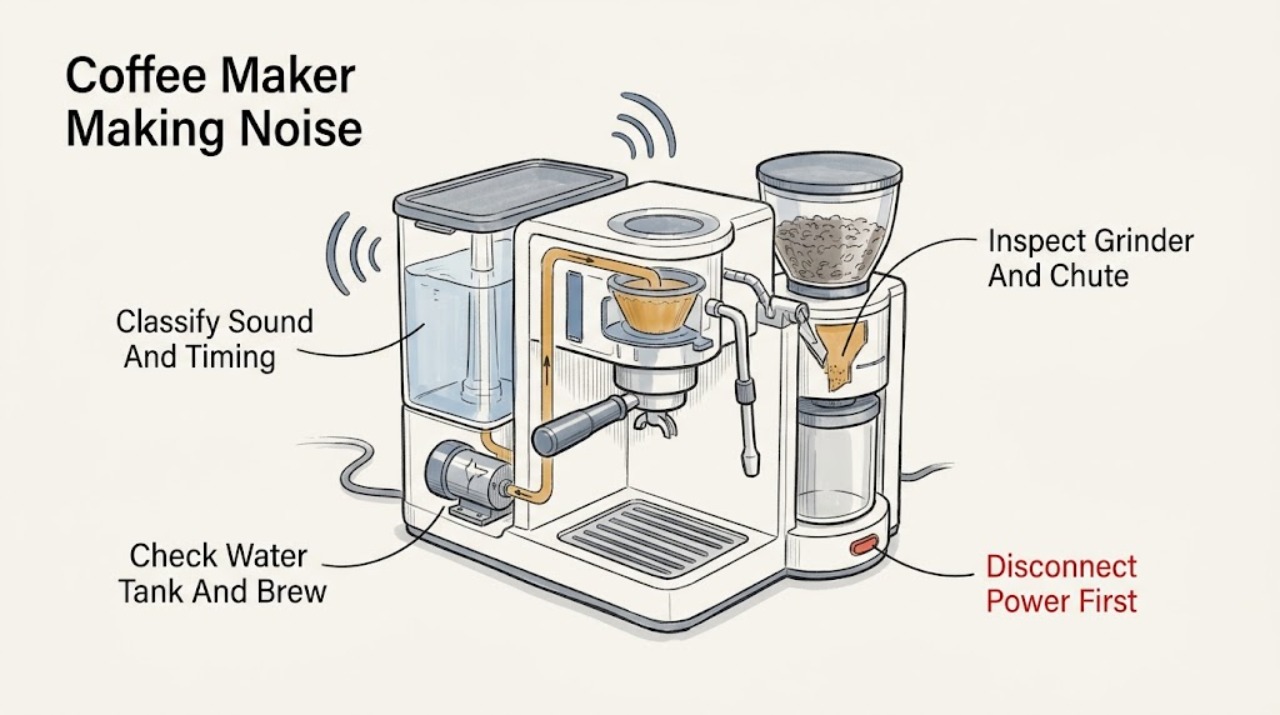
Work through in order
Diagnostic checks
Use only checks that match the exact appliance or system and its official guide.
-
Check 1
With the machine stopped, note whether the noise occurred during espresso extraction, steaming, hot-water delivery, automatic purge, grinding, chute movement, brewing, or while the appliance was idle. Identify the architecture from the controls and visible parts: portafilter/steam wand, grinder and hopper, or a combined espresso-and-grinder design. Record whether the expected output was normal at the same time.
Expected result: The sound is a pulsing pump sound during extraction or steam, a short purge or winding sound at the expected stage, a loud sound with poor/no water or grounds, or a rubbing/electrical sound while idle.
Next step: If the sound is expected and output is normal, monitor without changing parts. If flow, grounds, or the operating stage is abnormal, continue with the matching water-path, grinder, or safety check below.
Stop if: Do not deliberately repeat a dangerous sound, operate with smoke, burning odor, exposed wiring, a hot cord, repeated breaker trips, or a grinding/scraping sound that continues after the cycle stops.
Why this matters
Why: Timing and output separate documented operating sounds from a symptom that changes the diagnostic path. Pump pulsing, auto-purge, and chute winding can be normal on the relevant models; loudness combined with no flow/no grounds or a sound outside the operating stage is more consistent with a setup, blockage, foreign object, or service fault.
-
Check 2
For a pump espresso symptom, turn the machine off and allow hot parts to cool. Check that the water tank contains water above the model's minimum mark and is fully seated, then inspect only the accessible portafilter, filter basket, and visible brew outlet for a loose obstruction or excessive coffee buildup. Do not open tubing, valves, or the case.
Expected result: The tank is empty or not seated, the tank is correctly seated but there is little/no water through the brew path, the basket appears blocked or overfilled, or water flow and seating are normal.
Next step: Fill and reseat the tank exactly as the model manual shows; remove only loose accessible coffee residue and use the correct basket. If the manual indicates descaling, use its documented program. If flow remains absent or the sound continues, stop and arrange service.
Stop if: Do not run the pump dry repeatedly, force a portafilter, push tools into internal passages, remove panels, or test pump/valve/heater wiring while energized.
Why this matters
Why: Breville manuals identify an empty or poorly inserted tank as a cause of loud continuous pumping and identify fine/overdosed/over-tamped coffee, a blocked basket, or scale as possible causes of no water flow. Normal seating and a clear accessible path make an internal pump, valve, or heating fault more likely if the loud sound persists.
-
Check 3
For a grinder or Grind Control symptom, stop the cycle and disconnect power before opening the model's hopper, swing-out door, or coffee-chute access. Look only for a visible foreign item, damp beans/grounds, a packed chute, or a missing supply of beans; clean and dry removable burr/chute parts only as the exact manual permits. Keep hands, hair, clothing, and utensils away from any grinder that could start.
Expected result: A foreign item, moisture, compacted grounds, or empty hopper is visible; the machine makes only the documented winding sound; or the grinder remains loud, stalls, or makes a racket after the visible path is clean and dry.
Next step: Remove only the visible obstruction, discard wet or unsuitable material as the manual directs, dry the accessible parts fully, and reassemble before restoring power. If the burr will not turn freely, the obstruction is not accessible, or the abnormal sound returns, leave the grinder out of use and contact Breville support.
Stop if: Do not use metal tools to force burrs, reach into a powered grinder, bypass the hopper lid, pour liquid into the chute, or disassemble the grinder motor or wiring.
Why this matters
Why: Breville's grinder manuals associate a loud racket or motor with no grounds with a foreign object, moisture, a blocked hopper/chute, or no beans. A normal winding sound during chute movement is not itself evidence of a failed motor. Persistence after the model-approved external cleaning raises a mechanical or electrical fault that cannot be safely localized by the user.
-
Check 4
If the noise occurs at the steam wand or immediately after steaming, turn the machine off, release pressure only through the model's normal control if safe, and allow the wand to cool. Inspect the visible steam-tip openings for dried milk or debris and clean the tip/wand only by the exact Breville manual procedure; distinguish a documented pump/purge sound from weak steam or a persistent loud noise.
Expected result: The pump pulses only during steam or the machine performs its documented purge, the steam tip has visible residue and steam is weak, or the noise continues with poor steam, leakage, or no normal output.
Next step: Clean the cooled, accessible steam tip as documented and allow it to dry. If the sound, leak, or poor steam remains, stop using the steam system and arrange model-specific service; do not open the steam circuit.
Stop if: Do not touch a hot wand, unblock it while pressurized, insert improvised wire, operate with a steam leak, or dismantle a boiler, valve, or heater.
Why this matters
Why: Pumping during steam and internal water release during auto-purge can be normal. Milk residue or debris can restrict a steam wand and make it noisy, while persistent noise with leakage or poor output points beyond a simple cleaning correction.
-
Check 5
If the sound is rubbing, grinding, rattling, buzzing, or electrical; occurs while idle; returns immediately after the accessible correction; or accompanies smoke, burning odor, heat, leakage, an error, or a repeated breaker trip, stop the appliance. From a safe dry position, unplug it if the plug and cord are intact and accessible, then record the exact model, sound timing, output, recent cleaning/descaling, and any visible foreign object or damage for Breville support.
Expected result: The abnormal sound stops after a documented external correction and the appliance has normal output, or the sound persists/returns or there is a safety symptom.
Next step: For persistence or any safety symptom, keep the appliance out of service and contact Breville support or a qualified appliance technician. Provide the model and the observation record rather than ordering a generic pump, grinder, or control part.
Stop if: Do not re-energize the appliance to reproduce a hazardous sound, remove the cover, bypass a safety switch, perform live voltage tests, or replace an internal part based on noise alone.
Why this matters
Why: A resolved tank, blockage, or residue condition can explain a transient operating noise. Persistent or idle mechanical/electrical noise, heat, odor, leakage, or repeated protection trips indicates a fault that may involve the pump, valve, motor, heater, control, wiring, or another internal assembly.
Use your observations
Decision map
Find the observation that best matches what you see, then follow the next safe action.
-
PATH 01Safety boundary
What you see
The sound occurs only during espresso extraction/steaming, an expected purge, or documented chute movement, and water, steam, grounds, or brewed coffee output is normal.
Do this next
Leave settings and parts unchanged and monitor. Use the exact model manual if the sound becomes louder, changes timing, or output declines.
Why this path and its safety boundary
Why it matters: The timing and output fit documented operation for the relevant Breville architecture rather than a fault proven by noise alone.
Safety stop: Stop if the sound occurs while idle, becomes scraping or electrical, or is joined by heat, odor, leakage, smoke, or repeated electrical trips.
-
PATH 02Safety boundary
What you see
An espresso machine has a loud or continuous pump with little/no water, an empty or poorly seated tank, a blocked basket, or a fine/over-tamped coffee puck.
Do this next
Turn off and cool the machine, fill and reseat the tank, correct only the documented basket/coffee setup, and run the exact model's descale program when indicated. If the tank and accessible path are normal but flow and noise do not recover, call service.
Why this path and its safety boundary
Why it matters: The water supply or accessible brew restriction is more likely than a pump failure at this stage; scale is another model-specific possibility.
Safety stop: Do not run the pump dry repeatedly, force the portafilter, clear internal tubing, or open the hydraulic/electrical system.
-
PATH 03Safety boundary
What you see
A grinder-equipped Breville makes a loud racket or produces no grounds, and a foreign object, damp material, blocked hopper, or packed chute is visible.
Do this next
Disconnect power and follow the exact model's hopper/chute/burr cleaning procedure; remove only accessible material, dry fully, and stop if the burr will not turn or the noise returns.
Why this path and its safety boundary
Why it matters: The visible obstruction or moisture condition is a plausible cause, while a normal winding sound during chute movement is not the same symptom.
Safety stop: Do not reach into a powered grinder, force burrs, pour water into the grinder, or dismantle its motor or wiring.
-
PATH 04Safety boundary
What you see
Noise is concentrated at the steam wand and steam is weak or restricted, with visible dried milk or debris at the accessible tip.
Do this next
Switch off, cool the wand, and clean the visible tip using the exact manual. If weak steam, leakage, or abnormal noise persists, stop using steam and arrange service.
Why this path and its safety boundary
Why it matters: Residue at the steam tip can restrict flow and make the wand noisy; the normal pump/purge sound remains distinct when output is otherwise normal.
Safety stop: Do not unblock a hot or pressurized wand with an improvised tool or open the steam circuit.
-
PATH 05Safety boundary
What you see
The appliance makes scraping, rattling, buzzing, or grinding sounds while idle or after a safe correction, or there is burning odor, smoke, heat, leakage, damaged cord, or repeated breaker operation.
Do this next
Stop using it, unplug only from a safe dry location if possible, and contact Breville support or a qualified appliance service professional with the model and symptom record.
Why this path and its safety boundary
Why it matters: An internal mechanical or electrical fault is more likely and the symptom has crossed the user troubleshooting boundary.
Safety stop: Do not repeat a hazardous test, open the case, bypass a lid or interlock, perform live measurements, or replace an internal component from the sound alone.
Helpful context
Understand the symptom
Classify the sound before treating it as a fault
A Breville espresso machine can pulse while its pump extracts espresso or supplies steam, and some models release water during an automatic purge. A Grind Control brewer can make a winding sound as the coffee chute moves, while a grinder-equipped espresso machine can make motor and burr sounds during grinding. Those expected sounds should occur at the corresponding stage and stop when the operation ends. A new scraping, electrical buzz, repeated clatter, or loud sound while idle is a different symptom and should not be normalized.
The same noise can mean different things on different Breville designs
On a pump espresso model, compare the sound with water flow through the portafilter or steam wand and check the tank seating. On a drip brewer with a grinder, compare the sound with whether beans reach the basket and whether the chute is clear. On an Oracle-style combination machine, a grinder fault and a brew-pump fault are separate paths. Model manuals differ on access, alerts, and cleaning steps, so do not transfer a burr, filter, descale, or reset procedure from another Breville model.
Use a narrow cleaning boundary
Only inspect visible, user-removable areas named by the exact manual: a water tank, filter basket, portafilter, steam-tip openings, bean hopper, or coffee chute. Unplug before opening a grinder door or cleaning burrs/chutes when the manual requires it, keep all moisture away from electrical parts, and let components dry before reassembly. Internal pump, valve, motor, heater, wiring, and control faults require service.
Safety boundary
Stop conditions
- Stop using the coffee maker for smoke, burning odor, a hot or damaged cord, exposed wiring, water near electrical parts, leakage that reaches controls, repeated breaker trips, or an abnormal sound while idle.
- Disconnect power before opening a hopper, swing-out door, chute, or other removable cleaning area when the exact manual requires it; keep hands, hair, clothing, and utensils away from any grinder that could start.
- Do not run a pump dry repeatedly, force a clogged portafilter or burr, insert tools into internal passages, pour liquid into a grinder, or use improvised tools on a hot or pressurized steam wand.
- Do not remove the case, access the pump, valve, boiler, heater, motor, control board, wiring, or safety switch, and do not perform live electrical testing.
- If a documented tank, visible blockage, moisture, residue, or model-approved cleaning correction does not restore normal sound and output, stop testing and arrange professional service.
When checks do not resolve it
Need a professional?
Safety scope: The user workflow is limited to model-authorized controls, visible tank/basket/portafilter/steam-tip checks, and unplugged cleaning of specified removable grinder or chute parts. Qualified service personnel must handle internal hydraulic, steam, heating, motor, control, wiring, and safety-device work.
Common questions
FAQ
Is a pulsing sound from a Breville espresso machine normal?
It can be normal when it occurs during espresso extraction or steaming and water or steam output is normal. It is not enough to call a pump failed. A loud continuous pump with little or no water, an empty or poorly seated tank, or a blocked brew path changes the diagnosis; stop and follow the exact model manual.
Why is my Breville coffee maker making a loud pump noise but no coffee comes out?
On Breville espresso models, first turn the machine off and check the tank level and seating, then inspect the accessible basket/portafilter setup. A blocked basket, too-fine or excessive coffee dose, over-tamping, scale, or a tank condition can restrict flow. If the accessible checks and the model's documented descale procedure do not restore flow, arrange service rather than opening the hydraulic system.
Why does my Breville grinder make a loud rattling or racket sound?
Breville grinder manuals associate a loud racket or a motor running without grounds with a foreign object, moisture, a blocked hopper/chute, or no beans. Disconnect power before the applicable cleaning access, remove only visible material, and let removable parts dry fully. Do not force burrs or dismantle the motor; call service if the noise returns.
Is a winding sound from a Breville Grind Control brewer a fault?
A short winding sound while the documented coffee chute moves can be normal on the BDC650-style Grind Control architecture. It should match that stage and not be accompanied by a loud grinder racket, a stall, no grounds, or a packed chute. Use the exact model manual if the sound changes or output becomes abnormal.
When should I stop using a noisy Breville coffee maker?
Stop for scraping or electrical noise while idle, a sound that returns after visible tank/basket/steam-tip/hopper corrections, smoke, burning odor, unusual heat, leakage near controls, a damaged cord, repeated breaker trips, or any sound you cannot safely classify. Unplug only from a safe dry location if the cord and plug are intact, then contact Breville support or a qualified appliance technician.
Read the exact guide
Official sources
- BES878 Instruction ManualBreville · BES878 model-family manual; its pump, tank, grind, basket, and flow guidance is model-specific.
- BDC650 Instruction ManualBreville · BDC650 grind-and-brew model manual; the chute, burr, basket, and winding-sound details are model-specific.
- BES980 Instruction ManualBreville · BES980 model-family manual; grinder and dual-pump details must not be generalized to another Breville appliance.
- Espresso Machine Problems and FixesBreville · Breville US support article; use it for general escalation and steam-wand context, while the exact owner manual controls model-specific procedures.
- BES810 Instruction ManualBreville · BES810 model-family manual; pump, steam, tank, and purge details must not be assumed for another Breville model.
Community feedback
Share a repair observation
Share a plain-text repair observation. Accepted observations are published automatically; this page may take a moment to update.