
On this page
Start here
Quick answer
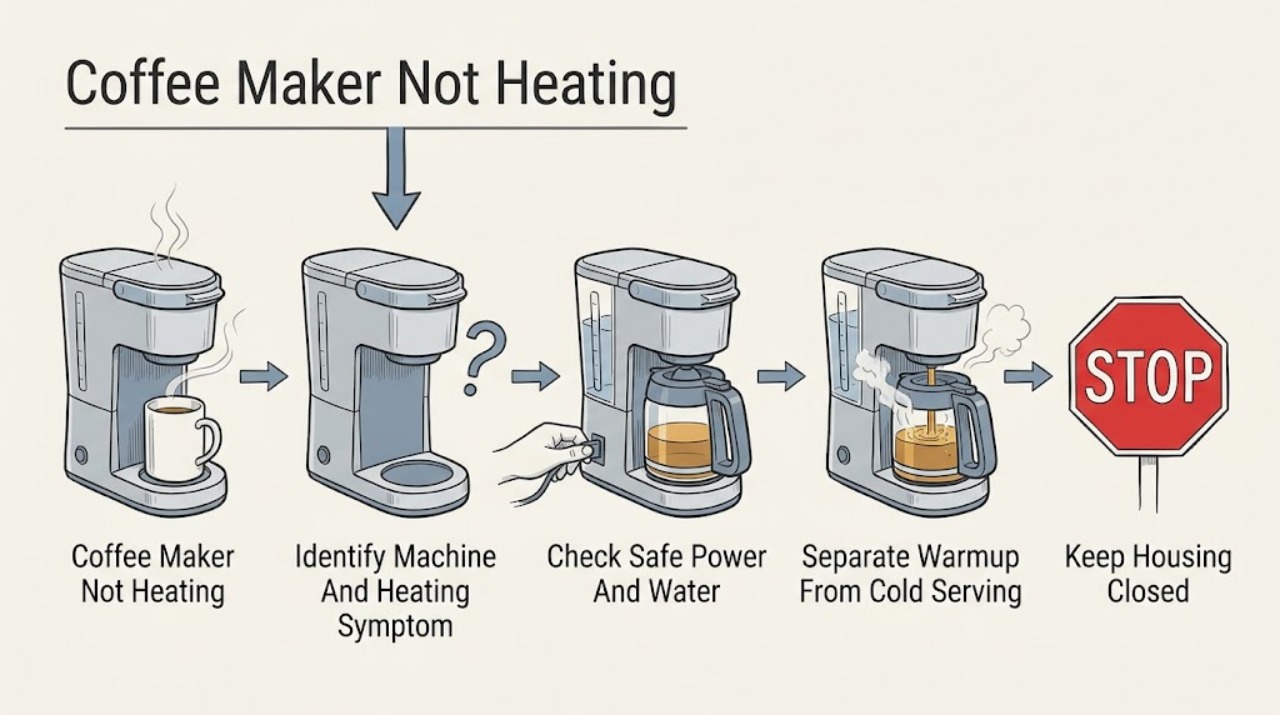
First identify whether the Breville is a drip brewer, an espresso machine, or only a cup or carafe that is cooling too quickly. A drip brewer may need its selected brew-temperature setting, water flow, or model-specific descaling checked; an espresso machine may still be warming while its power or steam light flashes, and a cold cup or portafilter can make a normal shot seem cold. Fill and seat the water tank, use the normal control sequence, allow the model's warm-up or preheating period, and use only the exact manual's descaling procedure when its cleaning indicator or symptoms call for it. If the machine never reaches ready state, produces no hot water or steam after the documented warm-up, stops after overheating, or remains cold after the external checks, stop using it and arrange Breville service. Do not open the housing, touch a heater or thermocoil, or test live wiring; hot water, steam, and heating surfaces can burn.
Before you begin
Safety first
- This article covers model identification, normal accessible power and water setup, documented controls, safe warm-up and serving-temperature checks, user-accessible steam-tip cleaning when the exact manual permits it, and the exact model-approved descale procedure. A qualified professional must handle heaters, thermocoils, thermal cut-outs, sensors, pumps, valves, control boards, internal wiring, pressurized circuits, and energized measurements.
Work through in order
Diagnostic checks
Use only checks that match the exact appliance or system and its official guide.
-
Check 1
Identify the Breville product family from its rating label or manual and describe the failure without opening it: drip brewer with cold brew water or cold keep-warm plate, espresso machine that never reaches ready state, coffee that is merely cool in the cup, or steam or hot-water mode that is not hot. Note the power, brew, steam, hot-water, clean, or descale indicators.
Expected result: The machine is completely unresponsive, the machine operates but the brew or cup is cold, the espresso machine's ready indication never appears, or only steam or hot water is affected.
Next step: Use the matching drip or espresso branch and the exact manual. Do not apply an espresso steam procedure to a drip brewer or assume that a cold cup proves the heater is defective.
Stop if: Stop testing for smoke, sparks, burning odor, leaking onto electrical parts, a damaged cord or plug, abnormal heat, or a breaker that trips again.
Why this matters
Why: No response keeps the accessible power path in view. A ready machine with cool coffee makes cup, portafilter, brew-temperature, or serving-mode factors more likely. A never-ready espresso machine points to warm-up, water, control, or heating issues. A steam-only symptom can be a mode, blocked wand, water, scale, or steam-circuit issue rather than a failed brew heater.
-
Check 2
With the machine switched off and cool, check the normal accessible setup: the plug and outlet, the power switch or button, a filled water tank, and—on models with a removable tank—the tank fully seated and locked as the manual shows. Confirm that a carafe, brew basket, or portafilter is installed as required for the selected mode. Do not remove electrical covers or perform any energized electrical test.
Expected result: The outlet or normal control was off, the tank is empty or not seated, a required carafe or brew component is missing, the machine is powered but still cannot reach ready state, or the external setup appears correct.
Next step: Correct only the clearly external setup issue and make one normal start or brew attempt. If the machine remains unresponsive, never reaches ready state, or a protection device trips, stop and arrange service.
Stop if: Do not repeatedly reset a breaker, use an adapter or damaged cord, bypass a tank or carafe interlock, or run the machine without water.
Why this matters
Why: An interrupted supply or missing water/setup condition can prevent heating or brewing without proving an internal heater fault. A correctly powered and filled machine that remains cold or never-ready keeps a control, sensor, pump, thermal protection, or heater fault in view.
-
Check 3
For an espresso model, use the ordinary brew or hot-water control and wait for the model's documented ready indication; a flashing power or steam light can mean it is still heating. For a drip brewer, use the selected hot-brew mode rather than a cold-brew mode. If the machine is ready, preheat a cup and, where the exact espresso manual calls for it, the portafilter with the machine's hot-water outlet before judging the coffee temperature.
Expected result: The ready indication appears and water is hot, the ready indication never appears, the machine is in a cold-brew or non-heating mode, or the drink is still cool only after the cup or portafilter was preheated.
Next step: Restore the correct normal mode and use the exact manual's preheating guidance once. If the machine is ready but water remains cold, or if it never becomes ready, switch it off and continue to the service boundary rather than extending the test.
Stop if: Do not touch hot water, steam, the heating plate, portafilter, or exposed surfaces with bare hands; do not enter undocumented service or temperature modes.
Why this matters
Why: A normal ready state and hot water make serving temperature or selected mode more likely than a heater failure. A light that continues its warm-up pattern without reaching ready keeps a heating, control, water, or safety issue in view. A cold-brew selection intentionally does not establish a hot-brew fault.
-
Check 4
For a drip brewer, check the model's brew-temperature setting and whether the water tank, filter basket, and carafe are correctly positioned. For an espresso machine, check that the steam or hot-water dial is returned to the ordinary standby position when the manual requires it for normal heat-up, then test the hot-water or steam mode only after the machine indicates readiness. Do not dismantle the steam circuit.
Expected result: A drip model is set to a non-hot mode or has a water-flow/setup issue, an espresso steam or hot-water light is still flashing, the espresso dial was left in a non-standby position, hot water works but steam does not, or both brew and steam remain cold.
Next step: Correct one documented control state and allow normal warm-up. If steam is still absent, clean only the user-accessible wand tip after power-off and cooling if the exact manual permits it; if both circuits remain cold or the machine never reaches ready, arrange service.
Stop if: Do not insert tools into a hot or pressurized circuit, remove a steam valve, bypass a control, or touch live electrical parts.
Why this matters
Why: Mode and control state can explain an apparent no-heat result on some Breville models. A steam-only failure makes the steam wand, dial, water path, or scale more relevant. Both brew and steam being cold after readiness and correct controls makes a shared heating, sensor, control, or electrical fault more likely.
-
Check 5
Check the exact model for a clean or descale indicator, reduced flow, extended steaming, unusual steam behavior, or a maintenance interval that the manual associates with mineral buildup. If the manual calls for descaling, use only its specified solution, sequence, container, and rinse process, with the machine in the required cool or operating state. Do not start a descale cycle if the model or procedure is unknown.
Expected result: The model's descale or clean indication is active, flow or temperature has declined with scale symptoms, descaling is not indicated and the machine is otherwise normal, or a correct descale cycle completes without restoring heat.
Next step: Complete one exact model-approved descale and rinse, then recheck the normal ready indication and hot-water or brew result after the appliance cools as directed. If the indicator remains active or heat does not return, stop and contact Breville service.
Stop if: Do not mix chemicals, use an unapproved descaler, immerse the appliance or cord, remove the water tank contrary to the manual, or continue a cycle with leaking or damaged equipment.
Why this matters
Why: Scale can reduce brewing temperature, flow, machine power, or steam performance on applicable models, so an indicated descale is a supported maintenance path. A completed descale with persistent no-heat does not prove that the heater is bad, but it moves the problem beyond routine scale maintenance.
-
Check 6
After one permitted external correction or completed model-approved maintenance cycle, switch the machine off and record whether it reaches ready state, delivers hot water, produces steam where applicable, and makes a normally warm brew. Let the machine cool before cleaning or moving it, and do not repeat a long heating test to reproduce the problem.
Expected result: Heat returns and remains normal, only the serving vessel was cold, the machine stops after overheating, the ready indication never appears, or brew and/or steam remain cold after the checks.
Next step: If the fault returns, if the machine stops again, or if it never reaches normal heat, keep it unplugged or switched off and arrange Breville or qualified appliance service with the model and indicator pattern.
Stop if: Do not open the housing, replace an internal heater or thermocoil, bypass thermal protection, repair wiring, or perform an energized diagnostic.
Why this matters
Why: A stable result after corrected setup, mode, preheating, or descaling supports that external condition as the immediate cause. A recurring or persistent no-heat result makes internal heating, thermocoil, sensor, thermal protection, pump, valve, control, or wiring issues more likely. A temporary overheat shutdown is a safety response, not permission to open the machine.
Use your observations
Decision map
Find the observation that best matches what you see, then follow the next safe action.
-
PATH 01Safety boundary
What you see
The Breville has no response or cannot start, and there is no smoke, burning odor, sparking, water near electrical parts, damaged cord, or repeated protection trip.
Do this next
Check the normal outlet, control, tank seating, and model-required carafe or brew components once. If the machine remains dead or protection trips again, leave it off and arrange service.
Why this path and its safety boundary
Why it matters: An interrupted accessible supply, empty or unseated water tank, or a required brew component may be more likely than a heater-only problem. If those external conditions are correct, an internal control or power fault remains possible.
Safety stop: Do not repeatedly reset protection, bypass an interlock, use a damaged cord, or open the machine.
-
PATH 02Safety boundary
What you see
The machine reaches its normal ready state and produces hot water, but coffee is cool only in the cup, carafe, or espresso setup.
Do this next
Use the exact model's normal hot-brew setting and preheat the cup or portafilter as documented. If the water itself is not hot or the result remains cold after that check, move to service rather than adjusting undocumented settings.
Why this path and its safety boundary
Why it matters: A cold cup or portafilter, a model-specific brew or water-temperature setting, selected cold-brew mode, or a keep-warm behavior is more likely than a complete heater failure.
Safety stop: Do not touch the heating plate or hot water bare-handed, and do not infer a heater failure from cup temperature alone.
-
PATH 03Safety boundary
What you see
An espresso machine brews normally but steam or hot water is not ready, the steam light remains in its documented heating pattern, the wand is blocked, or a descale indication and reduced flow are present.
Do this next
Return controls to the manual's required position, wait for readiness, and clean the accessible wand tip or run the exact model-approved descale only after power-off/cooling requirements are met. If the symptom persists, arrange service.
Why this path and its safety boundary
Why it matters: The steam or hot-water control state, water level or tank seating, blocked user-accessible wand tip, or mineral buildup is more plausible than a failed whole-machine heater, but the exact model determines the safe maintenance step.
Safety stop: Do not probe a hot or pressurized wand, dismantle valves, mix descaling chemicals, or continue if there is leaking, steam escaping from an unexpected location, or electrical damage.
-
PATH 04Safety boundary
What you see
After correct external setup, normal mode, warm-up, preheating, and any indicated model-approved descale, the machine never reaches ready state or both brew and relevant hot-water or steam functions remain cold.
Do this next
Switch off, unplug after the machine is safe to handle, keep it out of service, and arrange Breville or qualified appliance diagnosis. Provide the full model, lights or display behavior, water and steam result, and maintenance performed.
Why this path and its safety boundary
Why it matters: A shared heater or thermocoil, sensor, thermal protection, control, pump or valve, or internal wiring fault is more likely; the observations cannot identify a safe part or prove that descaling failed.
Safety stop: Do not open the housing, touch heater terminals, bypass thermal protection, substitute components, or perform a live electrical test.
-
PATH 05Safety boundary
What you see
The machine stops after overheating, or there is smoke, burning odor, sparking, abnormal heat, a damaged cord or plug, water near electrical parts, or a breaker that trips again.
Do this next
Stop using the machine, switch it off, and unplug only from a safe dry position after stopping the operation. Arrange prompt Breville or qualified appliance service.
Why this path and its safety boundary
Why it matters: Thermal protection or an electrical/heating fault may be active and continued operation could create a shock, burn, or fire risk.
Safety stop: Do not restart to reproduce the issue, repeatedly reset a breaker, pour water onto the appliance, or open it while hot or connected.
Helpful context
Understand the symptom
“Not heating” can describe three different results
A Breville drip brewer heats brew water and, on models that include it, may keep a carafe warm on a separate plate. A Breville espresso machine heats water for brewing and may switch to a separate steam or hot-water mode. A machine that reaches ready state but delivers coffee into a cold cup is a different problem from one that never reaches ready state. Record the machine family, which lights or display respond, whether water flows hot, and whether steam is available before choosing a repair path.
Check warm-up, water, temperature, and scale in that order
Breville's espresso instructions use a flashing power light during heat-up and describe a ready state after the machine reaches operating temperature. They also point to a filled and fully seated water tank, the steam or hot-water dial position, cup and portafilter preheating, and descaling when applicable. The Luxe Brewer instructions likewise distinguish a selected brew temperature, water-tank setup, flow, and a descale cycle. These checks are model-dependent; use the manual linked to the full model number rather than copying a button sequence from another machine.
A heater or thermocoil fault is a service diagnosis
If a normal power, water, control, preheat, and model-approved descale check does not restore heat, the remaining possibilities include an internal heater or thermocoil, thermal protection, sensor, pump or valve, control board, or wiring. The symptoms cannot select a safe replacement part. Turn the machine off, let it cool, disconnect it before cleaning or moving it, and use Breville's support and repair resources. Stop immediately for smoke, a burning smell, sparking, a damaged cord, leaking onto electrical areas, or repeated protection trips.
Safety boundary
Stop conditions
- Stop immediately for smoke, sparks, burning odor, abnormal heat, melting, water near electrical parts, damaged wiring or cord, or a breaker that trips again; isolate power only if safe and arrange prompt professional help.
- Do not touch hot water, steam, the heating plate, thermocoil area, portafilter, or recently used accessories without safe cooling and handling.
- Do not open the housing, access heater or control terminals, bypass a thermal or water-tank interlock, repair wiring, or perform a live electrical test.
- If one normal setup, warm-up, preheat, and exact model-approved maintenance check does not restore heating, keep the machine off and arrange Breville or qualified appliance service.
Only after diagnosis
Potential parts
- Breville model-matched heater, thermocoil, or thermal-protection assembly
Consider this category only after a qualified technician confirms an internal heating or thermal-protection fault following correct power, water, controls, warm-up, and any indicated descale. Persistent cold output alone does not identify the component.
Confirm the full Breville model and the technician's component identification before ordering; heater and thermocoil work requires professional access and testing. - Breville model-matched control, temperature-sensor, pump, or steam-valve assembly
Consider this category only when professional diagnosis links the observed no-ready, temperature, water-flow, or steam symptom to a specific internal control, sensor, pump, or valve after routine checks are correct.
Verify the complete model and qualified diagnosis; control, sensor, pump, and steam-circuit fitment cannot be inferred from a cold drink or flashing light.
When checks do not resolve it
Need a professional?
Safety scope: This article covers model identification, normal accessible power and water setup, documented controls, safe warm-up and serving-temperature checks, user-accessible steam-tip cleaning when the exact manual permits it, and the exact model-approved descale procedure. A qualified professional must handle heaters, thermocoils, thermal cut-outs, sensors, pumps, valves, control boards, internal wiring, pressurized circuits, and energized measurements.
Common questions
FAQ
Why is my Breville coffee maker not heating at all?
First identify whether the machine is completely unresponsive or is powered but never reaches ready state. Check the normal outlet, control, water tank, and required brew components once. If it remains dead, never becomes ready, or both brew and applicable steam or hot-water functions stay cold, leave it off and arrange Breville service rather than opening the housing.
Can a cold cup make a normal Breville espresso seem not heated?
Yes. On applicable espresso models, a cold cup or portafilter can reduce the serving or extraction temperature even when the machine reaches ready state and produces hot water. Preheat those parts only as the exact Breville manual directs; if the water itself is cold or the machine is not ready, treat it as a heating diagnosis instead.
Why is my Breville espresso machine not making steam?
The machine may still be warming if its steam or hot-water light is flashing. Breville also identifies water level or tank seating, the steam-dial position, a blocked user-accessible wand tip, and descaling as model-specific checks. If the machine is ready and steam remains absent after the exact manual's safe checks, arrange service.
Can scale cause a Breville coffee maker to stop heating properly?
Breville's opened manuals say mineral buildup can reduce brew temperature, flow, machine power, or steam performance on applicable models. Use the exact model's descale indicator and procedure; a completed descale that does not restore heat means the machine needs service, not an improvised chemical or internal repair.
Should I replace the heater or thermocoil in a Breville coffee maker?
Not based on a cold drink or flashing light alone. Persistent no-ready or no-heat symptoms can involve a heater or thermocoil, sensor, thermal protection, pump, valve, control, or wiring. Breville's instructions reserve non-cleaning maintenance and persistent faults for support or service, so keep the machine off and provide the model and symptom pattern to a qualified professional.
Read the exact guide
Official sources
- the Barista Express® - ESPRESSO Support & FAQsBreville · Official Breville product-support page for the Barista Express product family; support options and instructions should be matched to the registered model and region.
- Luxe Brewer™ Glass & Thermal Instruction Book – BDC415 & BDC465Breville · Official Breville-hosted instruction book for the named Luxe Brewer Glass and Thermal models; apply its controls and maintenance sequence only to a matching model family.
- the Barista Express® Instruction BookBreville · Official Breville-hosted instruction book for the BES870 Barista Express family; control lights, modes, and procedures vary across other Breville espresso machines.
Community feedback
Share a repair observation
Share a plain-text repair observation. Accepted observations are published automatically; this page may take a moment to update.