
On this page
Start here
Quick answer
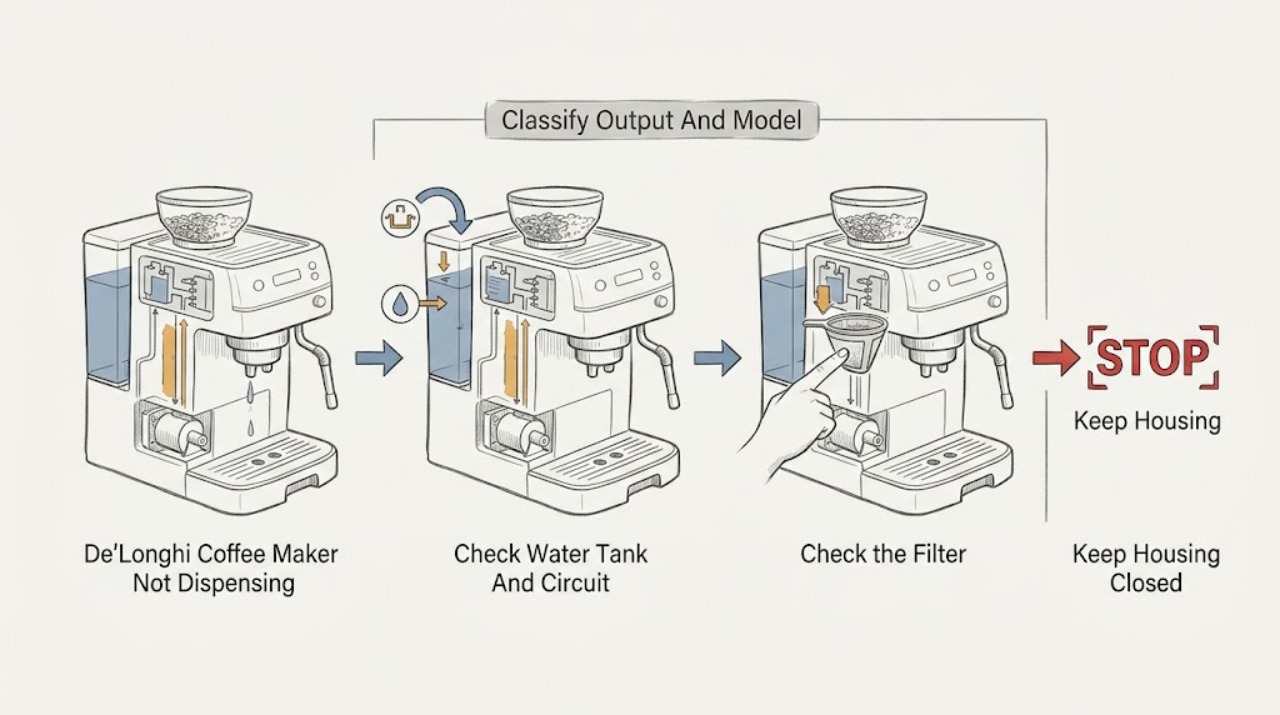
First identify what is not dispensing: coffee, hot water, steam, or all three, and record the exact De’Longhi model. Check that the water tank is filled and fully seated, then inspect only removable coffee or steam outlets for visible blockage. For bean-to-cup machines, confirm beans are present and the grinder is not being asked to process oily or coated beans; for a portafilter machine, check the filter basket, coffee amount, grind, and holder seating using the model manual. A water-circuit-empty message may have a model-specific fill or prime command, while descaling must follow De’Longhi’s exact procedure because hot acidic liquid can exit the spouts. If coffee alone fails, the outlet, filter, grind, or brew path is more likely; if hot water and steam also fail, an empty or blocked water circuit or an internal pump, valve, heater, or control fault is more likely. Stop for leaks, uncontrolled hot liquid, burning odor, smoke, repeated electrical trips, or persistent failure after the safe checks. Do not open the housing, reach into the grinder, remove an internal pump or valve, touch the heater, or perform energized testing.
Before you begin
Safety first
- The user may identify the model, fill and seat the removable tank, clean permitted external or removable spouts and baskets after shutdown and cooling, follow model-specific water-circuit and guided descaling steps, and observe output from a safe position. Internal pumps, valves, heaters, thermoblocks, grinders, brew mechanisms, sensors, control boards, wiring, pressurized fittings, housing disassembly, and energized testing are for qualified service personnel.
Work through in order
Diagnostic checks
Use only checks that match the exact appliance or system and its official guide.
-
Check 1
Read the complete model label and identify the failed output: brewed coffee, hot water, steam, milk output, or all water-based outputs. Note whether the display is ready, whether the pump makes a sound, whether an alarm or water-circuit message appears, and whether a small amount of liquid or no liquid leaves the outlet.
Expected result: Only coffee fails; only hot water or steam fails; coffee and hot water both fail; or the machine is unpowered or showing a model-specific message.
Next step: Use the exact model manual and continue only with the matching water, outlet, grinder, or steam check. If the machine is unpowered, leaking, or showing a persistent fault message, stop and arrange qualified service.
Stop if: Do not open the housing, infer a failed pump from sound alone, or use a different De’Longhi model’s procedure.
Why this matters
Why: A coffee-only failure keeps the coffee outlet, filter, grind, brew unit, or coffee-side path in focus. Failure of both coffee and hot water points more toward the tank, water circuit, pump, valve, heater, or control. The message and machine architecture determine the next safe check.
-
Check 2
Turn the machine off as directed by the model manual, allow hot parts to cool, and check the removable water tank. Fill it with fresh water within the marked limit, ensure any model-approved filter is installed as instructed, and press the tank fully into place. If the display explicitly says the water circuit is empty, use only the named model’s fill or OK command with a container under the outlet.
Expected result: The tank was empty or not seated; the machine completes its documented fill prompt and water flows; the circuit message returns; or no water flows despite a full, correctly seated tank.
Next step: If the exact model’s fill procedure works, make one normal beverage test after the machine returns to ready. If the circuit does not fill, leaks, or repeatedly reports empty, stop and arrange service.
Stop if: Do not remove internal hoses, prime with improvised tools, run the machine without its tank, or continue if water is escaping near electrical parts.
Why this matters
Why: An empty or mis-seated tank can interrupt the water circuit. De’Longhi’s Help Center documents an on-screen fill process for named automatic models, but a returning message or no flow after that model-specific step makes an internal blockage, pump, valve, or control issue more likely.
-
Check 3
For an automatic machine, inspect the external coffee spouts and clean only the openings the exact manual identifies, using a soft sponge or suitable non-sharp method. For a portafilter machine, with the machine off and cool, remove the holder and inspect the removable basket holes, holder seating, coffee amount, and grind against the model instructions. Do not release a pressurized holder or open the boiler outlet while dispensing.
Expected result: The coffee spouts or basket openings are blocked; the holder is mis-seated or overfilled; coffee drips slowly; or the coffee path is visibly clear but no coffee dispenses.
Next step: Clean and reseat only removable parts as the exact model manual allows, reduce an excessive dose or use the documented grind adjustment, and make one test. If no flow remains or liquid leaks around the holder, stop and arrange qualified service.
Stop if: Do not insert metal tools into a pressurized group, remove a holder during dispensing, dismantle the brew group beyond the manual, or access internal valves.
Why this matters
Why: De’Longhi identifies blocked coffee spouts as a cause on applicable automatic models. Its La Specialista guidance also identifies a blocked filter, too much coffee, or coffee ground too finely as causes of excessive group pressure and no brew. A clear, correctly assembled coffee path shifts suspicion toward the water circuit, brew unit, pump, valve, heater, or control.
-
Check 4
On a bean-to-cup model only, check the visible bean hopper level and whether the machine reports an empty or jammed grinder. Use the exact manual for removing a removable brew unit after a complete shutdown; inspect and rinse only the permitted removable parts. De’Longhi advises avoiding oily, caramelized, or coated beans and changing the grinder setting only while the grinder is actively operating, if that model permits adjustment.
Expected result: The hopper is empty; beans are oily, coated, or bridged; the grinder is silent or repeatedly alarms; the brew unit is visibly dirty or not seated; or the machine is a non-bean model.
Next step: Use fresh, appropriate beans and restore only the removable parts the model manual permits. Do not force the grinder or brew unit. If hot water flows but coffee still does not, arrange model-specific diagnosis.
Stop if: Do not put fingers, tools, or liquid into the grinder, bypass a hopper or brew-unit sensor, or change an internal drive or motor.
Why this matters
Why: A missing or bridged bean supply, a grinder jam, or an incorrectly seated brew unit can prevent coffee from reaching the outlet even when hot water works. This check does not apply to a drip or portafilter model, and a silent grinder or internal jam after the permitted cleaning points to service.
-
Check 5
After the machine has cooled enough to handle safely, inspect the removable hot-water or steam spout and wand tip. Clean only the external opening and removable accessory described by the exact manual; on a steam-capable model, confirm the control is in the documented steam or hot-water position and observe whether water, steam, both, or neither exits.
Expected result: Coffee dispenses but hot water and steam do not; the spout opening is visibly blocked; hot water flows but steam is weak; or the spout is clear and neither output works.
Next step: Clean and refit only the removable spout or wand parts the manual permits, then make one brief, supervised test with a suitable container. If no flow, uncontrolled spray, or a persistent fault remains, stop and arrange service.
Stop if: Do not touch hot liquid or steam, clear a hot outlet with fingers, remove a pressurized fitting, or open the steam valve, heater, or pump assembly.
Why this matters
Why: De’Longhi identifies a dirty or blocked hot-water/steam spout as a cause of no steam or hot water on applicable models. Coffee-only flow with a blocked steam path supports an outlet blockage; failure of all outputs after a clear spout points toward the water circuit, pump, valve, heater, or control.
-
Check 6
If the exact model requests descaling and there is no leak or electrical hazard, run only its guided descaling procedure with the specified De’Longhi descaler, a large container, and the required rinses. Do not substitute vinegar or improvise a priming sequence. Keep hands and face away from the outlets because the procedure can discharge hot acidic liquid.
Expected result: Flow returns after the model-specific descale and rinse; flow improves but remains restricted; the descale prompt returns; or no output remains from one or more paths.
Next step: Allow the machine to complete its documented rinse and make one normal test. If the prompt or no-dispense symptom returns, stop using the machine and arrange qualified De’Longhi appliance service with the model and output pattern.
Stop if: Do not touch descaling liquid, interrupt a hot discharge, mix chemicals, repeat cycles indefinitely, or access the pump, valve, heater, or wiring.
Why this matters
Why: Scale can restrict a water or coffee path, and De’Longhi identifies descaling as a maintenance step. A correctly completed procedure that does not restore flow makes a deeper blockage, pump, valve, heater, brew-unit, or control fault more likely; it does not justify opening the machine.
Use your observations
Decision map
Find the observation that best matches what you see, then follow the next safe action.
-
PATH 01Safety boundary
What you see
Hot water or steam works, but coffee does not; the water tank is seated and there is no active model fault.
Do this next
Follow the exact automatic or portafilter model procedure for removable spouts, basket, beans, grind, and brew-unit cleaning. If the coffee path is clear and coffee still will not dispense, arrange qualified service.
Why this path and its safety boundary
Why it matters: A blocked coffee spout, filter basket, overfilled or too-fine coffee path, grinder/bean supply, or brew-unit issue is more likely than a whole-machine pump failure.
Safety stop: Do not open the group head, force the brew unit, reach into the grinder, or release a pressurized holder during dispensing.
-
PATH 02Safety boundary
What you see
Coffee may dispense, but both hot water and steam fail or the hot-water/steam spout is visibly blocked.
Do this next
Cool the machine, clean only the documented removable outlet, and follow the exact model’s water-circuit or descale procedure once. Escalate if output does not return.
Why this path and its safety boundary
Why it matters: A blocked spout or shared water path is more likely than a coffee grind problem. If the spout is clear and the tank is correctly seated, an internal pump, valve, heater, or control fault becomes more likely.
Safety stop: Do not clear a hot outlet by touch, remove a steam fitting under pressure, or open the heater, valve, or pump.
-
PATH 03Safety boundary
What you see
The machine shows a water-circuit-empty or fill-circuit message, the tank was empty or mis-seated, or the pump sounds without water delivery.
Do this next
Use only the exact model’s on-screen fill/OK instruction with a container under the outlet. If the tank is fully inserted but no flow occurs or the message returns, arrange service.
Why this path and its safety boundary
Why it matters: The water circuit may be empty or not receiving water from the seated tank. The named De’Longhi models provide a model-specific fill command; a returning message after that step suggests a deeper water-path problem.
Safety stop: Do not run a dry pump repeatedly, inject water through openings, remove hoses, or bypass a tank sensor.
-
PATH 04Safety boundary
What you see
Flow is weak or absent at one or more outlets, the model requests descaling, and the tank, removable outlet, coffee basket, or bean path has not yet been cleared according to the manual.
Do this next
Complete the exact model’s permitted cleaning and guided descaling/rinse once, respecting the scalding warning. If flow remains restricted, use qualified service.
Why this path and its safety boundary
Why it matters: Scale or a user-accessible blockage remains plausible. The affected outlet determines whether to clean a coffee spout, filter, steam tip, brew accessory, or follow descaling.
Safety stop: Do not use vinegar where De’Longhi says not to, mix descalers, insert improvised tools into internal passages, or interrupt hot acidic discharge.
-
PATH 05Safety boundary
What you see
The correct tank, outlet, coffee path, grinder/brew-unit checks, and model-approved descale or fill procedure do not restore flow, or the machine leaks, trips protection, overheats, smells of burning, or displays a persistent fault.
Do this next
Stop using the machine, isolate power only from a safe dry position, keep people away from hot liquid, and arrange qualified De’Longhi appliance service with the model and observed output pattern.
Why this path and its safety boundary
Why it matters: An internal pump, valve, heater, thermoblock, grinder drive, brew mechanism, sensor, control, or wiring issue is more likely than a removable blockage; the exact component cannot be established safely from the symptom alone.
Safety stop: Do not open the housing, remove internal parts, defeat sensors, touch heaters, or perform energized electrical testing.
Helpful context
Understand the symptom
“Not dispensing” can describe three different paths
A De’Longhi automatic machine, manual espresso machine, drip maker, and steam appliance do not use the same outlet or controls. Note whether the machine makes coffee but not hot water, hot water but not steam, or nothing at all. The full model number determines whether the relevant user-accessible parts are a bean hopper and brew unit, a portafilter and boiler outlet, or a different water path.
Start with water and removable outlets
A low or incorrectly seated tank can leave the water circuit empty. Coffee spouts, a portafilter basket, a boiler outlet, and a steam wand or hot-water spout can each be blocked independently. De’Longhi permits cleaning of some removable accessories and spouts, but the appliance must be shut down and cooled where the model requires it; never turn an outlet blockage into an internal disassembly project.
Descaling and priming are model-controlled procedures
Use only the exact model’s guided descaling or water-circuit fill procedure. De’Longhi’s descaling guide warns that hot acidic solution flows from the spouts, and its Help Center gives different fill prompts for different machine families. If the procedure does not restore flow, the internal pump, valve, heater, control, or a deeper blockage needs qualified diagnosis.
Safety boundary
Stop conditions
- Stop using the coffee maker for smoke, arcing, burning odor, abnormal heat, damaged wiring, leaking near electrical parts, repeated protection trips, or uncontrolled hot liquid; isolate power only from a safe, dry position.
- Do not open the housing, reach into the grinder, remove internal pumps, valves, heaters, thermoblocks, control boards, sensors, or wiring.
- Do not release a pressurized holder or fitting during dispensing and do not touch hot water, steam, or acidic descaling liquid.
- Do not prime through improvised openings, run a dry pump repeatedly, bypass tank or brew-unit sensors, or perform energized electrical tests.
- Do not generalize a water-circuit, HI/LO, descale, or control sequence from another De’Longhi model.
Only after diagnosis
Potential parts
- water pump or inlet valve
Consider this only when the exact model is identified and qualified diagnosis confirms that the tank, accessible outlet, water circuit fill, and permitted descaling checks do not restore flow.
Verify the exact model and manufacturer fit information; pump and valve designs vary among De’Longhi machine families. - thermoblock or boiler heater
Consider this only when qualified diagnosis shows that water delivery or heating fails after the accessible water path and model-specific procedures are completed.
Do not infer the cooling or heating architecture or fit from the brand name; confirm the exact model and manufacturer fit information. - grinder or brew-unit drive
Consider this only for a bean-to-cup model when hot water works, the bean path and permitted brew-unit checks are complete, and qualified diagnosis confirms a grinder or brew mechanism fault.
Confirm the full model and manufacturer fit information; grinder and brew-unit components are not interchangeable by brand name alone. - control board or flow sensor
Consider this only when a persistent model-specific message or no-flow pattern remains after the tank, outlet, bean/coffee path, and guided fill/descale checks and service diagnosis identifies a control or sensing fault.
Use the exact model manual and manufacturer fit information before ordering; do not substitute a control or sensor based on a generic error description.
When checks do not resolve it
Need a professional?
Arrange qualified service when no output persists after the exact model’s tank, removable outlet, coffee or bean path, and permitted fill or descale checks; when a persistent fault message returns; or when the machine leaks, overheats, smells of burning, trips electrical protection, or sprays uncontrolled hot liquid. Stop using it immediately for smoke, arcing, or other electrical or scalding hazards.
Safety scope: The user may identify the model, fill and seat the removable tank, clean permitted external or removable spouts and baskets after shutdown and cooling, follow model-specific water-circuit and guided descaling steps, and observe output from a safe position. Internal pumps, valves, heaters, thermoblocks, grinders, brew mechanisms, sensors, control boards, wiring, pressurized fittings, housing disassembly, and energized testing are for qualified service personnel.
Common questions
FAQ
Why does my De’Longhi coffee maker dispense hot water but no coffee?
That pattern keeps the coffee-side path in focus: a blocked coffee spout or filter basket, too much or too-finely ground coffee, an incorrectly seated holder, a bean/grinder issue, or a brew-unit problem. Clean only the removable parts named by the exact model and arrange service if the clear path still produces no coffee.
What should I do if my De’Longhi machine will not dispense hot water or steam?
Allow the machine to cool, inspect and clean only the documented removable hot-water or steam spout, and check whether the water tank is full and seated. De’Longhi identifies a blocked spout as one possible cause; if the spout is clear and both outputs still fail, the water circuit or an internal pump, valve, heater, or control needs service.
How do I respond to a De’Longhi water-circuit-empty message?
Use the exact model’s on-screen fill command with a container under the outlet. De’Longhi’s Eletta Explore and named Dinamica Help Center pages use an OK/fill instruction, and both are model-specific. If the message returns after the tank is fully inserted and the documented fill is complete, arrange service.
Can a clogged filter or grind stop a De’Longhi espresso machine from dispensing?
Yes. De’Longhi’s La Specialista guidance lists a blocked filter basket, too much coffee, and coffee ground too finely as causes of excessive group-head pressure and no brewing. Follow the exact model’s dose, grind, and removable-filter instructions; do not release a pressurized holder or open the boiler outlet while the machine is dispensing.
Should I descale a De’Longhi coffee maker that is not dispensing?
Only when the exact model requests it or its manual supports it. Use the documented De’Longhi descaler and complete every required rinse; De’Longhi warns that hot acidic liquid exits the spouts during the procedure. If flow does not return after one correctly completed model-specific cycle, stop repeating it and arrange qualified service.
When should a De’Longhi no-dispense problem be serviced?
Arrange service when the tank and permitted removable outlets are clear but coffee, hot water, or steam still will not flow; when a water-circuit or fault message returns; or when the machine leaks, overheats, smells of burning, trips protection, or discharges uncontrolled hot liquid. Internal pumps, valves, heaters, grinders, brew mechanisms, controls, and wiring are not owner repairs.
Read the exact guide
Official sources
- IMPORTANT SAFEGUARDSDe’Longhi · The tank, filter-holder, hot-water, descaling, scalding, and no-flow troubleshooting applies to the ECO-310W model; other machines differ.
- No steam or hot water comes out of the spout | MaestosaDe’Longhi Coffee Machines Help Center · The blocked hot-water/steam-spout guidance applies to Maestosa; other models may use different wand and valve arrangements.
- Common Issues - Fully Automatic Coffee Machine FAQDe’Longhi US · Guidance applies to fully automatic machines; manual espresso, drip, and other De’Longhi models may use different parts and procedures.
- Coffee does not come out of the spouts | Eletta ExploreDe’Longhi Coffee Machines Help Center · The coffee-spout cleaning instruction applies to Eletta Explore; other models may have different spouts and access.
- Message: Water circuit empty, Fill water circuit, Hot water, Confirm? | Dinamica ECAM35X.55 - ECAM35X.75De’Longhi Coffee Machines Help Center · The OK/spout fill instruction and steam-dial note apply to the named Dinamica models only.
- Why is my La Specialista not brewing espresso and is showing a flashing alarm icons? FAQDe’Longhi US · The filter, dose, and grind guidance applies to La Specialista; automatic and drip machines use different brew paths.
- Message: Water circuit empty. Press OK to start filling process | Eletta ExploreDe’Longhi Coffee Machines Help Center · The OK/fill procedure applies to Eletta Explore; it is not a universal instruction for every De’Longhi machine.
- Guide: Descaling | Eletta ExploreDe’Longhi Coffee Machines Help Center · The sequence and display steps apply to Eletta Explore; other models can use different descale menus and quantities.
Community feedback
Share a repair observation
Share a plain-text repair observation. Accepted observations are published automatically; this page may take a moment to update.