
On this page
Start here
Quick answer
Start by identifying the exact De’Longhi product family and the symptom: no lights, lights on but no start, no coffee, no hot water, no heat, or an error/indicator message. Check the plug, outlet, and any external power switch only from a dry, safe position; for applicable models, confirm the rear switch is on and wake the machine from standby with its normal button. Fill and correctly seat the water tank, drip tray, portafilter/brew group, and other user-removable parts exactly as the model manual shows, but let hot surfaces and steam cool before handling. For no-flow symptoms, use only the model's documented filter, grind, dose, rinse, or descaling procedure; De’Longhi says clogged filters, excess or too-fine grounds, scale, and an empty or incorrectly seated tank can stop coffee or water flow on applicable machines. Use the manufacturer-recommended descaler rather than vinegar where the official guidance applies. If the machine stays dead, will not heat, pumps or grinds abnormally, an error returns, there is leaking near electrics, smoke, a burning smell, or a hot/damaged cord, stop using it and arrange qualified service. Do not bypass interlocks, force a portafilter, open the electrical enclosure, touch the heater or pump, or work on live wiring.
Before you begin
Safety first
- The user may identify the model, check an external outlet and cord from a dry safe position, use documented on/standby controls, allow cooling, reseat user-removable parts, clean accessible filters/accessories, and follow the exact approved rinse or descaling procedure. Internal wiring, heater, thermal protection, pump, valves, grinder mechanics, controls, and pressurized circuits are for qualified personnel.
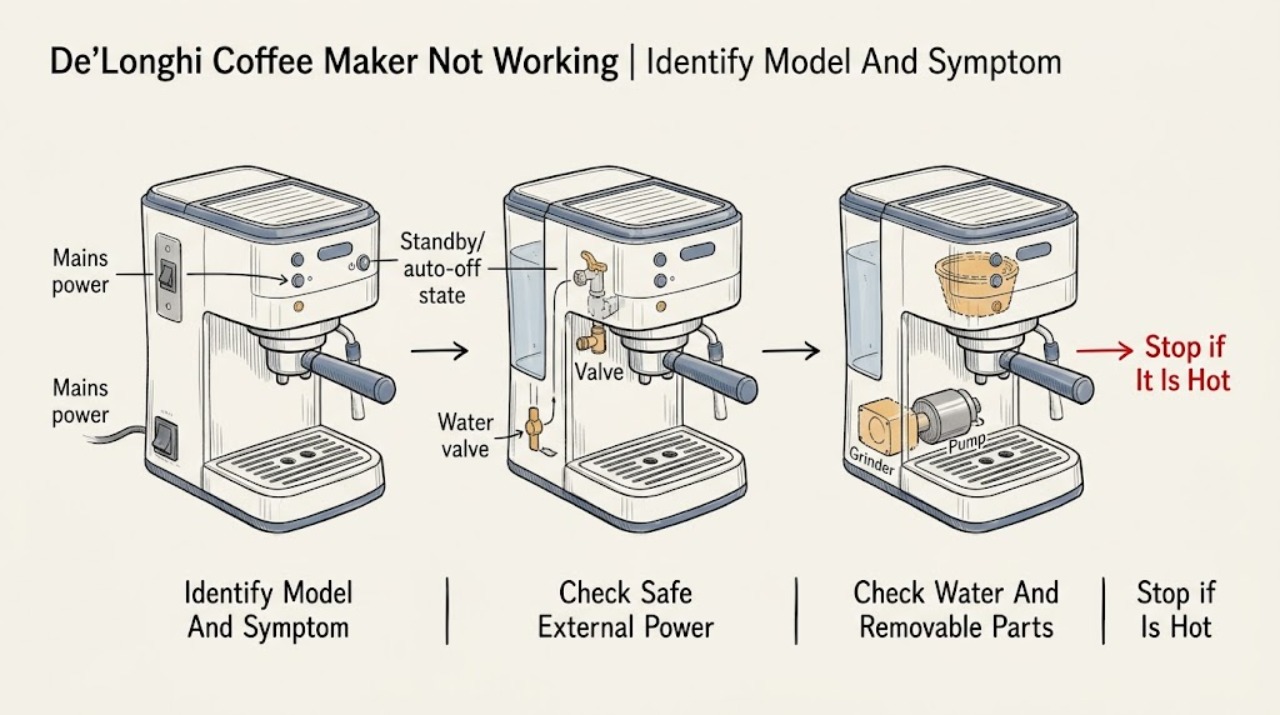
Work through in order
Diagnostic checks
Use only checks that match the exact appliance or system and its official guide.
-
Check 1
Read the full model and record whether the machine is a drip coffee maker, pump espresso machine, fully automatic bean-to-cup unit, or another De’Longhi coffee product. Note whether there are no lights, lights but no start, no coffee, no hot water, no heat, a stuck/noisy grinder, or a flashing indicator/error.
Expected result: The model and symptom family are known, the product is in standby, the display or indicator gives a model-specific message, or the product family cannot be identified.
Next step: Use the exact model manual and the matching branch below. If the model cannot be identified or the symptom is accompanied by a hazard, stop using the machine and provide the rating-label information to service.
Stop if: Do not remove covers or infer a part from the brand name alone.
Why this matters
Why: The same words describe different mechanisms across De’Longhi families. Model identity determines whether the relevant user checks involve a rear switch, steam control, portafilter, brew unit, grinder, water tank, or a particular indicator code.
-
Check 2
From a dry, safe position, verify the plug is seated in the intended outlet and inspect the cord and plug for visible damage, moisture, looseness, scorch marks, or abnormal heat. Check the household supply without opening an outlet. If the exact model has a rear power switch, confirm it is on; if it uses standby or auto-off, press its normal on/off control with the steam control released as the manual requires.
Expected result: The outlet is dead, a breaker or external protection has tripped, the cord/plug is damaged or hot, the rear switch was off, the machine is in standby, or the external power path and normal controls appear correct.
Next step: For a dead household supply, use qualified electrical help. For a damaged/hot/wet cord or repeated trip, stop using the machine and arrange service. If a documented switch or standby correction restores normal operation, monitor it without repeated cycling.
Stop if: Do not repeatedly reset protection, use an extension to bypass the circuit, or continue with a hot, wet, loose, or scorched plug/cord.
Why this matters
Why: A supply, switch, or standby state can explain a dark or apparently inactive machine. A hot/damaged cord, wet area, or repeated protection trip is an electrical safety issue. Normal external power shifts attention to water, brew, heater, grinder, control, or internal service.
-
Check 3
Stop the machine normally and wait until hot surfaces, water, and steam are safe to handle. Fill the water tank with the water specified by the exact manual and seat it fully; check only user-removable items such as the drip tray, portafilter/filter holder, brew unit, grounds container, hot-water tube, or milk accessory for correct placement and visible blockage. Do not force a locked part.
Expected result: The tank is empty or not seated, a removable part is missing or misaligned, a tray/container is full, a visible removable filter or outlet is blocked, or all user parts are correctly fitted.
Next step: Correct the documented user-removable condition once and perform only the model's normal rinse or water-delivery test. If no water moves, a part will not release, or water leaks into the base, stop and arrange service.
Stop if: Do not reach into a hot group head, force a portafilter, pry a brew unit, remove internal hoses, or pour water into the cabinet.
Why this matters
Why: Many De’Longhi machines inhibit brewing or water delivery when a tank, tray, brew group, or accessory is absent or incorrectly seated. A visible, user-accessible blockage is different from a pump or valve fault; correct seating does not prove the internal circuit is healthy.
-
Check 4
For a pump or fully automatic machine, follow the exact manual's user-level brew or rinse check after the machine is cool and the tank is seated. Inspect the removable filter basket or brew outlet for coffee residue; on a bean-to-cup model, note whether the grinder runs, whether a ground-too-fine or similar message appears, and whether water comes out during the documented rinse. Do not adjust a grinder unless the manual says it may be adjusted while actively grinding.
Expected result: No water comes from the hot-water or coffee outlet, coffee drips slowly, the filter is visibly blocked, there is too much or too-fine coffee, the grinder is noisy/stuck, or water flows normally but no coffee is delivered.
Next step: Clean only the removable filter/brew accessories and follow the model's documented grind, dose, rinse, or descaling procedure. If a blockage will not release easily, water still does not flow, or the grinder remains abnormal, stop and arrange service.
Stop if: Do not force a grinder, insert tools into a powered machine, run an unapproved cleaning chemical, or bypass a brew interlock.
Why this matters
Why: A blocked filter, dose, grind, scale, empty circuit, or brew-unit condition can restrict flow. De’Longhi says a noisy grinder may have a foreign object and that an electronic-grinder model should go to a service center; no water after the documented rinse can require service. These observations do not identify a pump or valve part.
-
Check 5
Observe one normal heat-up and brew attempt without touching internal parts. Note whether the ready/heating indicator changes, whether hot water or steam is produced as the manual describes, whether the drink is merely less hot, and whether a descale, water, alarm, or other message remains. Do not open a cap or portafilter while pressure or steam may be present.
Expected result: The machine never reaches ready, coffee or water is cold, the heating indicator stays in a fault state, a descale or alarm light returns, or heating and delivery are normal.
Next step: Complete only the exact model's documented descaling or indicator-reset procedure with the approved product. If the heater does not recover, the light returns, or the machine vents abnormally, stop and arrange qualified service.
Stop if: Do not touch a heater, thermal fuse, thermostat, valve, wiring, or pressurized circuit, and do not continue a hot-water test after leakage or steam escapes abnormally.
Why this matters
Why: A control or scale message can inhibit operation, while no heat after a correct water and control setup makes the heater, thermal protection, sensor, or control path more likely. A cold outlet is not a safe basis for testing a heater or thermostat.
-
Check 6
Record the model, power/indicator state, water-tank and removable-part result, coffee or hot-water flow, grind/dose or filter observation, heating response, descaling history, and any leak, sound, smell, heat, or error. Keep the machine unplugged when it is out of service and protect hands and surfaces from residual hot water.
Expected result: Operation returns after a safe external or user-removable correction, or the machine remains dead, fails to pump/grind/heat, leaks, repeatedly shows an indicator, trips protection, or smells/burns abnormally.
Next step: Provide the model and complete observations to De’Longhi Customer Care or a qualified appliance service center. For smoke, burning odor, electrical heat, water near electrics, or repeated trips, stop using the appliance immediately and isolate power only from a safe, dry position.
Stop if: Do not open the housing, perform live tests, replace an internal fuse or heater, service a pump/valve, or continue operation after a safety event.
Why this matters
Why: A stable recovery supports a power-state, seating, flow restriction, maintenance, or expected standby cause. Persistent failure points toward internal pump, grinder, heater, valve, control, or electrical work; a hazard requires immediate discontinuation rather than another brew attempt.
Use your observations
Decision map
Find the observation that best matches what you see, then follow the next safe action.
-
PATH 01Safety boundary
What you see
No indicators appear, the outlet or external supply is dead, the applicable rear switch is off, or a pump espresso model immediately returns to standby because its steam control is left engaged.
Do this next
Correct only the normal switch/standby condition once. For a bad supply, damaged cord, or repeated trip, stop and use qualified electrical/appliance service; otherwise continue with the model's normal start attempt.
Why this path and its safety boundary
Why it matters: An external supply, switch, or documented standby/safety state is more likely than a failed pump or heater. A damaged cord, hot plug, or repeated protection trip is an electrical hazard.
Safety stop: Do not bypass a safety state, reset protection repeatedly, or use damaged power parts.
-
PATH 02Safety boundary
What you see
The machine powers up but no coffee or hot water flows, the tank or tray is empty/misaligned, the filter or outlet is clogged, the dose/grind is unsuitable, or a rinse produces no water.
Do this next
Cool the machine, correct seating, clean only the documented removable parts, and use the exact model's approved rinse, grind, dose, or descale procedure. If flow remains absent or a part is stuck, arrange service.
Why this path and its safety boundary
Why it matters: A user-removable seating or flow restriction is more likely than a proven pump or valve failure. De’Longhi's published flow guidance also treats scale and grinder/brew-unit conditions as model-specific causes.
Safety stop: Do not force hot parts, insert tools into the grinder or outlet, or open the pump/valve circuit.
-
PATH 03Safety boundary
What you see
Power and water setup are normal but the machine never reaches ready, delivers cold coffee/hot water, repeatedly shows a descale/alarm/fault indicator, or fails after the documented maintenance cycle.
Do this next
Use only the exact manual's approved descaling or indicator procedure. If heating or the fault state does not recover, keep the machine out of service and arrange qualified diagnosis.
Why this path and its safety boundary
Why it matters: A heater, thermal protection, sensor, control, or scale-related issue is more likely. An indicator may have a different meaning by model, so it cannot identify a replacement part.
Safety stop: Do not test or replace the heater, thermal fuse, thermostat, sensor, or wiring yourself.
-
PATH 04Safety boundary
What you see
A grinder is loud or stuck and will not clear easily, the machine's pump/valve/heater remains inactive after the external checks, a removable part cannot release, or a control fault persists.
Do this next
Stop using the machine and arrange qualified De’Longhi/appliance service with the model and symptom record. Do not order an internal part from the brand name alone.
Why this path and its safety boundary
Why it matters: An internal grinder, pump, valve, heater, control, or mechanical obstruction is more likely than a simple user setting. De’Longhi directs electronic-grinder models and persistent no-water conditions to service.
Safety stop: Do not force a grinder, remove panels, bypass an interlock, or perform energized tests.
-
PATH 05Safety boundary
What you see
Water or steam leaks toward electrical parts, the cord/plug is hot or damaged, there is smoke, a burning smell, arcing, an abnormal electrical sound, or a protection device trips.
Do this next
Stop using the machine, keep hands away from hot water/steam and wet electrics, and isolate power only from a safe, dry position. Arrange qualified service and do not resume until assessed.
Why this path and its safety boundary
Why it matters: This is a shock, burn, or fire boundary rather than a brew-flow adjustment. Continued operation can worsen the hazard.
Safety stop: Do not wipe inside an energized machine, restore power for a test, open the housing, or touch exposed contacts.
Helpful context
Understand the symptom
Identify the machine family before changing anything
De’Longhi sells drip coffee makers, pump espresso machines, fully automatic bean-to-cup machines, and other coffee products. A “not working” report can mean no indicator, no brewing, no hot water, no heat, a blocked grinder, or an expected standby state. Read the model label and use its manual; a procedure for a portafilter machine is not a safe substitute for a bean-to-cup or drip-machine procedure.
Treat water, coffee, and steam as hot and pressurized
Stop a brew or steam cycle with the normal control and allow the machine to cool before removing a tank, portafilter, brew unit, or blocked accessory. Keep hands and face away from hot water and steam, and do not force a locked handle. Check only user-removable parts named by the exact manual. A pump, valve, heater, grinder, or internal hose is not an owner-level repair.
A no-flow symptom is not automatically a failed pump
Official De’Longhi guidance lists an empty or incorrectly seated tank, a clogged filter, too much coffee, coffee ground too finely, scale, and a grinder or brew-unit problem as different causes on different machine families. A clean basket or rinse that still produces no water changes the next step toward service; it does not justify opening the pump or descaling with an unapproved chemical.
Safety boundary
Stop conditions
- Stop using the coffee maker for smoke, arcing, burning odor, abnormal electrical heat, a hot/damaged plug or cord, water near electrics, repeated protection trips, or uncontrolled steam/hot-water leakage; isolate power only from a safe, dry position.
- Allow the machine to cool before removing a tank, portafilter, brew unit, filter, drip tray, or other accessory; never force a pressurized or hot part.
- Do not open the housing, perform live-voltage or continuity tests, replace internal fuses/heaters/thermostats, touch pumps/valves, or bypass a brew, steam, tank, or door interlock.
- Do not force or probe a grinder, use tools in a powered machine, or continue operating an electronic-grinder model with a persistent abnormal sound.
- Do not substitute vinegar or an unapproved chemical for the exact model's documented descaler, and do not repeat a descaling or reset cycle when the fault or leak persists.
When checks do not resolve it
Need a professional?
Arrange qualified De’Longhi or appliance service when the exact model's normal power/standby check, water-tank and removable-part check, documented flow/cleaning/descaling procedure, and normal heat-up do not restore operation; when a pump, grinder, heater, valve, or control remains inactive; or when an indicator returns. Stop immediately for smoke, burning odor, arcing, hot/damaged cord or plug, water near electrics, uncontrolled steam/hot-water leakage, or repeated protection trips. Internal electrical, pump, grinder, heater, valve, and control work is not an owner check.
Safety scope: The user may identify the model, check an external outlet and cord from a dry safe position, use documented on/standby controls, allow cooling, reseat user-removable parts, clean accessible filters/accessories, and follow the exact approved rinse or descaling procedure. Internal wiring, heater, thermal protection, pump, valves, grinder mechanics, controls, and pressurized circuits are for qualified personnel.
Common questions
FAQ
Why is my De’Longhi coffee maker not turning on?
Identify the exact model first, then check the external outlet, plug, and cord from a dry safe position. Applicable bean-to-cup models may have a rear power switch, and applicable pump espresso machines may be in standby or safety mode if the steam control is engaged. If the supply and documented controls are normal but the machine remains dead, arrange service.
Why does my De’Longhi coffee maker have power but make no coffee?
Check the model's water tank and user-removable brew parts, then follow its documented rinse or brew check. On applicable models, a blocked filter, too much or too-fine ground coffee, scale, an empty circuit, or a grinder/brew-unit condition can stop flow. No water after the model's safe procedure needs service rather than pump disassembly.
What should I do if my De’Longhi coffee maker is not dispensing hot water?
Let the machine cool enough to handle, fill and seat the tank, check the model's removable hot-water outlet or filter, and run only the documented rinse or hot-water procedure. If there is no flow, a persistent alarm, leakage, or an abnormal pump sound, stop and arrange qualified service.
Why is my De’Longhi coffee maker not heating?
Check the model's water level, normal ready/heating indicator, and documented descale status. A persistent descale light can require the approved procedure, but no heat after the correct external checks may involve the heater, sensor, thermal protection, or control. Do not test or replace those parts yourself.
What if my De’Longhi grinder is loud or not working?
On applicable non-electronic-grinder models, switch off and unplug before following the manual's accessible bean/foreign-object check, and do not force anything stuck. De’Longhi says electronic-grinder models and persistent no-water conditions should go to a service center. Do not insert tools into a powered grinder.
When should I stop using a De’Longhi coffee maker?
Stop for smoke, burning odor, arcing, a hot or damaged plug/cord, water near electrics, repeated protection trips, uncontrolled steam or hot-water leakage, or a part that will not release safely. Isolate power only from a safe, dry position and arrange qualified service; do not open the machine while hot or energized.
Read the exact guide
Official sources
- Frequently Asked QuestionsDe’Longhi · Confirms separate Coffee Maker, Fully automatic Espresso maker, and other product categories; exact instructions remain model-specific.
- Why is my La Specialista not brewing espresso and is showing a flashing alarm icons?De’Longhi · La Specialista model family; filter, dose, grind, and alarm details should not be generalized to every coffee maker.
- Descale Light is always flashing or not turning offDe’Longhi · Applicable De’Longhi coffee machines with the described descale indicator and water-hardness settings.
- Issues with the Coffee Grinder in My De'Longhi Coffee MachineDe’Longhi · Models with a coffee grinder; electronic-grinder models may require service and grinder locations/procedures vary.
- My pump espresso machine went into standby mode and now will not switch on. What can I do?De’Longhi · Applicable pump espresso machines with the described steam-button and auto-off behavior.
- De'Longhi Customer ServiceDe’Longhi · General support and model-identification guidance for De’Longhi coffee products.
- Common Issues - Fully Automatic Coffee MachineDe’Longhi · Fully automatic coffee-machine guidance; drip and pump machines use different parts and procedures.
- My bean to cup machine will not switch on. What can I try?De’Longhi · Applicable bean-to-cup models that have a rear switch; do not assume every De’Longhi coffee product has one.
Community feedback
Share a repair observation
Share a plain-text repair observation. Accepted observations are published automatically; this page may take a moment to update.