
On this page
Start here
Quick answer
Start by identifying the architecture and the exact symptom: Breville's drip machines such as the BDC650 use a water tank, carafe, filter basket, grinder, and brew controls, while espresso machines such as the BES840 use a water tank, portafilter, pump, heater, and steam wand. Check only the visible plug, water level, model-specific basket/portafilter, and displayed status; do not mix procedures between models. A persistent no-power, no-heat, no-flow, grinder, steam, or warning condition—especially with a damaged cord, burning odor, smoke, leaking onto electrics, or repeated breaker trips—needs Breville support or qualified service rather than an internal electrical test.
Before you begin
Safety first
- Do not open the housing, probe live wiring, defeat a drip-machine basket/door interlock, remove an espresso portafilter during extraction, work on hot or pressurized parts, or continue after smoke, burning odor, sparking, dangerous heat, liquid on electrical parts, a damaged cord/plug, or a repeated breaker trip. Switch off and unplug before documented cleaning or removable-part work, and keep hands away from grinder and hot-water/steam paths.
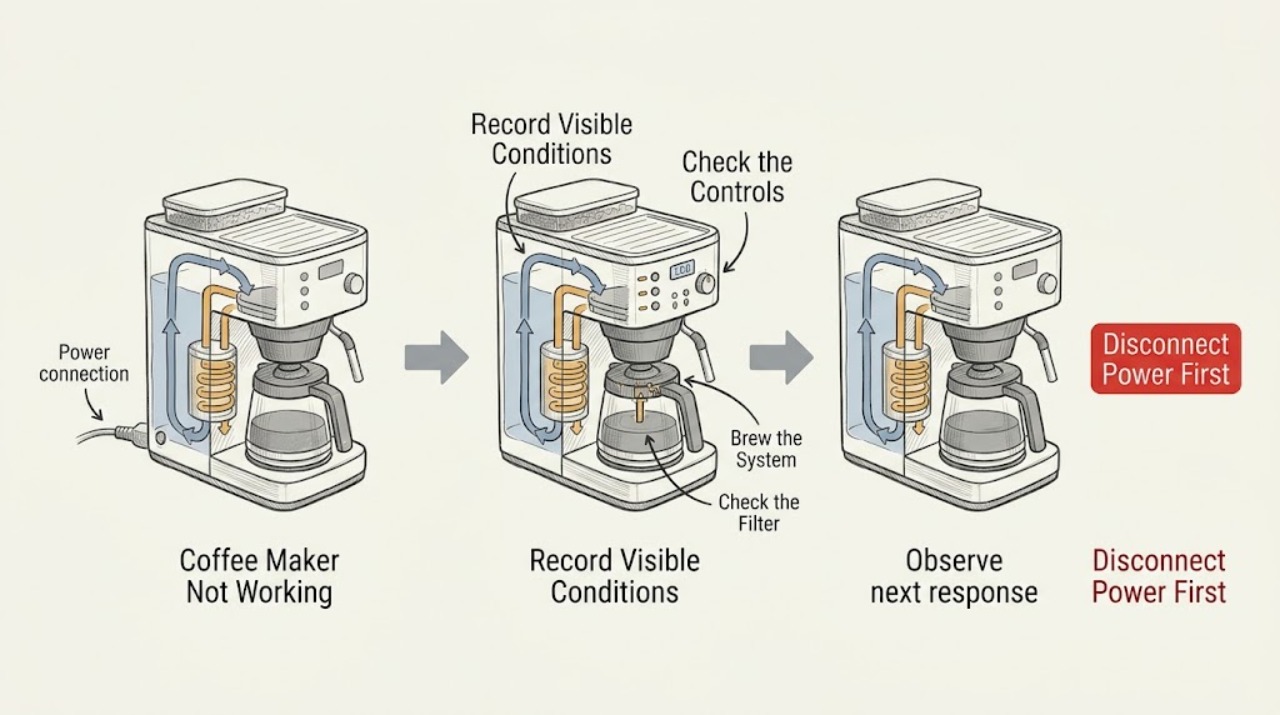
Work through in order
Diagnostic checks
Use only checks that match the exact appliance or system and its official guide.
-
Check 1
Classify the appliance and failure before starting another cycle. Record the full model, then note whether the display or power light is dark, the machine powers on but does not pump or brew, it cannot heat, the grinder or basket status blocks a drip brew, the espresso portafilter has restricted flow, the steam wand has no steam, or an exact warning remains.
Expected result: The model and symptom match either a drip/Grind Control design or an espresso/portafilter design, or the model and status are uncertain.
Next step: Use the exact Breville manual or Product Hub for the recorded model. If smoke, burning odor, damaged power parts, dangerous heat, or an active leak onto electrics is present, stop and arrange service without further testing.
Why this matters
Why: The BDC650 and BES840 have different water, brew, grinder, heating, and steam paths. An uncertain model or a hazard symptom is not a reason to try a procedure from another machine.
-
Check 2
For a dark display or no indicator, make only a safe visual power check with the area dry: confirm the visible plug is seated and inspect the cord, plug, and outlet area for cuts, melting, looseness, discoloration, or heat. Check the household breaker or outlet switch only from a safe position; do not open the coffee maker or perform a live electrical test.
Expected result: The cord or plug is damaged, the outlet area is hot or discolored, the breaker trips again, or the visible supply appears normal but the machine stays dark.
Next step: Keep the machine unplugged. Use a qualified electrician for a damaged or repeatedly tripping household supply and Breville or appliance service for a machine that remains dark after the safe visual check.
Why this matters
Why: A damaged or repeatedly tripping supply may be a household electrical fault. A normal-looking outlet does not prove the coffee maker's internal power, heater, pump, or control path is safe.
-
Check 3
For a powered machine that will not draw water, brew, or heat, follow the architecture-specific visible checks. On a BDC650, confirm the tank contains enough cold water, the carafe is empty with its lid locked and seated under the drip stop, and the filter basket is correctly fitted. On a BES840, confirm the tank is filled and fully locked, the steam/hot-water dial is in STANDBY during heat-up, and the portafilter is secured; never remove it during extraction.
Expected result: The relevant tank, carafe/basket, portafilter, or control position was wrong and becomes correct, or all visible conditions are correct but there is still no water, heat, or brew.
Next step: Correct only the visible model-specific setup and allow the espresso machine to finish its documented heat-up. If flow or heat remains absent, stop and arrange Breville service; do not remove a pressurized portafilter, open the housing, or probe the heater or pump.
Why this matters
Why: The BDC650 will not safely run some cycles when its tank, carafe, basket, or door conditions are wrong. On the BES840, an empty or unseated tank, a non-STANDBY dial during start-up, a cold machine, or a restricted portafilter path can prevent flow or heat; correct visible setup does not rule out an internal pump, heater, valve, or scale fault.
-
Check 4
If the drip machine's grinder or brew cycle is blocked, read the BDC650 status exactly before touching parts. 'LOCK BEAN HOPPER' points to the hopper/locking position, 'EMPTY COFFEE FILTER' points to the basket, door, or used grounds, and 'CLEAN COFFEE CHUTE' points to the grinder burrs or grounds chute. Switch off and unplug before any cleaning described in that exact manual, keep hands out of the hopper, and never run the grinder with its lid removed.
Expected result: The model-specific hopper, basket, door, or chute condition is corrected and the status clears, or a foreign object, jam, loud grinder, overflow, or persistent status remains.
Next step: Use only the BDC650's unplugged cleaning instructions for a visible, removable coffee buildup. If the warning remains, the grinder is noisy, the basket overflows, or a foreign object is not safely removable, leave it out of service and contact Breville.
Why this matters
Why: On the BDC650 these messages are tied to its safety and operating interlocks, not to the espresso portafilter system. A persistent jam, foreign object, or status can require service; do not force a burr, reach into moving parts, or substitute an espresso cleaning or grind procedure.
-
Check 5
For espresso restricted flow or no coffee, inspect only the cooled, removable preparation parts specified by the BES840 manual: check that the tank is full and locked, the portafilter is properly secured, and the filter is not visibly blocked by an unsuitable dose, excessively fine grind, or excess tamping. Do not remove a portafilter during extraction or use a pressurized test, gauge test, or internal pump test.
Expected result: The tank is low/unseated, the portafilter or dose is visibly incorrect, the filter appears blocked, or all visible preparation conditions are correct but no flow remains.
Next step: Follow the exact manual's cooled cleaning or descaling guidance only when it applies to the model. If flow remains absent, stop and arrange Breville service; do not open the machine or remove pressurized parts.
Why this matters
Why: The BES840 manual associates no flow or dripping with tank position, grind, dose, tamping, a blocked filter, or scale. If those user-level conditions are correct, an internal pump, valve, heater, or restriction cannot be diagnosed safely by escalating pressure or dismantling the machine.
-
Check 6
Treat steam as an espresso-machine-only branch. On a BES840, wait for the STEAM/HOT WATER light to finish its documented heat-up, confirm water is present and the dial is fully in STEAM, and use only the cooled, model-specific steam-wand cleaning instructions if the tip is visibly blocked. A BDC650 may release steam from its rear vent during grinding and brewing; that documented behavior is different from a steam-wand fault.
Expected result: The espresso steam light is still flashing during heat-up, the tank is empty/unseated, the dial is wrong, the wand tip is blocked, or steam remains absent after the documented conditions are met.
Next step: Return the espresso controls to the safe state, let hot parts cool, and follow only the exact manual's cleaning/descaling steps. If no steam persists, or the machine overheats, leaks, or smells burnt, stop using it and contact Breville service.
Why this matters
Why: A flashing heat indicator or an empty/unlocked tank can be normal reasons for no steam on the BES840, while the BDC650's rear vent steam can be normal during a brew. Persistent no-steam after these checks can involve heating, water, or a blocked internal path.
-
Check 7
Record any exact warning or unusual state instead of repeatedly restarting. For the BDC650, note messages such as 'FILL TANK', 'LOCK BEAN HOPPER', 'EMPTY COFFEE FILTER', 'CLEAN COFFEE CHUTE', or a numbered alert. For the BES840, note a flashing STEAM/HOT WATER light, a machine that ceases operation after heating, or any persistent no-heat/no-flow indication.
Expected result: The exact model manual gives a safe user action and the status clears, or the status persists, returns immediately, or is accompanied by smoke, odor, leaking, unusual heat, or a breaker trip.
Next step: Follow only the matching manual instruction once. If the status remains or a hazard is present, unplug from a safe position, keep the machine out of service, and contact Breville support or qualified service; do not clear a warning by opening the housing or bypassing an interlock.
Why this matters
Why: A model-specific status can identify a tank, hopper, basket, chute, heat-up, or thermal-protection condition, but a persistent warning or a hazard symptom can indicate a deeper pump, heater, control, or electrical fault.
Use your observations
Decision map
Find the observation that best matches what you see, then follow the next safe action.
-
PATH 01Next step
What you see
The machine is completely dark after a visible plug and household-supply check.
Do this next
Keep it unplugged. Use a qualified electrician for the household supply and Breville or appliance service for the machine; do not open the housing or repeatedly reset the circuit.
Why this path and its safety boundary
Why it matters: The first pattern makes a household electrical fault more likely; the second leaves an internal power or control fault possible without making an internal test safe.
-
PATH 02Next step
What you see
The display or controls work, but water, brewing, or heat is absent.
Do this next
Correct only the applicable visible setup and follow the exact manual's cleaning/descaling guidance. If the result does not change, stop and arrange Breville service; preserve the portafilter and hot-water safety boundary.
Why this path and its safety boundary
Why it matters: The first patterns make a model-specific setup or preparation issue more likely. Correct setup with no flow or heat makes a pump, valve, heater, scale, or control fault more likely and is not a reason to increase pressure or dismantle the unit.
-
PATH 03Next step
What you see
A BDC650 drip machine will not grind or brew and displays a hopper, filter, chute, or numbered status.
Do this next
Use only the unplugged BDC650 cleaning instructions for a safe, visible buildup. If the status or jam persists, leave it out of service and contact Breville; do not reach into moving parts or force the grinder.
Why this path and its safety boundary
Why it matters: The first pattern supports a BDC650-specific interlock or removable coffee-buildup condition. The second makes a persistent grinder, sensor, or control fault more likely; this branch does not apply to BES840 espresso machines.
-
PATH 04Next step
What you see
A BES840 espresso machine has no steam, a flashing steam/heat state, or stops after heating; or a BDC650 emits steam during a brew.
Do this next
Use only the exact cooled manual procedure and let the machine reach its documented state. For persistent no-steam, thermal shutdown, or any hazard, unplug safely and arrange Breville service; do not open the machine or work on hot or pressurized parts.
Why this path and its safety boundary
Why it matters: The first BES840 pattern can be normal heat-up, tank, control, or user-cleanable wand conditions, while persistent or hazardous symptoms make a heater, pump, water path, or control fault more likely. The BDC650 vent behavior is documented as normal and should not be confused with a steam-wand system.
Helpful context
Understand the symptom
A Breville coffee maker that is “not working” may be completely dark, powered but unable to draw water, unable to heat, blocked by a grinder or brew interlock, or limited to a steam fault. The BDC650 Grind Control is a drip machine with a hopper, coffee basket, carafe, and LCD; the BES840 Infuser is an espresso machine with a portafilter, group head, pump, heater, and steam wand. Confirm the model before following a check, because a drip-machine error or basket procedure does not apply to an espresso machine.
Keep hot water, steam, the pressurized portafilter, moving grinder parts, and wet electrical surfaces in mind. Switch off and unplug before cleaning or removing model-specific parts, wait for hot components and pressure to settle, and never open the housing, probe live wiring, defeat a basket or portafilter interlock, or continue after an electrical or burning symptom. Breville says maintenance beyond the documented cleaning belongs with its support or an authorized service path.
When checks do not resolve it
Need a professional?
Arrange Breville or qualified appliance service when the machine stays dark after a safe supply check, remains without water flow or heat after the correct model-specific setup, has a persistent grinder/basket warning or jam, fails to recover from a documented thermal-protection condition, or has persistent no steam. Use a qualified electrician when the outlet, breaker, cord, plug, or household wiring is implicated; contact emergency services for active fire or dangerous smoke/heat.
Safety scope: Do not open the housing, probe live wiring, defeat a drip-machine basket/door interlock, remove an espresso portafilter during extraction, work on hot or pressurized parts, or continue after smoke, burning odor, sparking, dangerous heat, liquid on electrical parts, a damaged cord/plug, or a repeated breaker trip. Switch off and unplug before documented cleaning or removable-part work, and keep hands away from grinder and hot-water/steam paths.
Have this ready
- Provide the exact Breville model, architecture (drip or espresso), display and indicator behavior, water/tank status, carafe/basket or portafilter position, grinder and brew symptoms, steam-light state, exact warning text, when the issue began, and any odor, smoke, leak, heat, noise, cord, plug, or breaker behavior.
Common questions
FAQ
Why is my Breville coffee maker not working?
Identify whether it is a drip machine or espresso machine, then separate a dark display from no water, no heat, grinder/brew blockage, restricted espresso flow, no steam, or a warning message. Use the exact model manual for the visible checks; do not mix a BDC650 procedure with a BES840 procedure or open the housing.
What should I check if my Breville machine has power but will not brew?
For a BDC650, check the cold-water tank, empty locked carafe, seated filter basket, closed door, and any hopper/filter/chute message. For a BES840, check tank position, heat-up state, portafilter position, dose/grind, and visible filter blockage. If the correct architecture-specific setup does not restore flow, arrange service rather than increasing pressure or dismantling the machine.
Why is my Breville coffee maker not heating or making steam?
On the BES840 espresso machine, a flashing heat light, an empty or unseated tank, the wrong steam dial position, or a blocked wand can prevent steam; the machine may also stop after a thermal cutoff and need the manual's cooling period. The BDC650 is a drip machine, and steam from its rear vent during grinding and brewing is documented as normal—not an espresso steam-wand fault.
When should I stop troubleshooting and call Breville service?
Stop for smoke, burning odor, sparking, dangerous heat, a damaged cord or plug, liquid on electrical parts, a repeated breaker trip, a persistent grinder or brew warning, no flow or heat after the correct model-specific checks, or no steam after the documented cooling/cleaning steps. Keep the machine out of service and use Breville support or a qualified professional; contact emergency services for active fire or dangerous smoke and heat.
Read the exact guide
Official sources
- Product Hub – Find Support, Spare Parts & Service for Your MachineBreville · Breville model-specific support, service cases, product hubs, and replacement-parts routing
- the Infuser™ Instruction Book - Manuel d’instructionsBreville · BES840 espresso-machine power, tank, heat-up, portafilter, pump, restricted flow, thermal cutoff, steam wand, and service boundary
- the Grind Control™ Instruction Book - Manuel d’instructionsBreville · BDC650 drip-machine power, water tank, carafe, basket, grinder, LCD statuses, safety interlocks, steam vent, and troubleshooting
Community feedback
Share a repair observation
Share a plain-text repair observation. Accepted observations are published automatically; this page may take a moment to update.