
On this page
Start here
Quick answer
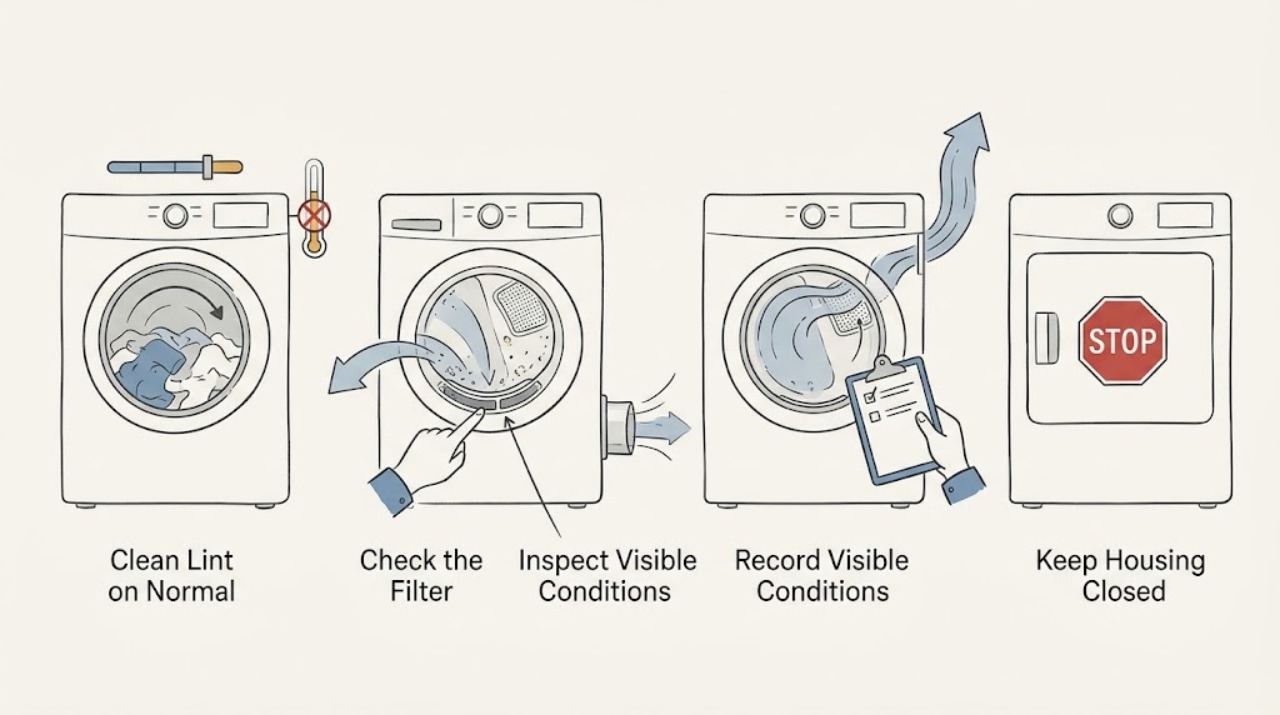
For the Electrolux EFDE317TIW3, a Clean Lint message on Normal is not enough to prove that the exhaust duct is blocked. Electrolux's dryer guidance describes the message/indicator as a reminder to clean the lint filter, while lint restriction, load size, cycle choice, moisture-sensor residue, and exhaust airflow can each make drying poor. Turn the dryer off and let the drum stop and cool, clean and fully dry the lint filter, then inspect the accessible exhaust hose and outside hood for kinks, lint, or a hood that cannot open. Do not run the dryer without its filter, open the cabinet, or keep operating it if it overheats, smells burnt, smokes, or has weak airflow. If Clean Lint returns on Normal after the external airflow checks, or the dryer stops early while Delicate works, arrange qualified service rather than replacing a sensor or heater from the message alone.
Before you begin
Safety first
- Do not open the dryer cabinet, reach into the blower/heater area, probe sensor or heater wiring, bypass thermal protection, operate without the lint filter, or continue running through overheating, weak airflow, burning odor, smoke, sparks, or lint ignition. Do not use improvised tools or blowers through a concealed exhaust duct.
Work through in order
Diagnostic checks
Use only checks that match the exact appliance or system and its official guide.
-
Check 1
Confirm the rating-plate model is EFDE317TIW3 and record the exact sequence: Normal or another cycle, how long it runs, whether the drum tumbles, whether clothing is warm or cold, whether Clean Lint appears at start or after stopping, and whether Delicate or Time Dry behaves differently.
Expected result: The model and cycle pattern match EFDE317TIW3, or the model/indicator timing is uncertain.
Next step: If the label or timing is uncertain, retrieve the exact Electrolux manual using the model/PNC before interpreting the message or changing a component. Keep all checks external and stop for a safety symptom.
Why this matters
Why: The exact-model public report describes Clean Lint after a Normal-cycle stop, but the indicator alone does not identify the cause. Cycle-dependent behavior changes the next check toward airflow, load, or sensing rather than a generic heater replacement.
-
Check 2
Turn the dryer off, allow the drum to come to a complete stop, and let it cool. Remove the lint filter, clear visible lint, and if it has a coating that blocks water flow, wash it only as Electrolux directs with warm soapy water; dry it completely and reinstall it before use.
Expected result: The filter is coated or visibly restricted, the filter is clean and dry, or the filter is damaged/missing.
Next step: Reinstall a clean, dry, intact filter. Never run the dryer without it. If the filter is damaged or cannot seat correctly, stop and arrange service before testing.
Why this matters
Why: Electrolux says lint buildup restricts airflow and advises cleaning the filter after every load; a damaged or missing filter is not a condition for continued operation. A clean filter does not rule out the exhaust run or an internal fault.
-
Check 3
From accessible, safe locations, inspect the exhaust hose and outside vent hood without pulling the dryer forward or reaching into the duct. Look for a crushed/kinked hose, lint at the connection, or a hood that does not open freely when the dryer is operating; do not use improvised blowers or tools through the duct.
Expected result: The accessible duct/hood is restricted or damaged, or it looks open and the hood operates normally.
Next step: Correct only an obvious accessible kink or external lint issue. Have a qualified vent professional clean a concealed or persistent restriction; stop the dryer if airflow is weak, the cabinet overheats, or lint accumulates unusually.
Why this matters
Why: Electrolux links restricted exhaust and poor ventilation to longer drying and says lint accumulation can hinder performance. A clear visible outlet does not prove the concealed duct or internal airflow path is clear.
-
Check 4
Use one correctly sized load of similar fabric weight and confirm Normal is a heat-producing cycle for this model. Avoid both a packed drum and a nearly empty load, and observe from outside whether items tumble freely and whether the cycle stops early.
Expected result: The load is overloaded/too small or mixed with dense items, the load tumbles freely, or Normal still stops early with Clean Lint.
Next step: Correct only the load or documented setting and make one supervised comparison. If the symptom persists, do not keep cycling the dryer or replace a sensor/heater based on the message; arrange service.
Why this matters
Why: Electrolux says load size, free tumbling, fabric mix, and cycle/temperature selection affect drying time. A cycle-specific stop with a clean filter and suitable load points toward a remaining airflow, sensor, control, or service issue without naming a part.
-
Check 5
With the dryer off and cool, inspect only the accessible moisture-sensor area described by the exact owner guide. If a visible softener-sheet film is present, clean the bars only by that guide's method; do not open the cabinet or probe sensor wiring.
Expected result: Residue is visible, the guide does not identify the sensor location for this model, or the accessible area is clean but Normal still stops early.
Next step: Follow the exact manual for any accessible sensor cleaning. If the guide does not match EFDE317TIW3 or the symptom continues, stop testing and request qualified Electrolux service.
Why this matters
Why: Electrolux notes that dryer-sheet residue can impair moisture sensing, but the Clean Lint reminder does not establish a sensor failure. An unknown sensor layout or recurrence after safe cleaning needs model-specific diagnosis.
Use your observations
Decision map
Find the observation that best matches what you see, then follow the next safe action.
-
PATH 01Next step
What you see
Clean Lint appears after a cycle, the lint filter is clean and correctly installed, the dryer otherwise completes, and there is no overheating or weak exhaust.
Do this next
Clean the filter after each load and follow the exact EFDE317TIW3 guide for clearing the indicator. Continue only while the dryer has normal airflow and no safety symptom; service is appropriate if the message is accompanied by poor drying or early stops.
Why this path and its safety boundary
Why it matters: The official Electrolux guide treats Clean Lint as a recurring cleaning reminder rather than a direct clogged-duct warning. The light alone does not justify a sensor, heater, or control-board diagnosis.
-
PATH 02Next step
What you see
Normal gives Clean Lint and stops early or leaves damp clothes, while Delicate or another cycle runs longer; the filter is clean but the accessible vent path is restricted or airflow is weak.
Do this next
Stop the dryer if it overheats or lint accumulates, correct only safe external restrictions, and arrange qualified vent or appliance service for a concealed restriction. Do not open the cabinet.
Why this path and its safety boundary
Why it matters: A lint/exhaust or ventilation restriction is more likely than a Clean Lint message being the root cause. Electrolux says restricted airflow hinders drying and can require professional exhaust cleaning.
-
PATH 03Next step
What you see
The filter is clean and dry, the visible exhaust hood opens normally, the load tumbles freely, and Normal still stops early with Clean Lint while the machine otherwise appears to run.
Do this next
Stop repeated test cycles and arrange qualified Electrolux service. Provide the exact model, cycle timing, message timing, load type, filter condition, vent findings, and whether Delicate completed.
Why this path and its safety boundary
Why it matters: The remaining possibilities include concealed airflow, moisture sensing, control, or heat-path conditions, but no public source supports choosing a sensor or heater from this pattern.
-
PATH 04Next step
What you see
A large or very small load, an inappropriate cycle/temperature, high room humidity, or sensor-bar residue is found and drying improves after the safe correction.
Do this next
Use the documented cycle and load guidance. Escalate if Clean Lint returns with poor drying on a suitable load or the cycle continues to stop early.
Why this path and its safety boundary
Why it matters: A load, setting, environment, or sensing-surface condition can explain the result without proving a failed component.
-
PATH 05Next step
What you see
There is a burning smell, smoke, visible lint ignition, severe overheating, damaged cord, sparking, repeated breaker operation, or the dryer is being operated without outdoor exhaust where required.
Do this next
Stop using the dryer, keep clear of smoke or fire, disconnect power only from a dry safe position if it can be done without approaching a hazard, and obtain qualified appliance/electrical/vent service. Do not restart to see whether the message clears.
Why this path and its safety boundary
Why it matters: This is a fire or electrical safety event, not a Clean Lint troubleshooting step. Continued operation can increase fire or shock risk.
Helpful context
Understand the symptom
The exact-model report for EFDE317TIW3 describes Normal stopping after about 20 minutes with Clean Lint even though the lint tray looked clean, while Delicate ran through. That is useful symptom context, not proof of a particular failed part. The public Electrolux guide says Clean Lint is a filter-cleaning reminder and explicitly separates that reminder from a clogged exhaust diagnosis.
Treat the message and the drying result as two observations: clean and reinstall the filter, then check airflow and load conditions. The exact model's owner guide controls any sensor location, exhaust specifications, or service procedure. Do not dismantle the cabinet or continue operating through overheating or a burning-lint smell.
When checks do not resolve it
Need a professional?
Arrange qualified Electrolux appliance service when EFDE317TIW3 continues to stop early with Clean Lint after the filter, load, cycle, and accessible exhaust checks, when clothes remain damp with normal airflow, or when the exact manual does not match the control behavior. Arrange qualified vent service for a concealed or persistent exhaust restriction.
Safety scope: Do not open the dryer cabinet, reach into the blower/heater area, probe sensor or heater wiring, bypass thermal protection, operate without the lint filter, or continue running through overheating, weak airflow, burning odor, smoke, sparks, or lint ignition. Do not use improvised tools or blowers through a concealed exhaust duct.
Have this ready
- Provide the complete EFDE317TIW3 model/PNC, cycle and temperature, time to stop, exact message timing, load size and fabric mix, filter condition, outside-hood airflow observation, duct history, whether Delicate or Time Dry completes, and any heat/odor/overheating symptom.
Common questions
FAQ
Does Clean Lint mean the exhaust duct is definitely clogged?
No. Electrolux's indicator guidance describes Clean Lint as a reminder to clean the lint filter and says it is not, by itself, a warning that the exhaust duct or filter is clogged. Poor drying still warrants the separate filter, load, and airflow checks.
Why can Delicate work while Normal stops early?
Different cycles can use different time, temperature, and sensing behavior. A cycle-dependent stop can be a clue for airflow, load, or sensing, but it does not identify a heater or sensor without model-specific diagnosis.
Can I keep running the dryer if the filter looks clean?
Only if the filter is correctly installed and the dryer has normal airflow and no safety symptoms. Do not run without the filter. Stop for weak exhaust, overheating, burning odor, smoke, sparks, or repeated early stops.
Should I replace the moisture sensor or heating element?
Not from Clean Lint and poor drying alone. First document the filter, cycle, load, sensor-surface guidance, and exhaust findings. A qualified provider should confirm the exact fault and compatible part.
Read the exact guide
Official sources
- Electrolux Dryer Message "Clean Lint"Reddit r/appliancerepair · Exact Reddit post naming Electrolux EFDE317TIW3; used only as an unresolved symptom report, not as technical authority or a part diagnosis.
- Complete Owner's GuideElectrolux · Official Electrolux owner-guide PDF; it covers multiple models, so it is used for the stated indicator semantics and safety boundary, not as an unverified EFDE317TIW3-specific component map.
- Electrolux User Manuals: How to Find & Download InstructionsElectrolux · Official Electrolux guidance that model number or PNC is required to retrieve the applicable owner and installation manual.
- Dryer - Not Drying and Extended Drying TimeElectrolux · Official Electrolux dryer support article used for safe external checks; exact EFDE317TIW3 manual controls any model-specific sensor or installation procedure.
- Dryers - How often do I need to clean my dryer or the lint screen/filter to optimize my drying performance?Electrolux · Official Electrolux dryer support article used for filter frequency and external exhaust inspection, not for an exact-model internal repair conclusion.
Community feedback
Share a repair observation
Share a plain-text repair observation. Accepted observations are published automatically; this page may take a moment to update.