
On this page
Start here
Quick answer
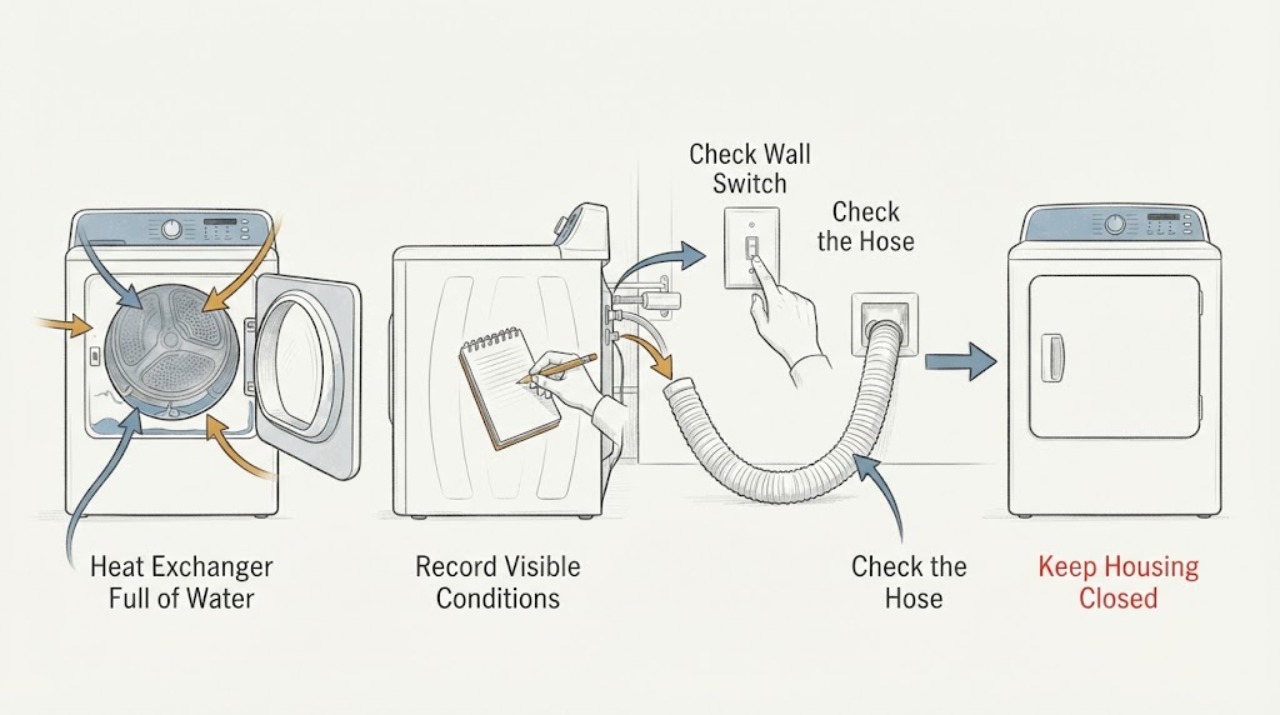
The Bosch WTB86200UC is a compact condensation dryer, not a conventional vented dryer. Water at the heat exchanger is not automatically proof that a pump has failed: Bosch's exact manual says residual water may escape when the exchanger is accessed for cleaning. First switch the dryer off, let it cool, and check the lint filter and the model's accessible heat-exchanger area exactly as the manual describes; use water only, remove fluff from the seals, let the exchanger and cap dry fully, and refit them correctly. Then check the condensation drain hose and its connections for a kink, blockage, leak, or backflow condition without moving the appliance. If a Check drain indication remains, water leaks onto the floor, the exchanger refills quickly, drying stays poor after the safe maintenance checks, or water reaches electrical parts, stop using the dryer and arrange qualified Bosch service. Do not tilt the stacked or heavy dryer, open the cabinet, test live voltage, or infer a failed pump from water alone.
Work through in order
Diagnostic checks
Use only checks that match the exact appliance or system and its official guide.
-
Check 1
Record the rating label and support-page identity as WTB86200UC (including any revision such as /06), and note whether the dryer is ventless/condensation, whether it is stacked, the selected programme, whether the load feels warm, and whether a Check drain or Cleaning required indication appears. Do this from the outside without moving the appliance.
Expected result: The label matches WTB86200UC, the unit is a condensation dryer, and the symptom is damp laundry, a visible water-filled exchanger area, a drain indication, or floor water; the revision or identity is uncertain.
Next step: Use the WTB86200UC manual linked from Bosch support for the remaining checks. If the model or revision cannot be confirmed, limit work to external observations and arrange service.
Stop if: Do not move a heavy or stacked dryer alone, tilt it to make water run out, or remove any cabinet panel.
Why this matters
Why: The exact manual and drain arrangement control which user checks are valid. An uncertain identity prevents safe assumptions about exchanger access, drainage, or indicators.
-
Check 2
Switch the programme selector to Off and let the dryer, drum, and exchanger cool. Following the exact manual, place an absorbent cloth under the maintenance flap, open the flap, release the two locking levers, remove the cap and heat exchanger, rinse the exchanger and cap with water only, remove visible fluff from the seals, let both parts drip-dry fully, then refit the exchanger before the cap and close the flap until it locks.
Expected result: Only a small amount of residual water escapes during the permitted cleaning, the exchanger or cap is visibly fouled, the seal has fluff, or water is excessive/returns immediately; a latch, exchanger, or seal is damaged.
Next step: For normal residual water or visible fluff, finish the manual cleaning and repeat the same controlled load only after everything is dry and correctly locked. For rapid refilling, damage, or a failed latch/seal, stop and arrange Bosch service.
Stop if: Do not use sharp objects, abrasive tools, a water jet on the cabinet, force the heat exchanger, reach into hidden channels, or run the dryer with the cap or flap not locked.
Why this matters
Why: A small release during access is expressly described by Bosch and is not by itself a pump diagnosis. Fluff or a poor seal can impair drainage or allow leakage; rapid refilling, damage, or inability to lock the assembly is not a completed maintenance result.
-
Check 3
With the dryer Off and cool, inspect only the visible condensation drain hose and its ends. Look for a kink, crush, loose connection, leaking joint, pinched tie, or hose end sitting in standing water; verify that the drain path is free-flowing and ventilated as the installation instructions require. Do not pull the appliance forward to reach a hidden connection.
Expected result: The Check drain indication is on, the hose is kinked or blocked, a connection leaks, water can back up, or the visible hose is secure and unobstructed.
Next step: Correct only a plainly visible, safe hose routing or connection issue without pinching the hose, then repeat the same controlled load. If the indication remains, drainage is slow, or the hose leaks, contact Bosch service.
Stop if: Do not disconnect a hidden hose, blow into it, pour water into the appliance, bypass a drain, or tilt/move the dryer to reach the back.
Why this matters
Why: Bosch's exact manual associates incomplete drainage with a blocked hose or connection condition and identifies a leaking hose as a separate cause. A clear external hose does not prove the pump, sump, or internal passage is healthy.
-
Check 4
Clean the lint filter as the manual directs and inspect the filter area for accessible fluff; reinstall the filter dry and correctly. Then use the exact manual to wipe the moisture sensors with the permitted method, only while the dryer is switched off. Compare one normally sized, similarly spun load on a programme suited to its fabric label.
Expected result: The filter or sensor has a visible deposit, the load dries better after cleaning and a suitable programme, or the load remains damp and the exchanger/drain indication persists.
Next step: Keep the maintenance routine that produced improvement. If the result is unchanged, do not compensate with repeated long cycles; use the service branch after recording the water and indicator behavior.
Stop if: Do not use solvents, abrasive cleaners, a steam or water jet, or continue drying laundry contaminated with flammable liquids, oil, wax, grease, or paint.
Why this matters
Why: Bosch states that a dirty filter extends drying time and increases energy use, and that the sensors measure laundry moisture. Improvement supports an airflow or sensing issue; no change keeps drainage, exchanger sealing, heating, or service in scope.
-
Check 5
Inspect the floor and the visible lower/front area without touching hot surfaces or electrical parts. Note whether water is a one-time spill from maintenance, appears between the door seal, pools under the dryer, or reaches a cord/outlet; also note whether clothes are warm but damp versus completely cold.
Expected result: Water appears only under the maintenance flap after cleaning, the door/seal area is wet, a pool forms under the appliance, water reaches electrical parts, or the drum turns with no warmth.
Next step: Dry the safe exterior and document the location. For recurring floor water, no heat, water near electrical parts, or a cold dryer, stop using it and arrange qualified Bosch service; do not diagnose a pump or heater from symptoms alone.
Stop if: Stop immediately for sparking, burning odor, damaged insulation, repeated breaker trips, smoke, unusual overheating, or water at the outlet/cord. Disconnect power only if it is safe and accessible without touching wet electrical parts.
Why this matters
Why: A one-time release during exchanger access is different from a recurring leak. Bosch's troubleshooting table lists drain blockage, leaking hose, an unlevel dryer, and a dirty exchanger seal for water leakage; no heat or water near electrical parts requires professional evaluation.
Use your observations
Decision map
Find the observation that best matches what you see, then follow the next safe action.
-
PATH 01Next step
What you see
A small amount of water escapes only when the cool heat exchanger is opened for the documented cleaning, the seals and cap can be refitted and locked, and drying improves afterward.
Do this next
Finish the water-only cleaning, dry the parts fully, reinstall them in the manual's order, and maintain the lint filter/exchanger. Escalate if the exchanger rapidly refills or drying again deteriorates.
Why this path and its safety boundary
Why it matters: This matches Bosch's warning that residual water may escape during exchanger access; it is not evidence by itself of a failed pump.
-
PATH 02Next step
What you see
Check drain remains lit, drainage is incomplete, the visible hose is kinked/blocked or leaking, or water backs up at the connection.
Do this next
Correct only the visible safe routing or connection issue and retest once. If the indication remains or the hose leaks, stop and arrange qualified service without moving the dryer.
Why this path and its safety boundary
Why it matters: The exact manual points first to the drain hose and its connection for incomplete drainage; a hose problem is not the same as a proven internal pump failure.
-
PATH 03Next step
What you see
Water repeatedly pools under the dryer or appears at the exchanger/door seal after correct cleaning, while the hose is visibly secure.
Do this next
Stop using the appliance, protect the floor, and give service the exact leak location, recurrence timing, indicator state, and whether the unit is stacked. Do not tilt or level a stacked unit yourself.
Why this path and its safety boundary
Why it matters: Bosch lists a dirty exchanger seal and an unlevel dryer among leak causes, but a clear hose does not rule out an internal sump, pump, seal, or passage fault.
-
PATH 04Next step
What you see
The dryer tumbles and becomes warm, but laundry remains damp after the appropriate programme, clean filter/sensors, correct exchanger refit, and clear visible drain path; or the dryer remains cold.
Do this next
Stop repeating cycles and arrange qualified Bosch service with the model/revision, programme, load, temperature result, exchanger water amount, drain observations, and cleaning indication.
Why this path and its safety boundary
Why it matters: Warm-but-damp results leave airflow, condensation handling, sensing, load, and heating/service causes open. No heat or a persistent failure after maintenance is not a user-safe part diagnosis.
-
PATH 05Next step
What you see
There is smoke, burning or chemical odor, sparking, damaged insulation, repeated breaker operation, unusual overheating, or water near the cord/outlet.
Do this next
Stop the cycle and keep clear. Disconnect power only if it can be done safely without contact with wet or damaged electrical parts, then arrange qualified appliance/electrical help; do not restart to test.
Why this path and its safety boundary
Why it matters: The issue has crossed a fire, electrical, thermal, or shock boundary; drying performance and exchanger troubleshooting must stop.
Helpful context
Understand the symptom
Start with the model boundary. Bosch's support page lists WTB86200UC/06 as a Compact Condensation Dryer, and its product sheet describes ventless operation. Do not apply a vented-dryer duct diagnosis or assume that every visible drop in the heat-exchanger compartment means the pump is defective.
The exact Bosch manual says residual water may escape when the maintenance flap and heat exchanger are opened. It also says the exchanger needs periodic cleaning, recommends cleaning the lint filter before or after each drying process, and routes a persistent Check drain indication to the drain hose and its connection. Those are separate observations with different next steps.
Treat the Reddit account as context, not a diagnosis: it reports a WTB86200UC with repeated water and poor drying despite inspections, but it does not establish a universal repair or a failed pump. If the safe maintenance and drain observations do not change the result, stop spending on guessed parts and give a qualified technician the exact model, water pattern, and test results.
When checks do not resolve it
Need a professional?
Call qualified Bosch service when the Check drain indication remains after the visible hose check, the heat exchanger rapidly refills, the cap or seal will not lock or is damaged, water repeatedly reaches the floor, drying stays poor after the exact maintenance steps, or the dryer has no heat. Stop immediately for smoke, burning or chemical odor, sparking, damaged insulation, repeated breaker trips, unusual overheating, or water near the cord/outlet. Do not tilt or move a stacked/heavy dryer, open the cabinet, test live voltage, bypass a safety device, or order a pump, heater, or other part from water alone.
Common questions
FAQ
Does water in the heat exchanger prove the pump is bad?
No. Bosch's WTB86200UC manual says residual water may escape when the exchanger is opened for cleaning. A persistent Check drain indication, incomplete drainage, recurring floor water, or rapid refilling after correct cleaning needs service evaluation; do not buy a pump from water alone.
Can I rinse the heat exchanger myself?
The exact manual provides a cool, switched-off cleaning procedure: place an absorbent cloth, use water only, avoid hard or sharp objects, remove fluff from the seals, let the exchanger and cap dry fully, and refit them in the stated order. Stop if access, seals, latches, or the assembly are damaged.
What does a Check drain indication change?
Bosch routes incomplete drainage to the drain hose and connection. Check for a plainly visible kink, blockage, leak, or unsafe connection without moving the dryer; if the indication remains after that safe check, contact service.
Read the exact guide
Official sources
- Dryer heat exchanger full of waterReddit · Exact Reddit discussion mentioning a Bosch WTB86200UC water-in-heat-exchanger and poor-drying report; anecdotal context only, not manufacturer guidance.
- Appliance Information - Compact Condensation Dryer | WTB86200UC/06Bosch · Bosch official support page for the WTB86200UC/06 compact condensation dryer, the assigned WTB86200UC model family.
- WTB86200UC Compact Condensation Dryer Product Specification SheetBosch · Bosch official product specification sheet for the WTB86200UC compact condensation dryer.
- WTB86200UC Use and Care ManualBosch · Bosch official use and care manual for the WTB86200UC dryer, including heat-exchanger cleaning, lint-filter maintenance, moisture sensors, drain hose, leak troubleshooting, and safety boundaries.
Community feedback
Share a repair observation
Share a plain-text repair observation. Accepted observations are published automatically; this page may take a moment to update.