
On this page
Start here
Quick answer
A Bosch dryer drum that scrapes needs to be stopped and localized before another load is run. With the dryer cool and power isolated, check the drum opening and door seal for a coin, zipper, bra wire, or other loose object, and note whether the sound is present when the empty drum is moved gently only as the exact manual permits. A sound that follows rotation, scraping that changes with load, or a drum that wobbles or binds makes a drum-support or drive problem more likely; a rattle from one object may be removable without disassembly. Bosch also notes that some compressor, pump, ventilation, or automatic-cleaning sounds can be normal, but a sharp scrape is not identified by a generic noise description. Do not reach into a rotating drum, pry at the seal, remove panels, or keep running the dryer if there is burning odor, smoke, abnormal heat, a damaged drum, or an electrical fault. Persistent or internal scraping belongs to qualified Bosch service.
Before you begin
Safety first
- This article covers normal stop controls, listening and recording, visible drum/seal inspection, accessible object removal without force, and a model-authorized cool hand observation only. Drum supports, seals, belt, idler, motor, control, heater, wiring, and cabinet access belong to qualified professionals.
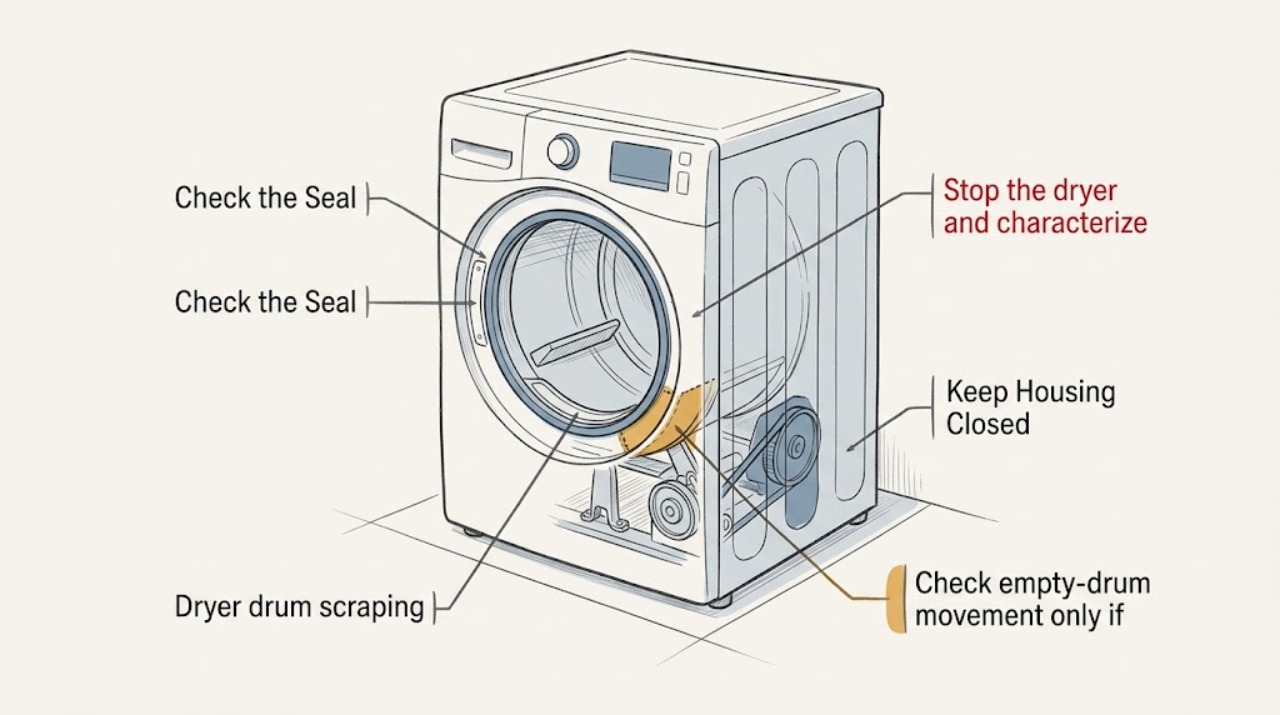
Work through in order
Diagnostic checks
Use only checks that match the exact appliance or system and its official guide.
-
Stop the dryer and characterize the sound
Stop the cycle using the normal control, wait for the drum to stop, and note whether the scraping is sharp, rhythmic, intermittent, accompanied by a hum or rattle, or paired with heat, odor, smoke, or a display error. Do not restart a hot or damaged dryer to reproduce the sound.
Expected result: The sound follows each rotation, appears only at startup or with a load, sounds like a loose rattle, or occurs with heat, smoke, odor, vibration, or an error.
Next step: Use the sound-pattern branch and continue only with a cool, power-isolated visual inspection. Keep the dryer off for a stationary heated load or any safety symptom.
Stop if: Stop immediately for smoke, burning odor, abnormal heat, visible damage, exposed wiring, shock, a repeated breaker trip, or a drum that cannot be stopped normally.
Why this matters
Why: A rotation-linked scrape makes contact, an object, support, or drive issue more likely than a normal compressor or pump sound. A loose rattle may be an object in the drum. Heat, smoke, odor, severe vibration, or an error overrides ordinary sound checks and requires immediate isolation.
-
Inspect the visible drum and seal for an object
With the dryer cool and power disconnected as the manual directs, inspect the drum surface, baffles, door seal, lint-filter area, and visible gap for a coin, zipper, wire, button, or other loose object. Remove only an object that is plainly visible and releases without force.
Expected result: A loose object is present, the opening is clear, the object is trapped behind a seal or baffle, or the drum surface or seal is damaged.
Next step: Remove only a loose visible object, then stop and arrange service if the scrape remains. Do not pry the seal, remove a baffle, or use tools to reach behind the drum.
Stop if: Do not insert a knife, screwdriver, wire, or hand into a hidden gap; do not run the dryer with a damaged seal, drum, or sharp exposed edge.
Why this matters
Why: A loose object can make a rattle or scrape that follows the drum. A trapped object, torn seal, gouged drum, or sharp edge needs service-level access and can damage clothing or the appliance if it continues to run.
-
Check empty-drum movement only if the manual permits
If the exact Bosch manual permits a user-level hand observation, rotate the empty drum gently from the opening with power isolated and the dryer cool. Stop at the first sign of scraping, binding, grinding, wobble, excessive play, or uneven resistance; skip this check if the manual does not authorize it.
Expected result: The drum moves smoothly, the sound repeats at one point in each rotation, the drum binds or wobbles, or the check cannot be performed safely.
Next step: Record the pattern and arrange qualified Bosch service if the sound persists or movement is abnormal. Do not force the drum or open the cabinet to inspect the drive.
Stop if: Do not energize the dryer with panels removed, touch the belt or motor, force a seized drum, or reach around the rotating assembly.
Why this matters
Why: Smooth hand movement makes a complete seizure less likely but does not rule out a belt, idler, motor, seal, or control problem under load. A repeated point in rotation, binding, or wobble makes drum contact or support damage more likely. An unclear access procedure is itself a reason to stop.
-
Check load interaction and visible installation stability
With the dryer off, note whether the scrape began after a bulky or heavy load, a new installation, stacking, or moving. From a stable position, observe whether the cabinet rocks or shifts and whether the appliance appears on a clean, level, firm surface; do not pull it out or lift it by the door.
Expected result: The noise occurs only with a bulky load, the dryer rocks or vibrates, the surface is uneven, installation changed recently, or the unit is stable and the scrape is present empty.
Next step: Use only the model's loading and installation guidance for an obvious external correction. If the unit is stacked, built in, unstable, or still scrapes empty, arrange qualified installation or appliance service.
Stop if: Do not exceed the model's load guidance, move a heavy or stacked dryer alone, loosen hidden feet or brackets, or operate it while rocking or contacting cabinetry.
Why this matters
Why: Load contact or an unstable installation can amplify vibration and noise, while an empty-drum scrape on a stable unit makes an internal contact or support issue more likely. Bosch says alignment affects noise, vibration, and drum movement, but exact adjustment depends on the installation.
-
Compare the sound with Bosch's normal-noise guidance
Without opening the appliance, note whether the sound is a low hum, airflow/whirring, pumping, or occasional clicking described in the Bosch manual, versus a sharp contact sound synchronized with drum rotation. Record when it occurs in the program and whether the drum actually tumbles.
Expected result: The sound matches a documented compressor, pump, ventilation, or automatic-cleaning behavior, or it is a new rotation-linked scrape, grind, or contact noise.
Next step: Do not use a normal-noise description to dismiss a scrape. If the sound is new, worsening, or persistent after the visible checks, keep the dryer off and arrange service.
Stop if: Do not place a hand inside during operation, remove covers to identify a sound, or keep using the dryer when the drum scrapes against a visible part.
Why this matters
Why: A documented operating sound may not indicate a drum fault. A new scrape that follows rotation is outside that normal-noise description and needs a mechanical or service decision even if the dryer still works.
-
Document the scraping pattern for service
Record the Bosch model marking, sound location, whether it follows rotation, empty-drum movement result, load dependence, installation or stacking status, visible object or damage, heat/odor/smoke, error indication, and when the noise began. Do not disassemble the dryer to improve the record.
Expected result: The scrape remains after the visible object check, the drum binds or wobbles, the noise is load-independent, or any safety or error symptom persists.
Next step: Leave the dryer off and arrange qualified Bosch appliance service. Provide the complete record and any safe photographs of the visible drum, seal, and installation area.
Stop if: Stop all homeowner troubleshooting when diagnosis requires cabinet panels, belt or motor access, live measurement, moving the appliance, or bypassing a door or thermal interlock.
Why this matters
Why: A repeatable rotation-linked or load-independent scrape with a clear drum opening makes an internal support, seal, drive, motor, or control issue more likely. These observations guide service but do not identify a replacement part without model-specific testing.
Use your observations
Decision map
Find the observation that best matches what you see, then follow the next safe action.
-
PATH 01Next step
What you see
The noise is a rattle or scrape and a coin, zipper, wire, button, or other loose object is visible in the drum or at the door opening.
Do this next
Remove only the loose visible object without tools or force. If the sound remains, the object is trapped, or the drum or seal is damaged, leave the dryer off and arrange service.
-
PATH 02Next step
What you see
The scrape repeats with drum rotation after the visible opening is clear, especially when the empty drum binds, wobbles, or has one rough point.
Do this next
Stop using the dryer and arrange qualified Bosch service. Do not force the drum or open panels to inspect the drive.
-
PATH 03Next step
What you see
The noise appears only with a bulky load or after installation/moving, and the cabinet rocks, vibrates, or is not visibly level and stable.
Do this next
Use the exact manual for load and installation guidance. Do not move a stacked or built-in appliance; request qualified installation or service if stability cannot be corrected safely.
-
PATH 04Next step
What you see
The sound is a low hum, airflow/whirring, pumping, or occasional clicking that matches the Bosch manual and there is no scrape, wobble, heat, odor, or damage.
Do this next
Continue monitoring without opening the appliance. Arrange service if the sound changes into a sharp rotation-linked scrape or any safety symptom appears.
-
PATH 05Next step
What you see
The scrape is worsening or accompanied by burning odor, smoke, abnormal heat, exposed wiring, shock, a damaged drum, a repeated breaker trip, or a load that cannot cool safely.
Do this next
Stop the dryer, isolate power at the breaker if safe, keep clear of smoke or exposed electrical areas, and arrange qualified appliance or electrical help. Use appropriate emergency help for fire, shock, or immediate danger.
Helpful context
Understand the symptom
A scrape that follows rotation is different from a normal dryer hum
Bosch says some dryers make normal compressor, condensate-pump, ventilation, or automatic-cleaning sounds. Those descriptions do not make a sharp metal-like scrape normal. Note whether the sound follows every drum revolution, occurs only during acceleration, changes with a load, or continues with an empty drum. Stop before using a sound alone to select a belt, bearing, roller, or motor.
Check the drum opening for the simplest cause
Bosch's public noise page specifically directs the user to check the drum for unwanted objects, such as a coin from a pocket. Inspect only the visible drum, door seal, baffles, and lint area with the appliance cool and isolated. A loose object that releases without force is a different branch from a scrape that remains after the opening is clear.
Vibration and alignment can amplify a mechanical sound
Bosch's manual requires a clean, level, firm installation surface and says incorrect alignment can cause high noise, vibration, and improper drum movement. A dryer that rocks or shifts can make a small clearance issue sound worse, but leveling a stacked or built-in unit may require installation access. Do not pull or tip the appliance to adjust hidden feet or expose the drive system.
Scraping with wobble, heat, or damage is a service boundary
If the empty drum binds, wobbles, has visible damage, or scrapes after an accessible object is removed, the fault may be in a support, roller, seal, belt, idler, motor, or another internal part. The sound pattern can help a technician, but it cannot identify a safe replacement part. Bosch's manual warns about electric shock, fire, injury, and material damage and reserves repairs and technical work for qualified professionals.
Safety boundary
Stop conditions
- Stop using the dryer for smoke, burning odor, abnormal heat, a damaged or sharp drum, exposed wiring, shock, a stationary heated load, or repeated breaker trips.
- Do not reach into a rotating drum, bypass a door or thermal interlock, energize the appliance with panels removed, force a binding drum, or remove the belt, motor, rollers, seals, or supports as an ordinary user check.
- Do not pry at a trapped object, move a heavy or stacked dryer alone, or treat a generic hum, pump, or ventilation sound as permission to continue a sharp rotation-linked scrape.
Only after diagnosis
Potential parts
- Bosch dryer drum support or roller assembly
Consider this category only when qualified diagnosis localizes the scrape, wobble, or repeated rough point to a drum support or roller after foreign objects and installation are excluded.
Confirm the exact Bosch model, support design, mounting, and manufacturer-approved fit before ordering. - Bosch dryer drum seal or felt seal
Consider this category only when service confirms that a torn, displaced, or worn seal is contacting the drum or causing the scraping sound.
Confirm exact model, seal location, orientation, adhesive or installation method, and approved compatibility before replacement. - Bosch dryer drive belt or idler
Consider this category only when qualified inspection finds a damaged, displaced, or mis-tensioned drive component after drum support and foreign-object causes are excluded.
Confirm the exact model, routing, tensioning arrangement, and manufacturer-approved component before selecting a part. - Bosch dryer drive motor
Consider this category only when qualified testing links the scraping or drive symptom to the motor or its circuit after mechanical contact and support causes are evaluated.
Confirm exact model, motor configuration, mounting, electrical connector, and approved compatibility before replacement.
When checks do not resolve it
Need a professional?
Arrange qualified Bosch appliance service when a sharp or rotation-linked scrape remains after a safe visible-object check, when the empty drum binds, wobbles, or has abnormal play, when the sound is load-independent, when the appliance rocks or installation access is required, or when diagnosis requires panels, drive or support access, live testing, or interlock work. Arrange electrical help for outlet or breaker faults. Stop immediately and seek urgent qualified help for smoke, fire, shock, exposed wiring, uncontrolled heat, or repeated breaker trips.
Safety scope: This article covers normal stop controls, listening and recording, visible drum/seal inspection, accessible object removal without force, and a model-authorized cool hand observation only. Drum supports, seals, belt, idler, motor, control, heater, wiring, and cabinet access belong to qualified professionals.
Have this ready
- Provide the exact Bosch model marking, sound description and location, whether it follows rotation, empty-drum observation, load dependence, installation or stacking status, visible object or damage, program stage, heat/odor/smoke, error indication, and when the sound began.
Common questions
FAQ
Why is my Bosch dryer drum scraping?
Stop the dryer and inspect the visible drum opening and seal for a loose object such as a coin or wire. If the sound repeats with rotation after the opening is clear, or the drum binds, wobbles, or has visible damage, a support, seal, belt, idler, motor, or other internal fault is more likely and needs qualified service.
Is a scraping noise from a Bosch dryer normal?
Bosch documents some normal hum, pump, ventilation, and automatic-cleaning sounds, but a sharp contact sound synchronized with drum rotation should not be dismissed as one of those descriptions. Stop and document a new or worsening scrape.
Can a coin cause a Bosch dryer to scrape?
Yes. Bosch specifically directs users to check the drum for unwanted objects such as coins. Inspect only the accessible drum, seal, and baffle area with power isolated and remove an object only if it releases without force.
Should I turn the Bosch dryer drum by hand?
Only if the exact owner's manual permits a cool, power-isolated hand observation. Turn it gently and stop for scraping, binding, wobble, or unusual resistance. Do not force it or remove panels, seals, supports, or drive parts.
Can an unlevel Bosch dryer make scraping worse?
Bosch states that incorrect alignment can cause high noise, vibration, and improper drum movement. Check stability only from a safe external position. Do not move a heavy, stacked, or built-in dryer alone or loosen hidden brackets as a routine check.
Is it safe to run a Bosch dryer while the drum is scraping?
No. Stop using it until the sound is understood, especially if it is rotation-linked or accompanied by heat, odor, smoke, vibration, or damage. Isolate power when safe and arrange service for persistent or internal noise.
When should I call for Bosch dryer scraping repair?
Arrange service when the scrape remains after a safe visible-object check, the empty drum binds or wobbles, the sound is load-independent, the appliance is unstable, or diagnosis requires panels, drive access, moving the unit, live testing, or interlock work.
Read the exact guide
Official sources
- Use and Care Manual, Installation InstructionsBosch Home Appliances · Official Bosch dryer manual opened for a Bosch dryer family; model-specific instructions govern exact procedures and access.
- Dryer repairs and troubleshootingBosch Home Appliances · Bosch dryer repair overview; exact issue pages and owner manuals control detailed troubleshooting.
- Dryer Troubleshooting: Dryer is Making NoisesBosch Home Appliances · Bosch dryer noise troubleshooting; persistent or internal scraping requires qualified service.
Community feedback
Share a repair observation
Share a plain-text repair observation. Accepted observations are published automatically; this page may take a moment to update.