
On this page
Start here
Quick answer
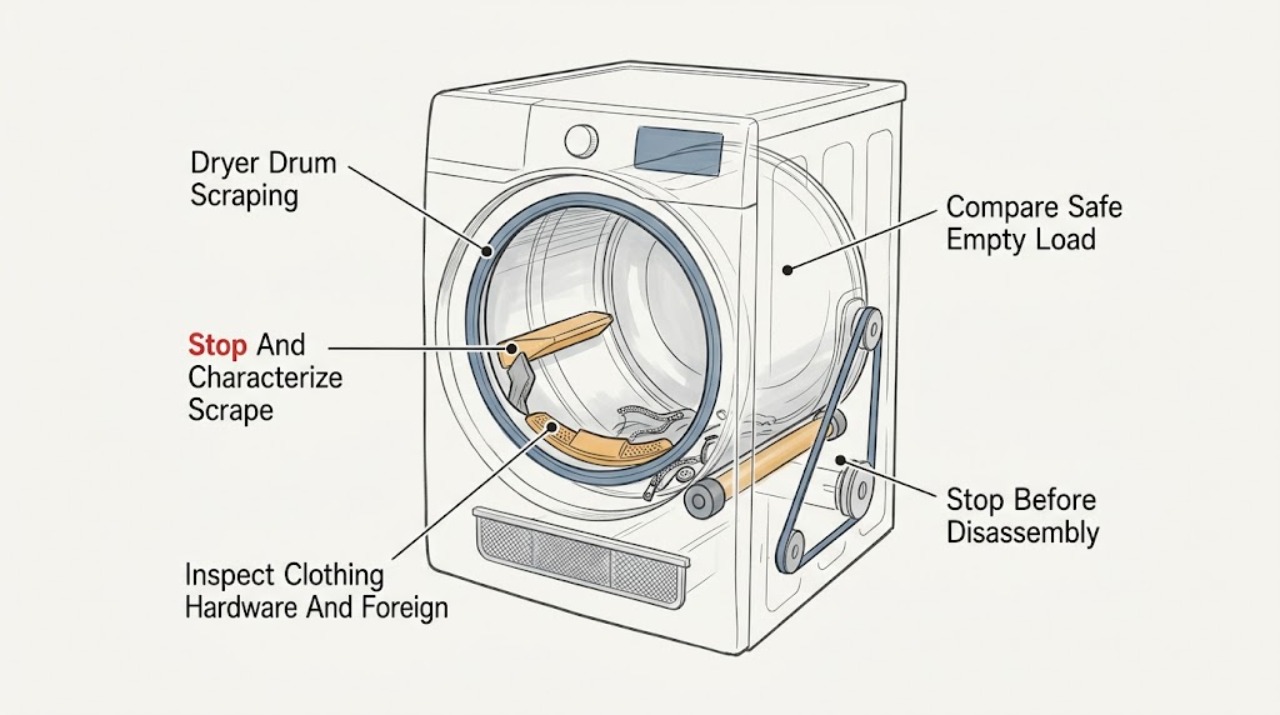
Stop an Electrolux dryer that is scraping and remove the load before the noise damages clothing or the appliance. Check pockets, belt buckles, zippers, and the drum for coins or another loose object; Electrolux identifies metal fasteners and foreign objects as common sources of rattling or clanking. If the noise disappears with the load removed, the article or an object is the likely source. If it continues during a carefully observed empty cycle, the sound is coming from the dryer and needs service. You can make only external, power-isolated observations of the drum opening and seal. Do not remove panels, reach around the belt or motor, force a scraping drum, or run the dryer with a loose part, sharp edge, smoke, burning odor, or clothing caught at the drum edge. A persistent scrape may involve an internal drum-support, seal, roller, belt-path, or motor condition that cannot be identified safely from the sound alone.
Work through in order
Diagnostic checks
Use only checks that match the exact appliance or system and its official guide.
-
Check 1
Stop the Electrolux dryer as soon as the scraping begins and wait for the drum and clothing to stop. Note whether the sound occurs at startup, throughout rotation, only with a heavy load, during reversal, or only at one position of the drum. Record any smoke, burning odor, heat, visible damage, loose drum edge, or clothing caught near the seal.
Expected result: The scrape is intermittent with clothing, continuous during rotation, tied to a heavy load, accompanied by rubbing or catching, or accompanied by smoke, burning odor, heat, or visible damage.
Next step: For an ordinary load-related sound, remove the load and inspect it and the drum. For continuous, rubbing, catching, heat, smoke, or burning, leave the dryer unused and arrange qualified service or emergency help as appropriate.
Stop if: Do not keep running the dryer to make a dangerous sound easier to locate.
Why this matters
Why: A load-related intermittent sound favors clothing hardware or a foreign object. A continuous or position-dependent scrape favors contact within the dryer, while a heavy-load or overheating pattern raises motor and drive stress. Smoke, heat, or damage changes this from a noise check to a stop-use condition.
-
Check 2
With the dryer stopped and cool, empty the drum and check every pocket and garment for coins, belt buckles, zippers, hooks, snaps, or other loose metal. Look across the drum surface, the front opening, and the visible seal for an object or fabric edge; remove only a loose item that is clearly reachable without tools or pressure.
Expected result: A coin or other object is present, a fastener is striking the drum, fabric is caught at the seal, the seal has a cut or lifted section, or nothing visible explains the scrape.
Next step: Remove a clearly loose object and secure or turn garments as appropriate before any further observation. If fabric is caught, the seal is damaged, or the scrape remains unexplained, do not pry or pull forcefully; arrange service.
Stop if: Do not reach into a narrow gap, use a blade or hook, pull fabric against a sharp edge, or run the dryer with a damaged seal or loose fragment.
Why this matters
Why: Electrolux identifies belt buckles, metal fasteners, and foreign objects as causes of rattling or clanking. Fabric caught at the edge or a damaged seal can create contact and can damage clothing; no visible object makes an internal dryer source more likely.
-
Check 3
If no object, caught fabric, sharp edge, smoke, heat, or visible damage is present, and the drum turns normally by the controls, run only the shortest empty observation allowed by the Electrolux model guide while remaining nearby. Stop immediately if the scraping returns loudly, worsens, or is joined by heat, odor, or vibration.
Expected result: The scrape disappears when empty, continues with the empty drum, changes with drum position, or returns with vibration, odor, or heat.
Next step: If the empty drum is quiet, secure clothing hardware and monitor a normal load. If the empty drum still scrapes, stop using the dryer and arrange qualified Electrolux service; provide when the sound occurs and whether it changes with drum position.
Stop if: Do not repeat empty-load tests through a worsening scrape, visible contact, loud vibration, smoke, burning odor, or overheating.
Why this matters
Why: Noise that disappears empty points toward clothing hardware or a loose load object. Noise that continues empty comes from the appliance and may involve the drum support, seal, rollers, belt path, motor, or another internal part; sound alone cannot select the failed component.
-
Check 4
Before any maintenance or cleaning, disconnect the dryer from its power supply as Electrolux directs. With the dryer cool and empty, use a light to inspect the visible front and rear edges of the drum, the seal, and the lint-screen area for a rubbing mark, loose material, or an object that could contact the drum. Do not remove panels, rotate a damaged drum forcefully, or touch the belt, motor, heater, or wiring.
Expected result: A rubbing mark, loose seal, foreign material, uneven gap, or sharp edge is visible, or the visible opening looks normal while the scrape persists.
Next step: Leave the dryer disconnected and arrange qualified service for visible contact, a loose or damaged seal, or a persistent unexplained scrape. Photograph the mark and record the model number for the service visit.
Stop if: Do not open the cabinet, handle internal drive parts, or reconnect power to test a suspected mechanical defect.
Why this matters
Why: Visible contact or a loose seal can explain scraping and can worsen with operation. A normal opening does not clear hidden rollers, support, belt, motor, or thermal components because those require internal inspection.
-
Check 5
Review whether the scrape began with an overloaded drum, a dense wet load, a very small load, or a cycle that stopped after the dryer became hot. Reduce the next load only if the dryer is otherwise safe and the prior inspection found no contact, odor, or damage; keep the load loose enough to tumble. Do not continue operating if the dryer becomes unusually hot or stops again.
Expected result: The sound occurs only with a heavy load, the motor stops or restarts after cooling, the dryer is unusually hot, or the scrape remains with a normal load.
Next step: If a smaller, safe load is quiet and the dryer does not overheat, use appropriate load sizes. If stopping, heat, scraping, or unusual noise returns, stop using the dryer and arrange qualified appliance service.
Stop if: Do not operate through overheating, scorching, smoke, or a burning odor.
Why this matters
Why: Electrolux says overloading can overheat the motor and that reducing the load may resolve a stop-operating symptom; it directs service when that does not resolve the issue. Repeated heat or stopping can compound mechanical stress, but a scrape that persists with a normal load still needs appliance diagnosis.
-
Check 6
If the scrape continues or returns, record the Electrolux model number, whether the drum is empty or loaded, when the sound starts, whether it changes with drum position or reversal, the condition of the seal and lint screen, and any heat, odor, vibration, or stopping symptom. Keep the dryer out of use until a technician evaluates the internal source.
Expected result: The sound is gone after removing a garment or object, returns only with a heavy load, or persists empty or with a normal load.
Next step: Use the dryer only if the scrape is gone and no safety symptom remains. Otherwise arrange qualified Electrolux appliance service and provide the full observation history; do not select a roller, belt, seal, or motor from the sound alone.
Stop if: Do not keep testing, remove panels, or work on live or recently heated components.
Why this matters
Why: A resolved load-related sound supports an article or loose-object cause. A persistent or recurring empty-drum scrape is more consistent with an internal mechanical or support issue, and an overheating or stopping pattern may involve thermal protection or drive stress.
Use your observations
Decision map
Find the observation that best matches what you see, then follow the next safe action.
-
PATH 01Next step
What you see
The scraping or rattling stops when the load is removed, and a coin, fastener, zipper, hook, or other loose object is found.
Do this next
Remove the loose object, secure the clothing hardware, and monitor a properly sized load. If the scrape returns with an empty drum, arrange service.
Why this path and its safety boundary
Why it matters: The pattern favors clothing hardware or a foreign object rather than a dryer-internal fault.
-
PATH 02Next step
What you see
No object is visible, but the same scraping continues during an empty observation or changes with drum position.
Do this next
Stop operating the dryer and arrange qualified Electrolux service. Provide the model number, when the scrape occurs, and any visible rubbing mark or vibration.
Why this path and its safety boundary
Why it matters: The sound is coming from the dryer and may involve the drum edge, seal, support, rollers, belt path, motor, or another internal component; the sound cannot identify which part is failed.
-
PATH 03Next step
What you see
Clothing is caught at the drum edge, the seal is lifted or cut, a sharp edge is visible, or clothing shows new snags or tears.
Do this next
Leave the dryer off and arrange service for the seal, drum edge, or internal support. Do not pull fabric forcefully or use a tool to free it.
Why this path and its safety boundary
Why it matters: Continued operation can damage clothing and worsen contact at the drum opening.
-
PATH 04Next step
What you see
The scrape or stopping begins with a dense wet load, the motor becomes hot, or the dryer stops and later operates after cooling.
Do this next
Allow the dryer to cool, reduce the load only when the appliance is otherwise safe, and stop using it if the symptom returns. Arrange qualified appliance service for repeated stopping or overheating.
Why this path and its safety boundary
Why it matters: Electrolux associates overload with motor overheating and says a thermal limiter can stop an electric dryer; a repeated event needs service rather than continued load experiments.
-
PATH 05Next step
What you see
There is smoke, a burning odor, scorching, sparking, damaged wiring, a loose drum, or a rapidly worsening scrape.
Do this next
Stop using the dryer and keep people away. Use local emergency guidance for smoke or fire and arrange qualified appliance or electrical service; do not restore power or restart it as a test.
Why this path and its safety boundary
Why it matters: This is an immediate appliance or fire safety boundary, not an ordinary dryer-noise adjustment.
Helpful context
Understand the symptom
Use the timing of the scrape as the first clue
A scrape that follows one garment, a coin, or a metal fastener and disappears when the load is removed is different from a scrape that continues with an empty drum. Electrolux recommends stopping to check for objects and comparing with an empty load when the source is uncertain. Do not treat an empty-load test as permission to keep operating through a sharp, loud, worsening, or heat-related sound.
The cabinet is the service boundary
The safe user checks are pockets, clothing hardware, the drum opening, the visible seal, load size, and a carefully observed empty comparison. Internal rollers, belt routing, motor, drum support, and thermal protection require model-specific access and diagnosis. Any smoke, burning odor, or damaged wiring requires immediate stopping rather than another test cycle.
Only after diagnosis
Potential parts
- Electrolux dryer drum seal
Consider this only when service inspection confirms a lifted, cut, worn, or otherwise damaged seal is causing contact at the drum edge.
Seal profile and adhesive or mounting method vary by model. Confirm the exact model and professional diagnosis before selecting a part. - Electrolux dryer drum support or roller assembly
Consider this only when service diagnosis finds rubbing, rough rotation, looseness, or wear in the drum support path after loose-object causes are excluded.
Support and roller assemblies are model-specific and require cabinet access. Do not infer a replacement from the scrape sound alone. - Electrolux dryer drive belt or motor component
Consider this only after qualified service identifies a belt-path or motor fault associated with persistent scraping, stopping, or overheating.
Drive components and safe access vary by model and fuel type. Have a qualified technician confirm the failed component and compatibility.
When checks do not resolve it
Need a professional?
Arrange qualified Electrolux appliance service when scraping continues with an empty drum, returns with a normal load, changes with drum position, involves a loose or damaged seal, or occurs with vibration, stopping, or overheating. Stop immediately for smoke, burning odor, scorching, sparking, damaged wiring, a loose drum, or clothing caught at the drum edge; use local emergency guidance for fire or immediate danger. Do not remove panels, handle the belt or motor, pull fabric from a sharp edge, or run repeated tests through a worsening scrape.
Common questions
FAQ
Why is my Electrolux dryer scraping when it runs?
First stop the dryer and check pockets, belt buckles, zippers, coins, and the visible drum seal. Electrolux identifies metal fasteners and foreign objects as common noise sources. If the scrape continues with an empty drum, the source is in the dryer and requires qualified service.
Can a coin or zipper make an Electrolux dryer sound like it is scraping?
Yes. Electrolux says foreign objects such as coins and metal fasteners on clothing can cause rattling or clanking. Stop the dryer, empty it, and remove only a loose object that is clearly reachable. Do not use a tool or reach into a narrow gap.
Should I run an empty Electrolux dryer to locate the scraping sound?
Electrolux recommends an empty-load comparison when no clothing object is found, but do it only when there is no sharp edge, caught fabric, smoke, heat, burning odor, or visible damage and the model guide permits it. Stop immediately if the scrape continues or worsens; persistent empty-drum noise needs service.
Can an overloaded Electrolux dryer cause scraping or stopping?
A heavy wet load can strain the drive and, according to Electrolux, can overheat the motor or activate thermal protection. Allow the dryer to cool and use a safe, smaller load only if there is no scraping damage or safety symptom. Repeated stopping, heat, or noise requires service.
When should I call for Electrolux dryer service?
Arrange service when the scrape continues empty, returns with ordinary loads, changes with drum position, involves a loose or damaged seal, or comes with vibration, stopping, or overheating. Stop immediately for smoke, burning odor, scorching, sparking, damaged wiring, a loose drum, or clothing caught at the edge.
Read the exact guide
Official sources
- Is it normal for my dryer to make sounds or noises?Electrolux · Electrolux dryer rattling, clanking, metal fasteners, foreign objects, empty-load comparison, and support boundary
- What should I do if my dryer stops operating?Electrolux · Electrolux dryer overload, motor overheating, thermal limiter, load reduction, and authorized service guidance
Community feedback
Share a repair observation
Share a plain-text repair observation. Accepted observations are published automatically; this page may take a moment to update.