
On this page
Start here
Quick answer
If a Bosch dryer stops before the selected cycle ends, first note whether the clothes are actually dry, whether the display shows an error, and whether the stop occurs immediately or halfway through. A moisture sensor covered with limescale or detergent residue can make an automatic programme decide the load is dry too soon; clean the sensor only as the exact model instructions allow. Also clean the fluff filter, check the selected programme and load size, and inspect the outside vent for blockage or a kink. Check the external power setup and that the door closes securely, but do not open panels or bypass the latch. If the dryer still stops with damp clothes, loses power, shows an unresolved code, overheats, smells abnormal, or repeatedly trips a protective device, stop using it and arrange qualified Bosch service.
Before you begin
Safety first
- This article supports only ordinary-access observation, model-approved sensor and filter care, load and programme checks, door observation, and safe external vent and power checks. Internal access to heating, fan, motor, sensor wiring, controls, or safety interlocks should be performed by a qualified appliance technician with the exact model procedure and power isolated.
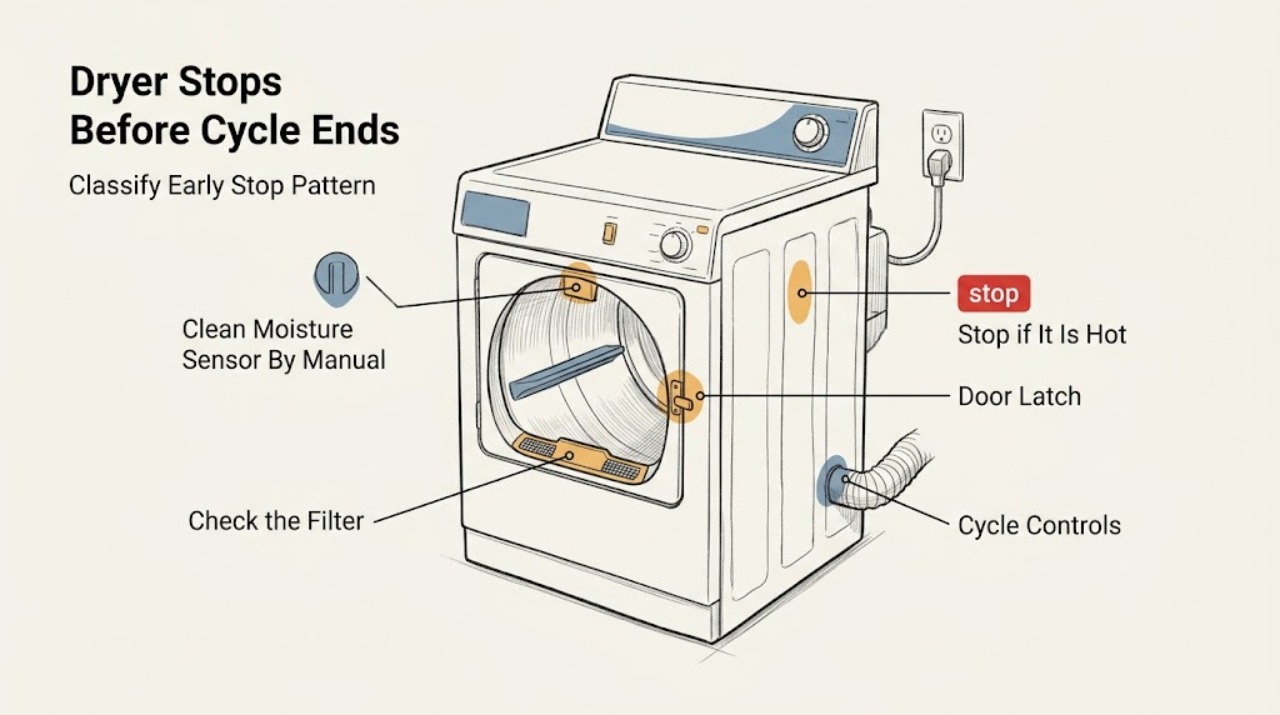
Work through in order
Diagnostic checks
Use only checks that match the exact appliance or system and its official guide.
-
Check 1
Record the stop without immediately restarting: note whether the clothes are dry, slightly damp, or wet; whether the drum and display are still active; whether the stop happens immediately, after a few minutes, or near the end; and whether a code, warning symbol, heat, odor, or unusual sound appears.
Expected result: The programme ends with damp clothes, pauses or loses power, stops only with a small load, stops after heating, or displays an error or warning.
Next step: Use the result to choose the sensor, filter, load, vent, power, or service check below. Do not keep restarting a dryer that smells abnormal, overheats, sparks, or trips power.
Stop if: Stop immediately for smoke, sparking, burning odor, a damaged cord or plug, severe heat, water near electrical parts, or a drum that is scraping or stuck; isolate power only when safe and arrange qualified help.
Why this matters
Why: Damp clothes after an automatic programme make sensor, filter, vent, programme, load, or heating issues more likely. A dark display or power interruption shifts attention to the electrical setup; a code or abnormal heat needs model-specific diagnosis rather than repeated cycles.
-
Check 2
With the dryer off, open the door and locate the moisture-sensor area using the exact Bosch manual. If the manual identifies it as user-cleanable, wipe the sensor with a damp cloth or the method Bosch specifies; do not use abrasives or steel wool and do not scrape the surface.
Expected result: A visible film or residue is present, the sensor area is clean, or the sensor cannot be identified or safely accessed under the model instructions.
Next step: Reassemble only the user-accessible parts and run one suitable programme with a representative load. If damp clothes remain or the sensor cannot be safely cleaned, stop repeated testing and arrange Bosch service.
Stop if: Do not use abrasives, steel wool, solvents, tools, or cabinet disassembly to clean the sensor, and do not continue if the sensor or surrounding wiring appears damaged.
Why this matters
Why: Limescale or detergent and care-product residue can interfere with moisture detection and cause an automatic programme to end too soon. A clean or inaccessible sensor keeps load, filter, vent, power, heating, and service causes in consideration.
-
Check 3
Remove and clean the fluff filter only as the exact Bosch manual allows. For models with a removable two-part filter, remove visible lint, clean the filter area, rinse only when the manual permits, dry the filter fully, and refit it correctly before testing.
Expected result: The filter is packed with lint, has residue or damage, is incorrectly seated, or is clean and correctly refitted.
Next step: Use one appropriate cycle after the filter is dry and correctly installed. If the filter is damaged, cannot seat, the filter path contains inaccessible lint, or the dryer still stops with damp clothes, arrange qualified service.
Stop if: Do not operate without the filter, force a filter or cover, push lint into the air duct, or open the cabinet to clean internal components.
Why this matters
Why: A blocked or poorly fitted filter can reduce performance and contribute to early stopping or incomplete drying. A clean, undamaged filter makes a blocked vent, sensor, programme, load, power, heating, or internal fault more likely.
-
Check 4
Compare the selected programme with the fabric and load using the exact Bosch manual. Separate a very small, already-dry, tightly packed, or unsuitable load and use a programme intended for that load; do not mix this check with a large batch of unusual items.
Expected result: The dryer stops only with a small or already-dry load, a programme does not match the fabric, the load is overloaded, or a representative load still stops damp.
Next step: Correct the load and programme according to the model manual and test once. If the same representative load stops early, keep the dryer off and continue to service escalation rather than changing programmes repeatedly.
Stop if: Do not dry items that the care label or Bosch manual excludes, overload the drum, or continue testing if the dryer becomes hot, smells abnormal, or stops with a fault indication.
Why this matters
Why: A programme may end when a small load is sensed as dry or when the selected programme is not suited to the material. An overloaded or mismatched load can also produce incomplete drying, while repeated early stops with a suitable load keep sensor, airflow, power, and service causes likely.
-
Check 5
From a safe external position, check that the accessible vent exit is not blocked and that the vent hose is not visibly kinked or crushed. Confirm the plug and switch are secure and the circuit is not overloaded; reset a tripped breaker only once if safe and permitted, without opening the electrical enclosure or moving a built-in dryer.
Expected result: The outside vent has weak or blocked airflow, the hose is kinked, the dryer shares an overloaded circuit, power has interrupted, a breaker trips again, or the external setup appears normal.
Next step: Clear only an obvious external obstruction and have a qualified person clean or inspect inaccessible venting. Arrange electrician or Bosch service for repeated trips, damaged wiring, or a persistent early stop after the external checks.
Stop if: Do not open panels, probe live power, use damaged cords, keep resetting a breaker that trips again, disconnect an inaccessible duct, or run a gas appliance with its vent disconnected.
Why this matters
Why: Restricted airflow can leave clothes damp and may make the dryer stop or protect itself; an unstable or interrupted supply can also stop a programme. A clear accessible path and stable external supply do not rule out an internal heater, fan, sensor, control, or other fault.
-
Check 6
Check that the door closes firmly and stays latched, then record any displayed error exactly as shown. Do not force the latch or bypass it. If the dryer still stops before the programme ends after the model-approved sensor, filter, load, vent, and external power checks, capture the model and serial information from an ordinary-access label.
Expected result: The door does not close or latch securely, the display shows a recurring code, the drum stops with no visible cause, or the dryer completes normally after a safe correction.
Next step: Arrange qualified Bosch service for a damaged latch, recurring code, or persistent early stop. Provide the model, programme, load, moisture result, stop timing, filter and sensor checks, vent and power observations, and any code.
Stop if: Do not bypass the door lock, run with a damaged door or panel, clear a recurring code by repeated resets, or perform internal electrical or heating repairs.
Why this matters
Why: A door that is not securely closed can interrupt a cycle, while a recurring code or persistent early stop points toward a model-specific electrical, heating, sensor, motor, control, or other fault. A single corrected load or setting issue is less concerning than a repeatable failure with a representative load.
Use your observations
Decision map
Find the observation that best matches what you see, then follow the next safe action.
-
PATH 01Safety boundary
What you see
Do this next
Clean the sensor only by the exact Bosch manual method and run one suitable load. If damp clothes remain or the sensor cannot be safely accessed, arrange service.
Why this path and its safety boundary
Why it matters: Incorrect moisture detection is more likely than a normal cycle completion.
Safety stop: Do not use abrasives, steel wool, solvents, or cabinet disassembly on the sensor.
-
PATH 02Safety boundary
What you see
Do this next
Follow the model's load and programme guidance and test once with a suitable representative load. Escalate when the same early stop occurs with that load.
Why this path and its safety boundary
Why it matters: Load sensing or programme selection is more likely than an immediate component failure.
Safety stop: Do not keep changing programmes while the dryer is hot, abnormal, or showing a fault.
-
PATH 03Safety boundary
What you see
Do this next
Clean and refit the user-accessible filter and clear only visible external blockage. Have inaccessible venting inspected and arrange Bosch service if the stop returns.
Why this path and its safety boundary
Why it matters: Restricted airflow or filter condition can explain incomplete drying and a protective or premature stop, but an accessible check does not rule out internal lint or a fan or heating fault.
Safety stop: Do not run without the filter, open the cabinet to remove lint, or disconnect a gas dryer vent.
-
PATH 04Safety boundary
What you see
Do this next
Use safe external checks and the model manual, then arrange an electrician or Bosch service for a damaged cord, repeated trip, defective outlet, or latch that will not secure.
Why this path and its safety boundary
Why it matters: An external electricity or door-interlock issue is more likely than a moisture-sensor decision, although repeated trips or latch faults need professional diagnosis.
Safety stop: Do not probe live power, bypass the latch, or repeatedly reset a protective device.
-
PATH 05Safety boundary
What you see
Do this next
Stop repeated cycles, keep the dryer off if it is abnormal, and arrange qualified Bosch service with the model, code, stop timing, and all observations.
Why this path and its safety boundary
Why it matters: A heating, fan, sensor, motor, control, door, or other model-specific fault is more likely than a user setting or maintenance issue.
Safety stop: Do not open the cabinet, run with a panel removed, bypass a safety device, or replace a component from the symptom alone.
Helpful context
Understand the symptom
An automatic programme can end early for more than one reason
A Bosch automatic dryer uses moisture information to decide how long to run. If sensor surfaces are coated with limescale or detergent and care-product residue, the programme may stop while clothes are still damp. A genuinely small or already-dry load, an unsuitable programme, a blocked filter or vent, a power interruption, or a door that does not remain latched can produce a similar complaint. The remaining moisture and stop pattern matter more than the timer alone.
Clean the parts the model makes user-accessible
Bosch describes cleaning the moisture-sensor area and fluff filter as user checks, but dryer designs and filter arrangements vary. Use the exact manual for the sensor location, filter removal, and any condensate or heat-exchanger care. Do not use abrasives or steel wool on a sensor, and do not open the cabinet to reach internal lint, wiring, heater, motor, or control parts.
Treat recurring stops as a service symptom
A dryer that stops repeatedly after the safe sensor, filter, load, door, vent, and external power checks needs diagnosis. A code can identify a path for the technician, but clearing a display or resetting power does not prove the underlying problem is gone. Keep the model and serial information, programme, load, moisture result, and timing of each stop for the service handoff.
Safety boundary
Stop conditions
- Stop using the dryer for smoke, sparking, burning odor, severe heat, a damaged cord or plug, water near electrical parts, a stuck drum, or a repeated protective-device trip; isolate power only when safe and arrange qualified help.
- Do not bypass the door latch, run the dryer with a panel removed, probe live wiring, open the cabinet, or perform internal heating, motor, fan, or control repairs as an ordinary user check.
- Do not use abrasives or steel wool on a moisture sensor, operate without a correctly fitted fluff filter, force a filter or door, or push lint into an air duct.
- Do not keep restarting a dryer that stops with damp clothes, a recurring code, abnormal heat, or weak airflow after the safe checks; a reset does not prove the fault is fixed.
- Arrange qualified Bosch service when the dryer repeatedly stops before the cycle ends, a door or filter is damaged, venting cannot be safely inspected, or sensor, load, filter, power, and door checks do not restore normal operation.
Only after diagnosis
Potential parts
- dryer moisture sensor or sensor assembly
Consider this category only if cleaning does not restore correct moisture detection and a technician confirms the sensor or its wiring is faulty.
Sensor location and assembly design vary by exact Bosch model; confirm the model and manufacturer's fit information before ordering. - dryer fluff filter or airflow component
Consider this category only if inspection confirms a damaged filter or model-specific airflow component after blockage and cleaning issues are ruled out.
Filter and airflow parts are model-specific; do not substitute by appearance or assume a clean filter proves an internal airflow fault. - dryer heating, fan, motor, or control assembly
Consider this category only after qualified diagnosis confirms a component fault when a representative load still stops early with the user checks correct.
Electrical and mechanical assemblies vary by model and require professional testing and exact model matching; early stopping alone does not identify the part.
When checks do not resolve it
Need a professional?
Arrange qualified Bosch appliance service when a representative load remains damp after the moisture sensor, fluff filter, programme, load, vent, door, and external power checks; when the dryer stops repeatedly or displays a recurring code; or when a heating, fan, motor, control, or electrical fault is suspected. Seek urgent electrical help for smoke, sparking, burning odor, severe heat, a hot or damaged cord or plug, or repeated breaker trips. Provide the exact model and serial information if safely visible, programme and load, moisture result, stop timing, sensor and filter condition, vent and door observations, power interruptions, and any error code.
Safety scope: This article supports only ordinary-access observation, model-approved sensor and filter care, load and programme checks, door observation, and safe external vent and power checks. Internal access to heating, fan, motor, sensor wiring, controls, or safety interlocks should be performed by a qualified appliance technician with the exact model procedure and power isolated.
Common questions
FAQ
Why does my Bosch dryer stop before the cycle is finished?
The selected automatic programme may sense the load as dry too soon if the moisture sensor has residue, or the stop may relate to the fluff filter, vent, load, programme, door, power, or an internal fault. Check only the model-approved user items. A repeatable early stop with damp clothes needs qualified service.
Can a dirty moisture sensor make a Bosch dryer stop early?
Yes. Bosch says limescale or detergent and care-product residue can cover the moisture sensor and affect the way the programme detects dryness. Clean it only as the exact manual allows, without abrasives or steel wool, then test once with a suitable load. If the problem remains, arrange service.
Could the Bosch dryer stop early because the load is too small?
A very small or already-dry load can be sensed as finished sooner, and an unsuitable programme may not match the fabric. Follow the model manual for programme and load guidance and test once with a representative load. If that load still ends damp or stops early, the problem is not established as a simple load issue.
What should I check if my Bosch dryer stops halfway and loses power?
Check the external plug, switch, and circuit only from a safe position and follow the model manual. A power interruption or tripped protective device can interrupt a programme, but a repeated trip, damaged cord, or persistent stop needs qualified electrical or appliance diagnosis. Do not open panels or keep resetting a device that trips again.
When should I call for Bosch dryer service?
Arrange service when sensor, filter, load, programme, vent, door, and safe external power checks do not stop the early endings; when the dryer shows a recurring code, loses power, overheats, or the drum or door is abnormal. Do not open the cabinet, bypass the latch, or replace a heating, motor, fan, sensor, or control part from the symptom alone.
Read the exact guide
Official sources
- Dryer keeps stoppingBosch Home Appliances Singapore · Manufacturer support article for Bosch tumble dryers that stop halfway through a programme; used for moisture-sensor care, two-part filter care, external electricity checks, and professional-service boundary.
- Tumble dryer keeps stoppingBosch Home Appliances UK · Manufacturer support article for Bosch tumble dryers stopping halfway; used to cross-check sensor and filter care and the power-interruption branch.
- Tumble dryer is not spinningBosch UK · Manufacturer support page for Bosch tumble-dryer rotation problems; used for the door-latch check and for keeping internal drive and roller diagnosis within professional service.
- Dryer troubleshooting: Dryer is not drying clothes completelyBosch Home Appliances · Manufacturer support page for Bosch dryers that stop before clothes are dry or do not dry completely; used for the sensor, filter, programme, vent, and service checks.
Community feedback
Share a repair observation
Share a plain-text repair observation. Accepted observations are published automatically; this page may take a moment to update.