
On this page
Start here
Quick answer
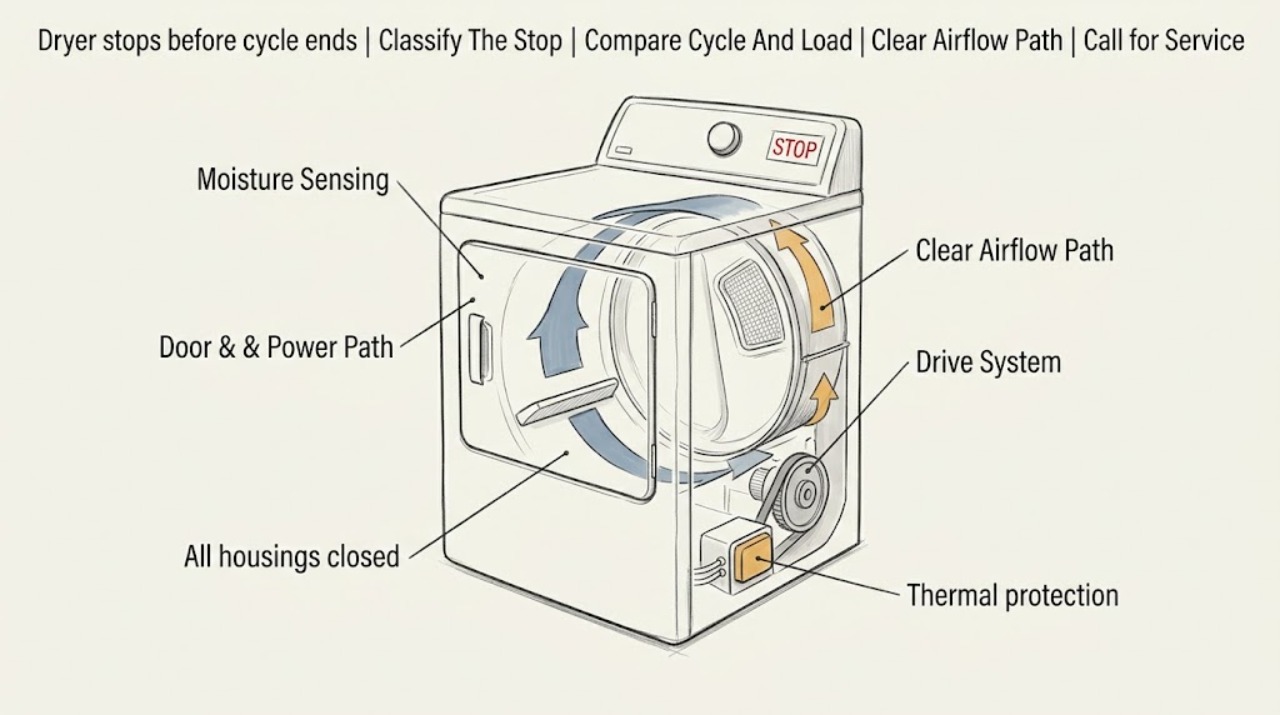
A dryer that warms and then stops before the selected cycle ends is not automatically a failed motor or thermal fuse. First separate a normal sensor-cycle decision from a true mid-cycle stop: note whether the display ends normally, whether the drum stops while controls remain active, whether clothes are damp, and whether the dryer runs again only after cooling. With the dryer off, disconnected, and cool, inspect the lint screen, accessible exhaust path, load, door latch, cord, and drum movement without opening the cabinet. Restricted airflow, a door or power interruption, a mechanical drag, a failing motor, a moisture-sensor decision, or thermal protection can produce overlapping symptoms. Stop use for smoke, burning odor, sparking, unusual heat, a damaged cord or outlet, or a gas odor, and have cabinet-level or gas-dryer work handled by qualified service.
Before you begin
Safety first
- This article supports symptom classification and ordinary external, power-off, cool checks only. A qualified technician must handle cabinet access, motor, belt, rollers, thermal fuse or cutoff, sensors, control, wiring, gas components, and internal venting.
Work through in order
Diagnostic checks
Use only checks that match the exact appliance or system and its official guide.
-
Check 1
During one normal observation, note whether the selected cycle ends with its normal signal, whether the drum stops while the display remains active, whether the load is dry or damp, and whether the door was opened. Do not continue testing a dryer that is unusually hot or smells burned.
Expected result: Record a normal cycle ending with dry clothes, an apparent early ending with damp clothes, a running display with a stopped drum, or a stop immediately after a door movement.
Next step: Record the cycle type, load, time to stop, and whether the dryer was warm. Use the branches below; stop instead of repeating the test if there is smoke, burning odor, sparking, or abnormal heat.
Stop if: Do not keep restarting a dryer that stops hot, produces an odor, smokes, sparks, or has a damaged cord, plug, outlet, door, or cabinet.
Why this matters
Why: A normal ending on an automatic cycle makes moisture sensing or cycle selection more likely. A stopped drum with active controls makes the door, belt, motor, thermal, or control path more likely. Damp clothes keep airflow and heat-removal problems in consideration.
-
Check 2
Check the owner manual for the selected cycle and compare the load without opening the cabinet: determine whether it is sensor or timed drying, whether the load is large enough to tumble and contact sensors, and whether clothes can move freely rather than being tightly packed.
Expected result: Record a stop that occurs only on a sensor cycle, only with a very small or mixed load, only with a tightly packed load, or on both a suitable timed cycle and a suitable automatic cycle.
Next step: Use the manual's recommended cycle and a freely tumbling load for one controlled comparison only when there is no stop-use symptom. If the dryer still stops after warming or leaves clothes damp, move to airflow and service-oriented checks.
Stop if: Do not overload the drum, hold the door closed, or continue testing when the dryer becomes unusually hot, noisy, or odorous.
Why this matters
Why: A cycle- or load-specific stop can be normal sensing, an unsuitable load, or a door pushed open by packing. A repeatable stop on a suitable timed cycle with a freely tumbling load is less consistent with normal moisture termination.
-
Check 3
Switch the dryer off, disconnect power as directed by the owner manual, and wait until it is cool. Clean the accessible lint screen and inspect the hose, wall connection, and outside hood for crushed sections, lint, debris, snow, ice, or a flap that barely opens; do not disassemble the cabinet or run a gas dryer with its vent disconnected.
Expected result: Record a loaded lint screen, a kinked or crushed hose, weak outside airflow, a blocked-looking hood, unusual laundry-area heat or humidity, or an accessible path that appears clear.
Next step: Correct only loose accessible lint or an obvious kink in the manner allowed by the manual, then stop if the symptom returns. Arrange vent or appliance service for weak airflow, hidden restriction, a blocked exterior hood, persistent heat, or uncertainty.
Stop if: Do not operate with weak airflow, excessive lint, a damaged vent, smoke, scorching, or a burning smell. Do not use plastic or improvised ducting as a workaround.
Why this matters
Why: Restricted exhaust can keep heat and moisture in the dryer, cause overheating or reduced heat, lengthen drying, and contribute to a protective stop. A clear visible path does not rule out an internal restriction, blower problem, or motor fault.
-
Check 4
With the dryer cool and disconnected, inspect only the external cord, plug, outlet area, door alignment, and latch for looseness, scorching, distortion, lint, or a door that does not stay closed. Do not probe the outlet, remove panels, tape the latch, or hold the door shut.
Expected result: Record an intact cord and secure latch, a loose or hot-looking connection, a door that can pop open, a latch that engages inconsistently, or a breaker that trips when the dryer runs.
Next step: Leave the dryer disconnected and call qualified appliance or electrical service for any damaged connection, repeated trip, or latch concern. If the exterior is intact, continue only with cool, power-off drum observation.
Stop if: Do not use a damaged cord, plug, outlet, or latch, and do not reset a breaker repeatedly to keep the dryer running.
Why this matters
Why: A door or power interruption can stop the motor and cycle without proving that the motor itself failed. Scorching, a hot connection, repeated breaker trips, or unreliable latching is a stop-use condition and may be electrical or mechanical.
-
Check 5
Only after power is disconnected and the dryer is fully cool, turn the empty drum gently from the doorway without forcing it or reaching past the opening. Note whether it turns smoothly, binds, scrapes, or makes an unusual sound when the appliance is later observed from outside during a normal run.
Expected result: Record smooth movement, stiffness or binding, scraping or rumbling, or a motor sound with a drum that does not rotate normally.
Next step: Keep the dryer out of service for binding, scraping, or abnormal resistance and arrange qualified repair. Do not remove the drum or open panels to inspect the drive system.
Stop if: Do not force a seized drum, run with grinding or structural damage, or reach inside the cabinet.
Why this matters
Why: Binding, scraping, or rumbling can overload the motor or indicate a belt, roller, bearing, or other drive problem. Smooth hand movement does not prove the motor, belt, controls, or thermal protection are healthy.
-
Check 6
If no immediate hazard is present, document whether the dryer stops only after it has warmed, whether the motor runs again after a long cool-down, whether controls remain powered, and whether the load is still damp. Do not deliberately repeat a hot stop or bypass any thermal, door, or control safety device.
Expected result: Record a repeatable warm-then-stop pattern with later restart, a stop with a hum or scraping sound, no restart after cooling, or a normal end-of-cycle indication.
Next step: Stop using the dryer when the pattern repeats or the housing is unusually hot. Give the technician the run time, cooldown behavior, airflow result, cycle, load, sounds, odors, and display state.
Stop if: Do not repeatedly cycle a motor that stops after warming, defeat thermal protection, run with panels removed, or test live motor wiring.
Why this matters
Why: A warm-then-stop pattern with later restart makes heat-related motor protection, restricted airflow, mechanical drag, or a thermal/control fault more likely, but it does not identify one failed part. A hum, no restart, or persistent damp load increases the need for service.
Use your observations
Decision map
Find the observation that best matches what you see, then follow the next safe action.
-
PATH 01Next step
What you see
The display ends normally on a sensor cycle, the load is dry at the selected level, and the dryer behaves normally with a suitable load.
Do this next
Use the cycle and load guidance in the owner manual. Arrange service if suitable loads remain damp, the cycle ends implausibly early, or the same symptom occurs on a timed cycle.
Why this path and its safety boundary
Why it matters: A normal moisture-sensing decision or cycle selection is more likely than a component failure.
-
PATH 02Next step
What you see
The stop depends on a sensor cycle, a very small or mixed load, loaded lint, weak exhaust, or a hot and humid laundry area, while the drum and controls otherwise behave normally.
Do this next
Use a suitable load and cycle and correct only accessible lint or a clear vent kink with power disconnected. Stop and arrange service if dampness, overheating, weak airflow, or early stopping recurs.
Why this path and its safety boundary
Why it matters: Moisture sensing, load contact, cycle selection, or restricted airflow is more likely than an isolated motor failure, although persistent heat can damage components.
-
PATH 03Next step
What you see
The drum stops with controls still active after the dryer warms, the load is damp, the housing is unusually hot or noisy, and the motor restarts only after cooling or does not restart.
Do this next
Stop operating the dryer and request qualified appliance service. Provide the cooldown pattern, airflow observations, drum movement, cycle, load, and any noise or odor.
Why this path and its safety boundary
Why it matters: A motor, mechanical drag, airflow, thermal-protection, or control fault is more likely than normal cycle termination; the cooldown clue is not a diagnosis.
-
PATH 04Next step
What you see
The stop coincides with a door that will not latch, a door that pops open, a damaged or hot cord or outlet, or a breaker that trips.
Do this next
Keep the dryer disconnected for visible electrical or latch damage and arrange qualified appliance or electrical service. Do not hold the door closed or repeatedly reset a breaker.
Why this path and its safety boundary
Why it matters: The door-switch or power path can interrupt the motor and cycle without establishing a failed motor.
-
PATH 05Next step
What you see
The empty drum binds, scrapes, rumbles, or the motor can be heard while the drum does not rotate normally.
Do this next
Leave the dryer out of service and have a qualified technician inspect the drive, supports, motor, thermal protection, and controls with power safely isolated.
Why this path and its safety boundary
Why it matters: A belt, roller, bearing, motor, or other drive load may be stopping or overloading the system; the exact part cannot be established by hand movement alone.
-
PATH 06Next step
What you see
There is smoke, a burning odor, sparking, scorching, rapidly increasing heat, or a gas odor on a gas dryer.
Do this next
Stop use. For gas odor or fire risk, leave the area as appropriate and contact the gas utility or emergency services from a safe location. For other hazards, keep clear and request qualified appliance service. Do not relight, reset, or inspect inside the cabinet.
Why this path and its safety boundary
Why it matters: This is an immediate fire, electrical, or gas safety concern, not a normal mid-cycle diagnostic condition.
Helpful context
Understand the symptom
Confirm whether the dryer ended normally
Automatic or sensor cycles can end when the controls decide the load has reached the selected dryness, and a timer can advance unevenly or appear to pause. That is different from the drum stopping while the control remains active, clothes staying damp, or the dryer becoming hot and stopping. Record the cycle, load, display state, and whether the door was opened before treating the symptom as a component failure.
Heat after running makes airflow important
A dryer that heats but cannot move heat and moisture out may run hot, dry slowly, reduce heat, or stop protectively. Check only the accessible lint screen, hose, wall connection, and outside hood with power disconnected and the dryer cool. Do not disconnect a gas dryer's vent as a test, run the appliance with panels removed, or use a damaged or improvised vent.
The cooling pattern narrows the path but does not name a part
If the dryer stops after warming and runs again only after a rest, heat-related motor protection, airflow restriction, mechanical drag, or a control or thermal-protection issue becomes more likely. The same observation cannot prove which part failed. Repeatedly restarting a hot dryer can worsen a fault and removes a useful safety boundary, so document the pattern and arrange service.
Internal parts remain behind the service boundary
The belt, motor, thermal fuse or cutoff, door switch, moisture sensors, heater, and control are commonly inside or behind panels. Maytag specifically notes that inspecting a thermal fuse or moisture sensor requires disassembly and recommends professional help for belt and latch access. Do not bypass a fuse or switch, probe energized wiring, or order a part by symptom alone.
Safety boundary
Stop conditions
- Stop using the dryer for smoke, burning odor, sparking, scorched wiring, a rapidly hot cabinet, or a gas odor; get appropriate emergency or gas-utility help from a safe location.
- Do not bypass or jumper a thermal fuse, thermal cutoff, door switch, motor protection, or other safety device, and do not test energized wiring.
- Do not repeatedly restart a dryer that stops after warming and later runs after cooling, or continue operating with weak airflow, excessive lint, unusual noise, or a damp load after repeated stops.
- Do not force a seized or scraping drum, hold a door closed, use a damaged cord or outlet, disconnect a gas dryer's vent as a test, or run with panels removed.
- Disconnect power before maintenance or cleaning and follow the exact model manual; cabinet access, thermal-fuse, motor, belt, sensor, control, gas, and internal-vent repairs belong to qualified service.
Only after diagnosis
Potential parts
- dryer drive motor
Consider this category only if qualified diagnosis finds that the motor fails under normal load, stops after warming, or does not restart after airflow and mechanical causes are addressed.
Confirm the exact dryer model, motor design, mounting, connector, and service procedure before ordering; a warm-then-stop symptom alone does not prove motor failure. - thermal fuse or thermal cutoff
Consider this only after qualified diagnosis confirms the protective device is open or defective and the underlying airflow or overheating cause has been addressed.
Verify exact model, temperature and electrical ratings, location, and approved replacement; never bypass a thermal safety device or substitute one by appearance. - door switch or latch
Consider this only when inspection and qualified testing show the door does not latch or the switch does not reliably register a closed door, and the power path is sound.
Confirm exact model, latch geometry, switch configuration, and safe installation procedure; do not hold the door closed as a workaround. - drive belt, roller, or idler
Consider this category only when qualified inspection finds binding, scraping, belt damage, abnormal support wear, or a drum that is not driven normally.
Confirm exact model and the complete drive configuration before ordering; cabinet disassembly and tension or alignment work require appropriate service. - moisture sensor or control
Consider this only when a suitable load, cycle, clean sensor surface, and airflow have been evaluated and qualified diagnosis finds a sensor or control fault causing premature termination.
Verify exact model, sensor or control configuration, connectors, and approved diagnostic procedure; sensor-cycle behavior alone is not proof that a part needs replacement.
When checks do not resolve it
Need a professional?
Arrange qualified appliance service when the dryer stops on a suitable timed or automatic cycle after warming, the motor runs again only after cooling, the drum binds or makes unusual noise, the door or power path is damaged, airflow remains weak, a thermal or control part is suspected, or the symptom recurs after accessible lint and cycle checks. For smoke, sparking, fire risk, or gas odor on a gas dryer, stop immediately and use emergency or gas-utility procedures from a safe location.
Safety scope: This article supports symptom classification and ordinary external, power-off, cool checks only. A qualified technician must handle cabinet access, motor, belt, rollers, thermal fuse or cutoff, sensors, control, wiring, gas components, and internal venting.
Common questions
FAQ
Why does my dryer stop after it warms up?
A warm-then-stop pattern can involve restricted airflow, motor heat protection, mechanical drag, a thermal device, a door or power interruption, a control, or a normal sensor-cycle decision. Note whether the drum stops with controls active and whether it restarts after cooling; stop repeated testing and arrange service if the pattern recurs.
Could my dryer be stopping normally on a sensor cycle?
Yes. Automatic cycles can end when the controls sense the selected dryness, and a timer may not advance evenly. If clothes remain damp, the drum stops while the display remains active, or a suitable timed cycle also stops, treat it as a service symptom rather than normal sensing.
Can a clogged vent make a dryer stop before the cycle ends?
Restricted exhaust can trap heat and moisture, reduce heat, lengthen drying, and contribute to protective stopping. With power disconnected and the dryer cool, inspect only accessible lint and vent areas. Have persistent weak airflow, a hidden restriction, or overheating professionally addressed.
What if the dryer runs again after it cools?
That pattern makes a heat-related motor, airflow, mechanical, thermal, or control issue more likely, but it does not identify one part. Do not keep restarting it to confirm the pattern; record the run time and cooldown behavior and call appliance service.
Why does the dryer stop with damp clothes?
The load may be ending a sensor cycle early, the cycle or load may be unsuitable, exhaust may be restricted, or the dryer may be stopping because of a drive, motor, thermal, door, or control fault. Compare cycle and load behavior once only when safe, then arrange service for recurrence.
Should I replace the thermal fuse if the dryer stops?
Not by symptom alone. The fuse is a safety device, and Maytag notes that inspecting it requires disassembly. A qualified technician should confirm the device and investigate airflow or overheating before any replacement; never bypass it.
Can a bad motor cause a dryer to stop mid-cycle?
A motor or drive problem is possible, especially when the dryer stops after warming, hums, binds, or restarts after cooling. Smooth hand movement does not prove the motor is good. Keep the cabinet closed and have the motor, belt, supports, airflow, and safety controls diagnosed together.
What if the dryer stops when the door moves?
A door latch or switch can interrupt the cycle if the door does not stay securely closed. Do not hold it shut or tape it; disconnect the dryer for visible damage and call qualified appliance service.
Is it safe to run a gas dryer with the vent disconnected to test airflow?
No. Do not run a gas dryer without its vent; combustion products including carbon monoxide can enter the room. Inspect the accessible vent externally with the dryer off and cool, or have the vent professionally serviced.
When is a dryer that stops after warming an emergency?
Treat smoke, burning odor, sparking, scorched wiring, rapidly increasing heat, a damaged outlet or cord, or gas odor as urgent. Stop use, leave for a gas or fire risk as appropriate, and contact emergency services, the gas utility, or qualified service from a safe location.
Read the exact guide
Official sources
- Dryer - Hot to the Touch or SweatsGE Appliances · GE Appliances support guidance used for general airflow and heat-safety reasoning; exact vent requirements belong to the dryer installation instructions.
- Dryer - Timer Stops During the CycleGE Appliances · GE Appliances support guidance used for general diagnostic distinctions; no GE model-specific behavior is asserted for an unbranded dryer.
- Why Does My Dryer Keep Stopping Mid-Cycle?Maytag · Maytag homeowner guidance used for general dryer symptom branches; the exact dryer model manual and qualified service govern diagnosis and part fit.
- Clothes are not dry after using Samsung dryerSamsung · Samsung support guidance used for general dryer airflow and sensor-cycle distinctions; model-specific tests and settings must not be generalized.
- Owner's ManualWhirlpool Corporation · Opened Whirlpool owner's manual used for general cycle and cool-down distinctions; it is not a model-specific manual for an unknown dryer.
- Dryer Stops Mid-Cycle - Product HelpMaytag · Maytag product help used to distinguish automatic cycles from timed or air-only cycles; exact model cycle names and behavior can differ.
Community feedback
Share a repair observation
Share a plain-text repair observation. Accepted observations are published automatically; this page may take a moment to update.