
On this page
Start here
Quick answer
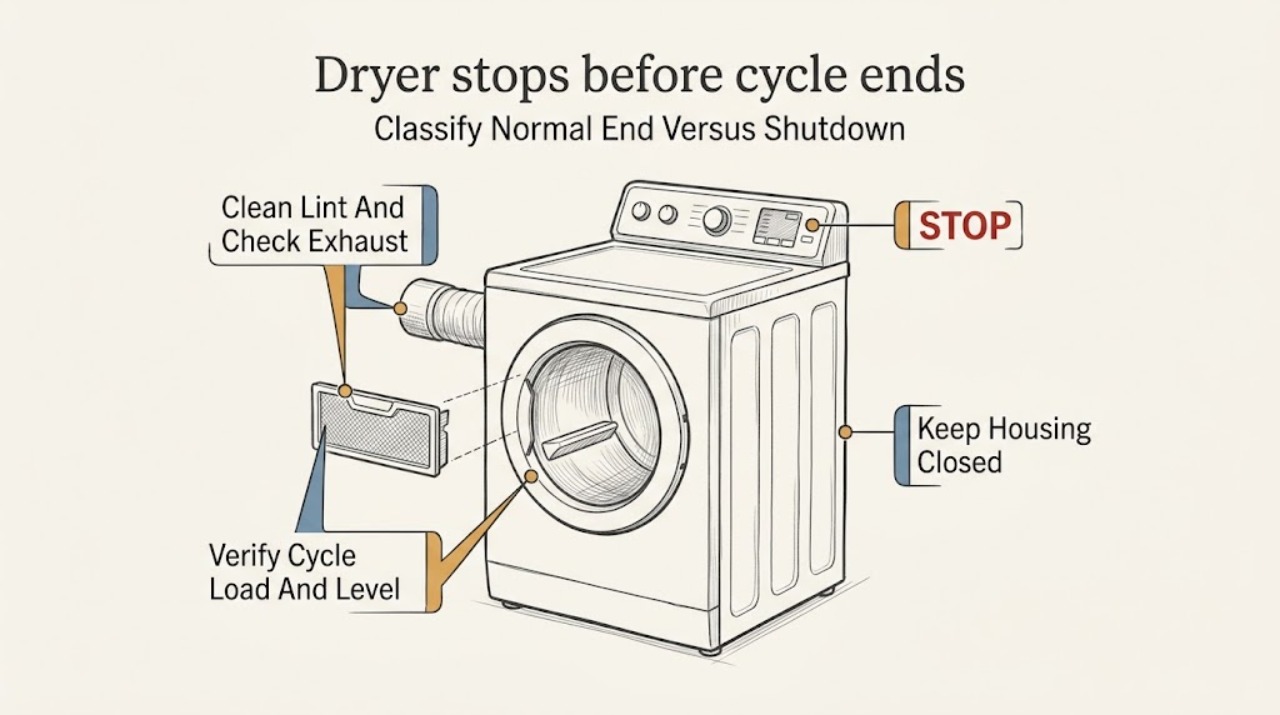
A dryer that stops before the cycle ends and works again only after cooling is not necessarily fixed: heat buildup can trigger a protective shutdown, and repeated restarting can worsen a restricted-vent, motor, drive, or control problem. First determine whether the cycle actually ended normally because a sensor cycle detected dry clothes, or whether the dryer became hot and lost power or stopped with damp clothes. After the dryer is fully cool, clean the lint screen, check the exterior exhaust opening and the space around the dryer, confirm the selected cycle and load are appropriate, and do not run the dryer without its filter. If it shuts off hot again, airflow is weak, the motor hums, a breaker trips, the drum stops turning, or the dryer needs a panel to inspect, keep it out of service and arrange qualified appliance repair. Stop immediately for smoke, burning odor, sparks, damaged wiring, or unusual heat.
Before you begin
Safety first
- This article supports recognizing normal sensor completion, allowing the dryer to cool, cleaning the accessible lint screen, checking the exterior exhaust and clearance, reviewing cycle and load selection, and observing external power and drum behavior. It does not authorize cabinet or vent disassembly, live electrical work, heater or motor service, component replacement, or safety bypass.
Work through in order
Diagnostic checks
Use only checks that match the exact appliance or system and its official guide.
-
Check 1
At the next occurrence, without restarting the dryer repeatedly, note whether the display shows the normal end state, whether the door opens normally, whether the load is dry or still damp, and whether the controls are completely unresponsive until the dryer cools.
Expected result: The cycle ends with its normal completion indication and dry or nearly dry clothes, or the dryer loses power or stops with damp clothes and becomes usable only after cooling.
Next step: For a normal end, check the selected cycle and load size. For a hot or unresponsive shutdown, stop using the dryer until it is cool and complete the airflow and safety checks below; do not run repeated test cycles.
Stop if: Stop immediately for smoke, burning odor, sparks, damaged wiring, a hot plug or outlet, or heat that remains abnormal after the dryer stops.
Why this matters
Why: A normal sensor-cycle end can be expected behavior. An unexpected stop with damp clothes and cooling-dependent recovery is a fault pattern that may involve overheating, airflow, motor protection, power, drive, door, or control components.
-
Check 2
After the dryer and load are fully cool, clean the lint screen and inspect the visible exterior exhaust hood for lint or an obstruction; check that the dryer front and surrounding area are not blocked. Do not open the cabinet or disconnect a hard-to-reach vent for this check.
Expected result: The screen or exhaust opening is loaded or blocked, airflow at the exterior is weak, the front clearance is restricted, or the accessible airflow path is clear.
Next step: Remove only accessible lint or an obstruction, restore the required front clearance, and follow the owner's instructions for vent maintenance. If the dryer stops again or airflow remains weak, keep it off and arrange qualified appliance service.
Stop if: Do not operate without the lint screen, reach into the exhaust duct, use the dryer with a crushed or damaged vent, or disassemble the vent or cabinet to chase the blockage.
Why this matters
Why: Lint and exhaust restriction can trap heat and contribute to a mid-cycle protective shutdown. A clear accessible path reduces but does not eliminate the possibility of an internal vent blockage, motor thermal protection, heater, control, or drive issue.
-
Check 3
Review the selected cycle and load after cooling: confirm that the cycle is intended for the load, the drum contains enough but not an excessive amount of clothing for sensor operation, and the dryer is level and stable without moving a stacked unit by force.
Expected result: The cycle is Air Only or another non-heating setting, the load is empty or very small, the load is bulky or overloaded, the dryer is tilted, or the cycle and stable load appear appropriate.
Next step: Choose the cycle and load arrangement specified by the owner's manual and avoid using a damaged or repeatedly overheating dryer. If a suitable load still causes a cooling-dependent stop, arrange service.
Stop if: Do not use a tiny or empty load to repeatedly test a suspected fault, overload the drum, bypass a sensor, or move a stacked or hard-connected dryer without proper support.
Why this matters
Why: Air-only and sensor cycles can appear to stop early for normal reasons; some models detect no load or a load positioned away from sensors. An overload can prolong drying and increase heat stress. A stable, appropriate load with a hot shutdown points away from normal sensing.
-
Check 4
With the dryer cool and off, inspect the plug, cord, outlet area, and accessible breaker or fuse status without opening electrical covers; also note whether the drum turns normally during a permitted cycle or whether it stops while the control remains on.
Expected result: A breaker or fuse trips, the cord or plug is hot or damaged, the dryer loses all display power, the drum stops turning while controls remain on, or external power and drum behavior appear normal before the shutdown.
Next step: Leave the dryer disconnected for a hot, damaged, or repeatedly tripping electrical condition. Arrange qualified appliance or electrical service for power loss, a stopped drum, or any symptom that persists after airflow and cycle checks.
Stop if: Do not reset a breaker repeatedly, use an extension cord, open electrical covers, test live voltage, reach near a moving drum, or continue operating with a hot plug, outlet, or damaged cord.
Why this matters
Why: A recurring power interruption or damaged connection needs electrical service. A stopped drum with controls still on can involve the belt, motor, door switch, or drive system; cooling-dependent recovery can also reflect motor thermal protection. Normal external power does not rule out internal failure.
-
Check 5
Before returning the dryer to use, record whether the stop was a normal sensor completion or a hot shutdown, the load and cycle, lint and exhaust findings, power behavior, drum movement, and the cooling interval; do not restart merely to see whether it fails again.
Expected result: The dryer completes an appropriate cycle normally after an accessible airflow or load correction, or it again shuts down hot, leaves clothes damp, needs cooling before restart, shows an error, or would require a panel to inspect.
Next step: Keep the dryer out of service and arrange qualified appliance repair for a repeated or unexplained shutdown. Provide the model, gas or electric type, cycle, load, timing, airflow, power, and drum observations.
Stop if: Do not remove panels, replace a thermal fuse, motor, belt, door switch, heater, or sensor, or bypass a thermal or door safety as a homeowner check.
Why this matters
Why: A resolved cycle-selection or accessible lint issue may explain the first event. A repeated cooling-dependent stop is consistent with an unresolved airflow, motor, thermal-protection, heater, drive, door, sensor, or control problem.
Use your observations
Decision map
Find the observation that best matches what you see, then follow the next safe action.
-
PATH 01Next step
What you see
The dryer shows its normal completion state, the load is dry or nearly dry, and it does not require a cooling interval to become responsive.
Do this next
Review the cycle and load guidance in the owner's manual. If the dryer later powers off hot with damp clothes or needs cooling before restart, treat that as a separate abnormal symptom.
Why this path and its safety boundary
Why it matters: The selected automatic or sensor cycle may have ended normally rather than stopping from a fault; sensor cycles can adjust duration based on load dryness.
-
PATH 02Safety boundary
What you see
The dryer stops with damp clothes, is hot, restarts only after cooling, and the lint screen, exhaust hood, front clearance, or vent path shows restriction.
Do this next
Leave the dryer cool and off, clean only accessible lint and obstructions, and have the full vent system inspected if airflow remains weak or the stop recurs. Do not continue cycles to dry the load.
Why this path and its safety boundary
Why it matters: Trapped heat and restricted airflow are more likely than normal sensor completion and can trigger protective shutdown behavior.
Safety stop: Do not run with a blocked, crushed, disconnected, or damaged vent, and do not open the cabinet to clean internal lint.
-
PATH 03Safety boundary
What you see
The dryer becomes hot, stops with damp clothes, and restarts after cooling even though the accessible lint screen, exterior hood, and front clearance are clear.
Do this next
Keep the dryer out of service and arrange qualified appliance repair. Give the technician the cooling-dependent restart pattern instead of repeatedly testing it.
Why this path and its safety boundary
Why it matters: An internal vent restriction, motor thermal protection, heater or thermostat issue, drive problem, door switch, control, or another internal fault remains possible.
Safety stop: Do not replace internal components, bypass thermal protection, or operate the dryer unattended to see whether it completes a cycle.
-
PATH 04Next step
What you see
The dryer ends early only with an empty, very small, or unsuitable load, or when the load is positioned away from the model's sensor area, without unusual heat or power loss.
Do this next
Use a suitable load and the cycle specified for it, keep the dryer level, and consult the model manual if the behavior remains normal but inconvenient. Escalate if it begins stopping hot or leaves normal loads damp.
Why this path and its safety boundary
Why it matters: A no-load or sensor-cycle behavior is more likely than thermal shutdown. Cycle duration and sensor behavior vary by model and selected program.
-
PATH 05Safety boundary
What you see
The dryer trips a breaker, loses power, has a hot or damaged plug or cord, produces smoke or a burning odor, sparks, or remains unusually hot after stopping.
Do this next
Stop using the dryer, disconnect power only if it can be done without contacting damaged or hot equipment, leave the area for smoke or fire danger, and contact emergency services or a qualified electrician or appliance technician from a safe location.
Why this path and its safety boundary
Why it matters: This is an electrical or fire-risk condition, not a cooling or cycle-selection issue.
Safety stop: Do not reset the breaker, reconnect the dryer, open panels, or use water on an energized electrical fire.
Helpful context
Understand the symptom
Cooling-dependent restart is a useful clue, not a repair
A dryer may stop normally when a sensor cycle decides the load is dry, but a dryer that becomes hot, stops with damp clothes, and only restarts after cooling points to a different symptom. Restricted airflow can trap heat; a motor or another internal component can also trip protection. Avoid restarting it repeatedly to prove the pattern.
Clear the airflow path while the dryer is cool
Clean the lint screen and check that the exterior exhaust opening is not blocked. Keep the front and surrounding space clear, and confirm that the dryer is not pressed against a wall or object in a way that restricts airflow. Cleaning an accessible screen or opening is different from disassembling the vent, cabinet, motor, or heater; persistent shutdowns need service.
Use the cycle and load behavior to separate normal from abnormal
Automatic or sensor cycles can change their remaining time and end when the load reaches the sensed dryness; a no-load or very small load may also finish early on some models. A dryer that powers off unexpectedly while the clothes remain wet, becomes unusually hot, or restarts only after a cooling interval is not explained by sensor behavior alone.
Safety boundary
Stop conditions
- Do not keep restarting a dryer that stops hot, leaves clothes damp, or becomes usable only after cooling; a protective shutdown does not prove the cause is gone.
- Stop immediately for smoke, burning odor, sparks, damaged wiring, a hot plug or outlet, unusual heat, or a breaker that trips again; leave the area and seek emergency help when there is immediate fire danger.
- Do not operate without the required lint screen, with a blocked, crushed, disconnected, or damaged exhaust path, or with the dryer front and airflow clearance obstructed.
- Do not remove cabinet panels, reach into the heater or motor area, test live electrical parts, replace a belt, motor, thermal device, heater, door switch, or sensor, or bypass a safety control.
- Arrange qualified appliance repair when accessible airflow and cycle checks do not prevent a cooling-dependent stop, or when the drum, controls, power, heater, motor, drive, or safety system behaves abnormally.
Only after diagnosis
Potential parts
- dryer motor or thermal protection device
Consider this category only after qualified diagnosis links cooling-dependent shutdown and restart to motor overheating or a failed thermal-protection component after airflow and power checks.
Confirm the exact dryer model and technician diagnosis before ordering; internal motor and thermal work requires disassembly and safety testing. - dryer drive belt
Consider this category only when service finds a worn or broken belt that explains a drum stopping while controls remain on, rather than a vent or thermal issue.
Confirm the exact model and complete drive diagnosis before ordering; belt replacement requires panel removal and correct tensioning. - dryer moisture sensor or door switch
Consider this category only when model-specific testing identifies a sensor or door-switch fault causing a premature end or interrupted cycle after airflow and load behavior are normal.
Confirm the exact model and diagnostic result; a sensor or switch part will not correct an overheating or blocked-vent condition.
When checks do not resolve it
Need a professional?
Arrange qualified appliance repair when the dryer stops with damp clothes and only restarts after cooling, the accessible lint and exhaust path is clear but the symptom returns, the drum stops while controls remain on, an error appears, or a motor, thermal device, belt, heater, door switch, sensor, wiring, or control would need access. Contact a qualified electrician for recurring breaker trips or damaged power wiring, and use emergency help for smoke, fire, or immediate electrical danger.
Safety scope: This article supports recognizing normal sensor completion, allowing the dryer to cool, cleaning the accessible lint screen, checking the exterior exhaust and clearance, reviewing cycle and load selection, and observing external power and drum behavior. It does not authorize cabinet or vent disassembly, live electrical work, heater or motor service, component replacement, or safety bypass.
Common questions
FAQ
Why does my dryer stop before the cycle ends and work again after cooling?
Cooling-dependent recovery suggests heat buildup or a component that is protecting itself, although a normal sensor cycle can also end early when clothes are dry. If the dryer stops hot with damp clothes, clean the accessible lint screen and check the exterior exhaust and clearance; if it happens again, stop using it and arrange service.
Can a clogged vent make a dryer shut off mid-cycle?
Yes. Lint or an exhaust restriction can trap heat and contribute to a protective shutdown. Clean the lint screen and inspect the exterior exhaust opening when the dryer is cool, but do not disassemble the vent or cabinet. Persistent weak airflow or another shutdown needs qualified inspection.
How can I tell if the dryer ended normally instead of overheating?
A normal sensor-cycle end usually shows the model's completion state and leaves the load dry or nearly dry without requiring a cooling interval before the controls respond. An unexpected power loss or stop with damp clothes, unusual heat, and restart only after cooling is an abnormal pattern.
Should I replace the thermal fuse or motor when the dryer restarts after cooling?
No—not from the symptom alone. Restricted airflow, motor thermal protection, power, drive, heater, door, moisture sensor, and control problems can look similar. Keep the dryer out of service if the hot stop repeats and let a qualified technician identify the failed condition and exact model-specific part.
Read the exact guide
Official sources
- Dryer - Timer Stops During the CycleGE Appliances · Used as general dryer guidance for distinguishing timer appearance, overheating clearance, no-load sensing, and leveling; the installed dryer's manual controls.
- Why Does My Dryer Keep Stopping? 8 Possible ReasonsWhirlpool · Used for diagnostic branches and professional boundary; model-specific service instructions control.
- Samsung dryer displays an error codeSamsung Support · Used for general safety context around trapped heat and exhaust restriction; error codes and instructions vary by model.
- Dryer Stops Mid-CycleWhirlpool Product Help · Used to distinguish normal sensor-cycle completion from an abnormal hot shutdown; exact model cycle behavior controls.
Community feedback
Share a repair observation
Share a plain-text repair observation. Accepted observations are published automatically; this page may take a moment to update.