
On this page
Start here
Quick answer
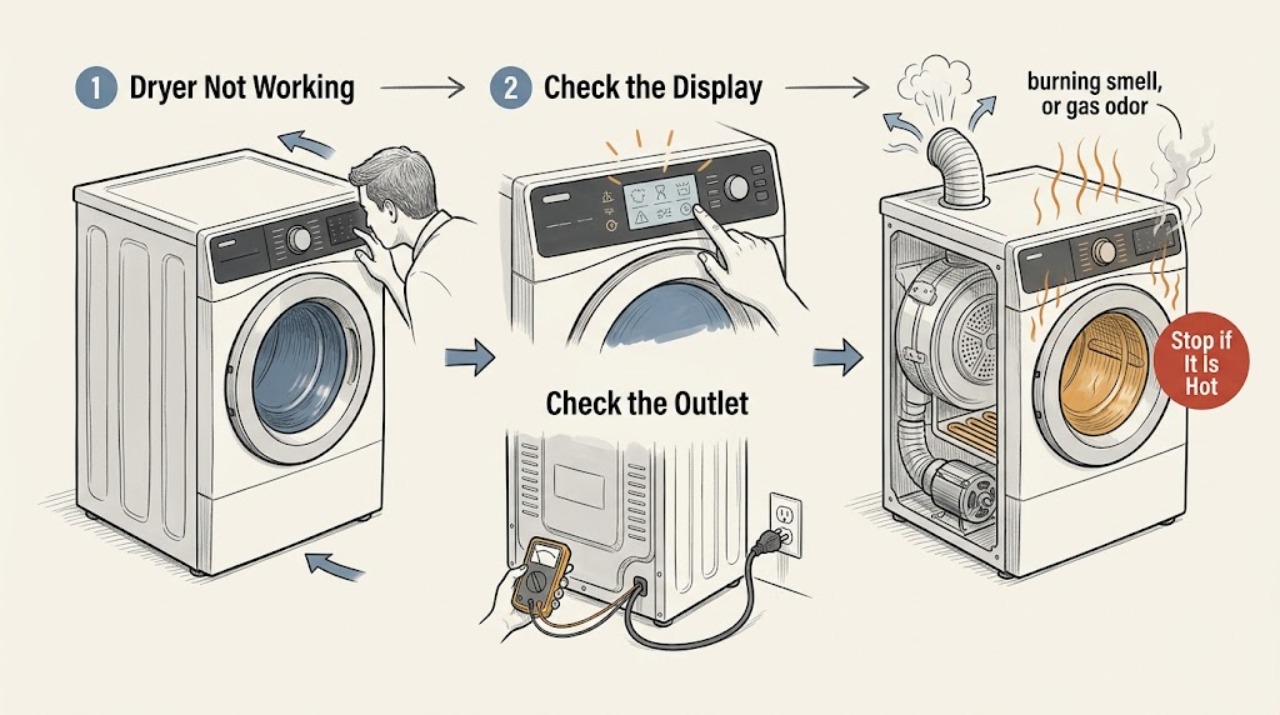
Separate an Electrolux dryer that has no display or drum movement from one that runs but does not heat. With the dryer off, confirm the door is fully closed, the cycle selector is in a start position, and the Start control is held long enough for the model. Check the plug, outlet, and household breaker or fuse without using an extension cord or opening the dryer. If it stopped after a large load, let the motor cool for about 30 minutes and reduce the load. For a gas model, do not operate without an outdoor exhaust path or investigate a gas odor yourself; for an electric model, do not measure or repair internal wiring. Smoke, burning smell, a gas-like odor, repeated trips, a damaged cord, a persistent error, or a dryer that remains dead after these checks requires qualified service.
Work through in order
Diagnostic checks
Use only checks that match the exact appliance or system and its official guide.
-
Check 1
Stop the cycle and note whether the display is blank, the display is on but the drum does not move, the drum turns without heat, or the dryer stopped mid-cycle. Check that the door is fully closed, the selector is at the intended cycle, and the Start control is engaged as the model requires.
Expected result: There is no display or response, the display works but the motor does not start, the dryer tumbles without heat, or it stopped after previously running.
Next step: Use the symptom branch below. If there is smoke, burning smell, unusual heat, a damaged cord, or a gas-like odor, stop immediately and keep the dryer out of service instead of trying another cycle.
Why this matters
Why: Electrolux lists a start-control position, fully closed door, plug connection, and household supply as causes of a dryer that does not start. A running drum with no heat is a different branch from a dead appliance, while a mid-cycle stop can follow motor overheating or a thermal limiter.
-
Check 2
With the dryer off, inspect only the outside of the power plug, cord, and outlet for looseness, moisture, scorching, or damage. Confirm the plug is seated in the wall outlet and check the household breaker or fuse once; do not use an extension cord, increase fuse capacity, remove covers, or test live wiring. Leave supply-voltage verification to a qualified electrician.
Expected result: The cord or outlet is damaged, the breaker or fuse has operated, the plug is loose, or the external supply appears normal.
Next step: Leave damaged or repeatedly tripping equipment off and arrange a qualified electrician or appliance technician. If the supply is normal but the dryer is still dead, keep it unplugged and arrange service rather than opening the cabinet.
Why this matters
Why: Electrolux directs a no-start check to a secure plug and household breaker or fuse, and says an overloaded circuit needs a qualified electrician. A damaged connection or repeat trip is an electrical fault, not a reset-and-retry situation.
-
Check 3
If the dryer stopped after a large or tightly packed load and there was no smoke, burning smell, or gas odor, remove some items and allow the motor to cool for about 30 minutes before considering one supervised retry. Do not bypass a thermal limiter or keep restarting a hot dryer.
Expected result: The load was large, the cabinet or motor area felt unusually hot, and the dryer resumes after cooling; or it remains stopped or stops again with a reduced load.
Next step: If it stops again or the thermal limiter may have operated, keep the dryer out of service and arrange authorized service. Do not remove or replace safety parts yourself.
Why this matters
Why: Electrolux says overloading can overheat the motor, recommends reducing the load and allowing 30 minutes to cool, and notes that an electric dryer's thermal limiter can turn the motor off during overheating. A repeat stop indicates more than a temporary overload.
-
Check 4
Identify whether the dryer is electric or gas from its rating label or owner's guide, without opening or moving the appliance. For an electric model, leave supply-voltage verification to a qualified electrician. For a gas model, do not operate if there is a gas odor, and do not run it without an exhaust duct that vents outdoors; have gas supply and ventilation checked professionally.
Expected result: A gas-like odor, suspected gas-supply interruption, missing or blocked outdoor exhaust, poor ventilation, or an electrical supply concern is present; or none is apparent.
Next step: For gas odor, leave the area and seek gas or emergency help from a safe location; do not switch equipment or inspect the connector. For ventilation, gas-supply, or electrical concerns, keep the dryer off until the appropriate qualified provider clears it.
Why this matters
Why: Electrolux says an electric dryer may tumble when one circuit is lost, directs voltage verification to a qualified electrician, and sends natural-gas supply interruptions to the gas company. It also warns that a gas dryer needs outdoor exhaust to avoid carbon-monoxide risk and adequate ventilation around the burner.
-
Check 5
If the dryer has power and no hazardous symptom, verify that the selected cycle and temperature are intended to heat. Air Fluff or a no-heat temperature will tumble without heat; check the lint screen and accessible exhaust path for blockage, and keep the lint screen installed before any operation.
Expected result: A no-heat cycle was selected, the lint screen or exhaust path is blocked, an EF1 or humidity-related code appears, or the settings and accessible airflow are normal but heat is still absent.
Next step: Correct only the cycle selection or accessible lint obstruction according to the model guide, then make one supervised observation. If heat remains absent, an error returns, or the duct needs specialist cleaning, stop and arrange qualified service.
Why this matters
Why: Electrolux identifies Air Fluff as a normal no-heat setting, recommends checking the lint screen, exhaust duct, and vent hood, and lists ventilation blockage and humidity-sensor codes in its dryer guidance. A normal setting and clear accessible path with no heat points toward an internal heating, sensor, or control fault.
-
Check 6
After the door, supply, load, fuel, ventilation, and cycle checks are normal, make one short supervised start attempt. Stop immediately for smoke, burning smell, gas odor, abnormal heat, unusual noise, a breaker trip, an error, or another mid-cycle stop; do not keep extending cycles to force operation.
Expected result: The dryer starts and operates normally, or the no-start, no-heat, stop, error, or safety symptom returns.
Next step: For recurrence, leave the dryer out of service and provide the model, display behavior, cycle, load, fuel type, supply observations, airflow findings, and exact symptom to authorized service.
Why this matters
Why: A single normal cycle after an external correction supports a control, load, or airflow cause but does not prove internal components are healthy. A repeatable failure after basic checks requires diagnosis of the motor, heater, limiter, sensor, control, wiring, or gas system by a qualified provider.
Use your observations
Decision map
Find the observation that best matches what you see, then follow the next safe action.
-
PATH 01Safety boundary
What you see
There is smoke, a burning smell, a gas-like odor, abnormal heat, a damaged cord, water near the appliance, or a repeated breaker trip.
Do this next
Stop immediately and keep the dryer out of service. For gas odor, leave the area and seek emergency or gas support from a safe location; otherwise disconnect power only if the plug and area are safe. Do not open panels or restart.
Why this path and its safety boundary
Safety stop: Continue with the symptom-specific external checks.
-
PATH 02Safety boundary
What you see
The dryer is dead, does not start, or stops after a large load.
Do this next
Check the closed door, Start control, selector, plug, outlet, and breaker once. If overloaded, reduce the load and allow the motor to cool for about 30 minutes; recurring stops need service.
Why this path and its safety boundary
Safety stop: If the drum runs but does not heat, check the cycle, lint screen, exhaust, fuel type, and ventilation branch.
-
PATH 03Safety boundary
What you see
The correct cycle, safe external supply, and accessible airflow are normal but the dryer remains cold or an error returns.
Do this next
Keep the dryer out of service and arrange authorized repair; do not bypass the thermal limiter, open the cabinet, test wiring, or alter gas parts.
Why this path and its safety boundary
Safety stop: Monitor normal operation and stop at the first recurrence of the not-working symptom.
Helpful context
Understand the symptom
Not working is a broad symptom. A blank display suggests supply or control power, a dryer that tumbles but has no heat points toward the cycle, supply, ventilation, or heating path, and a dryer that stops after running may be protecting an overheated motor. The first useful clue is what still works and when the failure occurs.
Keep checks external and model-aware. Electrolux uses different controls and error codes across models. Do not bypass a door or thermal safety device, open panels, probe live wiring, or continue operating after smoke, gas odor, burning smell, or repeated circuit trips.
When checks do not resolve it
Need a professional?
Keep the appliance out of service for gas odor, smoke, burning smell, abnormal heat, repeated trips, recurring error, persistent no-start or no-heat, repeated motor stops, or any internal electrical or gas fault.
Have this ready
- Provide the model number, electric or gas type, display and error code, selected cycle and temperature, whether the drum turns, load size, cooling history, outlet or breaker observations, lint and exhaust findings, and any odor, heat, noise, or smoke.
Common questions
FAQ
What should I check first if my Electrolux dryer will not start?
Confirm the door is fully closed, the cycle selector is positioned correctly, and the Start control is engaged. Then check the plug, outlet, and breaker or fuse without using an extension cord. A damaged connection or repeated trip needs qualified help.
Why did my Electrolux dryer stop working after a large load?
An overloaded dryer can overheat its motor. Reduce the load and allow about 30 minutes to cool only if there was no smoke, burning smell, gas odor, or abnormal heat; a repeat stop may involve the thermal limiter and needs service.
Why does my Electrolux dryer run but not heat?
Check that the cycle is not Air Fluff, the lint screen and exhaust path are clear, and the gas or electric supply matches the installation. Do not measure voltage, alter gas parts, or operate a gas dryer without outdoor exhaust; persistent no heat needs qualified service.
Read the exact guide
Official sources
- What should I do if my dryer does not start?Electrolux · Official Electrolux dryer support guidance; controls and electrical requirements vary by model and region.
- What should I do if my dryer stops operating?Electrolux · Official Electrolux dryer support guidance for mid-cycle stops; exact load limits and safety controls vary by model.
- Dryer - Not Drying and Extended Drying TimeElectrolux · Official Electrolux dryer support guidance; model-specific lint, exhaust, sensor, and circuit details must follow the owner guide.
- Laundry Dryer Error Code GuideElectrolux · Official Electrolux dryer error guide; codes and remedies vary by model.
- My dryer is running, but does not seem to be heating. What should I do?Electrolux · Official Electrolux dryer heating guidance; gas and electrical checks must follow local requirements and the exact installation instructions.
Community feedback
Share a repair observation
Share a plain-text repair observation. Accepted observations are published automatically; this page may take a moment to update.