
On this page
Start here
Quick answer
First separate no ice production from ice that is present but cannot dispense. For a newly installed refrigerator or one recently without power, Electrolux says to allow temperature stabilization and up to 24 hours for ice production. Confirm the ice maker is on, the display is not locked, water is available, the filter is correctly installed and not frozen or cracked, and the freezer is cold enough for the model. On top-freezer models with a wire signal arm, confirm the arm is in the documented ON position; do not force it. If ice exists but will not dispense, inspect the bin/auger path only as the model guide allows. Persistent no-ice production after these external checks needs qualified service rather than a guessed valve, motor, sensor or control replacement.
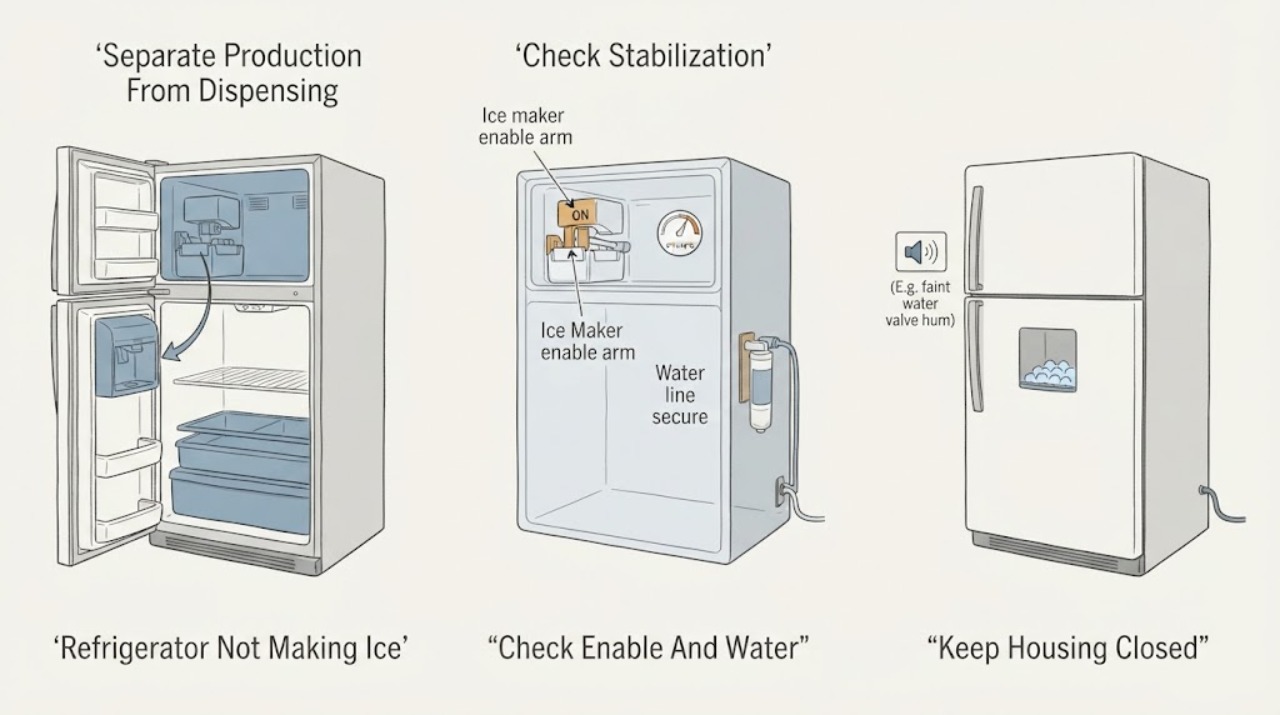
Work through in order
Diagnostic checks
Use only checks that match the exact appliance or system and its official guide.
-
Check 1
Inspect the ice bin or ice-maker area for newly formed cubes and record whether the actual complaint is an empty bin or ice that is present but will not dispense.
Expected result: The bin is empty, ice is present but jammed/frozen, the bin is mis-seated, or the dispenser path is blocked.
Next step: Use the production checks for an empty bin. If ice exists, remove and clean/reseat the bin only as the model guide allows and do not force or unnecessarily rotate the auger.
Why this matters
Why: No production and no dispensing are different paths; a locked display, door state, auger or ice jam can prevent dispensing without proving that the ice maker is not making ice.
-
Check 2
Record whether the refrigerator was installed, powered on, or affected by an outage within the last 24 hours, then allow the exact model's documented stabilization period before judging production.
Expected result: The unit is newly installed or recently restored after an outage, or it has been operating beyond the stabilization period with no ice.
Next step: For a new or recently restored unit, wait only the documented period and monitor. For a unit beyond that period, continue with enable, water, filter and temperature checks.
Why this matters
Why: Electrolux says new plumbing can cause empty cycles and that a refrigerator needs temperature stabilization before normal ice production; continued failure after that period needs further checks.
-
Check 3
Confirm the ice-maker On setting or model-specific wire-arm position, check that the display is not locked, verify water dispensing and the connected water line, and inspect the filter for secure installation, freezing or cracks.
Expected result: The ice maker is off, the display is locked, water is absent/slow, the filter is loose/frozen/cracked, or these accessible conditions appear normal.
Next step: Correct only the accessible condition using the model manual, prime/purge after a new filter or installation as directed, and monitor production. If the conditions are normal but the bin stays empty, continue to temperature and service checks.
Why this matters
Why: Electrolux identifies each of these as an external condition that can prevent ice production or dispensing; none establishes which internal component would be at fault.
-
Check 4
Verify the freezer setting against the model manual and check for accessible ice-bin, auger or chute ice only when ice is present but cannot dispense; do not force the mechanism or remove internal panels.
Expected result: The freezer is set warmer than the model recommendation, ice production improves after the documented stabilization time, or ice is frozen/jammed in the bin path.
Next step: Make only the model-authorized setting or bin correction and allow the documented stabilization period. Escalate if the bin remains empty or the jam returns.
Why this matters
Why: Electrolux says a warm freezer can reduce production; its no-ice guidance separately identifies frozen auger or ice jams as dispensing problems.
-
Check 5
Record the complete refrigerator model, ice-maker configuration, display state, filter history, water result and observations, then retrieve the matching manual before selecting any further procedure.
Expected result: The model manual provides a matching user-level step, or the ice maker remains empty after the documented checks or shows a leak/electrical hazard.
Next step: Follow only the matching manual. Arrange qualified Electrolux service for persistent no-ice production, water leaks, damaged wiring, burning odor, repeated breaker trips or any internal diagnosis.
Why this matters
Why: Configuration and model differences determine whether a display control, wire arm, water system or bin path applies; the symptom alone cannot identify a valve, motor, sensor or control failure.
Use your observations
Decision map
Find the observation that best matches what you see, then follow the next safe action.
-
PATH 01Next step
What you see
The refrigerator is newly installed or recently restored after a power outage, and the ice bin is still within the model's stabilization period.
Do this next
Allow the documented stabilization period, up to the official 24-hour guidance where applicable, and monitor without changing internal parts.
Why this path and its safety boundary
Why it matters: Electrolux says startup temperature stabilization and air in new plumbing can produce empty cycles before normal ice production.
-
PATH 02Next step
What you see
The ice maker is off, the display is locked, water is unavailable, or the filter is not seated correctly, frozen or cracked.
Do this next
Correct the documented accessible condition, prime or purge after a new filter/installation as directed, and monitor production.
Why this path and its safety boundary
Why it matters: The no-ice condition has an accessible enable, water or filter explanation rather than a confirmed internal component failure.
-
PATH 03Next step
What you see
The freezer is warmer than the model recommendation but the water and enable checks are normal.
Do this next
Use the model-authorized temperature adjustment and allow 24 hours for stabilization before judging the result.
Why this path and its safety boundary
Why it matters: Electrolux says a freezer set too warm can reduce ice production; this still does not identify a specific failed part.
-
PATH 04Next step
What you see
The bin contains ice but it will not dispense, or the auger/chute is visibly frozen or jammed.
Do this next
Remove, thaw, wipe dry and reseat the bin only as the model guide allows, avoiding force and unnecessary auger rotation. Arrange service if the path cannot be safely cleared.
Why this path and its safety boundary
Why it matters: The appliance may be making ice while the dispenser path is blocked or mis-seated; this is distinct from an empty ice maker.
-
PATH 05Next step
What you see
The ice bin remains empty after the model's stabilization and external enable, water, filter and temperature checks, or a leak/electrical hazard is present.
Do this next
Stop using the affected function and arrange qualified Electrolux appliance service. Do not open panels, probe live circuits, open the sealed system or order an internal part from the symptom.
Why this path and its safety boundary
Why it matters: The official family-level checks no longer narrow the cause to a safe user-level condition; a valve, motor, sensor, control or other internal issue cannot be diagnosed from no ice alone.
Helpful context
Understand the symptom
Confirm whether the ice maker is producing ice
Check the ice maker or bin rather than testing only the dispenser. A refrigerator can make ice while a locked display, open door, frozen auger, mis-seated bin, or ice jam prevents dispensing. Conversely, an empty bin with no new cubes points to the ice-production path. Record the refrigerator type, whether the unit is newly installed, the last power outage or filter change, and whether water dispenses.
Allow installation and power-outage stabilization
Electrolux says a newly installed refrigerator may need several hours to cool and can take up to 24 hours before ice production. Air in new plumbing lines can cause two or three empty cycles. A recent power outage also requires the refrigerator to stabilize before judging ice production, so do not turn a normal startup delay into a parts diagnosis.
Check the enable, water and filter conditions
Make sure the ice maker is enabled in the display or, on a top-freezer model with a wire signal arm, that the arm is in the model's ON position. Confirm the water supply is connected and available, then inspect the filter for correct installation, freezing or cracks. After a filter change or new installation, follow the model's priming and purging instructions rather than disconnecting internal tubing.
Check temperature and the ice-bin path
Electrolux notes that a freezer set too warm can reduce ice production and recommends allowing 24 hours after a setting change for temperature to stabilize. If the bin contains ice but the dispenser does not deliver it, check for a frozen auger or an ice jam and follow the model's bin instructions. Do not force the auger, rotate it unnecessarily, or reach into a moving dispenser mechanism.
Stop at the service boundary
If the ice maker remains empty after the external checks and the model's stabilization period, or if there is a water leak, damaged filter housing, repeated chattering without a connected water supply, damaged wiring, burning odor, or a tripped breaker, stop and arrange qualified Electrolux appliance service. Do not open the sealed system, probe live wiring, or replace a valve, motor, sensor, or control from the no-ice symptom alone.
When checks do not resolve it
Need a professional?
Arrange qualified Electrolux appliance service when the ice bin remains empty after the matching model's enable, water, filter, temperature and stabilization checks; when a water leak, damaged filter housing, damaged wiring, burning odor or repeated breaker trip occurs; or when internal valve, motor, sensor or control diagnosis is needed.
Common questions
FAQ
How long should an Electrolux refrigerator take to make ice after installation?
Electrolux says a newly installed refrigerator may need several hours to cool and can produce ice within 24 hours; air in new plumbing can cause two or three empty cycles. Use the exact model manual if its timing differs.
What should I check when my Electrolux ice maker is not making any ice?
Confirm the ice maker is on, the display is not locked, water is available, the filter is seated and not frozen or cracked, and the freezer is at the model's recommended setting. Allow the official stabilization period after installation, a filter change or power outage. Persistent no ice needs service rather than a guessed part.
What if there is ice in the bin but the Electrolux dispenser does not work?
That is a dispensing-path problem rather than proof that the ice maker is not producing. Check the lock, door closure, bin seating and accessible frozen auger or ice jam using the model guide; do not force or unnecessarily rotate the auger.
Can I turn on a top-freezer Electrolux ice maker without a water connection?
Electrolux says that if water cannot be connected, set the ice maker's On/Off feature to OFF; otherwise the fill valve may chatter while attempting to operate without water. Use the exact model's instructions for the control or wire arm.
Read the exact guide
Official sources
- Refrigerators - How do I use my ice maker in my Top-Freezer refrigerator?Electrolux · Official Electrolux top-freezer refrigerator support used only for models that actually have the documented wire-signal-arm ice maker and water connection.
- My refrigerator was just installed and the ice maker is not working, how do I fix it?Electrolux · Official Electrolux refrigerator-family support for installation, ice-maker enable state, water priming, empty startup cycles and 24-hour production timing.
- Refrigerators - No IceElectrolux · Official Electrolux support page applying to refrigerators; supports stabilization, lock, water, filter, door, auger and ice-jam checks without diagnosing internal parts.
- What should I do if my ice maker is not making enough ice in my refrigerator?Electrolux · Official Electrolux refrigerator-family support used for the conditional production-rate, filter, water-line, usage and freezer-temperature checks.
Community feedback
Share a repair observation
Share a plain-text repair observation. Accepted observations are published automatically; this page may take a moment to update.