
On this page
Start here
Quick answer
An Electrolux washer that does not complete a cycle may be paused or delayed, waiting for a closed and locked door or lid, unable to fill or drain, oversudsed, unbalanced, detecting an overfill, or stopping because of a power, motor, heater, sensor, or control fault. If water is running continuously, the floor is flooding, there is smoke, a burning smell, sparking, a hot cord, or water near electrical parts, turn off the water supply and power only if safely accessible, keep clear, and arrange qualified service. Otherwise record where the cycle stops and any displayed code. Check the door or lid, control lock, Start or Delay setting, water valves and hose routing, drain hose and standpipe, detergent amount, and load distribution without forcing the door or opening panels. Electrolux identifies E21 with slow draining, E11 with long filling, E35 with pressure-sensor overfill, and SU dS with oversudsing on applicable models; the exact code and recovery behavior are model-specific. If the same phase or error returns after the documented external checks, stop using the washer and arrange service.
Before you begin
Safety first
- This article supports ordinary-access control, door, water, drain, detergent, load, and model-approved reset checks only. Do not force locks, open panels, test live circuits, reach into moving or water-filled components, or continue using a washer with flooding, smoke, electrical damage, or a recurring safety error.
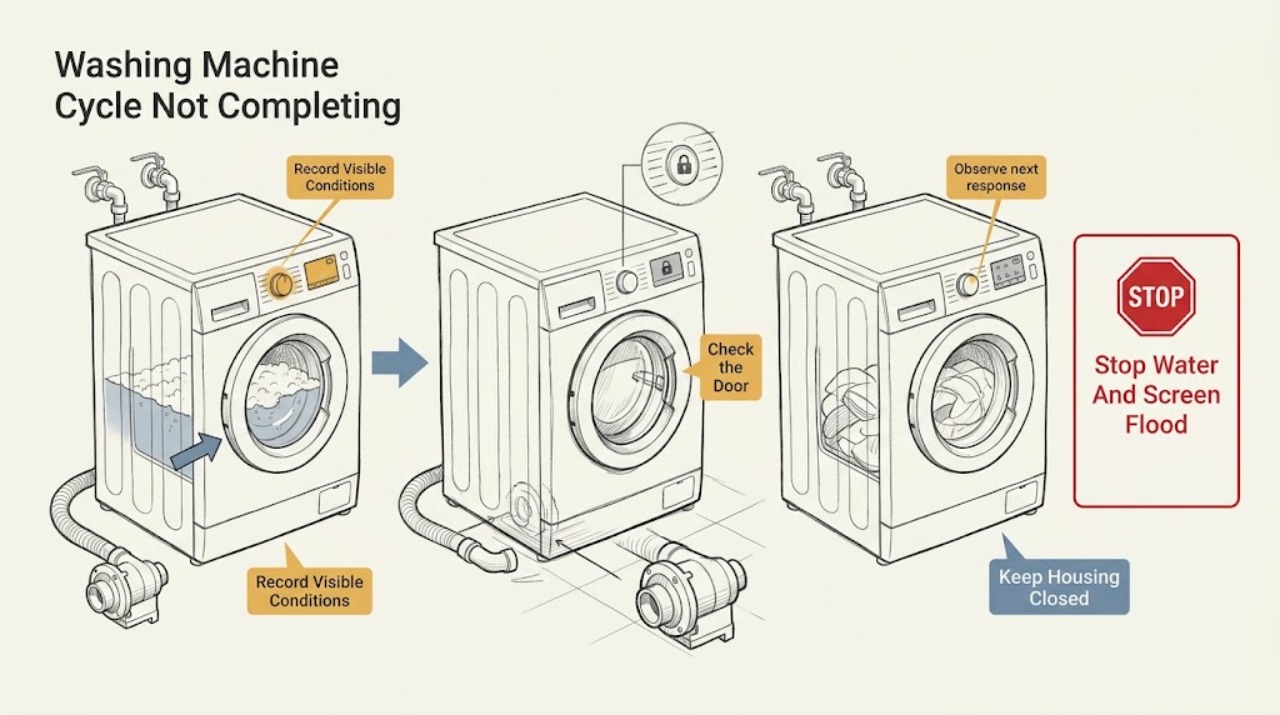
Work through in order
Diagnostic checks
Use only checks that match the exact appliance or system and its official guide.
-
Check 1
Stop the washer and inspect from a safe position for continuous water flow, a floor leak, smoke, burning odor, sparking, a hot or damaged cord, a door or lid that is forced, or water near electrical parts.
Expected result: Record whether water is entering continuously, draining onto the floor, trapped in the tub, or absent, and whether an electrical, fire, mechanical, or flood hazard is present.
Next step: For a leak or continuous fill, turn off the water supply and power only if safely accessible, contain water without touching wet electrical parts, and arrange qualified service or plumbing help. For smoke, sparking, burning odor, or a hot cord, keep the washer off and arrange electrical or appliance service.
Stop if: Do not restart a flooding, smoking, sparking, burning-smelling, electrically damaged, or mechanically jammed washer, and do not force the door or lid.
Why this matters
Why: A flood or electrical hazard overrides cycle diagnosis. A normal exterior permits ordinary-access checks only; it does not justify forcing a locked door or opening panels with water or power connected.
-
Check 2
Record the selected cycle, remaining time, display or indicator, water level, door or lid state, drum movement, and the exact phase at which the Electrolux washer pauses or cancels.
Expected result: Classify the symptom as paused before Start, stuck filling, stuck heating, stuck draining, refusing to spin, repeating rinses, stopping with water inside, losing power, or showing a code such as E11, E21, E35, SU dS, LOC, or a model-specific indication.
Next step: Use the exact model manual and the matching branch below; preserve a photo or written copy of the code before pressing Cancel or disconnecting power.
Stop if: Stop if the code is accompanied by flooding, smoke, a hot cord, a locked door with water, or repeated breaker operation.
Why this matters
Why: The stop phase changes the next check: fill points to water supply, drain points to hose or pump, repeated rinses point to suds, no operation points to door, control, or power, and an overfill indication points to water safety. A code is a clue for the exact model, not proof of a part failure.
-
Check 3
If the washer has not advanced and there is no hazard, confirm that Start was pressed after selection, Delay Start is not active, Control Lock is not active, and the door or lid is fully closed without clothing caught in the seal.
Expected result: Record whether the display is counting a delay, shows a lock symbol or LOC, the door or lid clicks shut, and the cycle resumes when the model-specific control is used normally.
Next step: Cancel only a documented delay or unlock the controls using the exact model procedure, close the door or lid, and make one normal restart. If the lock will not engage or the cycle stops again, request service.
Stop if: Do not force the lock, pry the door, bypass the lid switch, or reach into the drum while it is moving or contains unsafe water.
Why this matters
Why: Electrolux says a delay or normal pause can look like a stuck cycle, and a washer will not operate when the lid or door is not properly closed. LOC indicates a control lock on applicable front-load models.
-
Check 4
If the cycle stops while filling or shows a long-fill indication, confirm both water valves are open, the hoses are not kinked or pinched, the hot and cold hoses are connected to the correct inlets, and accessible inlet screens are not obstructed; do not loosen a pressurized connection.
Expected result: Record whether water enters within the model's expected start period, one valve has no flow, hoses are reversed or damaged, an inlet filter is blocked, or the washer recently moved or was installed.
Next step: Correct only an accessible valve, hose routing, or installation condition allowed by the manual, then run one normal test. If no water enters, a hose leaks, or a long-fill condition returns, turn off water and request service or installer support.
Stop if: Do not over-tighten or cross-thread fittings, disconnect hoses under pressure, increase water pressure by guesswork, or leave a leaking connection running.
Why this matters
Why: Electrolux says E11 indicates the washer is not filling during the wash phase and identifies reversed hoses, water supply, hose condition, inlet filters, and installation as checks. A normal fill with a recurring stop points toward sensing, control, heating, or another phase.
-
Check 5
If water remains in the tub or the cycle stops before spin, inspect the accessible drain hose and standpipe for kinks, crushing, an incorrectly sealed or loose installation, or an obvious household drain blockage; keep the washer off if water may reach electrical parts.
Expected result: Record whether water pumps out slowly, the hose is restricted, the standpipe backs up, the drain hose is inserted or sealed incorrectly, or the pump makes an abnormal sound.
Next step: Correct only a safe external hose or standpipe condition described by the manual and run one drain or rinse test. If the pump remains blocked, the drain backs up, or E21 returns, stop and arrange service or plumbing help.
Stop if: Do not reach into a pump, remove a filter with unsafe standing water, seal the standpipe airtight, or keep cycling a washer that is flooding.
Why this matters
Why: Electrolux identifies E21 as water taking too long to empty and lists a kinked or improperly installed drain hose as a common cause. A clear drain path with a persistent no-drain condition can indicate a pump, filter, pressure, or control fault.
-
Check 6
If the washer repeats rinses, pauses before spin, or stops with a load problem, check for excess suds, excessive detergent, an overloaded or badly unbalanced load, and garments trapped in the door or lid; use only the detergent type and amount specified by the model.
Expected result: Record whether SU dS or a suds indication appears, foam remains after draining, the load is concentrated on one side, or the washer resumes after a documented empty rinse or redistribution.
Next step: Use the correct high-efficiency detergent and amount, redistribute or reduce the load, and run the model-approved rinse or restart once. If the washer remains unbalanced, leaks, or stops with a normal load, request service.
Stop if: Do not add more detergent, force a high-speed spin, open a locked door, or repeat rinse cycles indefinitely while water or suds remain uncontrolled.
Why this matters
Why: Electrolux says SU dS indicates oversudsing and can add rinse cycles until suds clear. An unbalanced load can delay or interrupt spin, while a trapped garment can prevent a safe door seal. These conditions can lengthen a cycle without a heater or motor fault.
-
Check 7
After the applicable door, control, water, drain, suds, and load checks, perform only the exact model's documented Cancel or power reset once, then run one appropriate empty or small test cycle while observing the stop phase.
Expected result: Record whether the cycle completes, whether the same phase or code returns, whether water remains, whether the door stays locked, and whether the breaker, inlet, pump, motor, or heater behaves abnormally.
Next step: Keep the washer off if the fault returns or water cannot be controlled, and arrange authorised Electrolux service with the model, code, stop phase, water level, hose findings, load, detergent, and reset result.
Stop if: Do not keep resetting, run repeated tests with a leak or locked water-filled tub, open panels, test live circuits, or replace a pump, valve, lock, sensor, heater, motor, or control by symptom alone.
Why this matters
Why: Completion after correcting a delay, lock, supply, drain, suds, or load condition supports that condition as a contributor. A repeated code or phase after external checks points toward a pump, valve, lock, pressure sensor, motor, heater, wiring, or control diagnosis; it does not identify a safe replacement part.
Use your observations
Decision map
Find the observation that best matches what you see, then follow the next safe action.
-
PATH 01Safety boundary
What you see
Water runs continuously, the washer leaks onto the floor, smoke, burning odor, sparks, a hot cord, or water near electrical parts is present.
Do this next
Turn off water and power only if safely accessible, keep clear of wet electrical areas, contain water without forcing the door, and arrange qualified appliance or plumbing service.
Why this path and its safety boundary
Why it matters: This is a safety stop, not a cycle-reset problem.
Safety stop: Do not restart, force the door, touch wet wiring, or keep pressing Start while water enters or leaks.
-
PATH 02Safety boundary
What you see
The drum and water are normal, but the washer is paused, delayed, locked, or waiting for Start or a closed door.
Do this next
Cancel a documented delay, unlock the controls using the model procedure, close the door or lid, and make one normal restart.
Why this path and its safety boundary
Why it matters: The cycle may not be faulty; a control state or door/lid safety condition may be holding it.
Safety stop: If the lock will not engage or the washer stops again, do not bypass it; request service.
-
PATH 03Safety boundary
What you see
The cycle stops while filling, shows E11 or a similar long-fill indication, or no water enters normally.
Do this next
Check accessible valves, hose kinks, correct hot and cold connections, and inlet filters, then run one test; request service if the condition returns.
Why this path and its safety boundary
Why it matters: Water valves, hose routing, inlet screens, pressure, or a recent installation may be involved.
Safety stop: If a connection leaks, turn off water and do not continue testing.
-
PATH 04Safety boundary
What you see
Water remains in the tub, the washer stops before spin, or E21 or a similar drain indication appears.
Do this next
Check the accessible drain path and standpipe as documented, then run one drain or rinse test; arrange service or plumbing help if it persists.
Why this path and its safety boundary
Why it matters: A kinked hose, blocked standpipe, pump, filter, pressure, or drain installation issue may be preventing the next phase.
Safety stop: Do not open a water-filled pump area or continue when the machine is flooding.
-
PATH 05Safety boundary
What you see
SU dS repeats rinses, E35 or continuous filling indicates overfill, or the same phase or code returns after external checks.
Do this next
Use the exact model's documented suds or reset response once; for overfill, turn off water; arrange service if the condition returns.
Why this path and its safety boundary
Why it matters: Detergent or water-level conditions may be involved, but a pressure sensor, valve, pump, lock, motor, heater, or control fault remains possible.
Safety stop: Do not keep resetting, adding detergent, forcing the door, or using the washer until a persistent overfill or safety fault is inspected.
Helpful context
Understand the symptom
Find the phase where the cycle stops
A pause between wash and spin, a tub full of water, a door that stays locked, repeated rinses, and a machine that loses power are different failures. Note the selected cycle, remaining time, water level, drum movement, displayed code, and whether the stop follows filling, heating, draining, spinning, or a door interruption.
A pause is not always a fault
Electrolux says a washer can pause between Wash and Spin and pause longer during Soak. Delay Start, a control lock, an unpressed Start button, or a lid or door that is not closed can also make the cycle appear stuck. Confirm the model's display and controls before disconnecting power.
Fill and drain faults prevent the next phase
If the washer cannot fill to the required level, it may wait or show a long-fill condition; if it cannot empty, it may not proceed to spin. Electrolux identifies hose restrictions, incorrect hose installation, reversed hot and cold hoses, water valves, and drain restrictions as installation or plumbing checks. A kinked hose or clogged standpipe can be external, but a pump or pressure-sensor fault needs service.
Sudsing, overfill, and door safety need different responses
Too much detergent can trigger additional rinse time while the washer clears suds. An overfill indication or water that runs continuously is a flood-control concern, not a reason to keep pressing Start. A door-lock or lid condition must be resolved without forcing the door, because the machine may retain water or moving parts.
Safety boundary
Stop conditions
- Stop for continuous water flow, a floor leak, smoke, burning odor, sparking, a hot or damaged cord, water near electrical parts, a jammed door, or repeated breaker operation.
- Turn off water and disconnect power only if safely accessible; do not force a locked door or touch wet electrical parts.
- Do not bypass a door or lid lock, open panels, test live circuits, reach into a pump or moving drum, or disconnect hoses under pressure.
- Do not keep resetting a repeated E11, E21, E35, SU dS, LOC, or model-specific error, and do not select parts by code alone.
- Stop using the washer when the same phase or code returns after one documented external check and reset, or when the machine cannot complete without flooding, overheating, or abnormal mechanical behavior.
When checks do not resolve it
Need a professional?
Arrange qualified Electrolux washing-machine service when the cycle repeatedly stops at the same phase, E11, E21, E35, SU dS, LOC, or another model-specific indication returns, the door or lid will not lock or release safely, filling or draining remains abnormal, water runs continuously or leaks, the washer trips power, or diagnosis requires opening panels or testing live electrical, heating, motor, pump, valve, or pressure-sensor circuits. Provide the exact model, cycle and settings, stop phase and code, water level, door or lid state, inlet and drain observations, detergent and load details, recent installation or movement, and one documented reset result.
Safety scope: This article supports ordinary-access control, door, water, drain, detergent, load, and model-approved reset checks only. Do not force locks, open panels, test live circuits, reach into moving or water-filled components, or continue using a washer with flooding, smoke, electrical damage, or a recurring safety error.
Read the exact guide
Official sources
- Laundry front loading washer displaying Error Code LOC control lock activator.Electrolux · Electrolux's official front-load washer support article for LOC; control-lock labels and procedures vary by model.
- Laundry front loading washer displaying Error Code E35 pressure sensor indicates water overfill.Electrolux · Electrolux's official front-load washer article for E35 or pressure-sensor overfill; controls and reset behavior vary by model.
- Laundry front loading washer is leaking water.Electrolux · Electrolux's official front-load washer leak article; hose, door, dispenser, and drain access vary by model.
- Laundry front loading washer displaying Error Code SU dS too many suds.Electrolux · Electrolux's official front-load washer article for SU dS or oversudsing; display and controls vary by model.
- Laundry Water Supply GuideElectrolux · Electrolux's official front- and top-load washer water-supply guide; model requirements and hose access vary.
- Laundry front loading washer displaying Error Code E21 long pump out time.Electrolux · Electrolux's official front-load washer article for E21 or slow pump-out conditions; exact drain access varies by model.
- What should I do if my washer does not start?Electrolux · Electrolux's official washer support article; controls and lid or door behavior vary by model.
Community feedback
Share a repair observation
Share a plain-text repair observation. Accepted observations are published automatically; this page may take a moment to update.