
On this page
Start here
Quick answer
First separate a completely blank Electrolux washer from a machine whose display works but whose wash program will not begin. If there is a leak, smoke, burning odor, sparking, a hot or damaged cord, or repeated breaker trips, stop and arrange qualified appliance or electrical service. If the display is on, press Start after selecting a program, cancel an unintended Delay Start, check that the door or lid is fully closed, and look for a child-lock or padlock indication. Electrolux says the washer will not operate with an improperly closed lid or door, and its guidance also calls for water valves to be on and water available. From a dry position, check the plug and household outlet or breaker; do not use an extension cord or increase fuse capacity. For a blank display, test the outlet only with a safe external appliance and follow the model manual's reset procedure once. If the washer still will not start, shows an error, repeatedly loses power, leaves water in the drum, or the lock will not engage, keep it out of service and provide the exact model, display state, and checks already completed to qualified service.
Before you begin
Safety first
- A user may check visible settings, door or lid closure, accessible hose routing, water valves, outlet status with a safe external appliance, and one model-directed reset. Internal locks, valves, pumps, sensors, motors, heaters, controls, and live electrical work require qualified service.
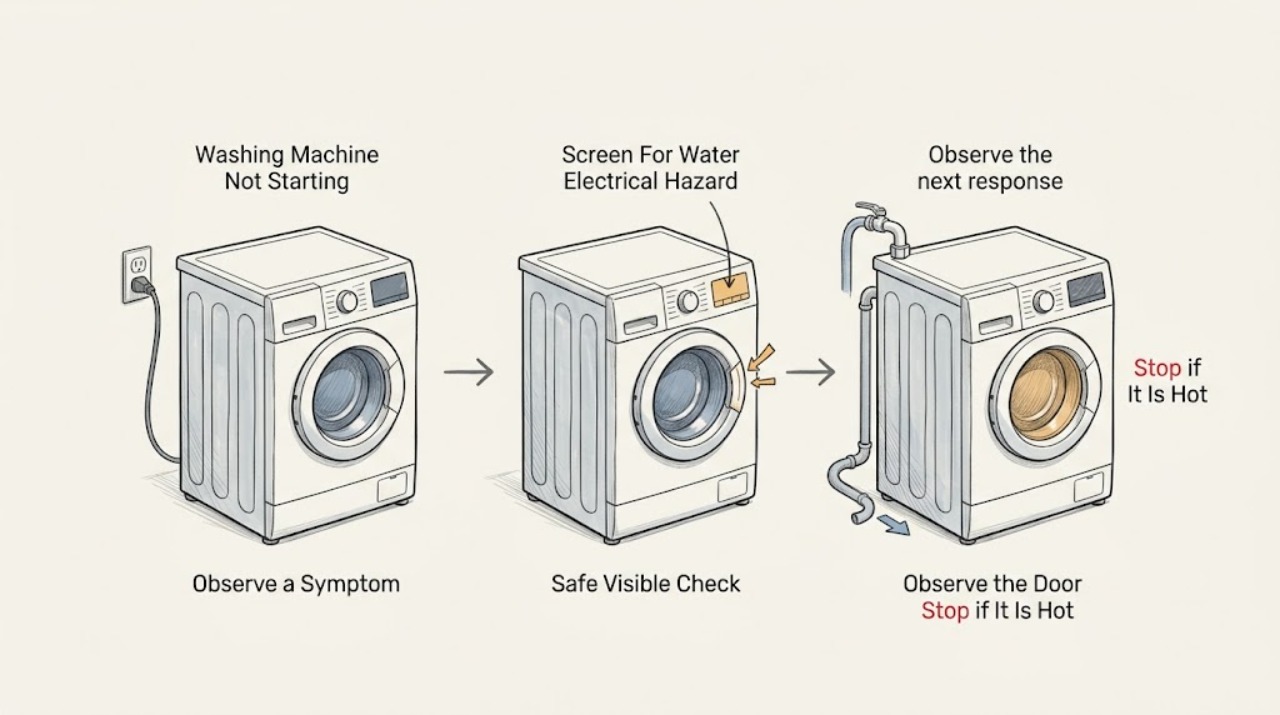
Work through in order
Diagnostic checks
Use only checks that match the exact appliance or system and its official guide.
-
Check 1
Stop and inspect from a dry position for active leaks, water near electrical parts, smoke, burning odor, sparking, a hot or damaged cord, a locked drum with abnormal water, or a breaker that opens again; do not reach into a moving or flooded washer.
Expected result: Record whether water is entering or escaping, whether the display remains on, whether the door or lid is locked, whether the drum contains water, and whether any heat or electrical warning continues after the control is stopped.
Next step: Keep the washer off, close the water valves if safe when filling does not stop, and arrange qualified appliance or electrical service. Continue only when the machine is dry, stationary, and free of stop signs.
Stop if: Stop immediately for uncontrolled water, smoke, burning odor, sparking, damaged power parts, or repeated protection trips.
Why this matters
Why: These signs are safety conditions rather than ordinary start-selection problems. A lock may remain engaged because water or an active cycle is present, while smoke, heat, or repeated electrical trips indicate a fault requiring professional assessment.
-
Check 2
With the washer safe and stationary, determine whether the display is completely blank, whether the panel responds, or whether a program is selected but waiting; photograph any padlock, delay, pause, beep, flash, or error indication.
Expected result: Note whether the ON/OFF control responds, whether Start is accepted, whether the selected program changes, whether Delay Start or a normal pause is shown, and whether the issue affects every program or one selection.
Next step: Use the power path for a blank panel, the control-and-lock path for a responsive panel, and the error path for a code. Do not guess from a symbol that is not clearly identified.
Stop if: Do not enter a hidden service mode or repeatedly select cycles to force the washer to start.
Why this matters
Why: A blank display points toward power or the appliance's control path. A responsive display that waits often points toward Start, Delay Start, pause, door or lid confirmation, child lock, or a water prerequisite. An error indication needs its model-specific meaning.
-
Check 3
If the panel works, select a normal program, press Start as the manual shows, cancel any unintended Delay Start, and close the door or lid fully; check only for visible clothing or debris at the seal and latch area.
Expected result: Record whether the program begins, whether the lock engages, whether an overloaded drum prevents closure, whether the padlock or child-lock indication remains, and whether the machine returns immediately to standby.
Next step: Remove only enough laundry to let the door or lid close normally, use the manual's child-lock procedure if that is clearly the active setting, and make one new start attempt. If the lock will not engage or the program still will not begin, arrange service.
Stop if: Do not force the door, defeat the lock, insert tools into the latch, or reach into the drum through a locked opening.
Why this matters
Why: Electrolux says the washer will not operate when the lid or door is not properly closed, and its support guidance identifies Delay Start, Start selection, child lock, and overload-related closure as common reasons for a program that does not begin.
-
Check 4
For a blank or intermittent display, from a dry position check that the plug fits the wall outlet and that the accessible household protection is on; test the outlet only with a safe external appliance and follow the exact model's one-time reset instruction.
Expected result: Note whether the test appliance works, whether the washer returns after the documented reset, whether the plug or outlet is warm or damaged, and whether a breaker or fuse opens again.
Next step: If the outlet is faulty or protection trips again, keep the washer disconnected and call a qualified electrician. If the outlet is sound but the washer remains blank, arrange appliance service rather than opening the control area.
Stop if: Do not use an extension cord, repeatedly reset protection, replace a fuse with a larger capacity, or test live appliance wiring.
Why this matters
Why: A test appliance that also fails points to the outlet or household supply; a working outlet with a blank washer points toward the appliance. Electrolux directs a qualified electrician to faulty power supplies and warns against extension-cord use or using a larger fuse.
-
Check 5
If the program accepts Start but does not proceed, verify that the hot and cold water valves are on, accessible inlet hoses are not kinked or pinched, visible connections are snug, and any user-accessible connector screens are checked only as the model manual permits.
Expected result: Record whether water begins entering, whether one or both supplies are unavailable, whether hoses are reversed or restricted after installation, whether a connector screen is visibly blocked, and whether a leak appears when the valve is opened.
Next step: Correct only a clearly closed valve or visible hose kink, check for leaks, and make one start attempt. If no water enters, a code returns, or a leak appears, close the valves when safe and arrange service.
Stop if: Do not remove internal hoses, force fittings, continue with a leak, or work near wet electrical parts.
Why this matters
Why: Electrolux says the washer will not function properly without water available and identifies supply valves, hose routing, connector filters, and inlet flow as checks. A clear visible hose does not prove that an internal valve or sensor works.
-
Check 6
If an error code, recurring no-start, drain condition, lock failure, or unresponsive control remains after the safe external checks, keep the washer off and prepare a qualified service request with the display evidence.
Expected result: Record the exact code or symbol, model and serial information, selected program, door or lid state, water and drain state, power behavior, whether the issue is front-load or top-load, and what changed after one documented reset.
Next step: Use the Electrolux model support and service path and provide the complete record. Do not order a part from the code alone or open the cabinet to test it.
Stop if: Do not bypass a lock, probe energized circuits, remove panels, or keep operating a washer that leaks, smells hot, sparks, or trips protection.
Why this matters
Why: Electrolux groups error families by water supply, draining, door lock, motor, heating, leakage, and power. A persistent code or failed interlock indicates that a concealed valve, pump, lock, sensor, motor, heater, control, or wiring path may need diagnosis.
Use your observations
Decision map
Find the observation that best matches what you see, then follow the next safe action.
-
PATH 01Safety boundary
What you see
There is an active leak near electrical parts, smoke, burning odor, sparking, a hot or damaged cord, or repeated breaker trips.
Do this next
Keep the washer off, close water valves if safe, leave damaged areas alone, and arrange qualified appliance or electrical service.
Why this path and its safety boundary
Safety stop: Do not reset protection repeatedly or run another cycle.
-
PATH 02Safety boundary
What you see
The display is blank and the ON/OFF control does not respond.
Do this next
Check the outlet with a safe external appliance and inspect the accessible plug and breaker state from a dry position; follow one model-directed reset.
Why this path and its safety boundary
Safety stop: A working outlet with a dead washer or a returning power interruption needs service; do not open the control area.
-
PATH 03Safety boundary
What you see
The display works but Start does not begin the program.
Do this next
Cancel Delay Start, confirm the program and Start control, close the door or lid, and check the child-lock indication according to the manual.
Why this path and its safety boundary
Safety stop: Do not force or bypass the door or lid lock.
-
PATH 04Safety boundary
What you see
Start is accepted but no water enters or a water-supply code appears.
Do this next
Check hot and cold valves, visible hose routing, connections, and permitted connector-screen access.
Why this path and its safety boundary
Safety stop: A returning code, no flow, or leak needs service; do not remove internal valve parts.
-
PATH 05Safety boundary
What you see
The door or lid will not lock, the door remains locked with water inside, or a drain condition prevents the next step.
Do this next
Wait for the drum to stop, note the water level, inspect only visible seal or latch obstruction, and use the exact model's safe release or drain guidance.
Why this path and its safety boundary
Safety stop: Do not pry the door, reach into standing water, or bypass the interlock.
-
PATH 06Safety boundary
What you see
An error returns after the model-directed external check and one reset, or the panel remains unresponsive.
Do this next
Keep the washer off and arrange qualified service with the exact code, model, cycle stage, and observations.
Why this path and its safety boundary
Safety stop: Do not enter hidden diagnostics, replace a part from the code alone, or continue operating a hazardous appliance.
Helpful context
Understand the symptom
A no-start can be a setting or a real fault
An Electrolux washer may appear not to start because Start was not pressed after the program was selected, Delay Start is active, the cycle is in a normal pause, or a door or lid is not closed. A blank display, a dead outlet, a persistent error, or a lock that never engages points to a different path. Note which state you see before repeatedly pressing controls.
Power and water are separate checks
A lit display does not prove that the machine can fill or lock, and an available water supply does not prove that the control panel or door circuit is powered. Check the household supply and water valves from a safe position. Electrolux warns against extension-cord use and directs a qualified electrician to handle an outlet or overloaded-circuit problem.
Treat the door or lid lock as a safety interlock
The program should not begin until the door or lid is correctly closed and the machine can confirm the lock. Remove only visible clothing from the seal or latch area and close it normally. Do not pry the door, insert tools into the latch, or bypass the lock to make the washer run.
Use the exact model manual for error codes
Electrolux error families vary by model and market. A code beginning with E, a padlock symbol, beeps, or flashing lights is useful evidence, not a reason to guess a replacement part. Photograph the display and use the model-specific support page; a returning water, drain, door, motor, heater, leakage, or power code needs service when the safe external check does not resolve it.
Only after diagnosis
Potential parts
- door or lid lock assembly
Consider only when the door or lid is visibly clear and correctly closed but the lock will not engage or a lock code returns.
Lock assemblies are model-specific and must not be bypassed; confirm the exact appliance during qualified diagnosis. - water inlet valve or connector screen
Consider only when both supplies are on and the visible hoses are clear but no water enters or a supply code returns.
Confirm model and water configuration; internal valve work requires qualified service. - drain pump or drain path component
Consider only when water remains and the visible drain route and permitted filter check do not restore draining.
Residual water and pump wiring require safe service procedures and model confirmation. - control board or user-interface assembly
Consider only when a known-good outlet is available but the washer remains blank or the control sequence fails after the safe reset.
Control revisions are model-specific; do not infer a board fault from one missed Start press. - water-level sensor or pressure circuit
Consider only when filling or draining behavior conflicts with the visible supply and the level-related code returns.
Sensor, air path, wiring, and control diagnosis require qualified service. - motor, heater, or wiring component
Consider only when the exact model code or cycle stage indicates a motor or heating path after safe power, lock, water, and drain checks.
Internal motor, heater, and wiring work is model-specific and requires qualified electrical service.
When checks do not resolve it
Need a professional?
Arrange qualified Electrolux appliance or electrical service for a blank washer with a working outlet, a returning error, a door or lid that will not lock or release safely, no water entry after supply checks, standing water, a control that remains unresponsive, a leak, smoke, burning odor, sparking, or repeated protection trips.
Safety scope: A user may check visible settings, door or lid closure, accessible hose routing, water valves, outlet status with a safe external appliance, and one model-directed reset. Internal locks, valves, pumps, sensors, motors, heaters, controls, and live electrical work require qualified service.
Have this ready
- Provide the exact model and serial information, display photo or symbol, selected program, Start and Delay Start state, door or lid state, water and drain observations, outlet and breaker behavior, child-lock indication, and the safe checks already performed.
Common questions
FAQ
Why does my Electrolux washing machine turn on but not start?
Confirm the program and Start control, cancel Delay Start, check for a pause or child-lock indication, and close the door or lid fully. If the lock does not engage or the program still waits, arrange service.
What should I do if my Electrolux washer display is blank?
From a dry position, test the outlet with a safe external appliance and check the accessible breaker and plug condition. Follow one model-directed reset; if the outlet works but the washer stays blank, keep it off and arrange service.
Can low water supply stop an Electrolux washer from starting?
Yes. Electrolux says the water valves must be on and water available. Check the hot and cold valves and visible inlet hoses; a returning supply code or no flow needs qualified diagnosis.
Why is the Electrolux washer door locked when it will not start?
The lock may be holding because a cycle is active or water remains, or the lock circuit may have a fault. Wait for the drum to stop, never force the door, and use the exact model's safe release guidance.
When should I stop troubleshooting an Electrolux washing machine?
Stop for leaks, smoke, burning odor, sparking, a hot cord, repeated breaker trips, standing water near electrical parts, an unsafe lock condition, or a code that returns after one model-directed external check.
Read the exact guide
Official sources
- Washing machine common error codes and troubleshooting tipsElectrolux Support · The guide gives common error families across models; the exact code meaning and user procedure must be checked for the installed appliance.
- Laundry Water Supply GuideElectrolux Owner Support · The guide applies to Electrolux front- and top-loading laundry washers; local plumbing and model-specific inlet arrangements vary.
- Washing Machine Not Working or Not Turning On – Troubleshooting GuideElectrolux Support · The guide covers blank or unresponsive appliances and powered machines whose programs do not begin; exact controls vary by model and market.
- What should I do if my washer does not start?Electrolux Owner Support · The guide applies to Electrolux washers; controls and door or lid details vary by model.
Community feedback
Share a repair observation
Share a plain-text repair observation. Accepted observations are published automatically; this page may take a moment to update.