
On this page
Start here
Quick answer
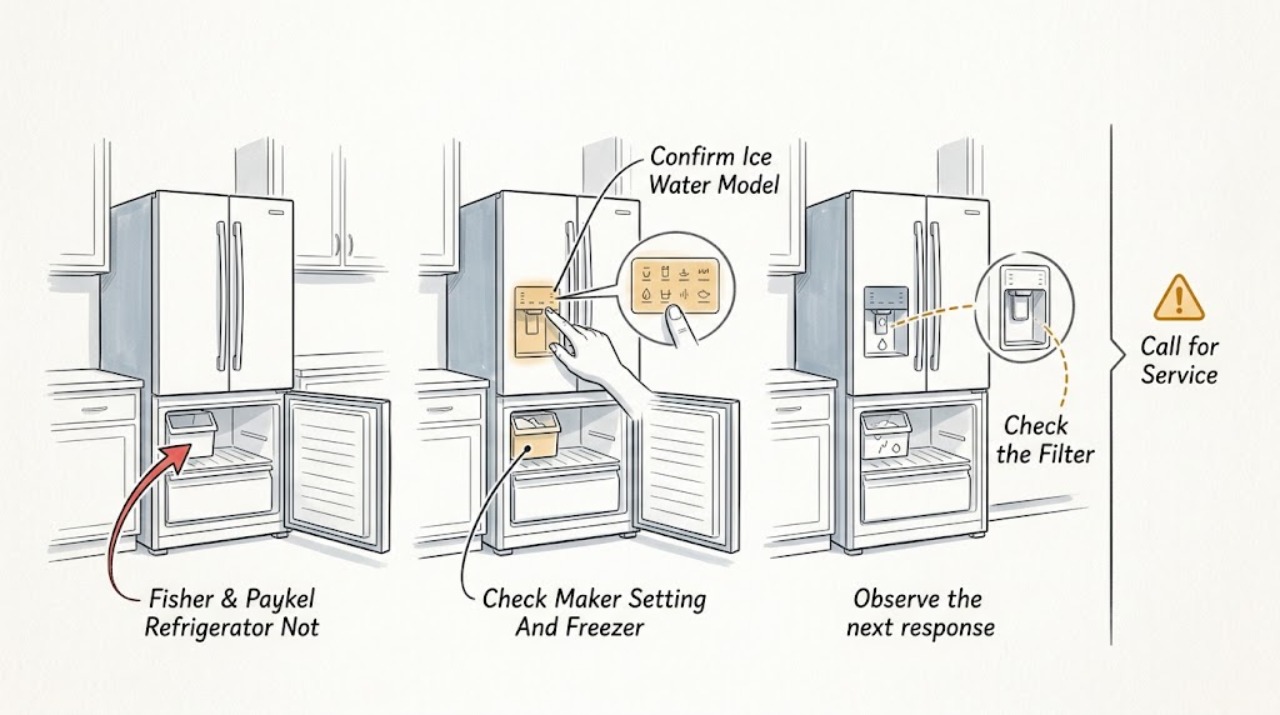
This guide applies only to a Fisher & Paykel refrigerator model that actually has an automatic ice maker, usually identified in its exact documentation as an Ice & Water model or an internal ice maker. First decide whether the freezer is making no new cubes or whether cubes already exist but cannot leave the ice box/outlet. For no production, check the exact model's IceOn/Off or ice-making setting, freezer operation, visible water supply and kinked line, filter indication, and safe external temperature/door clues. For an existing-ice blockage, turn the ice maker off if the model requires it, remove the ice box only as the manual shows, loosen clumped cubes, refit it correctly, and keep the outlet clear. If the freezer is not working, water supply is normal but no ice returns, the filter or water connection needs inaccessible work, ice is discolored, or the refrigerator leaks or has an electrical/cooling fault, stop and arrange Fisher & Paykel or authorized service.
Before you begin
Safety first
- The user may identify the model, verify maker controls, observe freezer and visible water conditions, follow the exact owner filter procedure, and remove/refit a removable ice box only as the manual shows. Water-line disconnection, pressure testing, internal maker/dispenser/control access, moving mechanisms, electrical work, cooling-system work, and repairs are for qualified professionals.
Work through in order
Diagnostic checks
Use only checks that match the exact appliance or system and its official guide.
-
Check 1
Read the refrigerator's full model code and exact user guide. Confirm that it is an Ice & Water or other documented automatic-ice-maker model. Then inspect without touching moving parts: is the ice box empty, are cubes present but not coming through the outlet, is the maker control off, does the freezer run, and does the water dispenser work if the model has one?
Expected result: The model has no documented automatic ice maker, the ice box is empty, the ice box contains cubes, the maker is off, the freezer is warm/not running, or water dispensing is also absent.
Next step: For a documented automatic maker, follow the no-production path when the box is empty and the existing-ice path when cubes are present. Use the exact model guide for controls and stop if the appliance configuration cannot be confirmed.
Stop if: Do not insert fingers into the maker, force an outlet, or infer an automatic-ice fault on a model that does not document an ice maker.
Why this matters
Why: A non-ice-maker model is outside this fault path. An empty box points toward production, water, or freezing conditions; cubes in the box point toward delivery, clumping, seating, or outlet obstruction. A non-working freezer or simultaneous water failure changes the likely fault scope.
-
Check 2
For an empty ice box, verify the exact model's IceOn/Off, Ice Making, or equivalent control is enabled. Confirm the freezer is operating, the freezer door closes fully, and the door gasket is visibly seated; minimize extended door openings while the temperature stabilizes. Do not change to an unverified numeric setting or open the maker mechanism.
Expected result: The maker was off, the freezer is warm or not operating, the door was ajar or gasket is not sealing, or the maker is enabled and the freezer appears to be working.
Next step: Enable the maker using the exact guide and allow the freezer to operate normally; correct only an obvious external door obstruction or gasket seating issue. If the freezer itself is not working, stop ice diagnosis and arrange service.
Stop if: Do not open the freezer cooling system, adjust sealed-system controls, bypass a door switch, or continue if the refrigerator is overheating, leaking, or electrically unsafe.
Why this matters
Why: A disabled maker, warm/non-working freezer, or poor door seal can explain no or slow ice without proving a failed ice-maker part. When these external conditions are normal, water-path and filter clues become more useful.
-
Check 3
For a maker that is enabled and a freezer that works, inspect only the accessible water tap and visible supply line for being off, disconnected, kinked, squashed, or leaking. Check whether the model's filter indicator is illuminated and follow the exact model's owner filter-replacement instructions if they are provided. Do not disconnect tubing or open the inlet valve merely to test flow.
Expected result: The tap is off, the visible line is kinked or leaking, the filter is indicated as clogged/restricted, water pressure appears low, or the visible supply and filter status are normal.
Next step: Restore an off tap or correct only an obvious external kink without moving the refrigerator. Replace the filter only as the exact model manual instructs, then allow the system to recover; if supply is normal and no ice returns, arrange service.
Stop if: Do not pull out a built-in refrigerator, disconnect a pressurized line, open a valve, work around a leak, or continue if water is near electrical parts.
Why this matters
Why: Fisher & Paykel lists no water connection, low water pressure, a kinked line, and a clogged filter as causes of an automatic maker that does not work or makes small cubes. A normal visible supply does not rule out an internal valve, inlet screen, control, or pressure fault.
-
Check 4
For cubes already present but not dispensing, turn the maker off first if the exact manual requires it and wait for the safe owner procedure. Remove the ice box only as the model guide shows; loosen cubes that are stuck together, remove obvious clumps, check that the box catch or cam seats correctly, and keep the ice outlet clear. Keep fingers away from the automatic mechanism and do not use tools to reach inside.
Expected result: The ice box is frozen in place, cubes are clumped, the box does not seat easily, the outlet is visibly obstructed, or cubes are loose and the box/outlet is correctly seated.
Next step: Refit the box exactly as the manual illustrates and allow one normal ice-making or dispensing attempt. If the box will not seat, the outlet remains blocked, or delivery fails with loose cubes, keep the maker off and arrange model-specific service.
Stop if: Do not chip ice with a sharp object, force a frozen box, put fingers near moving parts, defeat the maker's shutoff, or remove panels to reach the outlet mechanism.
Why this matters
Why: Clumped or mis-seated ice can prevent delivery and, in the referenced Fisher & Paykel guide, can cause abnormal ice-maker operation. Loose cubes with a clear, correctly seated outlet make an internal dispenser, auger, motor, or control issue more likely, depending on the model.
-
Check 5
Record the model, whether the issue is no new ice or no delivery of existing cubes, maker setting, freezer condition, water-dispenser result, filter indication, ice-box condition, and any alarm or unusual sound. After one documented external correction or one owner-level ice-box refit, observe the next normal attempt; do not repeatedly cycle the maker or refrigerator.
Expected result: Ice production resumes, existing cubes dispense after the box is cleared, no ice returns despite normal external conditions, the freezer is not cooling, water remains absent, cubes are discolored, or a leak/electrical symptom appears.
Next step: Keep the refrigerator operating only if it is cooling safely and arrange Fisher & Paykel or authorized service for persistent failure, a non-working freezer, discoloration, leak, or electrical/cooling symptom. Provide the recorded observations and exact model guide.
Stop if: Do not open the rear cover, access the sealed system, perform live electrical or water-pressure tests, bypass an ice-maker shutoff, or repeatedly run a jammed or faulting mechanism.
Why this matters
Why: Recovery after a documented setting, supply, filter, or clump correction supports that condition as the immediate cause. Persistent failure with normal external conditions points toward an internal ice-maker, inlet, pressure, freezer, dispenser, or control diagnosis that cannot be selected from the symptom alone.
Use your observations
Decision map
Find the observation that best matches what you see, then follow the next safe action.
-
PATH 01Safety boundary
What you see
The exact model guide does not identify an automatic ice maker or Ice & Water configuration.
Do this next
Use the exact model documentation to confirm its intended features. Do not install or order an ice-maker part based only on the refrigerator brand.
Why this path and its safety boundary
Why it matters: The refrigerator is outside the automatic-ice-maker troubleshooting path; an empty freezer does not establish a failed part.
Safety stop: Do not modify the freezer or water system to add an unverified ice maker.
-
PATH 02Safety boundary
What you see
The model has an automatic ice maker, the ice box is empty, and the maker is off or the freezer is warm/not operating.
Do this next
Enable the maker using the exact guide and check only obvious door/gasket conditions. If the freezer does not operate or cool, arrange service for the refrigerator before diagnosing the ice maker.
Why this path and its safety boundary
Why it matters: A disabled maker or freezer/cooling condition is more likely than an outlet blockage. The referenced guides direct freezer faults to service rather than an ice-box repair.
Safety stop: Do not access the sealed refrigeration system, internal fan, compressor, wiring, or door switch.
-
PATH 03Safety boundary
What you see
The maker is enabled and the freezer works, but the water tap is off, the visible line is kinked, the filter is indicated as restricted, or water pressure is reported low.
Do this next
Correct only the visible tap/line condition and replace the filter per the exact manual. If the supply appears normal and the maker still produces no cubes, book service.
Why this path and its safety boundary
Why it matters: The listed water-path condition can prevent production or make small cubes. It does not identify an internal valve or pressure component without model-specific testing.
Safety stop: Do not disconnect water tubing, open valves, move a built-in refrigerator, or work beside a leak or energized wet area.
-
PATH 04Safety boundary
What you see
The ice box contains cubes, but the outlet does not deliver them or the box is difficult to refit; cubes are clumped or visibly obstructed.
Do this next
Use the exact owner guide to remove and refit the box, separate clumps, and clear only visible obstruction. If loose cubes still do not dispense, leave the maker off and arrange service.
Why this path and its safety boundary
Why it matters: Delivery obstruction, clumping, or incorrect ice-box seating is more likely than a failure to make ice. The exact box, cam, outlet, and dispenser mechanism varies by model.
Safety stop: Do not force the box, chip ice with sharp tools, insert fingers into the mechanism, or access an auger/motor/control behind a panel.
-
PATH 05Safety boundary
What you see
The model has an automatic maker, the maker is enabled, freezer and visible water conditions are normal, but no ice returns; or there is a non-working freezer, discolored ice, leak, repeated alarm, abnormal noise, or electrical symptom.
Do this next
Keep the appliance or ice function off as appropriate and contact Fisher & Paykel Product Help or an authorized service partner. Provide the model, symptom split, controls, temperatures/operation, water observations, and any code or sound.
Why this path and its safety boundary
Why it matters: An internal ice-maker, water valve/pressure, filter housing, freezer/cooling, dispenser, control, or wiring fault is possible, but the symptom cannot safely select a part. Discoloration and electrical/water hazards require stopping use of the affected function.
Safety stop: Do not open panels, perform live tests, bypass safety controls, work on the sealed system, or repeatedly cycle a faulting maker.
Helpful context
Understand the symptom
Confirm that the exact refrigerator has an automatic ice maker
Fisher & Paykel refrigerators are sold in multiple configurations. The official troubleshooting tables label the automatic ice-maker checks for Ice & Water models only, while product documentation can describe an internal ice maker or an ice-and-water configuration. Read the model code and its exact user guide before treating an ordinary freezer compartment as a failed ice maker. Record whether there is an ice-maker control, an ice box, an outlet or dispenser, and whether the water dispenser also works. A model without an automatic ice-maker assembly cannot be made to produce cubes by changing a freezer setting.
Separate no production from no dispensing
If the ice box is empty and there are no new cubes, start with the maker-on state, freezer operation, water connection, pressure, line, and filter clues listed by Fisher & Paykel. If the ice box contains cubes but the outlet does not deliver them, the maker may be working and the immediate issue may be clumped cubes, a mis-seated ice box, or an obstructed outlet. The RX611/RX628 guide instructs the owner to remove the ice box, loosen stuck or clumped cubes, refit it, and keep the outlet clear; that procedure and the exact mechanism are model-dependent.
Keep water, refrigeration, and moving-part work within the safe boundary
The user-level checks are limited to controls, visible freezer and door conditions, an accessible water tap or line, the filter indication and replacement procedure allowed by the exact manual, and a removable ice box or outlet when the manual permits it. Fisher & Paykel warns not to put fingers near the moving ice-making mechanism while it operates, and says water-connection installation is for a trained service technician or qualified plumber in the referenced Ice & Water guide. Do not open the inlet valve, sealed cooling system, control housing, wiring, or a jammed mechanism.
Safety boundary
Stop conditions
- Stop immediately for smoke, burning odor, sparks, a hot or damaged plug/cord, water near electrical parts, a refrigerant/cooling concern, or a leak; isolate power or water only from a safe dry location.
- Do not place fingers in the automatic ice-making mechanism while it operates, bypass its shutoff, force a jammed mechanism, or chip ice with sharp tools.
- Do not disconnect water tubing, open the inlet valve, move a built-in refrigerator, remove panels, access wiring, or perform live electrical, pressure, or sealed-system tests.
- Do not assume every Fisher & Paykel refrigerator has an automatic ice maker or that a control/filter/part from another model fits.
- If no ice persists with normal external conditions, or the freezer, water, outlet, or ice box has a recurring fault, keep the affected function off and arrange qualified service.
When checks do not resolve it
Need a professional?
Arrange Fisher & Paykel or authorized refrigerator service when the exact model has an automatic ice maker but the freezer is not working, no ice returns after the maker, water, filter, temperature, and ice-box checks, the water connection needs disconnection or pressure testing, existing loose cubes still will not dispense, ice is discolored, or there is a leak, repeated alarm, abnormal noise, burning odor, hot connection, or other electrical/cooling symptom. Provide the full model, whether the box is empty or full, maker setting, freezer and water-dispenser observations, filter status, and the exact step where the failure occurs.
Safety scope: The user may identify the model, verify maker controls, observe freezer and visible water conditions, follow the exact owner filter procedure, and remove/refit a removable ice box only as the manual shows. Water-line disconnection, pressure testing, internal maker/dispenser/control access, moving mechanisms, electrical work, cooling-system work, and repairs are for qualified professionals.
Common questions
FAQ
Does every Fisher & Paykel refrigerator make ice automatically?
No. Fisher & Paykel's troubleshooting tables identify the automatic ice-maker path for Ice & Water models, and product configurations differ. Confirm the full model and exact user guide before diagnosing an empty freezer as an ice-maker failure.
Why is my Fisher & Paykel ice maker not making any ice?
For a documented automatic maker, check the model-specific maker-on control, whether the freezer is operating and closing properly, the visible water supply and line, filter indication, and water-pressure clues. The guides list these as separate possibilities; if they are normal and no cubes return, service is needed.
Why do I have ice in the box but nothing comes out?
That is an ice-delivery symptom rather than proof that the maker is not producing. Fisher & Paykel documents clumped cubes, a box that is not correctly seated, and a blocked outlet as possibilities on the referenced ice-box design. Follow the exact manual's removable-box procedure and do not reach into the moving mechanism.
Can a clogged filter stop a Fisher & Paykel ice maker?
Yes, the referenced Fisher & Paykel refrigerator guides list a clogged or restricted filter as a possible cause of an automatic maker that does not work, reduced flow, or small cubes. Replace it only with the exact model procedure and compatible cartridge; persistent no-ice needs service diagnosis.
When should I stop troubleshooting the Fisher & Paykel ice maker?
Stop for a non-working freezer, a leak, discolored ice, smoke, burning odor, a hot connection, water near electricity, a jam that will not clear through the exact owner procedure, or no ice after normal maker, freezer, water, filter, and box checks. Keep the affected function off and contact Fisher & Paykel or an authorized service partner.
Read the exact guide
Official sources
- Fisher & Paykel RS90A2 Integrated French Door Refrigerator Freezer User GuideFisher & Paykel · Use for the RS90A2 guide represented by this document; exact model controls and ice arrangements can differ.
- Fisher & Paykel RX611/RX628 Refrigerator User GuideFisher & Paykel · Use for the RX611/RX628 guide and its ice-box mechanism; other models may use a different box, outlet, or dispenser.
- Fisher & Paykel RF3/RF4/RF5/RF6 Refrigerator Freezer User GuideFisher & Paykel · Use for the RF3/RF4/RF5/RF6/E3/E4/E5 guide represented by this document; controls and filter systems differ across other families.
- 18.9 cu ft Series 7 Quad Door Refrigerator Freezer, Ice & WaterFisher & Paykel · Product-specific example only; do not infer that another Fisher & Paykel model has the same ice-maker configuration.
- Fisher & Paykel RS80/RS90/RS9120W Integrated Refrigerator Freezer User GuideFisher & Paykel · Use for the RS80A/RS90A/RS9120W guide represented by this document; integrated models and controls vary.
- Contact Us | Fisher & Paykel CanadaFisher & Paykel · Support navigation; region, model, and authorized-service availability can vary.
Community feedback
Share a repair observation
Share a plain-text repair observation. Accepted observations are published automatically; this page may take a moment to update.