
On this page
Start here
Quick answer
A Fisher & Paykel washing machine may appear not to finish because it is paused, correcting an out-of-balance load, dissolving excess suds, waiting for water, unable to drain, or reporting a fault. First note the progress stage, remaining-time display, warning lights or code, and whether water remains. Press Start/Pause once only when the machine is safely paused, then check the hot and cold taps, inlet hose filters, drain hose, and pump-filter access allowed by your model. Reduce or redistribute a heavy load and use the low-sudsing detergent specified by the manual. Fisher & Paykel says cycle time is approximate and can lengthen for low water flow, large loads, out-of-balance recovery, and oversudsing. If a fault returns, water remains, the machine floods, the door or lid will not release, power or water repeatedly fails, or the machine still stops, turn it off and arrange service. Do not force the lid or door, bypass the lock, reach into a moving drum, or dismantle the washer.
Before you begin
Safety first
- This article covers control-state observation and ordinary-access checks of taps, visible hoses, user-approved filters, load, detergent, and power symptoms only. Qualified service must diagnose internal pumps, valves, locks, sensors, motors, controls, wiring, and concealed plumbing or electrical conditions.
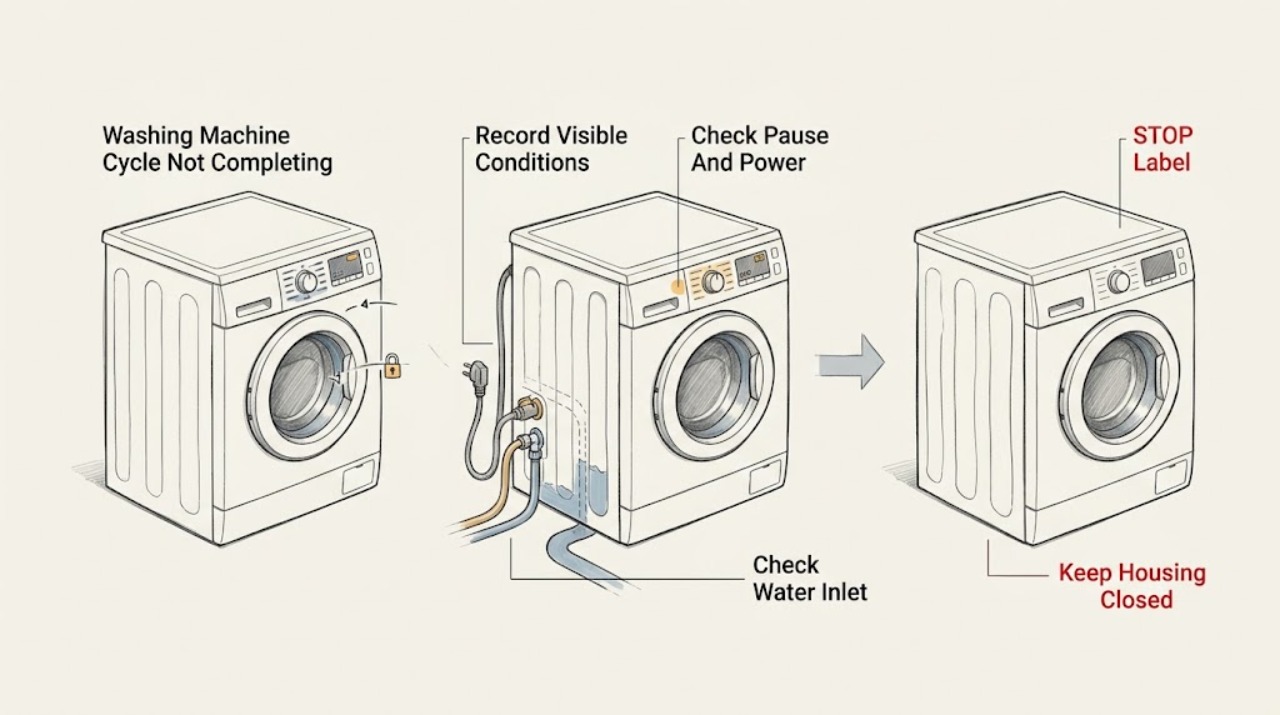
Work through in order
Diagnostic checks
Use only checks that match the exact appliance or system and its official guide.
-
Check 1
Observe the washer from a safe position without opening a locked lid or door, and record the cycle stage, remaining-time display, progress lights, warning message, beeps, and whether the drum contains water.
Expected result: Note whether the stop occurs during fill, wash, rinse, drain, or spin; whether the time is changing, paused, or approximate; and whether a fault or warning code is visible.
Next step: Keep the exact display and timing record, then use the matching water, drain, load, or pause check below; do not restart repeatedly to collect more symptoms.
Stop if: Stop for flooding, a damaged hose, electrical odor, smoke, a hot cord or outlet, abnormal mechanical movement, or a lid or door that will not safely release.
Why this matters
Why: The last active stage narrows the next check. A pause or changing estimate can reflect normal recovery, while a recurring code, a full drum, or a machine that is completely unresponsive requires a different and more urgent path.
-
Check 2
If the display or Start/Pause indicator shows that the washer is paused and there is no hazard, press Start/Pause once to continue; otherwise check the wall switch, plug, and household power from ordinary access.
Expected result: Record whether the washer resumes, remains paused, loses the display, or stops again at the same stage; note any tripped breaker without repeatedly resetting it.
Next step: If it resumes, monitor one cycle and keep the stage record. If power is unstable or the washer stops again, leave it off and arrange qualified appliance or electrical service.
Stop if: Do not operate with a damaged cord, wet electrical connection, burning smell, sparking, or a repeatedly tripping breaker; do not remove electrical covers.
Why this matters
Why: A deliberately paused cycle can continue normally. A loss of power or repeat stop points to a supply, control, or appliance fault rather than a timing estimate.
-
Check 3
If the washer stopped during or before fill, verify from ordinary access that the hot and cold taps are open as required by the selected cycle, inlet hoses are not kinked or damaged, and the accessible tap-end filters are not visibly blocked.
Expected result: Record whether water flows at the taps, the correct hose reaches the corresponding inlet, a filter is blocked, a hose leaks, or the washer displays a low/no-water warning.
Next step: Correct only a clearly closed tap or safe external hose position according to the model guide; arrange service for a persistent fill failure, leaking hose, blocked inaccessible filter, or warning that returns.
Stop if: Turn off the taps and stop for a leaking or split hose, uncontrolled water, a flooding warning, or any need to remove internal covers or reach energized parts.
Why this matters
Why: A failed or restricted water supply can hold a washer at a fill stage and prevent the cycle from completing. A normal tap and hose observation does not prove that an internal inlet valve or sensor is good.
-
Check 4
If water remains or the washer stopped during drain or before spin, inspect the visible drain hose for kinks, a blocked outlet, incorrect placement, or a hose sitting in standing water; clean a pump filter only if the exact model guide identifies it as user-removable and the washer is safely disconnected and drained.
Expected result: Record whether water drains, the hose is obstructed, the pump-filter access is available, the machine makes an unusual drain sound, or the drum remains full after the allowed check.
Next step: Restore only the model-specified hose position or clear an ordinary accessible obstruction; leave the washer off and request service if water remains, the filter is inaccessible, or the pump is noisy or silent.
Stop if: Do not reach into standing water with the appliance connected, open a locked door or lid, remove a pump or panel, or use force to clear a concealed blockage.
Why this matters
Why: A restricted drain path can prevent the washer from advancing to spin or completion. Persistent standing water after the permitted external check can indicate a pump, filter, sensor, or control fault that requires service.
-
Check 5
If the washer stops before or during spin, pause it only as the model guide allows and check whether the load is tightly bundled, a single heavy item, overloaded, or visibly out of balance; redistribute items without reaching into a moving drum.
Expected result: Note whether the machine resumes after a balanced, suitable load, repeatedly tries to rebalance, rocks on its feet, or leaves clothing very wet.
Next step: Use a suitable average load and the cycle's capacity guidance for one controlled retry; if the washer rocks, repeatedly rebalances, or still will not complete, stop and arrange service.
Stop if: Do not climb on the machine, hold the drum, defeat a lid or door lock, move the washer while full, or continue a violent or unstable spin.
Why this matters
Why: Fisher & Paykel guides say an out-of-balance load can reduce or delay spin and that level or load condition affects recovery. A repeated imbalance with a normal load can indicate installation or mechanical service needs.
-
Check 6
Review the detergent type and amount against the exact Fisher & Paykel guide, especially if the washer pauses with foam or repeatedly extends the wash; do not add more detergent to force completion.
Expected result: Record visible excess suds, detergent remaining in the dispenser, a low-sudsing detergent being used, or a cycle that slowly resumes after the foam subsides.
Next step: Allow a documented self-correction to finish if there is no hazard and use the model-specified low-sudsing detergent and dose on the next suitable load; seek service if the stop recurs with correct dosing.
Stop if: Stop for foam or water escaping the machine, a flooded floor, chemical exposure, or any need to open the cabinet or force the dispenser.
Why this matters
Why: The guides say excessive suds can make the washer wait or extend the cycle, while the wrong detergent or excessive dose can keep the problem recurring. A clear drum with a repeat stop is not explained by detergent alone.
-
Check 7
After the safe external checks, decide whether the same cycle still fails to complete or a fault, water, lock, power, or repeated imbalance condition remains.
Expected result: Answer yes if the machine stops at the same stage, a code returns, water remains, the door or lid stays locked, or an unsafe symptom is present; answer no only when a clear pause, water, drain, load, or suds condition has resolved and the cycle completes.
Next step: For yes, turn the washer off and arrange Fisher & Paykel trained or authorized service with the model, stage, code, load, water, drain, detergent, power, and reset history.
Stop if: Do not bypass a door or lid lock, open panels, test live wiring, replace a part by symptom, or repeatedly restart a washer that is flooded, unstable, overheated, or electrically damaged.
Why this matters
Why: A yes result requires model-specific diagnosis; it does not identify a failed pump, inlet valve, lock, motor, or control by itself. A no result supports monitoring, not a guarantee that the washer has no developing fault.
Use your observations
Decision map
Find the observation that best matches what you see, then follow the next safe action.
-
PATH 01Safety boundary
What you see
The washer is paused, the Start/Pause indicator or control state confirms it, and there is no water, electrical, mechanical, or lock hazard.
Do this next
Press Start/Pause once to continue and monitor the same stage; do not press repeatedly.
Why this path and its safety boundary
Why it matters: The cycle may simply be waiting for a user command.
Safety stop: Stop for a locked or forced lid/door, flooding, damage, smoke, or an electrical odor.
-
PATH 02Safety boundary
What you see
The remaining-time display changes, pauses, or extends while the washer is correcting an out-of-balance load or excess suds, with no fault or hazard.
Do this next
Allow the correction to finish and record whether the cycle completes; use a suitable load and low-sudsing detergent next time.
Why this path and its safety boundary
Why it matters: The time is approximate and the washer may be self-correcting rather than permanently stuck.
Safety stop: Stop if the cycle never advances, the washer repeatedly rebalances, foam escapes, or water remains.
-
PATH 03Safety boundary
What you see
The washer stops at fill or shows a low/no-water warning, and a tap is closed, a hose is kinked, or an accessible filter is blocked.
Do this next
Correct only the safe external supply condition specified by the model guide, then perform one controlled continuation; arrange service for a recurring or leaking supply.
Why this path and its safety boundary
Why it matters: The selected cycle cannot progress until the required water supply is restored.
Safety stop: Turn off water for a split hose, uncontrolled flow, flooding warning, or water near electrical equipment.
-
PATH 04Safety boundary
What you see
Water remains, the hose is blocked or incorrectly positioned, or the washer cannot advance from drain to spin.
Do this next
Check only the visible hose and model-approved pump-filter access with power disconnected; request service if water remains or the restriction is concealed.
Why this path and its safety boundary
Why it matters: A drain-path restriction or pump condition may be preventing completion; out-of-balance recovery can also delay spin.
Safety stop: Do not reach into standing water with power connected, open a locked door or lid, or dismantle the pump or cabinet.
-
PATH 05Safety boundary
What you see
A fault code returns, the display goes blank, power or water repeatedly fails, or the washer stops at the same stage after safe checks.
Do this next
Turn the washer off, record the exact code and serial or model information, and book Fisher & Paykel trained or authorized service.
Why this path and its safety boundary
Why it matters: A model-specific appliance, installation, or supply fault remains possible and cannot be identified from the symptom alone.
Safety stop: Do not repeatedly reset, bypass the lock, remove panels, test live circuits, or continue using the appliance with a damaged cord, flooding, smoke, or electrical odor.
Helpful context
Understand the symptom
A changing time display is not always a failed cycle
Fisher & Paykel displays an approximate remaining time, and its front-loader guidance says water flow, water pressure, load size, selected options, out-of-balance recovery, and oversudsing can change the total. A timer that pauses while the washer corrects a load or dissolves suds is different from a drum that is full of water, a recurring fault code, or a machine that loses power. Record the stage and display before restarting anything.
Use the last completed stage to choose the next safe check
If the washer stops before filling, look at the taps, water supply, and inlet filters from ordinary access. If it stops before or during spin, an unbalanced load, level condition, suds, or drain problem becomes more relevant. Fisher & Paykel guides also identify blocked drain hoses or pump filters, incorrectly positioned drain hoses, and a door or lid state as model-dependent causes. Do not reach into the drum or open a locked door to inspect clothing.
Keep a recurring stop inside the service boundary
A single pause or self-correction may resolve after the specified user check, but a repeated stop is not proof of a bad pump, valve, lock, motor, or control. Turn the washer off for a recurring fault, flooding warning, damaged hose, electrical smell, or water left in the drum, and arrange qualified Fisher & Paykel service. The support team says its technicians use diagnostic tools and genuine parts; give them the exact model, stage, code, load, water and drain observations, and any reset already performed.
Safety boundary
Stop conditions
- Turn the washer off and close the inlet taps for flooding, an uncontrolled leak, a flooding warning, or water near electrical equipment.
- Do not force or bypass a locked lid or door, reach into a moving drum, or open the machine beyond the user-removable parts identified by the exact model guide.
- Do not reach into standing water with the washer connected, remove a concealed pump or panel, or probe live wiring.
- Stop for a damaged power cord, burning or electrical odor, smoke, sparking, repeated breaker trips, violent movement, or a machine that rocks or shifts.
- Do not replace a pump, inlet valve, lock, motor, sensor, or control by symptom alone; recurring faults require model-specific qualified diagnosis.
Only after diagnosis
Potential parts
- model-specific drain pump or pump filter assembly
Consider this category only if qualified diagnosis confirms a drain-path or pump fault after the visible hose and model-approved filter checks, especially when water remains at the end of the cycle.
Confirm the exact Fisher & Paykel model, revision, pump design, and manufacturer fit information before ordering; a stopped cycle alone does not prove pump failure. - model-specific inlet valve or inlet filter assembly
Consider this category only if qualified testing confirms that the washer cannot receive the required water despite open taps, sound hoses, and clear accessible filters.
Confirm the exact model, valve configuration, water-temperature arrangement, and manufacturer fit information; do not substitute a valve by appearance. - model-specific lid or door-lock assembly
Consider this category only if qualified diagnosis confirms that the lock or its sensing circuit prevents a safe cycle transition after ordinary door or lid checks.
Confirm the exact model and lock design with qualified service; never bypass or defeat the lock to complete a cycle.
When checks do not resolve it
Need a professional?
Arrange Fisher & Paykel trained or authorized service when the cycle repeatedly stops at one stage, a fault code returns, water remains after the model-approved drain check, the machine cannot fill or drain, the door or lid will not safely release, the washer repeatedly goes out of balance with a suitable load, or power or water supply problems persist. Turn it off and use the appropriate emergency, electrical, or plumbing response for flooding, a damaged cord, smoke, sparking, or other immediate hazards.
Safety scope: This article covers control-state observation and ordinary-access checks of taps, visible hoses, user-approved filters, load, detergent, and power symptoms only. Qualified service must diagnose internal pumps, valves, locks, sensors, motors, controls, wiring, and concealed plumbing or electrical conditions.
Common questions
FAQ
Why does my Fisher & Paykel washing machine stop before the cycle finishes?
It may be paused, waiting for water, correcting an out-of-balance load, dissolving excess suds, unable to drain, or reporting a fault. Record the last stage, remaining-time behavior, warning, and water level, then check only the matching external conditions in the model guide.
Is it normal for Fisher & Paykel cycle time to change?
Yes, the manufacturer's guides say the remaining time is approximate and can change with water flow or pressure, load size, options, out-of-balance recovery, and oversudsing. A cycle that never advances, repeatedly stops, or leaves water behind still needs diagnosis.
What should I check if the washer stops before spinning?
Check whether water remains, whether the visible drain hose is kinked or blocked, and whether the load is tightly bundled, heavy, overloaded, or out of balance. Use pump-filter access only if the exact model guide identifies it as user-removable and the appliance is safely disconnected.
Can too much detergent prevent a Fisher & Paykel washer from finishing?
Excessive suds can extend a cycle while the washer waits for them to dissolve. Use the low-sudsing detergent and dose specified for the exact model. Stop for foam or water escaping the machine, and seek service if the same stop recurs with correct dosing.
Should I bypass the lid or door lock to finish the wash?
No. Fisher & Paykel guides warn not to force or disable the lid lock. Keep the washer off if the lock will not safely release, water remains, or a fault returns, and arrange trained or authorized service.
Read the exact guide
Official sources
- TOP LOADER WASHING MACHINE WL8058G1, WL9058G1 & WL1064G1 models USER GUIDEFisher & Paykel · An official Fisher & Paykel top-loader guide used for general branches such as pause, power or water failure, oversudsing, load balance, drain, and service boundaries; exact model guide takes precedence.
- Help & Support | Book A Service | Repair | TechnicianFisher & Paykel · Fisher & Paykel USA support page used for directing unresolved problems to Product Help or trained service; regional options may vary.
- FRONT LOADING CLOTHES WASHER WH2424F & WH2424P INSTALLATION GUIDE / USER GUIDEFisher & Paykel · An official Fisher & Paykel front-loader guide used for general diagnostic branches; exact model guide takes precedence because controls and user-removable parts vary.
Community feedback
Share a repair observation
Share a plain-text repair observation. Accepted observations are published automatically; this page may take a moment to update.