
On this page
Start here
Quick answer
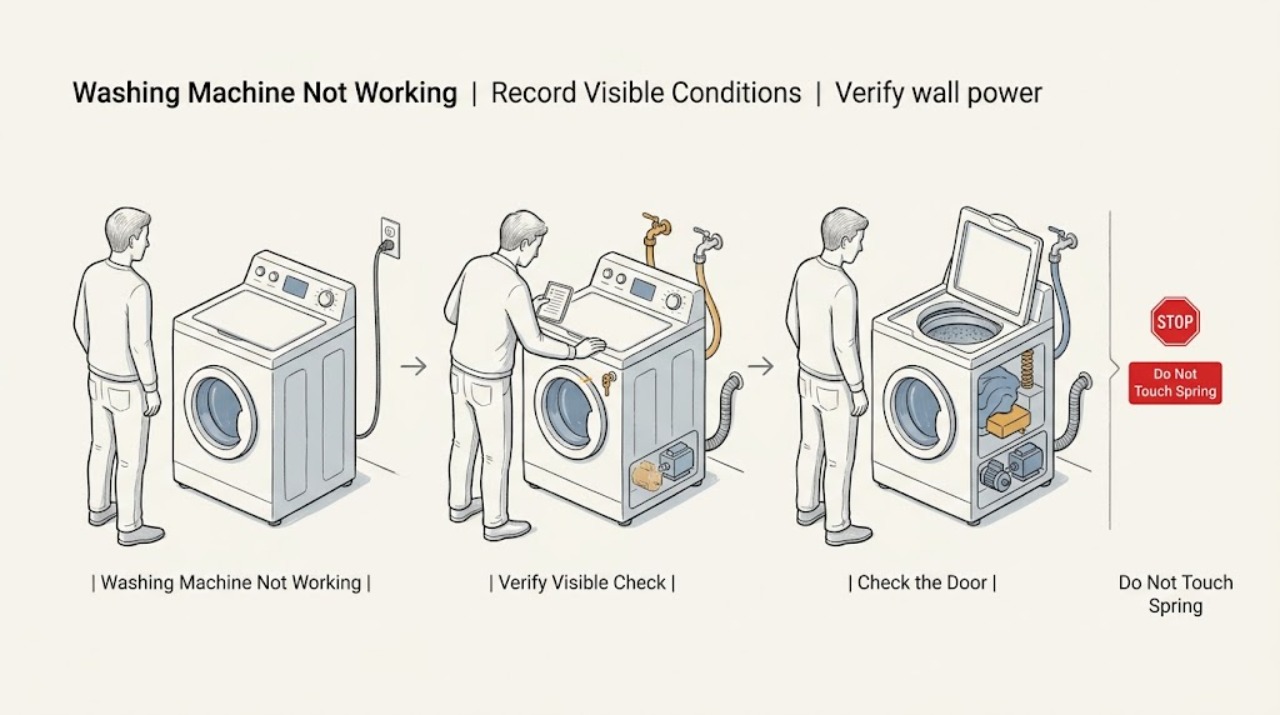
First identify whether the Fisher & Paykel washing machine is completely dead, powers on but will not fill or start, stops mid-cycle, or runs with an error pattern. Check the wall switch and household outlet, confirm the lid or door is fully closed, clear any active keylock or delay-start setting using the exact model guide, and verify the hot and cold water taps and inlet hoses. If the machine fills or drains incorrectly, inspect only the visible hose routing and household drain; a low or incorrectly installed drain hose can cause siphoning or continuous filling. Fisher & Paykel manuals advise a single power-off wait-and-restart sequence for some fault conditions, followed by leveling, load removal, and a rinse or spin check. If the fault returns, the machine will not respond, the cord is damaged, water reaches electrical parts, or a code persists, stop using it and arrange a Fisher & Paykel trained service technician.
Work through in order
Diagnostic checks
Use only checks that match the exact appliance or system and its official guide.
-
Classify the symptom and record any fault pattern
From a dry, safe position, note whether the panel or lights work, whether the machine responds to Power or Start, whether it is filling, agitating, draining, or spinning, where the cycle stopped, and whether beeps or a code are displayed. Photograph the panel pattern and note the model and serial number without removing covers.
Expected result: No lights or response suggests a power or internal control branch. A powered machine that will not start suggests keylock, door or lid, delay start, water supply, or detected fault. A mid-cycle stop with a code or repeating beeps indicates that the exact model's fault guidance is needed.
Next step: Follow the power checks for a dead panel, the door, water, and control checks for a powered no-start, and the code and service branch for a mid-cycle stop. Do not keep retrying an active fault.
Why this matters
Why: The same complaint can represent different stages of the wash sequence; the stage determines which external check is relevant.
-
Verify wall power and the household supply
Confirm the wall switch is on and the power cord is fully seated, then check the outlet with another suitable appliance from a dry position. If the model guide allows a reset, switch the washer off at the wall, wait the guide's stated interval, and turn it back on once. Do not use a damaged cord, extension cord, adapter, or repeatedly reset a breaker.
Expected result: If the other appliance also lacks power, the household supply or isolator is the likely branch. If the outlet works but the washer remains dark, the washer's power input or control may need service. If the panel returns after one reset but the fault returns, the reset did not correct the cause.
Next step: Arrange qualified electrical service for a dead or repeatedly tripping supply. Arrange appliance service for a washer that remains dead on a known-good outlet or returns to the same fault after one reset.
Why this matters
Why: An external supply check separates a household outage from an appliance failure without exposing the user to live electrical testing.
-
Check keylock, delay start, and the lid or door
Use the exact model guide to see whether Keylock is active, whether Delay Start is selected, and whether the lid or door is fully closed and latched. Remove only an item visibly trapped in the seal or opening. Do not force the lid, defeat the lock, or reach into a moving drum.
Expected result: Fisher & Paykel guides list keylock, delay start, an open lid or door, and a washer waiting for a command as reasons a powered machine may not begin. A latch that will not engage, a damaged seal, or a persistent lock indication supports a service branch.
Next step: Clear only the model-documented keylock or delay setting and close the lid or door normally. If the control remains locked, the latch is damaged, or the machine still will not start, stop and arrange service.
Why this matters
Why: The washer will not safely fill or spin until the control and lid or door interlock conditions are satisfied; a lit panel does not prove the interlock is healthy.
-
Check water supply and inlet hoses
Confirm the hot and cold taps required by the exact model are open, the hoses are connected to the correct valves, and the visible hoses are not kinked, leaking, or crushed. Inspect only the tap-end inlet screens if the manual provides that user check; turn off the taps before disconnecting a hose.
Expected result: Fisher & Paykel identifies closed taps, blocked inlet filters, crossed or damaged hoses, and a faulty water supply as reasons a washer may not fill or may stop. If water supply is normal but the washer does not fill, an inlet valve, sensor, door or lid, or control fault is possible.
Next step: Correct only an accessible tap or hose condition and run one model-approved start test. Stop for a leak or persistent no-fill condition and arrange qualified appliance or plumbing service.
Why this matters
Why: A washer can appear not to work when it is waiting for water; external supply checks rule out a simple installation or plumbing condition without opening the cabinet.
-
Check drain hose routing, siphoning, and household plumbing
If the machine fills continuously, drains while filling, leaves water behind, or will not advance, inspect the visible drain hose and standpipe or tub routing against the exact installation guide. Ensure the hose is secured, not kinked, not sitting in water, and not inserted too far or too low for the model. Check the household drain for a blockage without opening the washer pump.
Expected result: Fisher & Paykel explains that incorrect hose height or insertion can cause siphoning, continuous filling, or drainage problems, and that a blocked standpipe or tub can affect operation or cause flooding. A correctly routed hose with no household blockage but persistent failure points toward an internal pump, sensor, or control issue.
Next step: Correct only a visible, manual-approved hose or plumbing issue. If water remains, the pump makes an abnormal sound, or the machine leaks, disconnect it and arrange qualified service.
Why this matters
Why: The washer's drain path must be installed for the model; an external routing fault can look like a control or fill failure.
-
Check load balance, level, and suds
If the machine fills but stops at agitation or spin, pause it using the normal control, wait for the lid or door to unlock, and redistribute the load. Check that the washer does not rock and that the load is within the cycle's capacity. If excessive suds are visible, use only the model-approved rinse or correction and reduce detergent for future loads.
Expected result: Fisher & Paykel guides identify out-of-balance loads, an unlevel machine, and suds buildup as causes of poor spinning or a cycle that does not progress. A balanced load that still stops or displays a fault indicates more than a loading issue.
Next step: Run one suitable, balanced load with the model-recommended detergent amount. If the washer repeatedly stops, will not spin, or returns a code, stop using it and arrange service.
Why this matters
Why: The washer may pause or reduce operation as a protective response to imbalance or oversudsing; that behavior is different from a dead control or failed motor.
-
Use the exact model guide for fault codes and recovery
Record every displayed code, light sequence, or beep pattern before clearing it. Use Fisher & Paykel's model-specific manual or support page to interpret the message. If the guide instructs a single power-off wait, load removal, leveling, rinse, or spin recovery sequence, perform it once only when there is no leak or electrical hazard.
Expected result: Fisher & Paykel manuals state that a recurring fault after the documented recovery steps should be taken to trained service, and that the code, model, serial number, and problem description help the repairer identify the possible fault. A code that returns immediately is not resolved by clearing the display.
Next step: Stop after one documented recovery attempt. If the code or unusual light pattern returns, keep the washer out of use and arrange Fisher & Paykel trained service.
Why this matters
Why: Fault recovery is model-specific and can distinguish a temporary imbalance or supply event from an unresolved pump, motor, lock, sensor, or control problem.
-
Run one supervised confirmation after a safe correction
Only after correcting an accessible power, keylock, door, water, drain, load, or detergent condition, run one model-approved short cycle while staying nearby. Observe filling, agitation, draining, spin, leaks, lights, and sound. Stop immediately for smoke, burning odor, sparks, flooding, a damaged cord, a hot outlet, or any fault that returns.
Expected result: A complete cycle after the correction supports a temporary external condition. A repeat stop, no response, abnormal pump or motor sound, persistent code, leak, or failure to fill, drain, or spin indicates an unresolved fault.
Next step: Disconnect the washer and arrange qualified service when the confirmation fails. Preserve the code, model, serial number, cycle stage, and observations for the technician.
Why this matters
Why: One controlled test confirms whether the safe correction changed the symptom; repeated cycles can worsen a pump, motor, lock, water, or electrical problem.
Use your observations
Decision map
Find the observation that best matches what you see, then follow the next safe action.
-
PATH 01Next step
What you see
The panel is dark, the outlet is dead, or the power cord or receptacle is damaged or hot.
Do this next
Stop using the washer and arrange qualified electrical or appliance service. Do not repeatedly reset a breaker or use a damaged cord.
-
PATH 02Next step
What you see
The panel works, but Keylock, Delay Start, an open lid or door, or a waiting-for-command state prevents starting.
Do this next
Follow only the exact model's documented control and latch steps. Do not force or bypass the lid or door lock; arrange service for persistent lock or start failure.
-
PATH 03Next step
What you see
The machine does not fill, fills continuously, drains while filling, or leaves water behind.
Do this next
Check taps, inlet hoses, drain-hose routing, and household plumbing as the manual allows. Stop for leaks or persistent failure and arrange qualified service.
-
PATH 04Next step
What you see
The washer stops during agitation or spin, is out of balance, rocks, or has excessive suds.
Do this next
Redistribute the load, level the washer, and use the correct detergent amount once. If the problem or code returns, stop and arrange service.
-
PATH 05Next step
What you see
Smoke, burning odor, sparks, flooding, a hot or damaged cord or outlet, water near electrical parts, or a recurring fault code is present.
Do this next
Stop immediately, disconnect only if safe, keep clear, and seek qualified appliance or electrical help. Do not restart, open panels, or bypass a safety device.
Helpful context
Understand the symptom
Not working describes several different states
A dark control panel is a power or control branch. A powered machine that will not fill may be waiting for a command, keylock, door, water-supply, delay-start, or fault condition. A machine that stops mid-cycle may be paused, waiting for water or power, out of balance, oversudsed, or protecting itself after detecting a fault. Record the state and any light or display pattern before changing settings.
Keep electricity and water within the safe boundary
Stop the cycle normally and disconnect the washer before handling hoses or water. Do not operate it with wet hands, open panels, probe live wiring, bypass a lid or door lock, or tip a machine full of water. A damaged cord, smoke, burning smell, sparks, a hot outlet, flooding, or water near electrical parts requires immediate stop and qualified help.
Only after diagnosis
Potential parts
- inlet hose, inlet screen, or water valve
Consider this only when the taps and hoses are correct but qualified testing confirms an inlet restriction or valve fault.
Valves, screens, and hose connections vary by model; turn off water before any permitted hose work. - drain pump, internal hose, or drain component
Consider this only when the household drain and hose routing are clear but qualified testing finds an internal pump or hose fault.
Pump access can expose water and electrical hazards; verify the model and use trained service. - lid or door interlock
Consider this only when the lid or door closes correctly but qualified testing finds that the safety interlock is not enabling the cycle.
Never bypass the lock; interlocks are model-specific and safety-critical. - motor, sensor, suspension, or electronic control
Consider this only after qualified diagnosis rules out power, water, drain, door, load, and detergent conditions.
Motor, sensors, suspension, and control boards are model-specific and require safe electrical testing.
When checks do not resolve it
Need a professional?
Arrange Fisher & Paykel trained service when the washer stays dead on a known-good supply, will not start after the model-specific keylock, door, water, and control checks, fails to drain or fill, repeatedly stops mid-cycle, or returns a fault code after one documented recovery. Use qualified plumbing service for a blocked household drain and qualified electrical service for supply or cord issues. Stop immediately for smoke, burning odor, sparks, flooding, a hot or damaged cord or outlet, or water near electrical parts. Do not open panels, bypass the lid or door lock, or repeatedly cycle a faulting machine.
Common questions
FAQ
Why is my Fisher & Paykel washing machine not working?
Check whether the panel has power, then check keylock, delay start, lid or door closure, water supply, drain routing, and load balance. If it remains unresponsive or returns a code after one model-specific recovery, arrange trained service.
What should I do if my Fisher & Paykel washer will not start?
Confirm the outlet works, clear any documented keylock or delay setting, close the lid or door, and verify the required taps are open. Do not bypass the lock; a persistent no-start condition needs qualified diagnosis.
Can a drain hose make a Fisher & Paykel washer appear not to work?
Yes. Incorrect hose height or insertion can cause siphoning, continuous filling, or drainage problems. Compare the visible routing with the exact installation guide and stop for leaks or persistent failure.
Why does my Fisher & Paykel washer stop mid-cycle?
Possible external conditions include a paused command, power or water interruption, an unbalanced load, or excess suds. Record any code, redistribute the load once if safe, and arrange service if the stop or fault returns.
When should I stop using a Fisher & Paykel washing machine?
Stop for smoke, burning odor, sparks, flooding, water near electrical parts, a hot or damaged cord or outlet, repeated breaker operation, or a recurring fault code. Disconnect only if safe and do not open panels or bypass safety locks.
Read the exact guide
Official sources
- Washing Machine User Guide and Installation InstructionsFisher & Paykel · Power, no-start, water supply, drain hose, siphoning, balance, lid, fault recovery, and trained-service guidance
- Fisher & Paykel Washer Troubleshooting GuideFisher & Paykel · Power, load sensing, water supply, drain installation, out-of-balance recovery, fault codes, and service escalation
- Front Loading Clothes Washer User GuideFisher & Paykel · Washer not working, keylock, door, water supply, delay start, mid-cycle stops, and service evidence
- Help & Support | Book A Service | Repair | TechnicianFisher & Paykel · Product Help, manuals, troubleshooting, and service routing
Community feedback
Share a repair observation
Share a plain-text repair observation. Accepted observations are published automatically; this page may take a moment to update.