
On this page
Start here
Quick answer
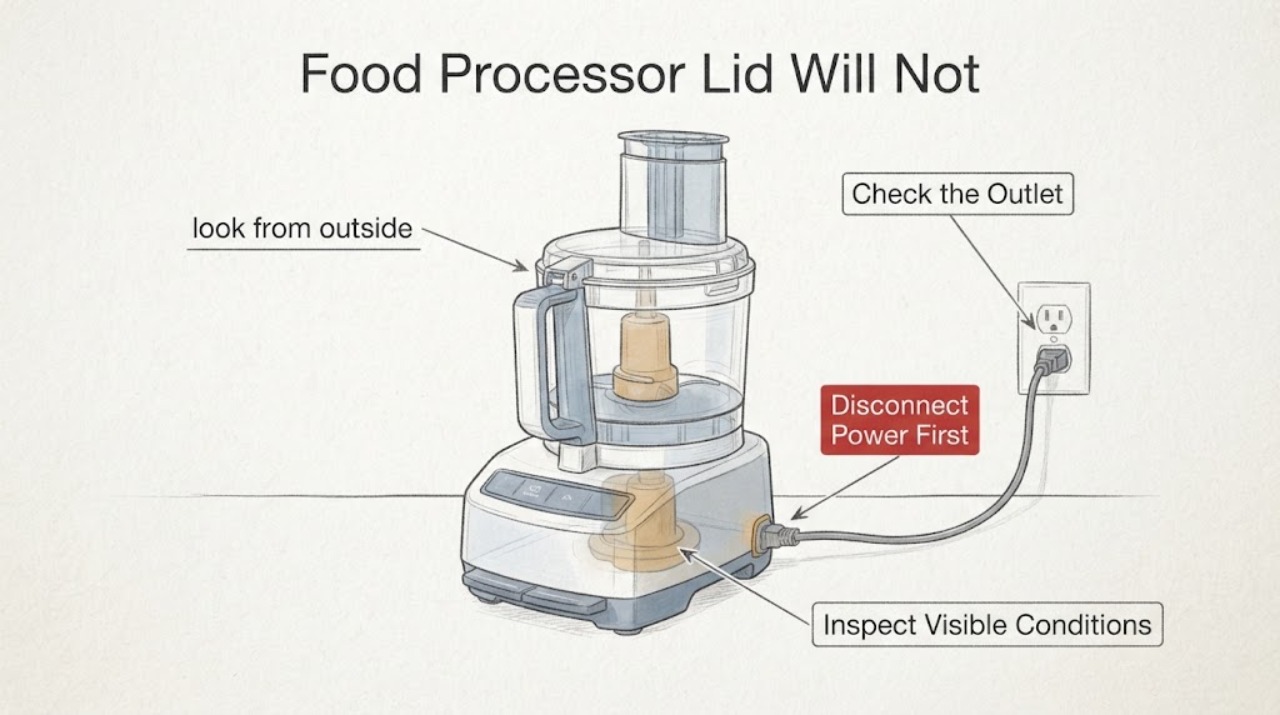
Unplug the food processor before trying to release the lid, wait until every blade or disc has stopped, and do not pry the lid, insert a tool, or defeat an interlock. With power disconnected, inspect only the visible bowl and lid alignment and any accessible obstruction, then use the exact model manual for its release procedure. A silent motor can result from an unseated interlock, missing power, overload protection, or a fault, so a lid that remains stuck or a processor that remains silent after the model-specific checks should stay out of service for qualified service.
Work through in order
Diagnostic checks
Use only checks that match the exact appliance or system and its official guide.
-
Check 1
Turn the processor off and unplug it from the outlet before touching the lid, bowl or cord. Keep hands away from the blade or disc and wait until all movement has stopped; do not reconnect it while the lid is still stuck.
Expected result: The appliance is disconnected and completely still, or there is smoke, burning odor, heat damage, a damaged cord or plug, liquid near the base, or a repeated breaker trip.
Next step: Keep the processor out of service and arrange qualified appliance service for any hazard sign. Do not handle a wet plug, reset a tripped breaker repeatedly, or test the processor while energized.
Why this matters
Why: A still, isolated appliance is the starting condition for an external inspection. Heat, odor, damage, liquid or repeated protection trips indicate a safety fault rather than a lid-release problem.
-
Check 2
With the plug removed, look from outside at the bowl, lid, feed tube and visible locking tabs. Note whether the bowl appears fully seated, the lid is aligned with its stop, a pusher or container is pressing on the lid, or visible food is wedged at the rim. Do not insert a utensil or turn the blade by hand.
Expected result: A visible object or misalignment is present, or the bowl and lid look seated with no accessible obstruction.
Next step: Remove only an obvious, loose obstruction without force and follow the exact model manual's release instructions. If nothing visible explains the stuck lid, stop handling it and move to model identification and service.
Why this matters
Why: A food processor may not permit operation until its bowl and lid are fully locked; an accessible obstruction can also keep a lid from reaching its release position. A clear exterior does not prove that the internal lock or motor is sound.
-
Check 3
Read the rating label or purchase documents and record the complete brand and model number. Open that exact owner's manual and look for the bowl/lid lock, cover-removal and no-operation sections before trying any release direction or reset sequence.
Expected result: The exact manual gives an owner-safe release procedure, gives only a service instruction, or cannot be matched because the label is missing or unreadable.
Next step: Use an exact, unplugged manual procedure only when it clearly covers the model. If the manual is unavailable or directs service, provide the model and serial information to a qualified technician and do not pry the lid or defeat the interlock.
Why this matters
Why: The manufacturers' guidance is model- and family-specific: the Panasonic safety-lock explanation describes its own lock, while the KitchenAid manual's alignment and troubleshooting guidance applies to the documented model. Neither establishes a universal movement for an unidentified processor.
-
Check 4
If the lid has been safely released by the exact manual procedure, inspect the plug, cord and outlet from outside and check the household breaker once without opening the base or using a live meter. Do not use the processor as a test while a cover or bowl is misaligned.
Expected result: The outlet and breaker appear normal, the plug or cord is damaged or hot, or the breaker trips again when the appliance is used according to its exact manual.
Next step: Leave the processor disconnected and arrange appliance service for a damaged cord, heat, a recurring trip or continued silence. Do not open the base, bypass the interlock or probe energized wiring.
Why this matters
Why: KitchenAid's model troubleshooting directs the owner to check the plug and fuse or breaker along with correct bowl/lid alignment, but a recurring trip or damaged cord is evidence of a fault rather than a reason to keep resetting power.
-
Check 5
If the exact manual identifies an overload or motor-protection reset, allow the documented cool-down period with the processor unplugged and clear only accessible, loose food after the blade has stopped. Do not apply a generic time, force the blade or keep cycling the controls.
Expected result: The exact manual supports a cool-down/reset step and the motor later responds, or it remains silent after that model-specific step.
Next step: Follow the exact manual once and stop if the symptom returns. Persistent silence, a stuck lid or any overheating sign requires qualified service rather than a switch, motor or control-board diagnosis.
Why this matters
Why: Some manufacturer manuals include overload or thermal-protection guidance, but the time and reset method are model-specific. A response after cooling does not authorize continued use if the lid, cord or lock remains abnormal.
Use your observations
Decision map
Find the observation that best matches what you see, then follow the next safe action.
-
PATH 01Next step
What you see
After unplugging, the lid releases only by the exact procedure in the matching manual and no hazard is visible.
Do this next
Keep the bowl and lid correctly seated, use the manual's no-operation checks once, and arrange service if the processor remains silent.
Why this path and its safety boundary
Why it matters: The lock was not shown to be defective; the original lid symptom may have been an assembly or interlock condition, while the silent motor still needs its own model-specific check.
-
PATH 02Next step
What you see
The lid remains stuck after power is disconnected and there is no visible loose obstruction.
Do this next
Stop pulling or twisting, photograph the assembly, record the model number if visible, and request qualified service.
Why this path and its safety boundary
Why it matters: The available evidence cannot identify the lock geometry or prove that the bowl is safe to force; prying could damage the lid, bowl or safety interlock.
-
PATH 03Next step
What you see
The lid releases but the processor is still silent after the exact plug, alignment and documented protection checks.
Do this next
Leave the processor unplugged and give the model, serial information, symptom timeline and any breaker or odor event to qualified appliance service.
Why this path and its safety boundary
Why it matters: An unresolved power, interlock, motor or control fault remains possible, but the symptom does not identify one particular failed part.
-
PATH 04Next step
What you see
There is burning odor, smoke, a hot or damaged cord, liquid at the base, sparking or a repeated breaker trip.
Do this next
Keep clear of the hazard, leave the appliance disconnected if it is safe to do so, and use qualified service; follow local emergency procedures for active smoke or fire.
Why this path and its safety boundary
Why it matters: The processor has a potential electrical or fire hazard that should not be investigated by repeated plugging in or by opening the housing.
Helpful context
Understand the symptom
A stuck lid and a silent motor need separate checks
The question does not identify a brand, model, bowl style, lid direction or whether food is pressing on the parts. Food processors commonly use a bowl-and-lid safety interlock, but the locking geometry and release procedure vary. A lid that will not release can be a remaining interlock or pressure problem, while silence after plugging in can also reflect an unseated assembly, power issue, overload protection or an electrical fault. Do not assign a failed switch, motor or control board from these symptoms alone.
Keep the first response unplugged and model-specific
KitchenAid's opened food-processor guidance says to turn the unit off, wait for the blade or disc to stop, and unplug before cleaning or removing parts. Once the processor is disconnected and still, inspect only what is visible from outside the bowl and lid. Find the exact model number before following any release motion or troubleshooting sequence; a similar-looking processor may use a different lock. If the lid remains stuck or the motor remains silent, use the manufacturer's service route rather than forcing the assembly or bypassing its lock.
When checks do not resolve it
Need a professional?
Call qualified appliance service if the lid remains stuck after unplugging and the exact manual does not provide a release, if the processor remains silent after model-specific external checks, or if there is any odor, heat, cord damage, liquid, spark or repeated breaker trip. Do not ask for a motor, switch, lock or control board solely from this symptom; let the technician identify the failed part after the model and assembly are confirmed.
Have this ready
- Provide the complete brand and model number, whether the bowl and lid were seated, what was in the bowl, whether the appliance had been running or overloaded, the exact time it became silent, and any breaker, odor or heat observation.
Common questions
FAQ
Can I force the lid off if the processor makes no sound?
No. Unplug it, wait for all movement to stop, and use only the release procedure in the exact manual. If the lid still will not release, stop and arrange service; silence does not prove that the blade or interlock is safe to handle.
Does plugging it in prove that the motor has failed?
No. A processor can remain silent when the bowl or lid interlock is not engaged, power is unavailable, overload protection is active, or a fault exists. The exact manual is needed to separate those possibilities without opening the base.
Should I bypass the lid lock to test the motor?
No. The lock is a safety feature and manufacturer guidance describes it as part of the condition for operation. Do not defeat it, insert tools or run the processor with a misaligned bowl or cover.
Read the exact guide
Official sources
- How to Use the Food ProcessorKitchenAid · KitchenAid's manufacturer guidance for operating a food processor, stopping blade or disc movement before cover removal, and finding model-specific manuals or service; used here as a scoped manufacturer example, not as a universal release direction.
- Food Processor Use and Care GuideKitchenAid · Opened KitchenAid owner manual used for its own model-family troubleshooting: plug and breaker checks, correct bowl/lid alignment, overload or motor protection guidance and service escalation. It is not evidence for an unidentified processor's exact lock geometry.
- Cleaning the Food ProcessorKitchenAid · KitchenAid's manufacturer cleaning guidance to turn the processor off and unplug before handling parts, keep the base out of water, and use model-specific support or service.
- How to Use the Safety Lock on the Food ProcessorPanasonic · Panasonic's manufacturer explanation that its bowl and lid safety lock must be fully engaged before operation; used only to establish the model-specific interlock principle, not to prescribe a Panasonic release motion for another brand.
Community feedback
Share a repair observation
Share a plain-text repair observation. Accepted observations are published automatically; this page may take a moment to update.