
On this page
Start here
Quick answer
To troubleshoot a food processor that is leaking, first identify the exact stage and accompanying signs, then make only the safe external checks supported by the owner guidance. Stop for hazards or recurrence and arrange qualified service.
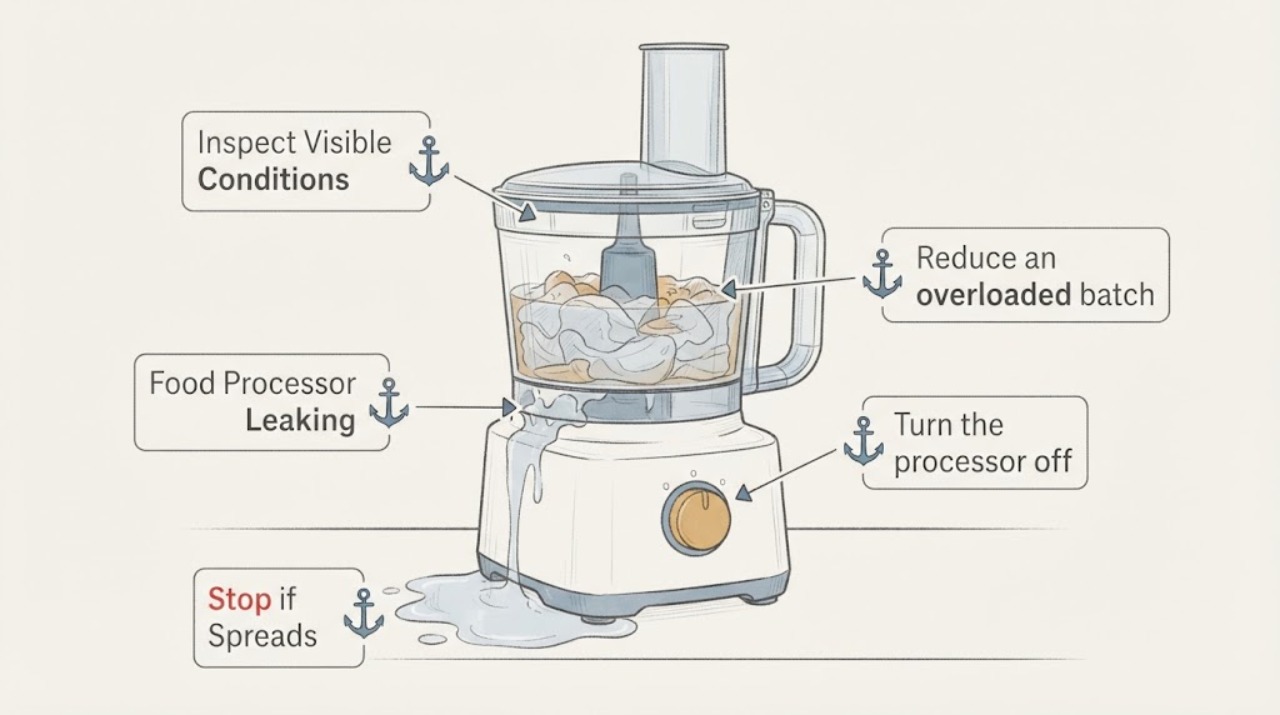
Work through in order
Diagnostic checks
Use only checks that match the exact appliance or system and its official guide.
-
Check 1
Observe whether the food processor is leaking only with a heavy load or in an empty test, and note whether the motor hums, stops, or remains silent.
Expected result: The symptom follows the load, starts after assembly, or occurs with no load.
Next step: Stop for smoke, burning odor, damaged cord, or an exposed blade.
Why this matters
Why: Load, assembly, and control observations distinguish overload protection from an interlock or electrical fault.
-
Check 2
Turn the processor off and unplug it before checking that the work bowl, lid, pusher, and blade are seated and locked exactly as the manual shows.
Expected result: A safety interlock is not engaged, a blade is blocked, or the assembly is correct.
Next step: Clear food only after power is removed and the blade has stopped; never reach into a moving bowl.
Why this matters
Why: Cuisinart describes the bowl and cover interlock as a reason the motor will not start; a blocked blade needs safe cleaning.
-
Check 3
Reduce an overloaded batch and check that ingredients are not packed against the blade or feed tube; use the manual for capacity and processing method.
Expected result: The load is excessive or blocked, or the load is modest and clear.
Next step: Process a smaller batch only after the unit cools as the manual directs.
Why this matters
Why: Excessive strain can slow or stop the motor and trigger its protector; a modest clear load with recurrence needs service.
-
Check 4
Check the cord and outlet with no exposed damage, then test one documented control operation.
Expected result: Power is absent, a breaker is open, or power is stable while the motor fails.
Next step: Use a qualified electrician for the outlet and arrange service for a persistent appliance fault.
Why this matters
Why: A supply issue differs from an internal motor or control fault.
Use your observations
Decision map
Find the observation that best matches what you see, then follow the next safe action.
-
PATH 01Next step
What you see
The food processor is leaking only during a specific function or load
Do this next
Follow the exact owner manual for that condition and monitor only when safe.
Why this path and its safety boundary
Why it matters: A function-specific or load-dependent pattern narrows the safe check but does not prove a failed component.
-
PATH 02Next step
What you see
The food processor remains leaking after the accessible checks
Do this next
Stop testing and arrange qualified service.
Why this path and its safety boundary
Why it matters: The symptom is not resolved by an external condition and needs model-specific diagnosis.
-
PATH 03Next step
What you see
The symptom includes smoke, burning odor, gas odor, exposed wiring, water near electrics, a safety alarm, or a repeat breaker trip
Do this next
Arrange qualified service if the food processor remains leaking after the safe external checks, if a control or cord is damaged, or if the symptom returns. Do not open the housing, bypass an interlock, or work on energized, gas, sealed, or refrigerant components.
Why this path and its safety boundary
Why it matters: The condition is unsafe to continue testing.
Helpful context
Understand the symptom
The useful decision for a food processor that is leaking is to separate an accessible loading, setting, assembly, airflow, or supply condition from a symptom that needs model-specific service. Observe each result before choosing the next safe step.
When checks do not resolve it
Need a professional?
Arrange qualified service if the food processor remains leaking after the safe external checks, if a control or cord is damaged, or if the symptom returns. Do not open the housing, bypass an interlock, or work on energized, gas, sealed, or refrigerant components.
Common questions
FAQ
Can I keep using the food processor while it is leaking?
Arrange qualified service if the food processor remains leaking after the safe external checks, if a control or cord is damaged, or if the symptom returns. Do not open the housing, bypass an interlock, or work on energized, gas, sealed, or refrigerant components.
Read the exact guide
Official sources
- Cuisinart | FAQCuisinart · Cuisinart food processor assembly interlock, motor, blade, load, noise, and support guidance
Community feedback
Share a repair observation
Share a plain-text repair observation. Accepted observations are published automatically; this page may take a moment to update.