
On this page
Start here
Quick answer
A larger bowl does not mean the processor can handle any amount or texture. If the blade turns empty but stops once food is added, first suspect an overload, a stiff mixture, a batch above the bowl or ingredient limit, or a bowl/lid/blade assembly that is not fully engaged. Turn the processor off and unplug it before clearing food or touching the blade, reduce the load, reseat the bowl, lid, spindle and blade according to the exact manual, and allow any overload protection to cool and reset as that manual specifies. If it still stalls with a small permitted batch or stalls when empty, stop using it and arrange service rather than forcing the blade or opening the motor base.
Work through in order
Diagnostic checks
Use only checks that match the exact appliance or system and its official guide.
-
Check 1
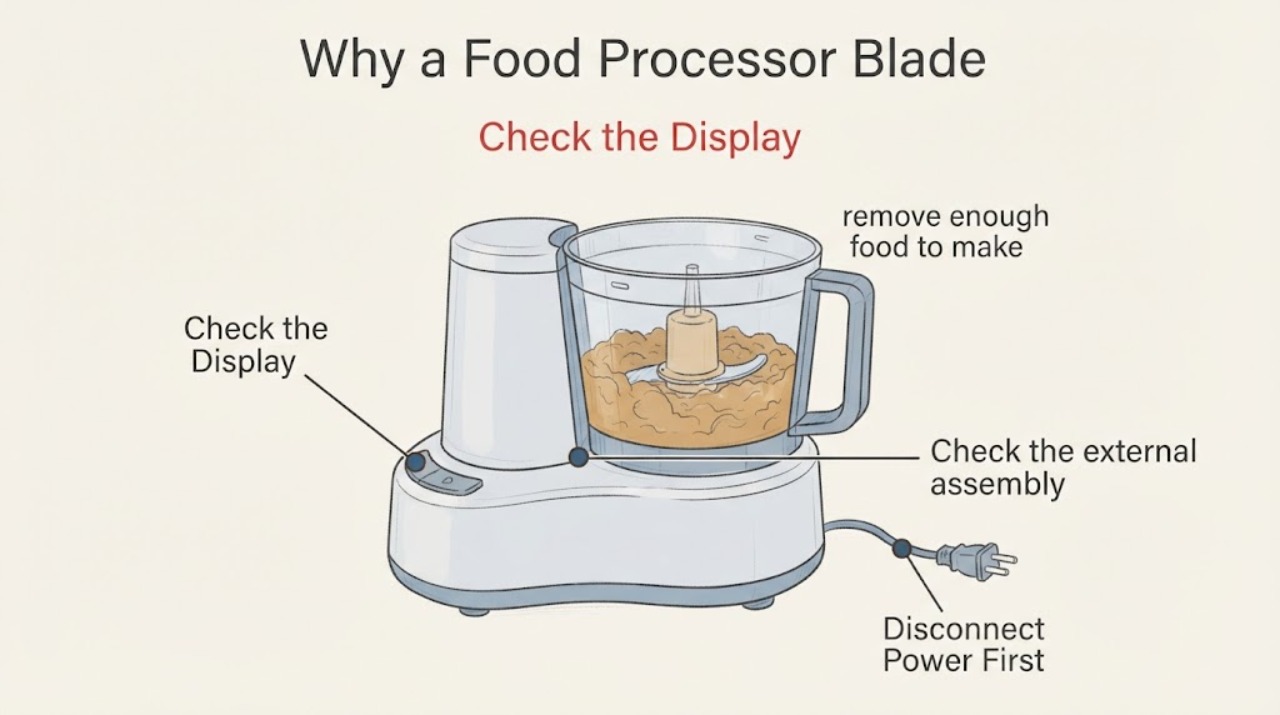
Turn the control to Off and unplug the food processor before opening the lid, clearing a jam, removing food, or touching the blade. Wait until all movement has stopped; never hold the lid or push the food toward the blade while the motor is running.
Expected result: The blade stops after power is removed, or food remains wedged and the blade or bowl cannot be handled without force.
Next step: If food cannot be cleared safely with the appliance disconnected, leave it alone and arrange service. Do not insert fingers, tools, or a hand into the bowl while the blade can move.
Why this matters
Why: The blade is a sharp moving part, and manufacturer manuals require power to be off before handling it. A jam that needs force is not a reason to test the processor repeatedly.
-
Check 2
With power disconnected, remove enough food to make a small batch and compare it with the exact bowl and ingredient limits in the manual. Cut dense food into the manual’s recommended size, leave room for food to move, and do not exceed a marked maximum line or the limit for thick mixtures.
Expected result: The blade runs with a small permitted batch but stalls with the larger load, or it stalls even with a small permitted batch.
Next step: Process smaller batches or use the manual’s specified speed and pulse method if the small-batch test is normal. If the blade still stalls with a permitted load, stop testing and arrange service.
Why this matters
Why: A stall only under load is consistent with overload, a stiff mixture, or an ingredient that exceeds the model’s limits; a stall with a small permitted batch makes load size a less complete explanation.
-
Check 3
Check the external assembly with the processor unplugged: lock the bowl onto the base, align and lock the lid, insert the required pusher or chute cover, and confirm that the blade or disc and any required spindle are seated as the exact manual shows.
Expected result: The bowl, lid, pusher, spindle, or blade was not fully aligned or locked, or the assembly already matches the manual.
Next step: Correct only the visible assembly issue and retry with a small permitted batch. Never tape, hold, or bypass a safety interlock; if correct assembly still stalls, keep the unit unplugged and seek service.
Why this matters
Why: A safety interlock can prevent the motor from running, and a blade or shaft that is not seated can slip or stop under resistance. Correct assembly is a prerequisite, not proof that the motor or coupling is healthy.
-
Check 4
If the processor’s manual describes overload or overheating protection, follow its power-off cooling and reset procedure after a stall. Do not choose one universal cooling time for every brand, and do not repeatedly restart the machine while it is hot or jammed.
Expected result: The processor resumes normally after the documented cool-down and a small batch, or it will not resume, stalls again, or shows a burning smell.
Next step: If the unit will not reset, stalls again, smells hot, or becomes unusually noisy, unplug it and arrange qualified appliance service. Do not open the motor base or test internal wiring.
Why this matters
Why: Panasonic and Breville describe protection systems that can stop operation under overload or heat, but their procedures and times are model-specific. Repeated failure after the documented reset points beyond a simple temporary overload.
-
Check 5
Compare an empty-bowl run only after the manual’s safe assembly is complete and the processor is clear of food. Stop immediately if the blade does not rotate empty, the shaft visibly wobbles, the blade hub slips, or the motor sounds abnormal.
Expected result: The blade runs smoothly empty but stalls with permitted food, or it fails, wobbles, slips, or sounds abnormal even when empty.
Next step: Do not continue no-load or loaded tests after an abnormal result. Keep the processor unplugged and provide the technician with the bowl size, blade/disc used, ingredient type, and whether the fault occurs empty or only under load.
Why this matters
Why: Load-only failure keeps capacity, ingredient stiffness, and drive engagement in question; no-load failure or visible drive damage warrants service and cannot be resolved by reducing the recipe.
Use your observations
Decision map
Find the observation that best matches what you see, then follow the next safe action.
-
PATH 01Next step
What you see
The blade runs with a small, permitted batch but stops only when the larger bowl is heavily loaded or the mixture is stiff.
Do this next
Reduce batch size, follow the exact manual’s ingredient and speed limits, and allow the processor to cool whenever its protection procedure requires it.
Why this path and its safety boundary
Why it matters: The symptom is consistent with an overload, ingredient-limit, or stiff-mixture condition rather than proof of a failed motor.
-
PATH 02Next step
What you see
The motor will not run after the bowl, lid, pusher, spindle, and blade are assembled, or the processor resumes when one of those parts is repositioned.
Do this next
Use the exact manual’s lock sequence and stop if the interlock does not engage. Do not defeat the lock with tape, pressure, or an improvised object.
Why this path and its safety boundary
Why it matters: A safety interlock or assembly engagement is involved; food in the larger bowl may have shifted the lid or bowl enough to interrupt the lock.
-
PATH 03Next step
What you see
The processor stalls with a small permitted batch, stalls when empty, or shows a slipping hub, bent shaft, burning smell, repeated protection trips, or abnormal noise.
Do this next
Stop using the processor, unplug it, and arrange qualified service. Do not disassemble the motor base or replace an unverified part.
Why this path and its safety boundary
Why it matters: The fault is not explained by the larger batch alone and may involve a worn blade/shaft, drive coupling, motor, or protection system that requires model-specific diagnosis.
-
PATH 04Next step
What you see
The machine’s brand/model manual does not match the bowl, blade, or interlock design in front of you.
Do this next
Stop using the disputed assembly and locate the exact manual or qualified service support before trying another blade, bowl, or procedure.
Why this path and its safety boundary
Why it matters: The available instructions are outside the appliance’s verified scope; large-bowl capacities and safety controls are not interchangeable across food processors.
Helpful context
Understand the symptom
Why the larger bowl can expose the problem
The larger bowl may accept more food, but capacity, ingredient limits, blade design, and overload protection remain model-specific. Panasonic says a processor can stop when overload or overheating protection activates and directs the user to reduce the ingredients. Breville warns that stiff mixtures can slow a blade and that its bowl has separate dry and thick-liquid capacities. These sources support checking the load and the manual’s limits; they do not prove a failed motor from the fact that a blade stops under food.
A safety interlock can look like a blade fault
Many food processors use the bowl, lid, chute, or pusher as part of a safety interlock. Breville states that its motor operates only when the bowl, lid, and large pusher are assembled correctly, while KitchenAid directs owners to check bowl/lid alignment and the blade or shaft for visible damage. Because designs vary, use the exact model manual for the assembly order and do not bypass an interlock.
When checks do not resolve it
Need a professional?
Stop and arrange qualified food-processor service when the blade stalls with a small permitted batch or when empty, the hub or shaft slips or wobbles, protection trips repeatedly, a burning smell or abnormal noise appears, the bowl/lid interlock will not engage, or the repair would require opening the motor base.
Common questions
FAQ
Does the larger bowl have enough power for a larger batch?
Not automatically. Bowl capacity, ingredient limits, blade design, and overload protection are model-specific. Use the exact manual’s maximum line and ingredient chart; split a dense or large batch when the blade slows or stops.
Can I hold the lid or safety switch down while the blade runs?
No. Do not bypass, tape, or manually defeat a safety interlock. Reassemble the bowl, lid, pusher, and blade exactly as the manual shows, and seek service if the lock will not engage.
Should I replace the blade or motor when it stops under food?
Do not choose a part from the symptom alone. First separate a load or assembly problem from a no-load fault using the safe checks above; if the processor still stalls, provide the exact model to qualified service for a parts and drive diagnosis.
Read the exact guide
Official sources
- Hamilton Beach food processor use and care manualHamilton Beach · Official Hamilton Beach manual opened for examples of bowl/lid locking, unplug-before-handling, maximum amounts, and the instruction to seek customer service rather than repair the unit when those checks do not correct a stop. The exact limits are model-specific.
- Blade Not Spinning - Has Power - Food ProcessorKitchenAid Product Help · Official KitchenAid food-processor guidance opened for visible blade/shaft damage, disc position, bowl/lid alignment, and service escalation. It is used as a family-specific example rather than a universal part or repair diagnosis.
- Food Processor stops during operation.Panasonic · Official Panasonic support page opened for the general decision that an overload/overheating protector or safety lock can stop a food processor. Its exact reset behavior is Panasonic-specific and is not treated as universal.
- BFP660 instruction manualBreville · Official Breville BFP660 manual opened for model-specific examples of maximum fill, bowl/lid/pusher interlock, overload protection, stiff-mixture behavior, and unplug-before-blade handling. It is not a claim about every food processor’s exact limits.
Community feedback
Share a repair observation
Share a plain-text repair observation. Accepted observations are published automatically; this page may take a moment to update.