
On this page
Start here
Quick answer
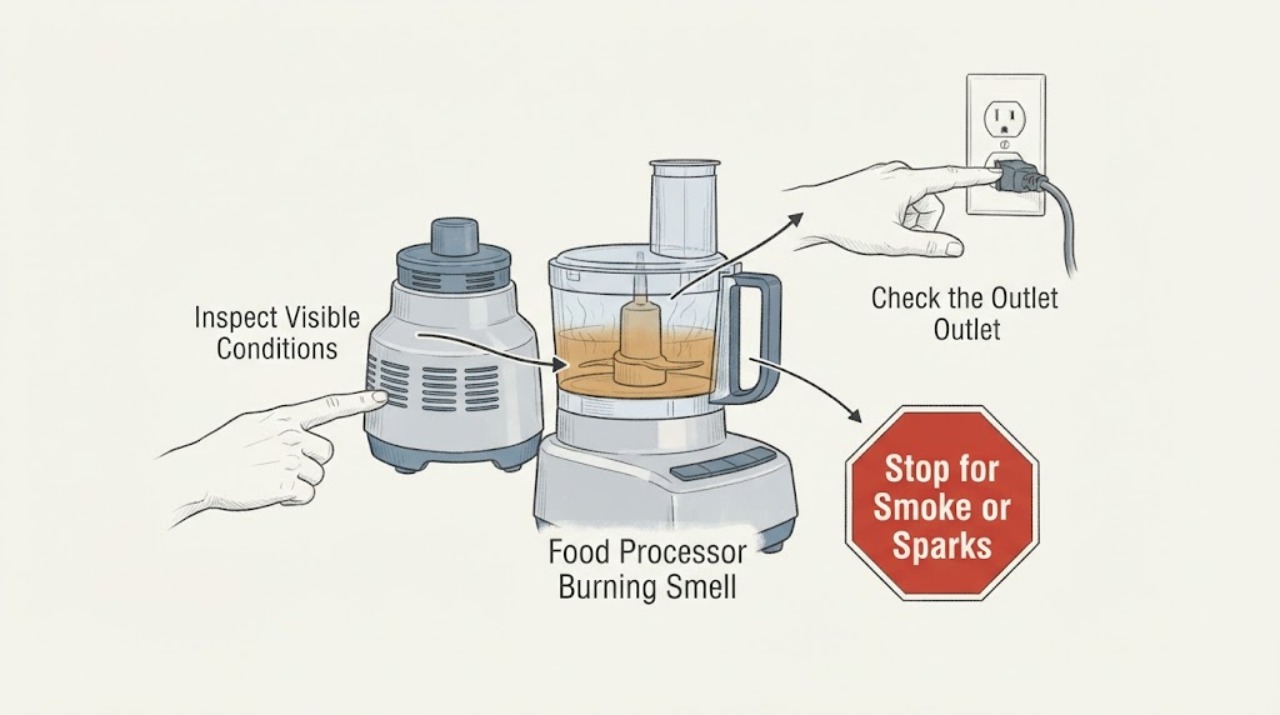
A strong burning smell or any visible smoke from a food processor is a stop condition: turn it off, unplug it when safe, and do not run it again to “test” the motor. A Hamilton Beach food-processor manual distinguishes a slight odor during initial use from strong odor or smoke, for which it says to unplug immediately and contact service; it also documents overload protection for its own model. Because no brand or model was supplied, do not copy another processor’s cool-down time, maximum load or part diagnosis. After the unit is fully unplugged and cool, check only the removable bowl/lid/blade area, visible food residue, cord and outlet for an obvious external cause. Persistent odor, repeated overheating, discoloration, electrical smell or smoke needs the exact manual/manufacturer or qualified service route.
Before you begin
Safety first
- Do not reopen or energize a smoking appliance, put hands near blades, remove the motor housing, probe live wiring, bypass lid interlocks or replace a guessed motor, capacitor, switch or thermal protector. Disconnect the plug only when safe; have a qualified electrician inspect a hot, wet, loose or scorched outlet/cord.
Work through in order
Diagnostic checks
Use only checks that match the exact appliance or system and its official guide.
-
Check 1
At the first sign of a strong burning smell, visible smoke, sparks, melted plastic or a hot/damaged cord, press Off if it is safe to do so and unplug the food processor. Keep hands away from the blade and do not restart it to reproduce the smell.
Expected result: The odor is mild and limited to initial use with no smoke, or there is strong/recurrent odor, smoke, heat, discoloration or electrical evidence.
Next step: For any strong/recurrent or smoke event, keep the processor unplugged and arrange manufacturer or qualified service. If the odor was mild first-use only, continue only with the exact model manual’s limits and monitoring.
Why this matters
Why: Hamilton Beach’s official manual allows that a slight initial-use odor may come from manufacturing residue but treats strong odor or visible smoke as an immediate unplug/service condition. The symptom does not identify a failed motor or wiring part.
-
Check 2
With the plug removed and the unit cool, inspect the removable bowl, lid, feed tube, blade/disc, drive adapter and visible base exterior. Look for trapped food, a jam, melted material, scorching, unusual residue or a part that is rubbing; do not remove the motor housing or touch sharp edges.
Expected result: A removable part or visible residue is damaged/blocked, or the visible assembly is clean and intact.
Next step: Clean or replace only parts and procedures allowed by the exact manual, with the base kept dry. If there is melting, scorching, a damaged blade/shaft or no obvious cause, stop and request service.
Why this matters
Why: A visible food blockage or damaged removable part can explain resistance or odor, but a clean exterior does not rule in a motor or control failure. KitchenAid’s guidance limits cleaning to unplugged, user-accessible parts and the outside of the base.
-
Check 3
Inspect the plug, cord and wall outlet from outside the appliance for heat, scorch marks, looseness, moisture or damage. Do not use a power strip, extension cord or a questionable outlet to run another test.
Expected result: The supply path is damaged/hot/discolored, or the external cord and outlet look normal.
Next step: If the cord, plug or outlet is hot, wet, loose or scorched, leave it disconnected and have the supply checked by a qualified electrician or appliance service. If it looks normal but the odor recurs, do not perform repeated tests.
Why this matters
Why: An electrical supply problem can create a burning smell independently of the food processor, while a normal-looking outlet does not prove the appliance base is safe.
-
Check 4
Review the exact owner’s manual for the food quantity, speed, maximum continuous run time and overload-protection procedure. Compare the event with the actual load and duration without powering the unit again; do not copy another brand’s 15-minute or 30-minute cool-down instruction.
Expected result: The unit was processing a dense/large load or for a long period, the manual documents an overload procedure, or the event occurred under a light load/short run.
Next step: If the exact manual explicitly permits a cool-down observation and there was no smoke, follow only that manual. For light-load/recurrent odor, any smoke, or unclear instructions, leave the unit unplugged and use service.
Why this matters
Why: Overload protection and operating limits differ by model. Hamilton Beach documents a model-specific overload cool-down and processing-size guidance, but that does not diagnose an unidentified processor or authorize a restart after smoke.
-
Check 5
Record the model label, first-use status, food/load, speed, run duration, whether the bowl/lid locked, where the smell seemed to come from, and whether there was smoke, heat, noise or loss of power. Give this record to the manufacturer or technician instead of naming a part.
Expected result: The odor was one-time and mild with no other symptom, or it returned/was accompanied by smoke, unusual sound, slowing, tripping or visible damage.
Next step: Monitor only within the exact manual’s limits if the manufacturer confirms the mild first-use case. Otherwise keep the processor unplugged and request qualified service; do not replace a guessed motor or thermal device.
Why this matters
Why: A one-time mild first-use odor can fall within some manufacturer guidance, but recurrence or additional electrical/mechanical symptoms moves the issue outside a safe user-level diagnosis.
Use your observations
Decision map
Find the observation that best matches what you see, then follow the next safe action.
-
PATH 01Next step
What you see
The odor was mild, occurred only during the first few uses, and there was no smoke, heat, discoloration or power abnormality.
Do this next
Check the exact manual and monitor only within its stated limits. Stop immediately if the odor becomes strong, returns after the initial period or smoke appears.
Why this path and its safety boundary
Why it matters: Hamilton Beach documents a slight initial-use odor from manufacturing residue for its own food processor; that is an example, not proof that every model behaves the same way.
-
PATH 02Next step
What you see
A strong burning smell, visible smoke, melting, scorching, sparks or a hot/damaged cord occurred.
Do this next
Keep the processor unplugged, disconnect the supply only if safe, and contact the manufacturer or qualified service. Do not restart or open the motor base.
Why this path and its safety boundary
Why it matters: This is outside a mild first-use observation and is a fire/electrical stop condition; the symptom does not identify which internal part failed.
-
PATH 03Next step
What you see
The smell appeared after a dense load or long run, the processor stopped, and there was no smoke or visible damage.
Do this next
Use the exact model manual before any restart. If its instructions are missing, the smell recurs or the processor slows/gets hot, leave it unplugged and arrange service.
Why this path and its safety boundary
Why it matters: Some processors use overload protection; Hamilton Beach documents a 15-minute cool-down on one model, but the time and restart rules are not universal.
-
PATH 04Next step
What you see
The removable bowl, lid, blade/disc or visible drive area contains a jam, stuck residue or melted material.
Do this next
With power disconnected, clean or replace only the user-accessible item allowed by the exact manual. Do not force the blade or dismantle the base; request service if damage or odor remains.
Why this path and its safety boundary
Why it matters: The obstruction or damage may have increased resistance, but an external observation cannot establish the condition of the motor, shaft or thermal protection.
-
PATH 05Next step
What you see
The external parts and supply look normal, but the burning smell returns during a light load or short run, or the unit makes an unusual sound or trips power.
Do this next
Stop using the processor, keep it unplugged and provide the model, load and symptom record to service. Do not order a motor, switch or thermal protector by appearance.
Why this path and its safety boundary
Why it matters: The documented external checks do not support a safe component diagnosis; recurring odor under light use needs manufacturer or qualified service.
Helpful context
Understand the symptom
Stop first when the smell is strong or smoke is visible
A food processor can produce a mild new-appliance odor in some manufacturer documentation, but a strong burning smell, visible smoke, sparks, melted plastic or a hot cord changes the decision. The Hamilton Beach manual opened for this research says to unplug immediately and contact customer service for strong odor or visible smoke. That is a conservative safety boundary for an unidentified processor: do not keep pulsing it to learn whether the smell returns and do not assume the motor is the failed part.
Inspect only after power is disconnected
Once the plug is removed and the base is cool, look at the outside of the cord, plug, outlet, bowl, lid, blade/disc and visible drive area for food residue, melted plastic, discoloration or an obvious jam. KitchenAid’s official food-processor care guidance says to unplug before removing parts, wipe the base and cord with a warm damp cloth, dry them and never immerse the base or cord. Do not open the motor housing or reach into a blade assembly.
Do not transfer a timer or part diagnosis from another model
The task has no manufacturer, model number, voltage or processing load. Hamilton Beach documents a 15-minute cool-down for overload protection on one specific processor, while other designs may use different limits or no user-reset procedure. Treat that as an example of why the exact manual matters, not as a universal fix. If the smell recurs after a documented external check, use the manufacturer’s support route or qualified service rather than ordering a guessed motor, switch or thermal part.
When checks do not resolve it
Need a professional?
Arrange manufacturer or qualified appliance service for any visible smoke, strong/recurrent burning smell, melted or scorched plastic, hot/damaged cord or plug, repeated overheating, power trips, unusual grinding, or odor during a light load. Provide the model/serial label, voltage information, load, speed, run duration and whether the odor began on first use.
Safety scope: Do not reopen or energize a smoking appliance, put hands near blades, remove the motor housing, probe live wiring, bypass lid interlocks or replace a guessed motor, capacitor, switch or thermal protector. Disconnect the plug only when safe; have a qualified electrician inspect a hot, wet, loose or scorched outlet/cord.
Common questions
FAQ
Can a new food processor have a burning smell?
Some manufacturer manuals, including Hamilton Beach’s, say a slight odor during initial use may come from manufacturing residue. That exception is narrow: strong odor or any visible smoke requires immediate unplugging and service, and your own model manual controls the decision.
Should I keep running the processor until the smell goes away?
No if the smell is strong, recurrent or accompanied by smoke, heat, discoloration or electrical symptoms. Unplug it and stop. Do not use another model’s cool-down time or restart instruction without the exact manual.
What can I safely inspect?
After unplugging and cooling, inspect only removable bowl/lid/blade parts and the outside of the cord, plug, outlet and base. KitchenAid says to unplug before disassembly, wipe the base and cord, dry them and never immerse the base or cord.
Does a burning smell prove the motor is bad?
No. The smell may relate to first-use residue, an overload, a jam, an electrical supply issue or an internal fault. Without a brand/model manual and safe service test, do not name or order a motor, switch or thermal part.
Read the exact guide
Official sources
- Cleaning the Food Processor - Product HelpKitchenAid · This is official KitchenAid food-processor care guidance for a specified family/model size, not proof about the unidentified appliance’s internal design. It is used only for the low-risk principle to unplug before disassembly, keep the base/cord dry and use model-specific cleaning rules.
- Hamilton Beach Stack & Snap Food Processor (70820) - Use & CareHamilton Beach Brands, Inc. · This is an official manufacturer manual for one Hamilton Beach model, not the unidentified task appliance. It is used as a conservative manufacturer example for the distinction between mild initial-use odor and strong odor/smoke, and to show why overload timing and load limits must not be transferred across models.
Community feedback
Share a repair observation
Share a plain-text repair observation. Accepted observations are published automatically; this page may take a moment to update.