
On this page
Start here
Quick answer
Start by naming the behavior: does the Frigidaire dryer not start at all, start and stop, tumble without heat, or run but leave clothes damp? For a no-start condition, confirm the start control, cycle position, fully closed door, plug, and breaker or fuse. For poor drying, check the cycle and temperature, load size, lint screen, moisture-sensor condition, ventilation, and exhaust path. Do not use an extension cord, operate a gas dryer without an outdoor exhaust, or keep resetting a breaker. If the dryer stops again, stays cold, overheats, smells burnt, shows damage, or remains abnormal after these external checks, leave it off and arrange qualified service.
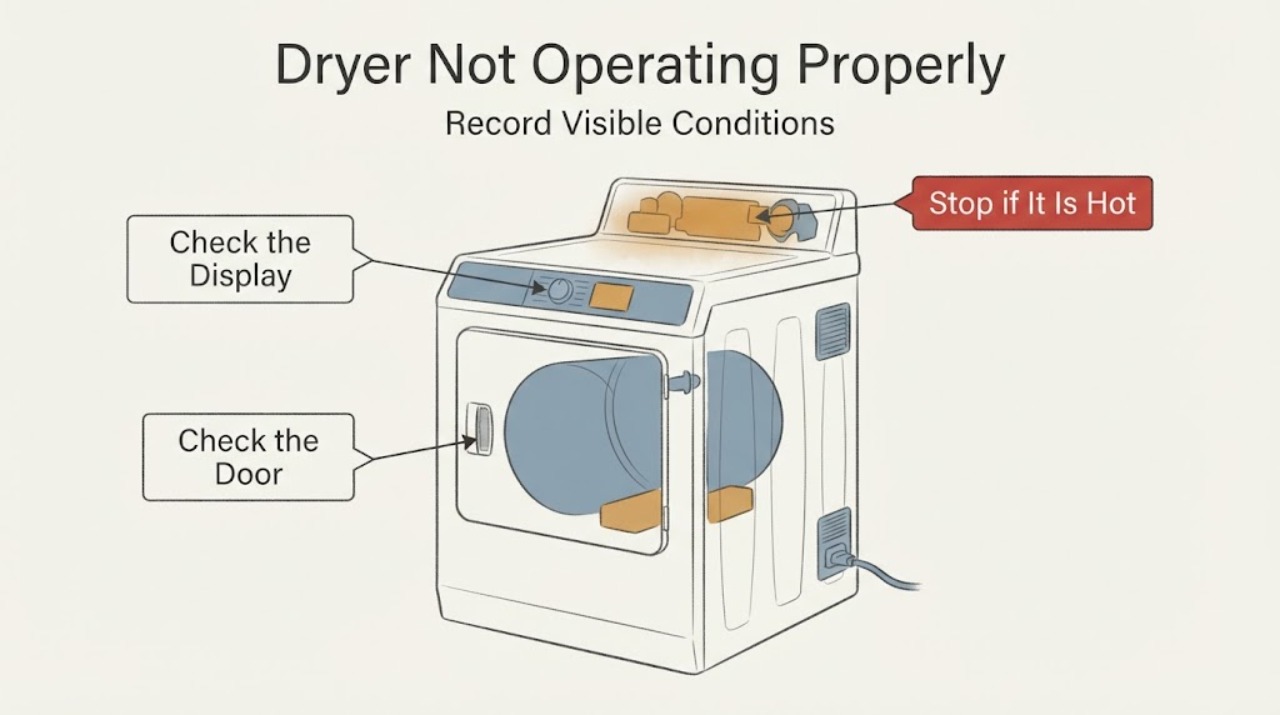
Work through in order
Diagnostic checks
Use only checks that match the exact appliance or system and its official guide.
-
Check 1
Record the exact Frigidaire model and classify the symptom before changing settings: no start, starts then stops, tumbles with no heat, takes too long, leaves clothes damp, shows a code, or makes an unusual sound.
Expected result: The display is dark or active, the drum turns or does not turn, heat is present or absent, and the behavior is tied to one cycle or all cycles.
Next step: Follow the no-start branch for a dead or non-starting dryer, the drying branch for heat or moisture problems, and the stop or hazard branch for a recurring interruption or unsafe symptom.
Stop if: Do not run another cycle if there is smoke, a burning smell, sparking, a hot or damaged cord, water near electrical parts, or a repeated breaker trip.
Why this matters
Why: Frigidaire maintains separate support paths for starting and drying performance. The observed pattern determines which external check is relevant and prevents a generic replacement decision from hiding the actual fault.
-
Check 2
For a no-start condition, verify that the start control is engaged as the model requires, the selector is fully at a cycle, the door closes completely, the plug fits firmly, and the household breaker or fuse is normal.
Expected result: The cycle starts after one control or door correction, the outlet or protective device is faulty, or the dryer remains inactive with normal household power.
Next step: If the dryer remains inactive after the external checks, leave it off and arrange qualified appliance service. Have a qualified electrician correct an overloaded circuit or a breaker that will not hold.
Stop if: Do not use an extension cord, increase a fuse rating, remove panels, or keep resetting a protective device that opens again.
Why this matters
Why: Frigidaire lists start-control timing, selector position, door closure, plug connection, fuse, and breaker conditions as possible causes of a dryer that does not start.
-
Check 3
For a dryer that tumbles but seems cold or dries poorly, check the cycle and temperature setting, clean the lint screen and reinstall it, and inspect the accessible exhaust hood and duct for an obvious restriction. If it is a gas dryer, confirm that the exhaust vents outdoors and do not operate it without that duct.
Expected result: The dryer was in a no-heat setting, the lint screen or exhaust is restricted, the air is warm with weak airflow, or the visible path is clear but drying remains poor.
Next step: Correct only an obvious user-accessible issue and run one supervised cycle with a suitable load. If heat or airflow remains abnormal, stop and arrange service.
Stop if: Do not operate a gas dryer without outdoor exhaust, bypass a vent or guard, or dismantle the exhaust or cabinet to reach internal parts.
Why this matters
Why: Frigidaire says Air Fluff can tumble without heat and identifies lint, ventilation, exhaust, and gas-dryer venting as drying-performance factors. A clear visible path does not prove that an internal heater, fan, sensor, or duct is sound.
-
Check 4
Check the load and sensing conditions without exceeding the exact model's capacity: use items with similar fabric weight, leave room for tumbling, and inspect the accessible moisture-sensor bars for residue as the owner's guide permits.
Expected result: The load is tightly packed or unusually small, fabrics are mixed, sensor bars have residue, or a correctly sized load still stops or stays damp.
Next step: Use one suitable load and a documented cycle. If the dryer still stops or leaves clothes damp, preserve the settings and arrange qualified service instead of adding heat or time blindly.
Stop if: Do not exceed the drying limit, operate without the lint screen, or clean a sensor or interior component in a way the manual does not authorize.
Why this matters
Why: Frigidaire says loads that are too big or too small can extend drying and that residue on moisture sensors can interfere with wetness detection. These checks can explain a timing or dryness result but do not prove an internal sensor fault.
-
Check 5
If the dryer starts and later stops, record the elapsed time, load, heat, airflow, display, and whether it restarts only after cooling. Perform at most one model-approved supervised retest after the appliance is cool and the accessible checks are complete.
Expected result: The dryer completes with a suitable load, stops again at a similar time, runs cold, becomes unusually hot, or shows a warning.
Next step: For any repeat stop or abnormal temperature, leave the dryer off and provide the complete model and observations to qualified appliance service. Do not choose a replacement part or appliance solely from this broad symptom.
Stop if: Stop immediately for smoke, burning odor, scorching, sparks, a damaged cord, severe vibration, water exposure, or a repeated breaker trip.
Why this matters
Why: A repeatable stop or a temperature-dependent result is outside a simple start-button or load-setting correction. The symptom may involve a thermal limiter, motor, heater, sensor, control, door, or airflow path, but the exact part cannot be identified from timing alone.
Use your observations
Decision map
Find the observation that best matches what you see, then follow the next safe action.
-
PATH 01Next step
What you see
The Frigidaire dryer does not start, but the door is fully closed, the selector and start control are correct, the plug is secure, and the household power check is normal.
Do this next
Leave the dryer off and arrange qualified appliance service. Provide the full model, display state, door response, and the result of the outlet and breaker or fuse check.
Why this path and its safety boundary
Why it matters: The basic user-accessible start conditions are present, so the broad symptom cannot identify whether the door switch, control, motor, wiring, or another internal component is involved.
-
PATH 02Next step
What you see
The dryer tumbles but produces no heat or takes unusually long, and the cycle, load, lint screen, moisture-sensor area, ventilation, and accessible exhaust path are appropriate.
Do this next
Stop repeated cycles and arrange qualified Frigidaire service. For a gas model, keep the outdoor exhaust requirement intact and do not open the burner or heater area.
Why this path and its safety boundary
Why it matters: The user-level drying conditions do not explain the result. A heater, supply, airflow, sensor, or control problem may remain, and the exact appliance type and model determine the safe service path.
-
PATH 03Next step
What you see
The dryer starts, then stops again after warming up or after a similar elapsed time, even with a suitable load and no visible exhaust restriction.
Do this next
Leave the dryer off and give service the timing, load, heat, airflow, display, and cool-down observations. Do not repeatedly restart it to force a complete cycle.
Why this path and its safety boundary
Why it matters: A recurring mid-cycle stop is not established as a normal setting. It may reflect a thermal, motor, door, control, or airflow condition that needs model-specific diagnosis.
-
PATH 04Next step
What you see
Smoke, burning odor, scorching, sparks, a hot or damaged cord, water near electrical parts, severe vibration, or a breaker that trips again accompanies the operating problem.
Do this next
Stop the cycle and isolate power only from a dry, safe external position if possible. Keep the dryer out of service and arrange qualified appliance or electrical help; use local emergency procedures for active smoke or fire.
Why this path and its safety boundary
Why it matters: This is an electrical, fire, equipment-damage, or installation safety boundary rather than a routine operating diagnosis.
Helpful context
Understand the symptom
Define what 'not operating properly' means
A dryer that never starts needs a different first check from one that tumbles without heat or stops after running for a while. Record whether the display lights, whether the drum moves, whether air is warm, whether the door-lock or door-closed state changes, whether a code appears, and whether the problem happens with every cycle or only one setting. Frigidaire's support area separates these operating, heating, drying, and noise symptoms, so a repair decision should follow the observed behavior rather than the age of the appliance alone.
For a dryer that will not start
Frigidaire says the start control may need to be pressed or turned long enough to engage, the selector may need to be moved fully into a cycle, and the door must be completely closed. Check that the plug is firmly connected and that a household fuse or breaker has not opened. Do not use an extension cord or increase a fuse rating. If the breaker opens again, leave the dryer off and have the circuit checked by a qualified electrician.
For a dryer that runs but does not dry correctly
Frigidaire says an Air Fluff or other no-heat selection can tumble without heat, and that loads that are too large or too small, residue on moisture-sensor bars, poor ventilation, or a restricted exhaust can extend drying. Clean and replace the lint screen as directed, check only the accessible exhaust path, and use a suitable load and setting. A gas dryer must have an exhaust duct that vents outdoors. Do not open the cabinet to test the heater, motor, sensor, or wiring.
When a mid-cycle stop is a service symptom
A dryer that stops after it has warmed up may have a load, airflow, door, control, or thermal condition, but the broad symptom does not identify one failed part. Allow the appliance to cool only if the exact model guidance permits a cool-down check, then use one correctly sized load and a documented cycle. If it stops again, remains cold, becomes unusually hot, or produces an odor or noise, stop testing and give the technician the timing and conditions. Do not turn a repair-versus-replace decision into a parts guess.
When checks do not resolve it
Need a professional?
Arrange qualified Frigidaire appliance service when the dryer will not start after the external checks, repeatedly stops, remains cold, dries poorly after the accessible airflow and load checks, or needs internal diagnosis. Use a qualified electrician for a faulty or overloaded circuit. Stop immediately for smoke, burning odor, scorching, sparks, damaged wiring or cord, water near electrical parts, severe vibration, or a repeated breaker trip. Do not open the cabinet, bypass a door or thermal safety, or select a replacement part or appliance from the broad symptom alone.
Common questions
FAQ
Why is my Frigidaire dryer not operating properly?
First identify whether it will not start, stops during a cycle, tumbles without heat, or leaves clothes damp. Frigidaire gives different checks for start controls, door and power conditions versus cycle, load, lint, sensor, ventilation, and exhaust conditions. A recurring or unsafe symptom needs service rather than a generic replacement decision.
What should I check if my Frigidaire dryer will not start?
Confirm the start control is engaged as required, the selector is fully in a cycle, the door is completely closed, the plug is secure, and the household fuse or breaker is normal. Do not use an extension cord or repeatedly reset a breaker. If it remains inactive, arrange qualified service.
What if the Frigidaire dryer runs but does not dry?
Check that a no-heat setting such as Air Fluff was not selected, clean and replace the lint screen, use a suitable load, inspect the moisture-sensor area as the manual permits, and check ventilation and the accessible exhaust path. Never operate a gas dryer without an outdoor exhaust duct. Persistent no-heat or poor drying needs service.
Read the exact guide
Official sources
- Support for DryersFrigidaire Owner Support · Opened official Frigidaire dryer support index; it lists separate articles for starting, heating, drying, codes, noises, and stopping, supporting symptom-specific routing rather than generic replacement advice.
- What should I do if my dryer does not start?Frigidaire Owner Support · Opened official Frigidaire dryer support guidance for a dryer that does not start; model-specific manuals control different controls or procedures.
- Dryer - Not Drying and Extended Drying TimeFrigidaire Owner Support · Opened official Frigidaire guidance for poor or extended drying; it supports symptom-level external checks and does not identify an internal part for an unspecified model.
Community feedback
Share a repair observation
Share a plain-text repair observation. Accepted observations are published automatically; this page may take a moment to update.