
On this page
Start here
Quick answer
Start by separating a true long-dry problem from a cycle or load choice. Frigidaire recommends cleaning the lint screen, checking the selected cycle and temperature, using a suitable load size and fabric mix, inspecting the moisture-sensor bars for residue, and checking the exhaust duct and hood for restrictions. A dryer installed in a closet or under a counter may lack ventilation, and a gas dryer must not be operated without an exhaust duct venting outdoors. Record whether the clothes remain damp, whether the drum tumbles and heats, and whether the change began suddenly. Stop for smoke, a burning smell, unusual heat, sparks, a hot connection, or repeated breaker trips. If the vent, load, cycle, and accessible sensor checks do not resolve the longer time, request authorized Frigidaire service rather than opening the cabinet or guessing at a heater, sensor, motor, or control part.
Before you begin
Safety first
- Keep the dryer off for smoke, burning odor, scorching, unusual heat, sparks, a damaged connection, repeated breaker trips, or operation without required gas exhaust. Do not open the cabinet, bypass thermal protection, or keep running comparative tests.
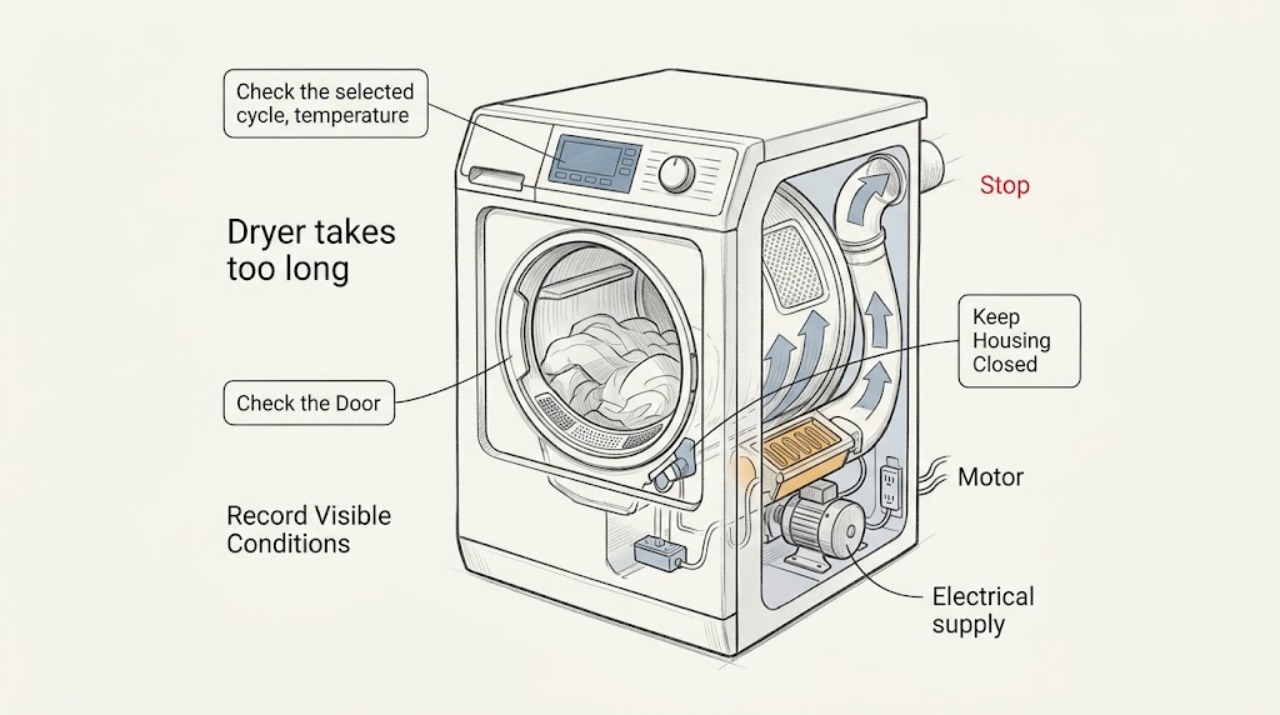
Work through in order
Diagnostic checks
Use only checks that match the exact appliance or system and its official guide.
-
Check 1
Run no further test until you record whether the dryer tumbles, heats, displays an error, stops, or simply takes longer. Note whether clothes are damp or dry at the end and look from a safe position for smoke, burning odor, unusual heat, sparks, a hot connection, or a repeatedly opening breaker.
Expected result: The dryer is unusually hot or smoky, has an electrical sign, stops during operation, tumbles with little heat, or completes with clothes dry but more slowly.
Next step: For any safety sign, keep the dryer off and obtain qualified help. Otherwise record the exact result and continue with cool, manual-directed checks.
Why this matters
Why: Smoke, burning, abnormal heat, and electrical signs are safety conditions. A no-heat or stop symptom follows a heating or motor branch, while dry clothes after a longer cycle keep load, airflow, humidity, and cycle settings in focus.
-
Check 2
Check the selected cycle, temperature, and load without changing the appliance internals. Compare the load with the model guidance: note whether it is too large, too small, tightly packed, mostly one heavy item, or mixed fabrics that may dry at different rates.
Expected result: Air Fluff or another no-heat setting is selected, the load is too large or too small, items cannot tumble freely, fabrics are mixed, or the cycle and load are appropriate.
Next step: Use a suitable cycle and load only on a future attempt when no safety sign exists. If the same long time persists with an appropriate load, continue to the accessible airflow and sensor checks and then request service if unresolved.
Why this matters
Why: Frigidaire says cycle choice, load size, fabric mix, and room to tumble affect drying time. A suitable cycle and load with persistent long drying make airflow, sensing, heating, or service causes more plausible.
-
Check 3
With the dryer cool and off, remove and clean the lint screen exactly as the owner manual describes, and inspect the visible exhaust duct and hood for bends, crushing, lint, debris, or a blocked flap. Do not run the dryer without its required lint screen or, for a gas model, without an outdoor exhaust duct.
Expected result: The lint screen has residue, the exhaust route is restricted or disconnected, the hood is blocked, the dryer is in a tight installation with poor clearance, or the visible airflow path is clear.
Next step: Correct only a visible, manual-documented maintenance or routing issue. Have an authorized service provider clean an inaccessible duct or diagnose recurring long drying; do not improvise vent fittings.
Why this matters
Why: Frigidaire connects lint, restricted exhaust, and inadequate ventilation with longer drying. A clear visible path does not prove the internal blower or duct is clear, and a gas dryer without outdoor exhaust is unsafe to operate.
-
Check 4
When the drum is cool and empty, inspect the model-documented moisture-sensor bars for fabric-softener or other residue and check whether the cycle uses automatic sensing. Clean accessible sensor surfaces only as the exact manual directs; do not open the cabinet or substitute a different sensor location.
Expected result: Sensor bars are coated, the dryer is using a sensor cycle with a very small or already nearly dry load, the cycle is timed, or the sensor area and load conditions appear normal.
Next step: Follow the model's accessible sensor-care guidance and use a suitable load. If the dryer still takes too long or leaves clothes damp, stop user-level testing and arrange service.
Why this matters
Why: Frigidaire says residue can inhibit moisture sensing and that load and cycle conditions affect drying duration. A clean sensor path with a repeatable long cycle points away from a simple sensor-surface issue.
-
Check 5
Check the installation environment without moving the appliance or removing covers: note whether it is in a closet or under a counter, whether the room is unusually humid, whether the exhaust terminates outdoors, and whether the dryer has recently changed from normal performance. Do not operate a gas dryer without its required outdoor exhaust.
Expected result: The installation has limited ventilation, humidity is high, the exhaust is not outdoors or is blocked, the installation recently changed, or the environment appears suitable.
Next step: Use only the exact installation instructions to correct a visible placement or vent issue. For a gas exhaust problem, stop operation until corrected. Request qualified service when the installation is suitable but performance remains poor.
Why this matters
Why: Frigidaire identifies inadequate ventilation and humidity as factors that can extend drying; the exhaust arrangement is also a safety requirement for gas models. A suitable installation with sudden worsening keeps appliance faults in focus.
-
Check 6
If the dryer stops, loses heat, or shuts down before the expected end, copy any error code or indicator exactly and record whether the motor area was hot, the drum stopped, or a breaker opened. Do not open the cabinet, bypass thermal protection, or perform an energized test.
Expected result: The dryer stops after heating, the motor seems overheated, a thermal or power indicator appears, the breaker trips, or no code appears but long drying repeats.
Next step: Keep the dryer off for overheating, repeated trips, or damage and arrange qualified appliance or electrical service. Provide the exact model, code, cycle, load, airflow findings, and stop history.
Why this matters
Why: Frigidaire identifies motor overheating and thermal-limiter activation as possible stopped-operation conditions. A power or thermal symptom needs professional diagnosis; a no-code recurring long cycle after airflow and load checks may involve heating, sensing, or controls.
Use your observations
Decision map
Find the observation that best matches what you see, then follow the next safe action.
-
PATH 01Next step
What you see
The lint screen, exhaust duct, hood, or installation airflow is visibly restricted, or the dryer is in a poorly ventilated location.
Do this next
Perform only manual-directed accessible cleaning or routing correction. Do not operate a gas dryer without outdoor exhaust; use an authorized service provider for inaccessible duct work or a recurring symptom.
Why this path and its safety boundary
Why it matters: Restricted airflow or ventilation is a leading user-checkable explanation for extended drying, but a visible fix does not rule out an internal blower, heater, or control fault.
-
PATH 02Next step
What you see
The load is too large or too small, cannot tumble freely, contains mixed heavy fabrics, or uses a cycle or temperature that does not match the load.
Do this next
Use a suitable load and documented cycle on a later attempt only if no safety sign exists. If the dryer remains slow with a suitable load, continue toward service rather than continually changing loads.
Why this path and its safety boundary
Why it matters: Frigidaire says load size, fabric mix, available tumbling room, and settings affect drying time and can make a healthy dryer appear slow.
-
PATH 03Next step
What you see
The dryer tumbles and heats but an automatic cycle ends or changes timing with damp clothes, and sensor bars have residue or the load is unusually small or nearly dry.
Do this next
Clean accessible sensor surfaces only per the exact manual and use a suitable load. Request service if long drying or damp results recur with clean sensors and correct conditions.
Why this path and its safety boundary
Why it matters: Moisture sensing and load conditions may be affecting the automatic decision; Frigidaire notes that sensor residue can interfere with sensing.
-
PATH 04Next step
What you see
The dryer stops after becoming hot, loses heat, shows a code, opens the breaker, or repeatedly stops despite suitable load and clear accessible airflow.
Do this next
Keep the dryer off for overheating, electrical signs, or repeated trips and arrange qualified appliance or electrical service. Do not bypass protection or open the cabinet.
Why this path and its safety boundary
Why it matters: Motor overheating, thermal protection, power, heating, or control faults become more plausible than a simple load choice; Frigidaire directs persistent stopped operation to authorized service.
-
PATH 05Next step
What you see
The load, cycle, sensor surfaces, ventilation, and accessible exhaust path are appropriate, but drying remains consistently slow or suddenly worsened.
Do this next
Request authorized Frigidaire service with the exact model, cycle, load, drying result, elapsed behavior, temperature observations, and all user-level checks. Stop repeated testing if performance is worsening.
Why this path and its safety boundary
Why it matters: An internal heating, airflow, motor, sensor, control, or supply fault is possible, and the symptom cannot safely identify a part.
Helpful context
Understand the symptom
Measure the change before choosing a cause
Long drying can result from restricted airflow, a load that is too large or too small, a cycle or temperature choice, moisture-sensor residue, high room humidity, poor ventilation, or a heating or control fault. Note whether the clothes are damp, whether the drum tumbles, whether heat is present, and whether the change is new. A longer cycle with normal dry results is a different decision from a dryer that runs hot and leaves clothes wet.
Airflow is an accessible first branch
Frigidaire recommends lint-screen and exhaust checks and says a restricted duct can extend drying. Clean only the user-accessible pieces described in the exact owner or installation manual. Do not operate without the required lint screen, attach an unapproved screen at the vent hood, or operate a gas dryer without outdoor exhaust.
Load and sensor behavior can change automatic timing
An overloaded or nearly empty drum, mixed fabrics, high humidity, or residue on the moisture-sensor bars can make an automatic cycle run differently. Frigidaire notes that items need room to tumble and that sensor residue can inhibit sensing. Correct the accessible condition only when the dryer is cool and safe; recurring long cycles with correct conditions need service.
Heat and power faults need a professional boundary
If the dryer tumbles but produces little heat, stops after becoming hot, or has a power interruption, do not infer a single part. Frigidaire lists motor overheating and thermal-limiter activation among possible stopped-operation causes. Internal heating, drive, motor, control, and wiring work should be left to qualified service.
Safety boundary
Stop conditions
- Stop immediately for smoke, a burning smell, scorching, sparks, unusual heat, a hot or damaged plug or outlet, or repeated breaker trips. Keep the dryer off and obtain qualified appliance or electrical help.
- Do not operate without the required lint screen, do not operate a gas dryer without an exhaust duct venting outdoors, and do not attach an unapproved screen over the vent hood.
- Do not open the cabinet, reach near the heater or motor, bypass a door or thermal safety device, alter wiring, or perform an energized electrical test.
- Use the exact Frigidaire owner and installation manuals for cycle, sensor, filter, ventilation, exhaust, and error-code guidance. Stop user-level troubleshooting when long drying persists after accessible checks or the model instructions do not match.
Only after diagnosis
Potential parts
- moisture sensor or sensor-bar assembly
Consider this category only after manual-directed surface care and suitable-load checks, followed by qualified diagnosis of persistent long drying or incorrect automatic decisions.
Sensor assemblies and locations vary by exact Frigidaire model. Confirm the model and diagnosis before selecting a component. - lint filter, exhaust, or vent component
Consider this category only when qualified inspection finds a damaged or model-specific airflow component after visible cleaning and routing checks.
Filter and vent components depend on dryer type and installation. Do not improvise a vent restriction or fit by appearance alone. - heating or temperature-control component
Consider this category only after qualified diagnosis confirms inadequate heat or temperature control rather than load, sensor, or airflow causes.
Heating components can create fire and electrical hazards and are model-specific. Confirm exact fit and professional diagnosis. - motor or thermal-limiter component
Consider this category only when qualified inspection links repeated hot stops, motor overheating, or thermal protection to the model.
Never bypass thermal protection or select a motor by appearance. Confirm the exact model and diagnosis first.
When checks do not resolve it
Need a professional?
Request authorized Frigidaire appliance service when drying remains too long with a suitable load, correct cycle, clean accessible sensor and lint surfaces, and clear documented airflow; when the dryer stops after heating; or when a code or motor symptom returns. Use an authorized service provider for inaccessible exhaust cleaning. Call a qualified electrician for damaged connections, an overloaded circuit, or repeated breaker trips. Treat smoke, burning odor, sparks, or uncontrolled heat as immediate safety issues.
Safety scope: Keep the dryer off for smoke, burning odor, scorching, unusual heat, sparks, a damaged connection, repeated breaker trips, or operation without required gas exhaust. Do not open the cabinet, bypass thermal protection, or keep running comparative tests.
Common questions
FAQ
Why is my Frigidaire dryer taking so long to dry?
Check the cycle and temperature, load size and fabric mix, lint screen, moisture-sensor bars, ventilation, and exhaust duct as the exact manual describes. Frigidaire also notes humidity and installation ventilation. If the dryer still runs long with a suitable load and clear accessible airflow, request service.
Can a full or nearly empty load make drying take longer?
Yes. Frigidaire says a load that is too big or too small can extend drying and that items need room to tumble freely. Use a suitable load only when there is no safety sign; a recurring problem with suitable loads needs diagnosis.
Can a dirty lint screen or vent cause extended drying?
Restricted lint and exhaust paths can affect drying time. Clean the accessible lint screen and inspect the visible exhaust route only as the manual directs. Do not operate without the lint screen or, for a gas dryer, without outdoor exhaust; have inaccessible or recurring restrictions serviced.
Why does an automatic cycle take longer when the sensor bars look dirty?
Frigidaire says fabric-softener residue on moisture-sensor bars can inhibit sensing. With the dryer cool and off, clean accessible sensor surfaces only as the exact manual directs and use a suitable load. Persistent long drying after that check needs service.
When should I call service for a Frigidaire dryer that takes too long?
Call authorized service when correct cycle and load settings, accessible lint and sensor care, and documented exhaust checks do not resolve the longer time, or when the dryer stops after heating, repeatedly trips power, shows a code, or becomes unusually hot. Treat smoke, burning odor, sparks, or a hot connection as immediate safety issues.
Read the exact guide
Official sources
- Dryer - Not Drying and Extended Drying TimeFrigidaire · Frigidaire U.S. manufacturer support article for dryers; exact owner and installation manuals control model-specific maintenance and venting.
- What should I do if my dryer does not start?Frigidaire · Frigidaire U.S. manufacturer support article for dryer start and supply conditions; exact model controls apply.
- What should I do if my dryer stops operating?Frigidaire · Frigidaire U.S. manufacturer support article for dryers; exact model and installation instructions control.
Community feedback
Share a repair observation
Share a plain-text repair observation. Accepted observations are published automatically; this page may take a moment to update.