
On this page
Start here
Quick answer
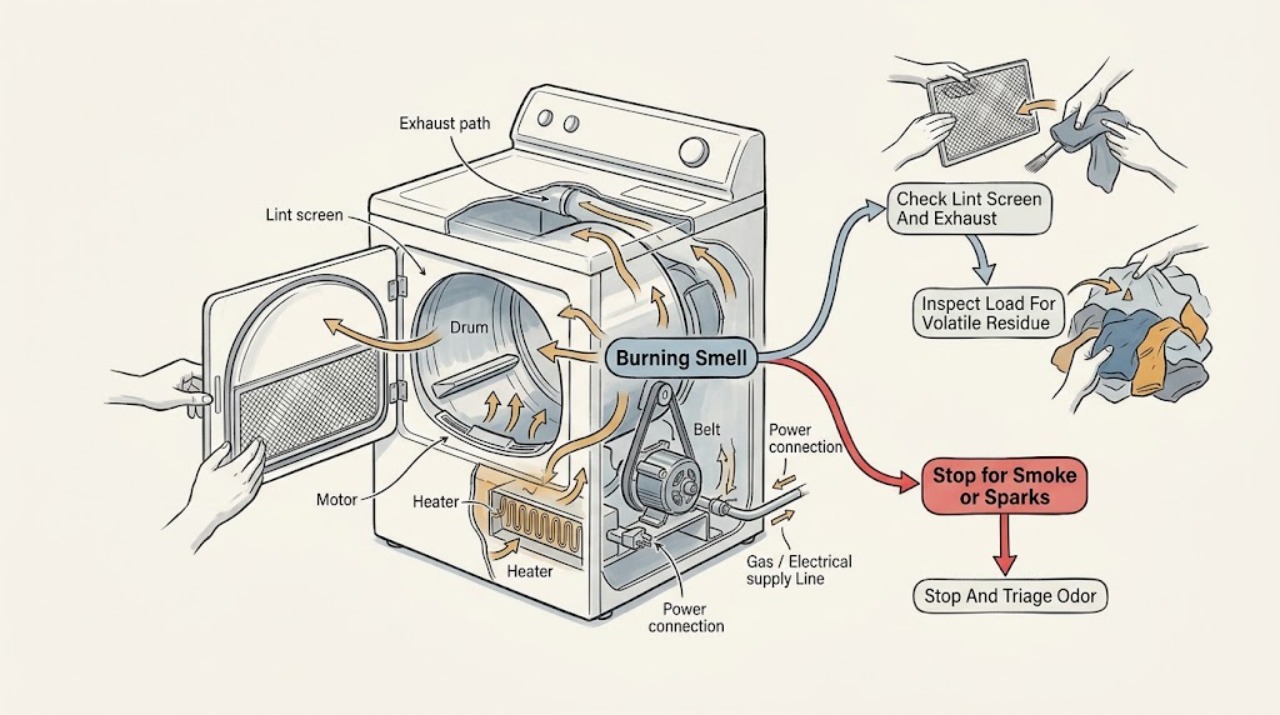
Treat a burning smell from a Frigidaire dryer as a stop-and-check symptom, not as a smell to cover up with another cycle. Turn the dryer off, keep people away from smoke or flames, and disconnect power only through a safe normal disconnect if there is no gas or fire emergency. Once cool, check the lint screen, accessible exhaust path, area behind the dryer, and clothing for lint, restriction, or residue from volatile chemicals; Frigidaire says lint can restrict airflow and recommends qualified cleaning of the cabinet interior and exhaust duct. If the smell is electrical, returns after the accessible checks, comes with smoke, sparks, scorching, a hot cord, a gas odor, or abnormal heat, leave the dryer out of service and arrange qualified service; for active smoke or fire, leave the area and contact emergency services.
Before you begin
Safety first
- This article covers stop-and-triage observation, load removal, ordinary-access lint and exhaust checks, and visible power-connection inspection only. Do not open the cabinet, probe live circuits, reach toward heat or drive parts, operate without the lint screen or exhaust, or restart a dryer with a recurring odor or hazard.
Work through in order
Diagnostic checks
Use only checks that match the exact appliance or system and its official guide.
-
Check 1
Stop the dryer immediately, press Power if it responds, and keep the door and area clear while noting the odor from a safe position; do not touch a hot or damaged cord or operate switches when there is a gas odor.
Expected result: Record whether there is visible smoke or flame, a gas odor, an electrical or melting-plastic smell, scorching, a hot plug or cord, unusual heat, weak airflow, or a smell that is limited to the load.
Next step: For active smoke, fire, or gas odor, leave the area and contact local emergency services according to local guidance. Otherwise disconnect power only through a safe normal disconnect if appropriate, leave the dryer off, and continue only when it is cool and hazard-free.
Stop if: Do not restart for any smoke, flame, gas odor, electrical smell, sparking, scorching, damaged cord, or rapidly worsening heat.
Why this matters
Why: Smoke, gas odor, electrical smell, scorching, or abnormal heat is an emergency or service boundary, not a routine lint check. A load-only odor without appliance heat still requires checking for chemicals or residue before the clothing is dried again.
-
Check 2
Once the dryer and clothing are cool, remove the load and identify any garment or rag exposed to gasoline, cooking oil, cleaning agent, finishing oil, grease, or another volatile chemical; do not return questionable items to the dryer.
Expected result: Record whether the smell follows one item or the whole load, whether there is visible oily residue or scorching, and whether the odor remains in the empty drum after the load is removed.
Next step: Follow the garment-care and CPSC guidance for washing or preferably hanging contaminated items to dry away from heat; arrange service if the empty drum or appliance still smells burned.
Stop if: Do not dry clothing with gasoline, cooking-oil, cleaning-agent, or other volatile-chemical residue, and do not leave potentially ignitable items in the dryer or a hot pile.
Why this matters
Why: CPSC warns that volatile chemicals on clothing can create an ignition risk when heated. An odor that remains without clothing points more toward the dryer, lint, exhaust, power, or an internal component than toward one garment.
-
Check 3
With power off and the dryer cool, clean and fully dry the lint screen, confirm it is seated, and inspect only the accessible exhaust duct, connection, outside hood, and area behind the dryer for lint, crushing, kinks, or blocked airflow.
Expected result: Record whether the lint screen is missing, damaged, wet, or heavily coated; whether the duct is crushed or restricted; whether lint has accumulated behind the dryer; and whether outside exhaust air can escape when the appliance is later serviced or safely operating without the odor.
Next step: Restore a clean, dry, correctly seated screen and have a qualified person clean the cabinet interior or exhaust duct when lint is extensive, the duct is inaccessible, or the smell returns; do not run the dryer without the screen.
Stop if: Do not reach into the cabinet, use the dryer with a missing or damaged screen, disconnect the exhaust and operate the dryer, or keep testing a restricted or overheated exhaust path.
Why this matters
Why: Frigidaire says lint buildup restricts airflow and warns not to operate without the screen; CPSC says lint in the dryer or exhaust duct can block airflow, raise heat, and result in fire. An odor that remains after accessible airflow care needs qualified inspection.
-
Check 4
From outside the appliance, inspect the plug, cord, outlet face, and visible connection for looseness, heat damage, discoloration, or scorching; verify the dryer is directly connected as required and that nothing flammable is piled around it.
Expected result: Record whether the plug fits securely, the cord or outlet is hot or damaged, the circuit breaker has tripped, an extension cord is present, or combustible clutter is touching the dryer or exhaust area.
Next step: Leave power off and arrange a licensed electrician or qualified service when the cord, plug, outlet, breaker, or connection is damaged, loose, hot, or repeatedly trips; clear only ordinary combustible clutter from a cool, safe area.
Stop if: Do not probe the outlet, tighten live terminals, use an extension cord, increase fuse capacity, handle scorched wiring, or keep resetting a breaker.
Why this matters
Why: A damaged or overheated power connection is an electrical service issue, not a lint-cleaning problem. A blocked or cluttered area can worsen heat and airflow conditions; visible damage requires a licensed electrician or qualified appliance professional.
-
Check 5
After the load, lint, exhaust, and visible power checks reveal no hazard, do not perform repeated heat tests; instead document whether the odor disappeared while empty and provide the model and observations to qualified service if it returns.
Expected result: Classify the result as no odor after removing the load and correcting lint, odor only on contaminated clothing, odor that remains with the empty drum, or odor that returns during any safe operation; note unusual noise, drum resistance, weak airflow, smoke, or heat.
Next step: Keep the dryer out of service for any recurring or empty-drum burning smell and request qualified diagnosis; provide the model, odor timing, load history, airflow result, and photos of any visible damage.
Stop if: Do not run repeated cycles, leave the dryer unattended, open the cabinet, or continue when the smell returns, intensifies, or is accompanied by smoke, sparks, scorching, or abnormal heat.
Why this matters
Why: A load-specific odor can point to the clothing, while an empty-drum or recurring appliance odor makes lint inside the cabinet, exhaust, electrical connection, heater, motor, or another internal component more likely. The smell alone cannot identify the failed part.
Use your observations
Decision map
Find the observation that best matches what you see, then follow the next safe action.
-
PATH 01Safety boundary
What you see
The burning smell follows one garment or rag and that item may contain gasoline, cooking oil, cleaning agent, finishing oil, or another volatile chemical.
Do this next
Do not put the item back in the dryer; follow garment-care and CPSC guidance for additional washing or preferably air-drying away from heat, and clean any residue from the drum only by a safe manufacturer-approved method.
Why this path and its safety boundary
Why it matters: The load itself may present an ignition risk when heated, even if the dryer has no visible damage.
Safety stop: Do not heat or leave potentially ignitable items in the dryer or a hot pile, and do not use the dryer if the smell remains after the load is removed.
-
PATH 02Safety boundary
What you see
The lint screen or exhaust path is clogged, crushed, damaged, missing, or surrounded by substantial lint, and the dryer has weak airflow or unusually long drying.
Do this next
Leave the dryer off, clean and dry the screen, arrange qualified duct or cabinet cleaning when needed, and use the appliance only after the complete safe exhaust path is restored.
Why this path and its safety boundary
Why it matters: Restricted airflow can allow heat to build up; CPSC identifies lint blockage as a fire concern, and Frigidaire requires the screen to remain in place.
Safety stop: Do not disconnect the exhaust and run the dryer, operate without a screen, or keep testing a burning smell through a restricted path.
-
PATH 03Safety boundary
What you see
The smell is electrical or melting-plastic, or the plug, cord, outlet, or breaker is hot, loose, discolored, damaged, or repeatedly trips.
Do this next
Leave the dryer off and disconnect power only through a safe normal disconnect; arrange a licensed electrician or qualified appliance technician to inspect the connection and dryer.
Why this path and its safety boundary
Why it matters: The power connection or electrical system may be overheating; this requires electrical or appliance service rather than another dryer cycle.
Safety stop: Do not probe the outlet, handle scorched wiring, use an extension cord, increase fuse capacity, or repeatedly reset the breaker.
-
PATH 04Safety boundary
What you see
The burning smell remains after removing the load and checking the accessible lint and exhaust areas, or returns during a normal load.
Do this next
Stop using the dryer and request qualified Frigidaire appliance diagnosis; provide the model, odor timing, airflow result, and any abnormal sound or heat.
Why this path and its safety boundary
Why it matters: The source may be inside the cabinet or in a heating, motor, drive, or other component; the accessible checks have not established a safe repair.
Safety stop: Do not open the cabinet, lubricate a motor or bearing, reach toward the heater, or continue operating to see whether the odor worsens.
-
PATH 05Safety boundary
What you see
There is a gas odor, visible smoke, a flame outside the normal burner area, or an active fire.
Do this next
Leave the building or area and contact local emergency services according to local guidance; do not operate appliances, electrical switches, or the dryer in a gas-odor situation.
Why this path and its safety boundary
Why it matters: This is an immediate fire or gas-safety emergency, not a dryer maintenance branch.
Safety stop: Do not use a phone in a gas-filled building, re-enter to retrieve items, or attempt to extinguish an appliance fire unless trained and it is safe to do so.
-
PATH 06Safety boundary
What you see
The odor was limited to a questionable load or an accessible lint condition, disappears with the load removed or screen and exhaust safely corrected, and no damage or abnormal heat remains.
Do this next
Keep contaminated items out of the dryer, maintain the clean dry screen and exhaust path, and monitor the next use without leaving the appliance unattended; stop and request service if the smell returns.
Why this path and its safety boundary
Why it matters: The immediate trigger may have been the load or airflow condition, but the result does not prove the interior is free of lint or that an intermittent fault cannot recur.
Safety stop: Do not resume use if any burning smell, smoke, electrical odor, scorching, unusual heat, or abnormal noise returns.
Helpful context
Understand the symptom
Stop first and identify the kind of odor
A burning smell can come from lint or restricted airflow, a garment contaminated with oils or another volatile chemical, an overheating electrical connection, or an internal mechanical or heating fault. It is not possible to identify the source by smell alone. Stop the cycle and record whether there is visible smoke, a hot plug or cord, scorching, a gas odor, unusual heat, reduced airflow, or a new sound before deciding whether any ordinary-access check is safe.
Check lint and ventilation without opening the cabinet
After the dryer is off and cool, clean and fully dry the lint screen and inspect the accessible exhaust connection and outside hood for obvious restriction, crushing, or lint buildup. Frigidaire says not to operate without the lint screen and recommends qualified service personnel for periodic cleaning inside the cabinet and exhaust duct. CPSC likewise warns that lint can block airflow and create excessive heat, so a persistent odor or weak exhaust is not a reason to keep testing.
Keep electrical, gas, and internal-part diagnosis professional
Do not remove the cabinet, reach toward the heater or motor, probe the outlet, or bypass a safety device to locate an odor. If clothing was exposed to gasoline, cooking oil, cleaning agent, or another volatile chemical, follow the CPSC cleaning and drying guidance and do not put contaminated items back into a hot dryer until they are safe. An electrical odor, gas odor, smoke, visible scorching, or a smell that returns after lint and exhaust checks requires qualified service or emergency response rather than another cycle.
Safety boundary
Stop conditions
- Stop immediately for smoke, flame, gas odor, electrical or melting-plastic smell, sparking, scorching, a hot or damaged cord, water near electrical parts, or a repeated breaker trip.
- Do not operate the dryer with a missing, wet, damaged, or clogged lint screen, or with a restricted, crushed, disconnected, or visibly damaged exhaust path.
- Do not heat clothing contaminated with gasoline, cooking oil, cleaning agents, finishing oils, or other volatile chemicals; keep questionable items away from heat until safely cleaned or air-dried.
- Do not open the cabinet, reach toward the heater or motor, probe live electrical parts, bypass a safety device, lubricate internal parts, or handle scorched wiring.
- Do not run repeated cycles to test a recurring or empty-drum burning smell; leave the dryer out of service until qualified diagnosis.
Only after diagnosis
Potential parts
- lint screen or filter assembly
Consider this category only when the exact model's screen is missing, damaged, or cannot be seated and the odor or airflow issue is confirmed safe for a compatible replacement.
Match the complete Frigidaire model and filter configuration; never operate with a missing, damaged, wet, or incorrectly fitted screen. - exhaust duct or vent component
Consider this category only when a qualified inspection confirms a crushed, damaged, or incompatible duct or hood is restricting airflow or collecting lint.
Follow the model installation guide and applicable requirements; restore the complete outdoor exhaust path before using the dryer. - heater, motor, or drive component
Consider this category only after a qualified technician confirms an internal overheating, mechanical, or electrical component as the odor source.
Confirm the complete model, diagnosis, and manufacturer parts information before ordering; do not infer a part from the smell alone. - power cord or terminal connection
Consider this category only when a licensed electrician or qualified technician confirms damaged or incorrectly fitted power hardware as the source.
Match the model and installation requirements; electrical connection work belongs to a qualified professional and must never be improvised.
When checks do not resolve it
Need a professional?
Arrange qualified Frigidaire appliance service when the burning smell remains with the drum empty, returns after the accessible lint and exhaust checks, or is accompanied by unusual noise, abnormal heat, weak airflow, or a warning. Arrange licensed electrical service for a hot, loose, damaged, or discolored cord, plug, outlet, or repeated breaker trip. For gas odor, smoke, flame, or active fire, leave the area and contact local emergency services; do not continue troubleshooting.
Safety scope: This article covers stop-and-triage observation, load removal, ordinary-access lint and exhaust checks, and visible power-connection inspection only. Do not open the cabinet, probe live circuits, reach toward heat or drive parts, operate without the lint screen or exhaust, or restart a dryer with a recurring odor or hazard.
Common questions
FAQ
Can lint cause a burning smell in a Frigidaire dryer?
Lint buildup can restrict airflow and raise heat. Clean and fully dry the lint screen, inspect the accessible exhaust path, and arrange qualified cabinet or duct cleaning when lint is extensive. Do not operate without the screen or keep testing a recurring odor.
What should I do if the burning smell follows one load?
Remove the load and check whether clothing contacted gasoline, cooking oil, cleaning agents, finishing oils, or another volatile chemical. Do not heat questionable items again; follow safe washing or air-drying guidance and request service if the empty dryer still smells burned.
Is a slight burning smell from a Frigidaire dryer normal?
Do not assume it is normal without identifying the source. Stop and check for lint, restricted airflow, contaminated clothing, a hot cord, smoke, scorching, or an electrical or gas odor. A smell that remains with the load removed or returns needs qualified diagnosis.
Can I run my Frigidaire dryer empty to see if the smell goes away?
Do not use repeated heat cycles as a test. After the dryer is cool and the load is removed, a qualified service path is appropriate if the odor remains empty. Stop immediately for smoke, sparks, burning odor, scorching, abnormal heat, or a damaged cord.
When is a Frigidaire dryer burning smell an emergency?
Treat visible smoke, flame, gas odor, electrical smell, sparks, scorching, a hot or damaged cord, or rapidly worsening heat as an emergency or immediate stop condition. Leave the area for active smoke, fire, or gas odor and contact local emergency services according to local guidance.
Read the exact guide
Official sources
- CPSC Publication 5022 - Overheated Clothes Dryers Safety AlertU.S. Consumer Product Safety Commission · Federal consumer-safety guidance for household clothes dryers; the installed manufacturer's instructions and local emergency procedures also apply.
- Laundry Centers - How do I care for and clean my Frigidaire Laundry Center?Frigidaire · Frigidaire owner-support care guidance for laundry centers; the dryer model's manual controls exact access and maintenance details.
- Dryer - Not Drying and Extended Drying TimeFrigidaire · Frigidaire owner-support drying guidance; only the lint, ventilation, and exhaust safety points relevant to odor are used here.
- Appliance and Electrical Fire SafetyU.S. Fire Administration · U.S. Fire Administration household appliance and electrical safety guidance; local electrical codes and emergency procedures also apply.
- What should I do if my dryer does not start?Frigidaire · Frigidaire owner-support start and supply guidance; electrical repairs require a qualified professional.
Community feedback
Share a repair observation
Share a plain-text repair observation. Accepted observations are published automatically; this page may take a moment to update.