
On this page
Start here
Quick answer
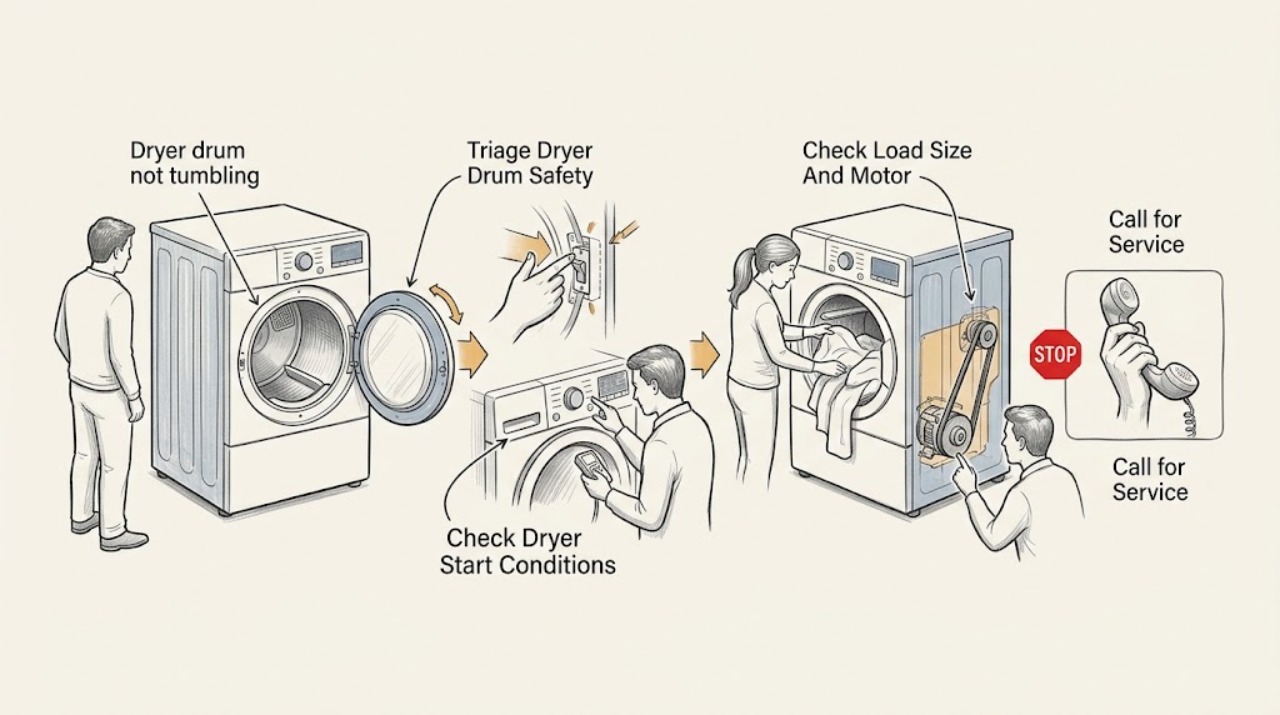
A Frigidaire dryer drum that does not tumble can be stopped by a simple start condition, an overloaded or overheated motor, a thermal limiter, a foreign object, or a drive-system fault. Do not reach into a moving or hot dryer. Stop the cycle, remove laundry only when the drum is stationary and safe, and check the door, cycle selector, Start control, plug, and household supply from outside the cabinet. Frigidaire says an overloaded dryer can overheat the motor; it recommends allowing the motor to cool for 30 minutes and reducing the load, and says an activated thermal limiter requires a service provider. If the drum starts only briefly, hums or clicks without moving, stops with heat or odor, will not start with an empty load, or the breaker trips, stop using the dryer and arrange qualified service. Do not remove panels, reach around the belt or motor, bypass a thermal device, or operate a gas dryer without its exhaust duct.
Before you begin
Safety first
- Owner checks end at safe external start and supply observation, cool load assessment, model-approved motor cooling, visual drum obstruction check, and external lint/exhaust inspection. A qualified professional must handle cabinet or drum access, belt, rollers, motor, thermal limiter, switch, control, wiring, blower, gas, and internal vent work.
Work through in order
Diagnostic checks
Use only checks that match the exact appliance or system and its official guide.
-
Check 1
From a safe position, stop the dryer if it is running and note whether the drum is stationary, hot, smoking, sparking, or accompanied by a burning smell, gas odor, or unusual grinding. Do not open a hot door to reach inside, move the dryer, or touch the drum, lint path, cord, or cabinet if a hazard is present.
Expected result: The drum is cool and stationary with no hazard; the dryer starts and stops; or smoke, sparks, odor, abnormal heat, or gas danger is present.
Next step: For smoke, fire, active arcing, or gas danger, leave the area as appropriate and contact emergency help from a safe location. Otherwise keep the dryer off and continue only after it is cool and hazard-free; do not restart it to reproduce a dangerous symptom.
Stop if: Stop immediately for smoke, flames, sparks, burning odor, gas odor, exposed wiring, a hot cabinet, a breaker that trips, or any need to touch moving or hot parts.
Why this matters
Why: A safe stationary drum allows only external start and load checks. Heat, smoke, sparks, odor, gas danger, or a rapidly stopping drum can indicate fire, combustion, electrical, or overheating risk rather than a simple belt symptom.
-
Check 2
With the door closed and the dryer safe to approach, check from outside that the cycle selector is positioned in a real cycle, the Start or Push-to-Start control is engaged as the model requires, the door is fully closed, and the power cord and household supply appear connected. Do not use an extension cord, change fuse capacity, or open the console.
Expected result: The door is open or misaligned; the selector is between cycles; Start was not held as required; the display is blank; a cord, fuse, or breaker issue is visible; or the dryer starts but the drum remains still.
Next step: Correct only an obvious, safe external setup issue and follow the model manual. If the drum remains still after the documented start sequence, do not repeatedly press Start; continue with the cool-load and obstruction checks or arrange service.
Stop if: Stop if the cord or outlet is hot or damaged, the breaker trips again, the dryer is hardwired and supply is uncertain, the door will not latch, or any check requires panel access or electrical testing.
Why this matters
Why: Frigidaire identifies the door, selector, Start control, plug, fuse, and breaker as reasons a dryer may not start. If the control sequence works but the drum does not move, the issue shifts from a start condition toward load, motor, thermal protection, or drive-system diagnosis.
-
Check 3
When the drum is stationary and safe, remove the load without forcing a jammed drum and assess whether it was tightly packed, unusually heavy, or nearly empty. Leave the dryer off for the Frigidaire-recommended 30-minute motor-cooling period if overheating is suspected, then reduce the load to a normal loose amount; do not restart if there was smoke, odor, abnormal heat, or a thermal-protection symptom.
Expected result: The load was oversized or tightly packed; the dryer was nearly empty; the motor cools and one reduced load tumbles normally; or the drum still will not tumble after cooling and unloading.
Next step: If a safe reduced load restores stable tumbling without heat or odor, follow the model's load guidance and monitor it. If no-load or reduced-load tumbling still fails, or the dryer repeatedly stops, stop using it and request service for the motor, belt, rollers, thermal limiter, or control system.
Stop if: Stop for a hot motor or cabinet, repeated stopping, a thermal-limiter indication, smoke, odor, a jammed drum, or any need to reach behind the drum or motor.
Why this matters
Why: Frigidaire says overloading can overheat the motor and recommends cooling it and reducing load size; its drying guidance also says the drum needs enough room and enough items to tumble freely. A stationary empty or reduced-load drum is not explained by load size alone.
-
Check 4
With power off and the door open, look inside the empty drum for a coin, fastener, garment hardware, or other foreign object that could stop or scrape it. Remove only a loose object that is plainly reachable without reaching through a narrow gap or touching a sharp edge; do not pry, spin a resistant drum, or remove drum baffles, filters, or panels.
Expected result: A loose object is visible; the drum turns freely only when the appliance is safely de-energized and the manual permits that check; the drum resists or binds; or no obstruction is visible.
Next step: Remove only the plainly reachable safe object and leave the dryer off if the drum remains resistant, damaged, or noisy. Arrange qualified service for binding, scraping, repeated noise, or any suspected belt, roller, motor, or drum-support fault.
Stop if: Stop for sharp metal, a trapped object, a damaged baffle, a drum that binds, a hot or energized appliance, or any need to disassemble the drum or cabinet.
Why this matters
Why: Frigidaire identifies foreign objects as a source of dryer drum noise, but an object-free, binding, or resistant drum suggests a mechanical drive or support issue rather than a clothing problem. A visual inspection cannot confirm belt or motor condition.
-
Check 5
From outside the dryer, confirm the lint screen is present and reasonably clear, the external exhaust hood is not visibly blocked, and the duct is not visibly crushed or disconnected. For a gas dryer, never operate it without an exhaust duct venting outdoors; do not remove the duct, reach into the blower, or clean an inaccessible run as a first-line drum test.
Expected result: The lint screen is blocked or missing; the exhaust hood or duct is restricted; the dryer is gas and its exhaust is not safely connected; or the visible airflow path is clear.
Next step: Restore only a safe, model-approved lint-screen or external-vent condition, and do not run the dryer if the gas exhaust is incomplete or restricted. If the drum still does not tumble, arrange qualified appliance or vent service rather than opening the cabinet.
Stop if: Stop for a missing or damaged lint screen, blocked or disconnected gas exhaust, lint near heat, a hot cabinet, gas odor, or any need to disassemble the vent or blower.
Why this matters
Why: Frigidaire warns not to operate without the lint screen and says restricted exhaust can affect dryer operation and drying; it specifically warns of carbon-monoxide risk if a gas dryer lacks an outdoor exhaust duct. A clear external path does not prove the drum drive is sound.
-
Check 6
Prepare a service record with the complete Frigidaire model and serial information, electric or gas type, whether the drum is silent, humming, clicking, or starts then stops, load size, cooling result, door/start/power checks, visible obstruction, lint and exhaust condition, and any odor, heat, error, or breaker event. Do not remove panels or run a risky test for a better video.
Expected result: The drum tumbles normally after a safe start or reduced-load correction; it fails empty or after cooling; it stops repeatedly; or the thermal limiter, belt, motor, roller, control, or supply is suspected.
Next step: Keep the dryer unused for a recurring, no-load, noisy, hot, or unsafe failure and arrange authorized Frigidaire appliance service. Give the technician the record; do not bypass a thermal limiter or replace a drive part from symptoms alone.
Stop if: End owner troubleshooting when diagnosis requires cabinet or drum removal, belt/motor/roller access, thermal-device replacement, electrical measurement, gas work, or internal vent/blower access.
Why this matters
Why: A stable recovery after a documented start or load correction differs from a no-load failure or repeated stop. The sound and timing pattern helps a technician separate start/supply, overload/thermal protection, obstruction, belt/roller, motor, and control faults.
Use your observations
Decision map
Find the observation that best matches what you see, then follow the next safe action.
-
PATH 01Next step
What you see
The dryer is silent or the display is blank, the drum does not move, and there is no smoke, heat, odor, or other hazard; the door, selector, Start control, plug, and household supply have not yet been verified.
Do this next
Correct only a safe external setup issue according to the exact manual. If the controls still do not start the dryer or the breaker trips, stop and arrange qualified appliance or electrical service.
Why this path and its safety boundary
Why it matters: A start or supply condition is more likely than a belt or motor fault. Frigidaire identifies the door, selector, Start control, plug, fuse, and breaker as no-start checks.
-
PATH 02Next step
What you see
The drum tumbles with a small loose load after cooling, but stops or fails with a tightly packed or heavy load; there is no smoke or burning odor and the dryer remains otherwise stable.
Do this next
Follow the model's load guidance and avoid overloading. If the motor overheats again, the drum stops with a normal load, or the symptom returns, stop using the dryer and request service for thermal protection, motor, airflow, or drive diagnosis.
Why this path and its safety boundary
Why it matters: Load size and motor overheating are more likely. Frigidaire says an overloaded dryer can overheat the motor and recommends cooling it and reducing the load; a repeated stop is not normal to ignore.
-
PATH 03Next step
What you see
The dryer starts or hums/clicks but the drum remains still, the drum resists safe inspection, or foreign-object noise persists after a plainly reachable object is removed.
Do this next
Stop using the dryer and arrange qualified service. Do not reach around the drum, release a belt, oil rollers, bypass a switch, or repeatedly press Start to make the motor catch.
Why this path and its safety boundary
Why it matters: A belt, motor, idler/roller, drum support, obstruction, or thermal/control fault is more likely than a cycle setting. The official owner checks do not identify which internal part failed.
-
PATH 04Next step
What you see
The drum starts briefly and then stops, the cabinet or motor area becomes unusually hot, the dryer has a burning odor, or Frigidaire's thermal-limiter condition is suspected.
Do this next
Stop the dryer, let it cool without restarting, and arrange qualified service. Check only safe external lint and exhaust conditions; do not reset, bypass, or replace a thermal device yourself.
Why this path and its safety boundary
Why it matters: Overheating, restricted airflow, motor failure, or thermal protection is more likely. Frigidaire says an activated electric-dryer thermal limiter turns off the motor and requires a service provider.
-
PATH 05Next step
What you see
The dryer is gas and the outdoor exhaust duct is missing, disconnected, blocked, or uncertain, or there is a gas odor, lint near heat, smoke, or a hot cabinet along with the no-tumble symptom.
Do this next
Do not operate the dryer. Leave for a gas emergency, smoke, or fire as appropriate and contact emergency or qualified gas/appliance service from a safe location; have the vent and drive system inspected before use.
Why this path and its safety boundary
Why it matters: Combustion, carbon-monoxide, fire, and overheating risks take priority over diagnosing tumbling. A no-tumble dryer should not be operated to test the vent or burner.
Helpful context
Understand the symptom
First distinguish no start from no tumble
Listen and observe only from a safe position. A completely silent dryer with no display may have a supply or start condition; a humming dryer with a stationary drum has a different path; and a drum that starts then stops can indicate overheating or a drive problem. Do not keep pressing Start to force a response or open the cabinet while energized.
Load and cooling checks are limited
Frigidaire says overloading can overheat the motor and recommends allowing it to cool for 30 minutes and reducing the load. That is a one-time, model-appropriate observation—not a reason to keep restarting a hot dryer. A thermal limiter or a repeat failure needs service, not a bypass or reset.
Vent and lint conditions protect the drive system
A lint screen or exhaust path that is restricted can reduce airflow and contribute to heat. Frigidaire says to keep the lint screen in place, check the exhaust duct and hood, and never run a gas dryer without an exhaust duct venting outdoors. These are external checks; belts, rollers, motors, switches, and thermal devices remain service work.
Safety boundary
Stop conditions
- Stop for smoke, flames, sparks, burning odor, gas odor, abnormal heat, exposed wiring, lint near heat, a breaker that trips, or a gas dryer without a safe outdoor exhaust duct; leave and seek emergency help from a safe location when appropriate.
- Do not reach into a moving or hot drum, move hot laundry, open the cabinet or console, inspect live wiring, release a belt, oil rollers, bypass a door switch or thermal limiter, or replace an internal component from symptoms alone.
- Do not repeatedly press Start, run an empty load to reproduce a humming or overheating failure, use an extension cord, increase fuse capacity, or restart a dryer that stopped with heat, odor, smoke, or a tripped breaker.
- Use the exact Frigidaire model manual for start controls, load guidance, lint access, exhaust requirements, and any owner-approved checks. A similar model's procedure is not proof of fit or safety.
- Call qualified Frigidaire appliance service when the drum fails with a safe empty/reduced load, starts then stops, hums or clicks without moving, binds, activates thermal protection, or requires motor, belt, roller, drum, electrical, gas, or internal vent access.
Only after diagnosis
Potential parts
- Frigidaire dryer drive belt, idler, or drum-support roller
Consider this only when qualified inspection confirms a broken, stretched, slipping, seized, or damaged mechanical drive/support part after start, load, obstruction, and thermal conditions are ruled out.
Verify exact model, belt path, roller/idler design, mounting, and manufacturer fit information; do not open the cabinet or order by appearance alone. - Frigidaire dryer drive motor
Consider this only when qualified testing confirms the motor cannot start or sustain drum movement with a safe normal load and the belt, supports, supply, and thermal protection are addressed.
Confirm exact model, motor configuration, shaft, connectors, ratings, and service instructions; a hum or stalled drum does not by itself prove motor failure. - Frigidaire dryer thermal limiter or thermal protection component
Consider this only when qualified diagnosis confirms an activated or failed thermal-protection device and identifies the underlying airflow, motor, or heat condition that must also be addressed.
Verify exact model, device type, rating, location, and manufacturer service information; never bypass or substitute a thermal safety device. - Frigidaire dryer door switch, control, or start circuit component
Consider this only when the drum will not start despite a properly closed door, correct selector/start operation, stable supply, and no load or obstruction explanation.
Confirm exact model, switch/control revision, connector, electrical rating, and configuration; do not test live circuits or replace a control from a no-start symptom alone.
When checks do not resolve it
Need a professional?
Arrange qualified Frigidaire appliance service when the drum does not tumble after the exact model's safe door, selector, Start, power, load, cooling, and external vent checks; when it hums, clicks, binds, starts then stops, or activates thermal protection; or when the dryer repeatedly overheats. Treat smoke, sparks, burning or gas odor, abnormal heat, lint near heat, missing gas exhaust, exposed wiring, and tripped breakers as urgent safety conditions.
Safety scope: Owner checks end at safe external start and supply observation, cool load assessment, model-approved motor cooling, visual drum obstruction check, and external lint/exhaust inspection. A qualified professional must handle cabinet or drum access, belt, rollers, motor, thermal limiter, switch, control, wiring, blower, gas, and internal vent work.
Common questions
FAQ
Why is my Frigidaire dryer drum not tumbling?
Possible causes include a door or start condition, power issue, overloaded or overheated motor, thermal limiter, foreign object, belt/roller/motor problem, or control fault. Check only safe external conditions and stop if the drum fails with a normal or empty load.
What should I check first when the Frigidaire dryer drum will not turn?
Stop the dryer and check for hazards, then verify the door is fully closed, the selector is in a cycle, Start is engaged as the model requires, and the supply is connected. Do not open the cabinet or repeatedly press Start.
Can an overloaded Frigidaire dryer stop the drum?
Yes. Frigidaire says an oversized load can overheat the motor. Remove the load when safe, allow the motor to cool for 30 minutes, and reduce the load. If the drum still fails or the symptom returns, call service.
How long should I let a Frigidaire dryer motor cool?
Frigidaire's support guidance says to allow an overheated motor to cool for 30 minutes. Treat that as a limited observation, not a reset to repeat. Do not restart after smoke, odor, abnormal heat, or a thermal-protection symptom.
What does it mean if the dryer hums but the drum does not move?
A belt, motor, roller, drum support, obstruction, or thermal/control fault is possible. The sound does not identify the part. Stop using the dryer and arrange qualified service rather than reaching around the drum or repeatedly pressing Start.
Why does my Frigidaire dryer start and then stop?
Overheating, restricted airflow, motor trouble, or thermal protection may be involved, especially if the cabinet is hot or there is an odor. Stop the dryer, let it cool without restarting, check only the external lint/exhaust condition, and call service for a repeat failure.
Can a blocked lint screen or vent stop a Frigidaire dryer drum?
Restricted airflow can contribute to heat and poor operation. Keep the lint screen in place and check the external hood and duct for visible blockage. Do not open the blower or run a gas dryer without an outdoor exhaust duct.
Can I turn the Frigidaire dryer drum by hand to test the belt?
Do not force or spin a resistant drum, and do not open the cabinet to inspect the belt unless the exact manual explicitly makes that an owner task. A visual obstruction check with power off is safer; belt and drum-drive diagnosis belongs to a qualified technician.
Why does the dryer run but the drum stays still with a large load?
A tightly packed or heavy load can overload the motor or prevent free tumbling. Remove the load when safe, let the motor cool, and use a normal loose load. If it will not tumble with a reduced load, request service.
When should I call a technician for a Frigidaire dryer drum that will not tumble?
Call when the drum fails empty or with a normal load, starts then stops, hums or clicks without moving, binds, repeatedly overheats, activates thermal protection, trips a breaker, or requires belt, motor, roller, electrical, gas, or internal vent access.
Read the exact guide
Official sources
- What should I do if my dryer stops operating?Frigidaire Owner Support · Official Frigidaire dryer support; exact model and gas/electric configuration control procedures.
- What should I do if my dryer does not start?Frigidaire Owner Support · Official Frigidaire dryer start guidance; controls and timing vary by model.
- Dryer - Not Drying and Extended Drying TimeFrigidaire Owner Support · Official Frigidaire dryer performance guidance; exact model and installation instructions control.
- Is it normal for my dryer to make sounds or noises?Frigidaire Owner Support · Official Frigidaire dryer noise guidance; it does not authorize cabinet or drive-system disassembly.
- Laundry Centers - How do I use my display or select cycles on my Frigidaire Laundry Center?Frigidaire Owner Support · Official Frigidaire laundry-center guidance; standalone dryer controls may differ.
Community feedback
Share a repair observation
Share a plain-text repair observation. Accepted observations are published automatically; this page may take a moment to update.