
On this page
Start here
Quick answer
A Frigidaire dryer drum that scrapes may have a coin, fastener, or other object caught in or around the drum, clothing hardware striking the drum, a loose pedestal or unlevel installation, or an internal support, belt, roller, bearing, idler, or blower problem. Stop the dryer, remove the load, and inspect only the ordinary-access drum and door area; do not reach into the cabinet. Frigidaire recommends an empty-load comparison when objects are not found: if the scraping remains with the drum empty, stop using the dryer and arrange service. Do not continue running it when the drum binds, the sound is metallic or worsening, there is a burning smell, smoke, sparking, scorching, or a damaged cord.
Before you begin
Safety first
- This article covers ordinary-access observation, pocket and drum inspection, stability checks, and one controlled empty comparison only. Do not open the cabinet, probe live circuits, reach into drive or blower mechanisms, force rotation, or operate a dryer with a hazard or persistent empty-drum scrape.
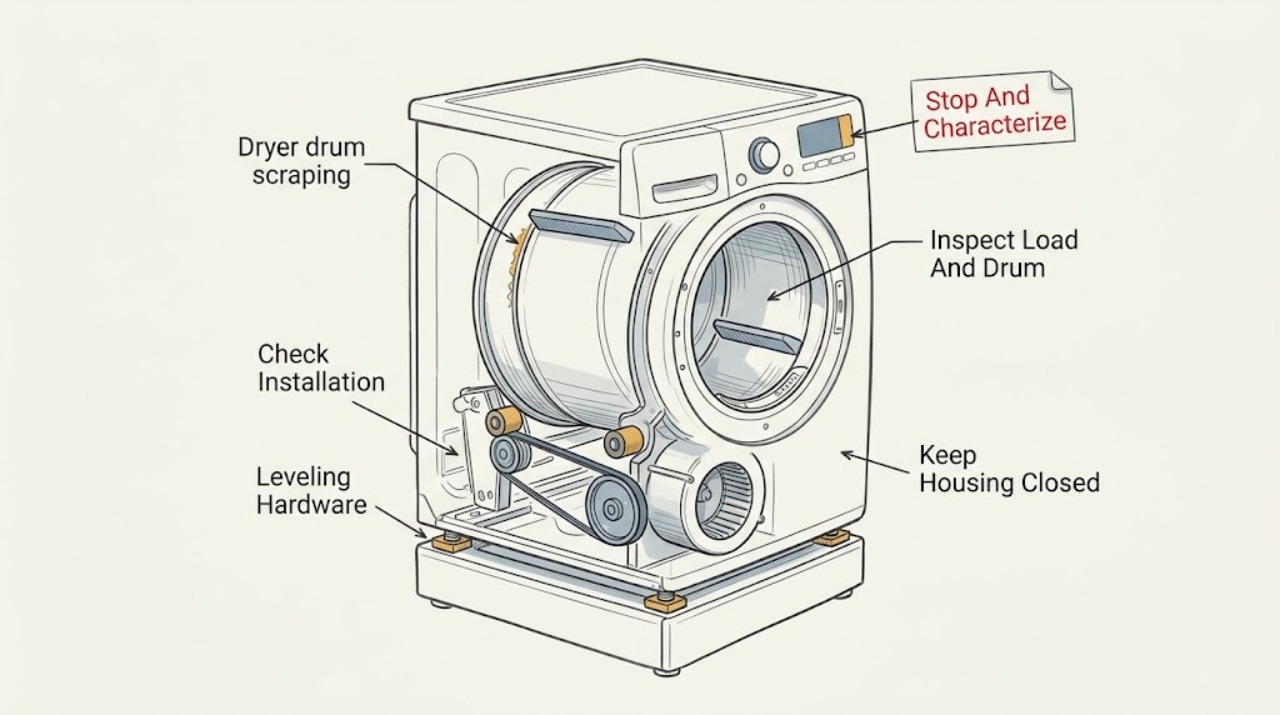
Work through in order
Diagnostic checks
Use only checks that match the exact appliance or system and its official guide.
-
Check 1
Stop the dryer, switch it off, and record when the scrape occurs before running another cycle; listen only from outside the closed appliance and do not touch a hot or damaged cord.
Expected result: Note whether the sound is metallic, rubbing, squealing, or clanking; whether it occurs at startup, every drum revolution, only with clothes, or continuously; and whether there is vibration, smoke, odor, or a warning from the controls.
Next step: Continue only with ordinary-access checks when no hazard is present; leave the dryer off and arrange qualified service for smoke, sparks, burning odor, scorching, a damaged cord, or a worsening scrape.
Stop if: Stop immediately for smoke, sparking, burning smell, scorching, a hot or damaged cord, exposed wiring, water near electrical parts, or a breaker that trips again.
Why this matters
Why: The timing separates an object or load-related noise from a repeatable rotating-part noise. A burning smell, smoke, sparking, scorching, or worsening metallic scrape is a hazard boundary rather than a routine noise check.
-
Check 2
With the dryer off and cool enough to handle, remove the load and inspect pockets, zippers, buckles, buttons, and the visible drum surface and seam for coins, screws, paper clips, or other loose objects.
Expected result: Record whether a loose object is present, whether a fastener is striking the drum, whether an object appears caught at the drum edge, or whether the visible area is clear; do not reach past the drum opening or pry a trapped object.
Next step: Remove only a loose object that is plainly accessible without tools, secure or turn clothing hardware as the owner guidance suggests, and then use one controlled empty comparison; obtain service if an object is trapped or the sound is unchanged.
Stop if: Do not insert tools, fingers, wire, or a hand into a seam, remove the drum, or force an object past a seal or guard.
Why this matters
Why: A loose object or clothing fastener can create a load-specific rattle, clank, or scrape. A clear visible drum does not rule out an object at an inaccessible seam or an internal support problem.
-
Check 3
From outside the cabinet, check whether the dryer is stable and level, whether a pedestal or stacking arrangement is visibly loose, and whether the unit is newly installed with shipping materials or installation hardware still present as applicable to the model.
Expected result: Record whether the cabinet rocks, walks, vibrates, is visibly out of level, or is loose on a pedestal; distinguish a new-installation condition from a noise that began after normal use.
Next step: Follow the owner's installation instructions for ordinary leveling or securing checks only; if the unit remains loose, stacked hardware is uncertain, or scraping persists when stable and empty, arrange service.
Stop if: Do not lift a stacked unit alone, remove structural brackets, disturb gas or exhaust connections, or operate a visibly unstable dryer.
Why this matters
Why: Frigidaire links clanking or squeaking to a loose pedestal and vibration or walking to leveling or installation conditions. These checks can explain movement-related noise, but they do not prove that a persistent empty-drum scrape is harmless.
-
Check 4
After the visible load and stability checks show no hazard, perform one short empty-load comparison according to the owner's guide while remaining nearby; stop immediately if the scrape becomes harsh or any hazard appears.
Expected result: Classify the result as silent when empty, the same scrape when empty, a brief normal startup sound that settles, or a scrape that changes with drum speed or direction.
Next step: If silent, reload only after checking pockets and fasteners. If the scrape remains empty, stop using the dryer and provide the recording, timing, and model to qualified service.
Stop if: Do not run repeated empty cycles, leave the appliance unattended, or continue for diagnosis when the drum binds, scrapes metal-on-metal, smells hot, smokes, sparks, or vibrates severely.
Why this matters
Why: Silence when empty makes clothing or a loose object more likely. Continued scraping with no laundry indicates that the source is in the dryer and is the service boundary Frigidaire describes; a brief startup noise still needs model-specific judgment if it is sharp, metallic, or worsening.
-
Check 5
If the noise persists, document the complete model identity, load-versus-empty result, stability result, direction or speed dependence, and any visible wear without opening the cabinet or removing drive parts.
Expected result: Record whether the drum rotates freely only through ordinary safe access with power disconnected, whether it feels rough or binds, whether the scrape is at the front or rear, and whether there is a visible damaged seal or edge; do not force rotation or reach inside mechanisms.
Next step: Leave the dryer out of service and arrange qualified appliance diagnosis; send the model, symptom recording, and all observations so the technician can inspect the model-specific assembly.
Stop if: Do not remove panels, test energized parts, apply lubricant, bend drum supports, bypass a guard, or order internal parts before model-specific diagnosis.
Why this matters
Why: Rough or binding rotation and an empty-load scrape make a support, seal, roller, belt, idler, motor, blower, or other internal diagnosis more likely, but the observed sound cannot identify which part is at fault. A loose or damaged visible edge may also require service rather than adjustment.
Use your observations
Decision map
Find the observation that best matches what you see, then follow the next safe action.
-
PATH 01Safety boundary
What you see
The noise occurs only with a particular load, and a coin, fastener, zipper, or other loose object is found or the empty comparison is quiet.
Do this next
Empty pockets, secure fasteners, turn garments inside out when appropriate, remove only plainly accessible loose objects, and retest with a safe load once.
Why this path and its safety boundary
Why it matters: The laundry or an object is more likely than a persistent internal drum fault.
Safety stop: Do not use tools or fingers to retrieve an object caught in the drum seam or continue if the drum edge or seal is damaged.
-
PATH 02Safety boundary
What you see
The drum is empty and the same scraping continues, or the scrape repeats with each rotation regardless of load.
Do this next
Stop using the dryer and arrange qualified service; provide the model and a description or recording of the sound and where it seems loudest.
Why this path and its safety boundary
Why it matters: The appliance itself is the more likely source, and Frigidaire directs contact for continuing noise after the empty-load comparison.
Safety stop: Do not keep running empty cycles, lubricate the drum, or remove panels to look for a roller, bearing, belt, or seal.
-
PATH 03Safety boundary
What you see
The unit rocks, walks, vibrates, or is loose on a pedestal or stacking arrangement, especially after installation or relocation.
Do this next
Follow the exact installation guide for safe leveling or securing checks; have the installer or qualified service correct uncertain stacked or pedestal hardware.
Why this path and its safety boundary
Why it matters: Leveling or installation hardware may be contributing to movement-related clanking or squeaking, but it does not establish that a sharp empty-drum scrape is solved.
Safety stop: Do not operate a visibly unstable unit, lift a stacked appliance alone, or remove structural or gas/exhaust connections.
-
PATH 04Safety boundary
What you see
With power disconnected, ordinary safe rotation feels rough, catches, wobbles, or binds, or the scrape is accompanied by grinding or severe vibration.
Do this next
Leave the dryer off and request qualified diagnosis before ordering or replacing internal parts.
Why this path and its safety boundary
Why it matters: A support, seal, roller, bearing, drive, or related internal problem is possible; the exact component cannot be safely identified from this observation.
Safety stop: Do not force the drum, remove the belt, access the motor, or operate the dryer to see whether the resistance worsens.
-
PATH 05Safety boundary
What you see
Scraping is accompanied by weak airflow, unusual vibration, an object near the lint or exhaust path, or a dryer that is not drying properly.
Do this next
Clean the lint screen as the guide requires, inspect only the accessible exhaust hood and duct for an obvious blockage, and arrange service when airflow remains weak or scraping persists.
Why this path and its safety boundary
Why it matters: A lint, exhaust, or blower-area issue may coexist with the noise, but a scraping sound is not resolved by ignoring airflow or by opening the cabinet.
Safety stop: Do not operate a gas dryer without its required outdoor exhaust, remove guards, or reach into the blower area.
-
PATH 06Safety boundary
What you see
Smoke, sparks, burning smell, scorching, a hot or damaged cord, water near electrical components, or a repeated breaker trip occurs with the scraping.
Do this next
If safe, stop the cycle and disconnect power at the normal disconnect or breaker without touching damaged parts; keep the dryer out of service and arrange qualified repair. Leave the area and contact local emergency services for active smoke or fire.
Why this path and its safety boundary
Why it matters: This is an immediate electrical, fire, or equipment-damage boundary rather than a noise diagnosis.
Safety stop: Do not restart, open the cabinet, handle scorched wiring, or keep resetting a tripping breaker.
Helpful context
Understand the symptom
First establish whether the scraping follows the laundry
Stop the cycle before searching for the source. Empty pockets, remove coins and other loose objects, and check zippers, buckles, buttons, or fasteners on the load. Frigidaire recommends an empty-load comparison when no object is obvious: if the sound disappears, the laundry or an object was the more likely source; if it remains with the drum empty, the appliance itself needs attention.
Use the sound and movement to narrow the safe next step
A brief rattle or clank tied to clothing hardware is different from a sharp metallic scrape that repeats as the drum rotates. Note whether the noise occurs only while loaded, on every revolution, at startup, or even during an empty comparison. A machine that vibrates, walks, or is loose on a pedestal also needs its installation checked, but a scrape that persists in an empty drum should not be treated as a leveling adjustment alone.
Keep cabinet and drive diagnosis on the service side
The drum edge, seals, supports, rollers, belt, idler, motor, and blower area are model-specific and may require cabinet access. Frigidaire's owner guidance directs service when an empty load does not resolve continuing noise. Do not lubricate, bend, pry, bypass a guard, or order a part based only on a scraping description; preserve the sound pattern and model information for a qualified technician.
Safety boundary
Stop conditions
- Stop immediately for smoke, sparking, burning odor, scorching, a hot or damaged cord, exposed wiring, water near electrical parts, or a breaker that trips again.
- Do not run repeated cycles when the drum scrapes while empty, binds, wobbles, grinds, or makes a worsening metal-on-metal sound.
- Do not insert tools, wire, or fingers into the drum seam, front or rear support area, blower area, or any gap beyond ordinary safe access.
- Do not remove the cabinet, belt, motor, rollers, idler, bearing, seals, guards, pedestal brackets, or gas and exhaust connections as a first-line check.
- Do not lubricate, bend, pry, bypass a safety device, or order an internal part from a noise description without model-specific diagnosis.
Only after diagnosis
Potential parts
- drum support, roller, bearing, or glide assembly
Consider this category only when a qualified diagnosis confirms rough, wobbling, binding, or scraping drum support components after excluding a loose object and installation condition.
Match the complete Frigidaire model and the diagnosed support design; do not assume all rollers, bearings, glides, or seals fit across product families. - drive belt or idler assembly
Consider this category only when a qualified technician confirms belt tracking, idler resistance, or related drive wear as the source of the scrape.
Confirm the model-specific belt path and idler design before ordering; cabinet access and electrical isolation are required for diagnosis or replacement. - blower wheel or blower-area component
Consider this category only when weak airflow or a qualified inspection identifies a damaged, obstructed, or noisy blower component.
Confirm model, blower design, and the source of the noise; do not reach into or operate an exposed blower assembly. - door or drum seal
Consider this category only when inspection confirms a damaged or displaced seal allowing the drum to rub or scrape.
Confirm the exact model and seal location before ordering; do not continue operating with a damaged seal or exposed metal edge.
When checks do not resolve it
Need a professional?
Arrange qualified Frigidaire appliance service when scraping continues with an empty drum, the drum feels rough or binds, the unit is unstable after ordinary installation checks, the noise is metallic or worsening, a visible seal or drum edge is damaged, airflow is weak with noise, or any internal access is required. Keep the dryer out of service for smoke, sparks, burning odor, scorching, a damaged cord, water exposure, or repeated breaker trips.
Safety scope: This article covers ordinary-access observation, pocket and drum inspection, stability checks, and one controlled empty comparison only. Do not open the cabinet, probe live circuits, reach into drive or blower mechanisms, force rotation, or operate a dryer with a hazard or persistent empty-drum scrape.
Common questions
FAQ
Why is my Frigidaire dryer scraping only with clothes inside?
A coin, zipper, buckle, button, or other loose object may be striking the drum. Stop the dryer, check pockets and visible drum areas, and compare with one empty cycle. If the sound continues empty, stop using the appliance and arrange service.
What if the Frigidaire dryer still scrapes when empty?
Frigidaire directs service when noise remains during an empty-load comparison. Leave it off and give the technician the model, sound timing, and whether the drum feels rough or binds with power disconnected through ordinary safe access.
Can an unlevel Frigidaire dryer cause scraping or clanking?
An unstable or unlevel dryer can vibrate, walk, or make movement-related noise, and Frigidaire also calls out a loose pedestal. Follow the installation guide for ordinary stability checks, but do not assume leveling fixes a sharp metallic scrape that persists when empty.
Should I lubricate the Frigidaire dryer drum when it scrapes?
Do not add lubricant or open the cabinet based only on the sound. Scraping can involve a foreign object, seal, support, roller, belt, idler, motor, or blower component, and the exact part needs model-specific diagnosis.
Is a scraping dryer safe to keep running?
Do not keep running it when scraping persists empty, worsens, or is accompanied by binding, severe vibration, smoke, sparks, burning odor, scorching, or a damaged cord. Disconnect power only through a safe normal disconnect and arrange qualified repair; contact local emergency services for active smoke or fire.
Read the exact guide
Official sources
- Laundry Dryer NoisesFrigidaire · Frigidaire owner-support noise guide for laundry dryers; installation and sound behavior vary by model.
- Dryer - Not Drying and Extended Drying TimeFrigidaire · Frigidaire owner-support guidance for drying performance; only the accessible checks relevant to a scraping symptom are used here.
- Is it normal for my dryer to make sounds or noises?Frigidaire · Frigidaire owner-support guidance for dryers; exact normal sounds and component arrangement depend on the model and owner's guide.
Community feedback
Share a repair observation
Share a plain-text repair observation. Accepted observations are published automatically; this page may take a moment to update.