
On this page
Start here
Quick answer
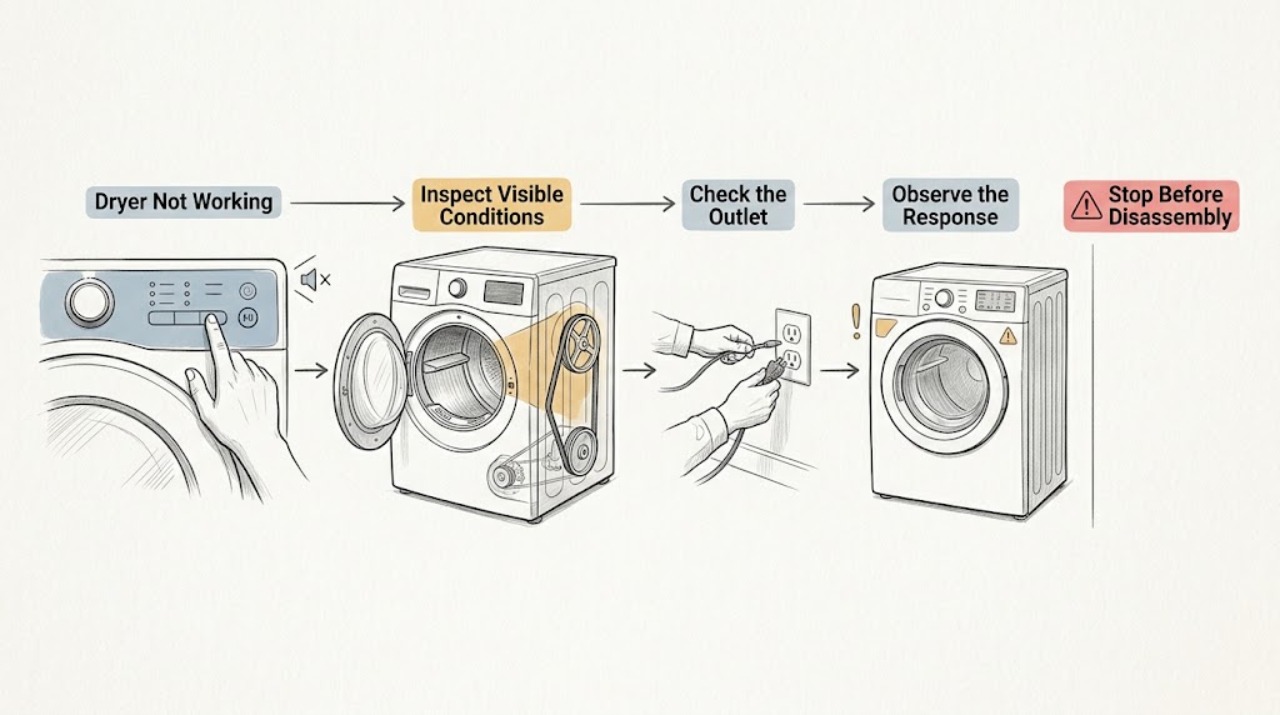
When a Frigidaire dryer is not working, first separate a no-start symptom from a dryer that starts and then stops or tumbles without heat. Confirm the door is fully closed, the cycle selector is at a start position, and the Start control is held as the model requires. Check the plug and household breaker or fuse without increasing fuse capacity or using an extension cord. If the dryer stopped after a large load, let it cool and reduce the load; keep the lint filter installed and the exhaust path clear. For a gas model, do not operate without proper ventilation or if a gas odor is present. If the problem returns, a breaker trips, the dryer overheats, or internal electrical, gas, motor, or thermal components need testing, stop and arrange qualified service.
Work through in order
Diagnostic checks
Use only checks that match the exact appliance or system and its official guide.
-
Check 1
With the dryer empty and the area clear, set the cycle selector to the intended start position, close the door fully, and hold or press Start exactly as the model manual describes. Observe whether the display, drum, motor sound, or airflow responds; do not reach into the drum while it is moving.
Expected result: No display or sound points toward power or control input. A display with no motor response points toward the door switch, start input, or internal control path. A motor that starts and then stops is a different branch from a dryer that never starts.
Next step: Record the exact cycle and visible response. If smoke, sparking, an electrical smell, a gas odor, or abnormal heat appears, stop immediately, disconnect power or gas only when safe, and arrange qualified service.
Why this matters
Why: Frigidaire identifies the Start control, cycle position, and completely closed door as basic conditions for operation, so a control-selection fault should be separated before internal diagnosis.
-
Check 2
Inspect the power cord, plug, and wall outlet from a dry, safe position without opening the dryer. Check the household breaker or fuse for the dryer circuit and confirm the plug is firmly seated. Do not use an extension cord, do not increase fuse capacity, and do not touch exposed wiring.
Expected result: A loose plug, open fuse, or tripped breaker can produce a dead dryer. If the breaker trips again, the outlet or cord is damaged, or the dryer remains dead with power available, the fault needs qualified electrical or appliance diagnosis.
Next step: Reset a tripped breaker only once if the circuit is dry and safe. If it trips again or the dryer does not respond, leave it out of service and arrange qualified service rather than repeatedly resetting it.
Why this matters
Why: Frigidaire's start guidance treats household power and connection as owner-level checks but directs overloaded or recurring electrical conditions to a qualified electrician or service provider.
-
Check 3
If the dryer stopped during a load or starts briefly and stops, switch it off and allow the motor to cool. Remove excess clothing and check that the drum is not overfilled; do not bypass a thermal device or restart repeatedly while the cabinet is unusually hot.
Expected result: A dryer that runs again after cooling and a smaller load is consistent with an overheated motor or load-related shutdown. If it stops again, overheats quickly, or never restarts after cooling, a thermal limiter, motor, airflow, or control fault remains possible.
Next step: Use only a normal load if the dryer has cooled and no hazard is present. Stop and arrange service if the stop repeats, the cabinet becomes abnormally hot, or the dryer has smoke, burning odor, or unusual noise.
Why this matters
Why: Frigidaire says overload can overheat the motor and identifies thermal-limiter activation as a service condition on electric dryers; cooling does not prove that the underlying cause is resolved.
-
Check 4
For a gas Frigidaire dryer, inspect only the visible gas-supply status and the space around the appliance after confirming there is no gas odor. For an electric dryer, note whether the drum turns but the heater does not. Do not open gas connections or measure electrical supply yourself; keep laundry and rugs from blocking the front or rear ventilation space.
Expected result: A gas dryer with a closed supply valve or restricted air space can fail to heat, while an electric dryer that tumbles without heat may have a separate supply or heater-circuit issue. A gas odor, soot, abnormal flame, or electrical smell is an immediate stop condition.
Next step: If gas supply or installation is uncertain, contact a qualified gas professional. If an electric dryer tumbles without heat or the supply is uncertain, arrange qualified electrical or appliance service; do not run a suspect dryer to test it.
Why this matters
Why: Frigidaire distinguishes gas-supply and air requirements from electric-dryer circuit and heater behavior, and the fuel type changes which professional should diagnose the appliance.
-
Check 5
With the dryer off and cool, inspect the lint filter and the visible exhaust outlet. Clean the filter as the Frigidaire manual describes, replace it before operation, and look for an externally blocked or crushed exhaust path without dismantling the duct or cabinet.
Expected result: A blocked or missing filter or restricted exhaust can reduce airflow and contribute to long drying or overheating. A clean installed filter and clear visible outlet with a dryer that still stops or will not start points toward a component or control fault.
Next step: Have a qualified service provider clean inaccessible duct or cabinet areas and diagnose repeated shutdowns. Keep the dryer out of service if lint is heavily accumulated, the exhaust is damaged, or heat or burning odor is abnormal.
Why this matters
Why: Frigidaire says lint buildup can block airflow and recommends routine exhaust inspection; airflow maintenance is necessary but cannot identify a failed motor, limiter, heater, or control.
Use your observations
Decision map
Find the observation that best matches what you see, then follow the next safe action.
-
PATH 01Next step
What you see
The display is active but the dryer does not start, and the door is not fully closed or the cycle is not at its start position.
Do this next
Close the door and select the cycle according to the exact model manual, then use the required Start action once. Arrange service if the condition returns.
-
PATH 02Next step
What you see
The dryer has no response and the plug, outlet, fuse, or breaker is abnormal.
Do this next
Do not use an extension cord or increase fuse capacity. Reset a breaker only once when safe; arrange qualified electrical or appliance service for a repeat trip, damaged cord, or continued no-start.
-
PATH 03Next step
What you see
The dryer stopped after a large load and operates again only after cooling or reducing the load.
Do this next
Use a smaller, normal load only after the dryer is cool and there is no hazard. Stop and arrange service if it stops or overheats again.
-
PATH 04Next step
What you see
A gas dryer has a gas odor, abnormal flame, soot, or uncertain gas connection, or the exhaust or ventilation is not safe.
Do this next
Stop the dryer, avoid ignition sources, leave the area if gas is suspected, and contact local gas emergency support or a qualified gas professional from a safe location. Do not restart it.
-
PATH 05Next step
What you see
The dryer tumbles without heat, has restricted airflow, smells of burning, smokes, sparks, or continues to fail after the external checks.
Do this next
Keep it out of service and arrange qualified electrical, gas, or appliance repair according to the model and fuel type. Do not bypass a thermal device or open the cabinet.
Helpful context
Understand the symptom
Identify what 'not working' means
Watch one safe attempt from outside the dryer. Does nothing happen, does the motor hum or stop, does the drum turn without heat, or did the dryer stop during a load? A completely closed door, correct cycle selection, and a properly held Start control are basic start conditions. If the dryer smells hot, smokes, sparks, or has a gas odor, stop the attempt and use the safety branch.
Check simple controls and power first
Frigidaire's first checks are external: the Start control, cycle selector, door, plug, household fuse or breaker, and circuit loading. Do not use an extension cord or increase fuse capacity. A repeated breaker trip is evidence of an electrical fault, not a reason to keep resetting the circuit.
Protect against heat, gas, and lint hazards
Keep the lint filter in place and do not run a gas dryer without the ventilation and exhaust arrangement specified by the installation instructions. Do not remove the cabinet, bridge a door switch, test live wiring, handle gas components, or continue running a dryer that overheats, smokes, or smells of gas or burning.
Only after diagnosis
Potential parts
- door switch or start-control component
Consider this class only after the exact model is confirmed and qualified diagnosis shows that the door-closed or Start input is not reaching the control despite correct external operation.
Verify the complete Frigidaire model and professional diagnosis before selecting a component. - thermal limiter or motor component
Consider this class only after qualified diagnosis links repeated stopping or overheating to the motor or thermal protection and airflow has been checked.
Do not bypass a thermal device or select a component from a stop symptom alone; confirm the model and fuel type. - heater or gas burner control component
Consider this class only when a qualified technician identifies a fuel-specific no-heat fault after supply, ventilation, lint, and cycle checks.
Confirm the exact Frigidaire model and qualified installation requirements before selecting any electrical or gas component.
When checks do not resolve it
Need a professional?
Provide the exact Frigidaire model and serial number, electric or gas fuel type, symptom stage, cycle and Start behavior, door response, display or error message, outlet and breaker observations, load size, whether cooling changed the symptom, lint and exhaust condition, and any heat, smoke, gas, burning, or electrical odor. Keep the dryer unplugged or the gas supply isolated only when safe until service.
Common questions
FAQ
Why is my Frigidaire dryer not working at all?
Check the cycle position, fully closed door, Start control, plug, and household breaker or fuse. Do not use an extension cord or increase fuse capacity. A dead dryer with confirmed power needs qualified diagnosis.
What if my Frigidaire dryer stopped during a load?
Switch it off, let the motor cool, and reduce an overloaded load. If it stops again, becomes unusually hot, or a thermal limiter may have activated, keep it out of service and arrange repair.
What should I check on a gas Frigidaire dryer?
Only inspect visible gas-supply status and ventilation when there is no gas odor. Keep the exhaust and air space clear. Stop for any gas smell, abnormal flame, soot, or uncertain connection and contact qualified gas support.
Can lint make a Frigidaire dryer stop working?
Lint can restrict airflow and degrade performance. Clean and reinstall the lint screen and keep the visible exhaust path clear, but arrange service for overheating, burning odor, smoke, or repeated stopping.
Read the exact guide
Official sources
- My dryer is running, but does not seem to be heating. What should I do? | FrigidaireFrigidaire · Frigidaire dryer that runs, fails to heat, or needs fuel-type and airflow separation
- Dryers - How often do I need to clean my dryer or the lint screen/filter to optimize my drying performance? | FrigidaireFrigidaire · Frigidaire dryer not working, stopping, or performing poorly where airflow may be restricted
- What should I do if my Frigidaire Laundry Center is not starting? | FrigidaireFrigidaire · Frigidaire stacked or combined laundry configuration where dryer start behavior may be affected by shared installation context
- What should I do if my dryer stops operating? | FrigidaireFrigidaire · Frigidaire dryer that starts and then stops or will not resume
- What should I do if my dryer does not start? | FrigidaireFrigidaire · Frigidaire dryer that does not start or has no initial response
Community feedback
Share a repair observation
Share a plain-text repair observation. Accepted observations are published automatically; this page may take a moment to update.