
On this page
Start here
Quick answer
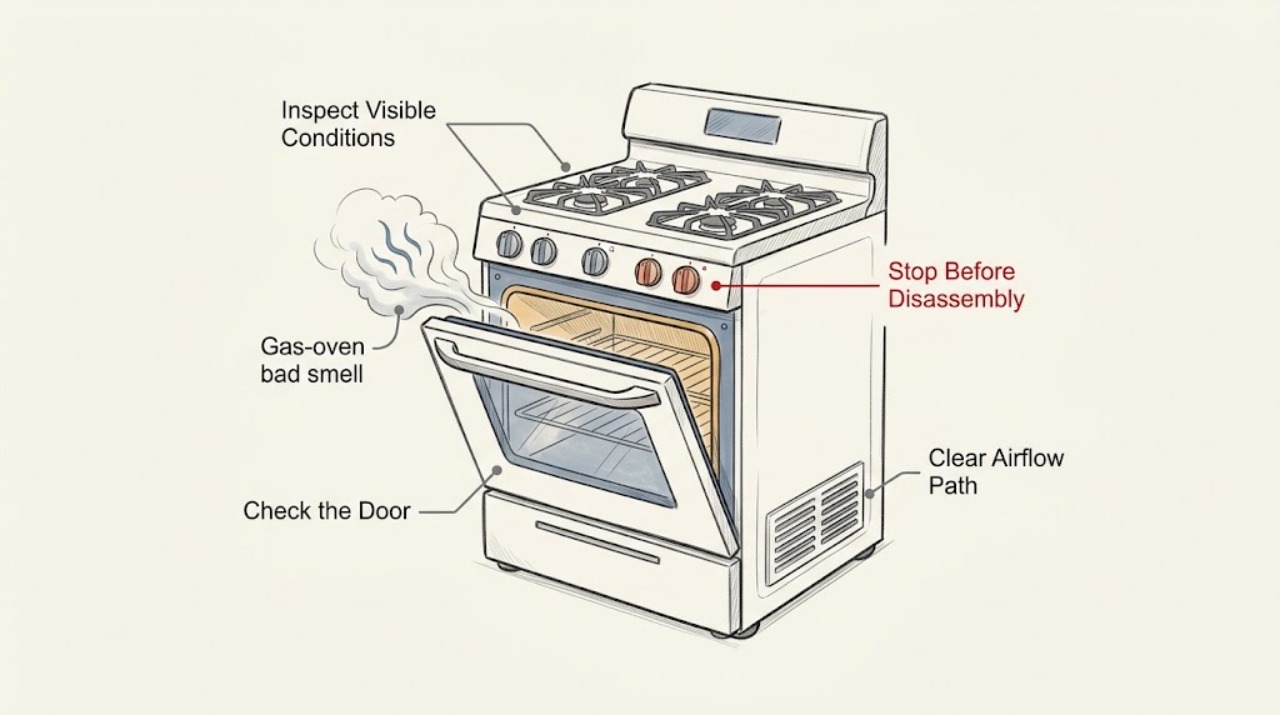
A bad smell from a Frigidaire gas oven can come from food or grease on a hot surface, residue left in the cavity or on a tray, a cleaning product, or a combustion or ventilation problem. Turn the oven off and classify the smell before trying another cycle. A gas odor, smoke that does not quickly stop, scorching, a melting or electrical smell, an abnormal flame, or a carbon-monoxide alarm is an immediate stop: leave the area as appropriate and contact emergency or gas professionals from a safe location. If the smell is limited to a spill or cooking residue, let the oven cool, clean only as directed by the model manual, and arrange service if the odor returns with a clean oven.
Work through in order
Diagnostic checks
Use only checks that match the exact appliance or system and its official guide.
-
Check 1
Turn the oven controls to Off and observe from a safe position. Classify the odor as food or grease, cleaning chemical, musty or damp, charred or melting, electrical, or gas-like; also note visible smoke, flame behavior, an unusual cabinet temperature, a CO alarm, or symptoms in anyone nearby.
Expected result: The smell follows a spill or cooking load, or it is accompanied by gas odor, smoke, scorching, abnormal flame, an electrical or melting smell, a CO alarm, or symptoms.
Next step: For gas odor or a CO alarm or symptoms, leave the area immediately as appropriate and contact emergency or gas authorities from a safe location; do not operate lights, phones, or other electrical equipment before leaving if a gas leak is suspected. For smoke, scorching, or melting odor without gas, keep the oven off and arrange qualified service.
Why this matters
Why: A load-related smell points toward residue or the food itself. Gas, smoke, scorching, abnormal flame, or melting odor can indicate fire, fuel, or electrical danger. A CO alarm or symptoms are urgent even though CO itself is odorless.
-
Check 2
If the odor is food-like or smoky and the oven is fully cool, inspect the oven floor, racks, tray, door area, and any accessory used in the affected cycle for spilled grease, crumbs, foil, parchment, or baked-on food. Check the model manual before cleaning and keep the oven bottom clear of items that should not be there.
Expected result: A visible spill, grease film, crumb, accessory residue, or covering is present, or the cavity appears clean.
Next step: After the oven cools, clean the accessible residue using only the model's care instructions and remove the cause from the load. Do not restart for a high-heat cleaning test if the odor is strong, chemical, electrical, or gas-like; use service instead.
Why this matters
Why: Frigidaire explains that drips and crumbs on the oven bottom can burn and create smoke; crowded or greasy Air Fry food can also drip. A clean cavity with a recurring odor makes an internal appliance, vent, or gas-flame issue more likely.
-
Check 3
Review the last cycle and anything placed in the cavity: determine whether the smell began after Air Fry, broiling, a fatty or dripping food, a spill, foil or parchment use, or a cleaning product. Confirm that no pan, foil, or bakeware is covering the oven bottom or interfering with the intended airflow.
Expected result: The smell has a clear cycle or load trigger, or it occurs during ordinary baking with a clean, correctly arranged cavity.
Next step: Remove only the confirmed accessory or residue after cooling and follow the model instructions for cleaning. If the odor occurs again with ordinary use, stop the oven and arrange qualified appliance service; do not alter the gas or combustion path.
Why this matters
Why: Grease and drips can smoke on hot surfaces, while covering the bottom of a natural-gas or propane oven can block combustion airflow and create carbon monoxide. An odor with ordinary clean use is not explained by one cooking load and requires escalation if it repeats.
-
Check 4
From outside the appliance, check that the room's range hood or ventilation is available and that the oven vent area is not covered by towels, foil, storage items, or renovation debris. Do not move the range or inspect the gas connector; note any hissing, gas odor, or signs of soot instead.
Expected result: Ventilation is blocked, the oven vent area is covered, the room has a fuel odor or hissing, or the external path appears clear.
Next step: Remove only an obvious loose object after the oven is off and cool. If there is hissing, gas odor, soot, or uncertainty about the connector or vent, leave the area as appropriate and contact gas or appliance professionals; do not move the range or continue operating it.
Why this matters
Why: Combustion appliances require proper airflow, and the CPSC warns that blocked vents or a gas leak can create serious fire or carbon-monoxide risk. An appliance connector can be damaged by movement, so its condition belongs to a qualified professional.
-
Check 5
For a Frigidaire gas oven, observe only the normal external result during a permitted supervised use after the cavity is clean and no safety symptom is present: note whether the burner flame appears stable and whether the odor returns as the oven heats. Do not remove panels, adjust the burner, or attempt to service the fuel system.
Expected result: The odor returns with heating, the flame appears abnormal or sooty, or the cycle runs without the odor and the flame appears normal.
Next step: Turn the oven off and arrange qualified gas-appliance service for a recurring odor or abnormal flame. If the odor is gas-like, leave immediately and contact gas authorities from outside rather than making another observation.
Why this matters
Why: An odor that returns independent of food residue points toward the burner, ignition, venting, or another internal fault. A sooty or abnormal flame needs professional combustion diagnosis; a single clean cycle without odor does not prove the appliance is safe if the symptom recurs.
-
Check 6
If the oven shows an error, thermal warning, or unusually high heat, record the exact display and turn the oven off. Allow it to cool, then use the model's documented reset procedure only when there is no gas odor, smoke, electrical smell, or CO concern; do not repeatedly reset a safety warning.
Expected result: The warning clears and the oven remains normal, or the warning or odor returns after cooling and reset.
Next step: Keep the oven out of use and arrange qualified service if the warning, unusual heat, or odor returns. If anyone has possible CO symptoms or a CO alarm sounds, leave for fresh air and contact emergency services; do not reenter until cleared by authorities.
Why this matters
Why: Frigidaire identifies F10 on standard range and wall ovens as detection of higher-than-normal temperatures and directs the oven to be turned off and cooled. A returning warning or odor points to a fault that needs service, not a setting adjustment.
Use your observations
Decision map
Find the observation that best matches what you see, then follow the next safe action.
-
PATH 01Safety boundary
What you see
The odor is gas-like, there is hissing, a CO alarm sounds, or someone has possible CO symptoms.
Do this next
Leave the area immediately as appropriate and contact emergency, gas, fire, or medical services from a safe location. Do not use the oven, operate switches, or try to find the leak or CO source.
Why this path and its safety boundary
Safety stop: Classify the odor as residue, food, cleaning product, ventilation, overheating, or an internal appliance fault and continue only with cool, external checks.
-
PATH 02Safety boundary
What you see
Grease, crumbs, a spill, foil, parchment, or accessory residue is visible after the oven cools.
Do this next
Follow the model-specific cleaning instructions, keep the oven bottom clear, and remove the trigger from the load. Stop instead of doing a high-heat test if smoke is heavy or the smell is chemical, electrical, or gas-like.
Why this path and its safety boundary
Safety stop: A clean cavity with a recurring smell needs qualified appliance diagnosis, especially if the odor occurs during ordinary baking.
-
PATH 03Safety boundary
What you see
The smell appears only during a greasy, high-temperature, broil, or Air Fry cycle.
Do this next
Check for drips and crumbs on the oven bottom and use the accessory arrangement recommended by Frigidaire. Do not cover the bottom of a gas oven or overload a tray.
Why this path and its safety boundary
Safety stop: A smell during ordinary clean use is not explained by the cooking load; keep the oven off and arrange service if it repeats.
-
PATH 04Safety boundary
What you see
The oven is unusually hot, shows a thermal warning, produces soot or an abnormal flame, or the odor returns after cooling and cleaning.
Do this next
Stop operation and arrange qualified gas-appliance service. Do not adjust the burner, move the range, open panels, or repeatedly reset the control.
Why this path and its safety boundary
Safety stop: A single residue-related odor may be resolved after the oven is cool and cleaned, but stop and seek service if it returns with a clean cavity.
Helpful context
Understand the symptom
The first question is not which part to replace; it is whether the odor is from food residue or from fuel, combustion, overheating, or an electrical fault. Turn the oven off and note whether the smell is greasy or smoky, chemical, musty, charred or melting, or like gas. Do not open panels, move the range to inspect the connector, or keep reheating an unknown odor.
Frigidaire says grease, crumbs, and drips on an oven bottom can smoke when exposed to hot air, especially during Air Fry. The CPSC also warns that carbon monoxide from fuel-burning appliances cannot be detected by smell, so a CO alarm or symptoms such as headache, nausea, dizziness, or shortness of breath must be treated as an emergency even when the oven has no noticeable gas odor.
Only after diagnosis
Potential parts
- oven cavity seal or door gasket
Consider this only if a qualified technician finds a damaged seal that allows heat or smoke to escape during otherwise normal operation.
Confirm the full Frigidaire model number and model-specific parts information before ordering. - oven burner or ignition component
Consider this only after a qualified gas-appliance technician diagnoses an abnormal ignition or burner flame; an odor alone does not identify a part.
Fuel and ignition components are model-specific and require qualified diagnosis and installation. - temperature sensor or control component
Consider this only when a technician confirms unusual heat or a recurring thermal warning after safe external checks.
Use the model-specific technical and parts information; do not infer fit from appearance.
When checks do not resolve it
Need a professional?
Stop using the Frigidaire gas oven and seek emergency or qualified gas service for a gas odor, hissing, a CO alarm, possible CO symptoms, flames outside the intended burner area, soot, or smoke that does not quickly stop. Arrange qualified appliance service for an electrical or melting odor, repeated burning smell, abnormal flame, unusual heat, an F10 or other thermal warning, or an odor that returns with a clean cavity. Do not move the range to inspect its gas connector, open panels, adjust gas pressure or burner calibration, or service fuel-burning components yourself.
Have this ready
- Frigidaire model number and whether the odor occurs in Bake, Broil, Air Fry, or another mode
- The odor description and whether it began after installation, cleaning, a spill, a particular load, or a long period without use
- Any display code, soot, abnormal flame, smoke, unusual heat, gas odor, or CO alarm
- What was found in the cavity, on the oven bottom, around the vent, and after the oven cooled
Common questions
FAQ
Why does my Frigidaire gas oven smell like burning food?
Grease, crumbs, or drips on a hot surface can smoke, especially during high-heat or Air Fry cooking. Let the oven cool, inspect the cavity and oven bottom, and clean only according to the model instructions.
Is a gas smell from a Frigidaire oven normal?
Do not assume it is normal. Stop using the oven; if you suspect a gas leak, leave the area and contact local gas or emergency authorities from a safe location. Do not operate switches or try to inspect the connector yourself.
Can foil on the oven bottom cause a dangerous smell?
Yes. The CPSC warns that covering the bottom of a natural-gas or propane oven can block combustion airflow and produce carbon monoxide. Keep the oven bottom clear and follow the model manual.
What does an F10 warning mean on a Frigidaire gas oven?
Frigidaire says F10 on standard range and wall ovens indicates higher-than-normal temperature detection. Turn the oven off, let it cool, and arrange service if the warning or odor returns.
Read the exact guide
Official sources
- Oven Error Codes and Alarms GuideFrigidaire · Frigidaire standard range ovens and wall ovens thermal warning, cooling, reset, and service guidance
- Understanding Sounds & Lights of Your Gas RangeFrigidaire · Frigidaire gas range operating sounds, lights, and model-specific support boundary
- Certain Older Gas Connectors May Be DangerousU.S. Consumer Product Safety Commission · Gas appliance connector safety, no appliance movement, and immediate response to suspected gas leaks
- Air Fry Tray - How do I limit the amount of smoke when using the ReadyCook™ Air Fry Tray?Frigidaire · Frigidaire ranges, ovens, wall ovens, and Air Fry Tray smoke from grease, crumbs, drips, and oven-bottom residue
- How to Clean Your Gas RangeFrigidaire · Frigidaire gas range cleaning instructions and model-specific care boundary
- Carbon Monoxide Fact SheetU.S. Consumer Product Safety Commission · Carbon monoxide from fuel-burning ranges and ovens, blocked combustion airflow, symptoms, alarms, and service boundaries
Community feedback
Share a repair observation
Share a plain-text repair observation. Accepted observations are published automatically; this page may take a moment to update.