
On this page
Start here
Quick answer
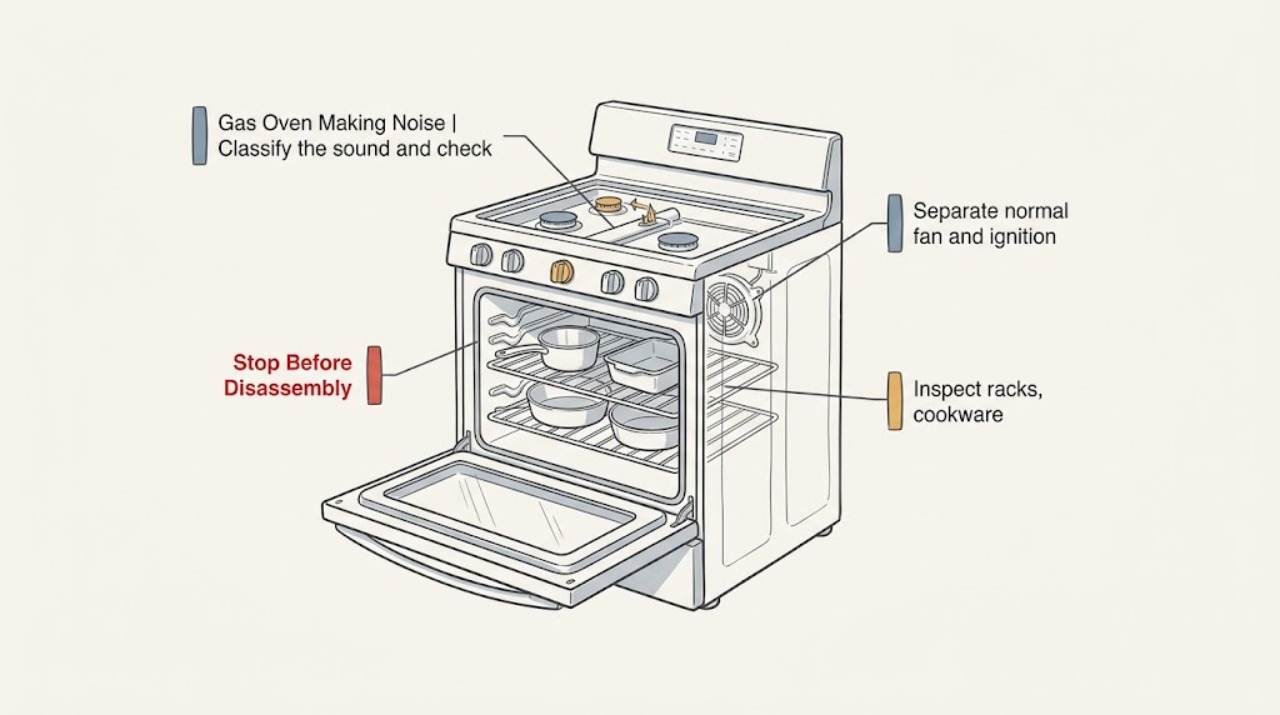
Some Frigidaire gas-oven sounds are expected: the igniter can click during lighting, a burner can make a soft whoosh once lit, and a cooling or convection fan can run during or after cooking. A new loud bang, grinding, scraping, rattling, repeated clicking without ignition, or noise with a gas smell, smoke, sparks, or abnormal flame is not a normal sound to keep testing. Stop the oven, keep the door closed if flames or smoke are present, and leave the area for an unignited gas smell. Once the appliance is cool and its controls are off, check only accessible racks, cookware, the door area, and the visible floor or surrounding contact points. Do not open the control panel, burner compartment, or gas connections. If the noise persists, the burner fails to ignite, or any gas or electrical symptom appears, discontinue use and arrange qualified appliance service.
Work through in order
Diagnostic checks
Use only checks that match the exact appliance or system and its official guide.
-
Classify the sound and check for gas or electrical danger
Turn the oven control off and identify whether the sound is a brief ignition click, soft burner whoosh, fan hum, ticking, pop, bang, scraping, grinding, or repeated clicking. Look for smoke, sparks, a yellow or unstable flame, a hot electrical smell, or a gas odor, but do not put your face near the oven or burner.
Expected result: The sound matches a brief ignition or fan event with a stable flame and no hazard, or it is persistent, loud, accompanied by an abnormal flame, smoke, sparks, heat, or an unignited gas smell.
Next step: For an unignited gas smell, do not operate switches, create a flame, or retry ignition; leave the area and contact the gas utility or emergency service from a safe location. For smoke, sparks, or a hot electrical smell, stop using the range, disconnect power only if safe, and seek qualified help. Otherwise let the oven cool fully before accessible checks.
Why this matters
Why: Frigidaire describes fan operation and certain gas-range operating sounds as normal in context. A gas odor, failed ignition, abnormal flame, smoke, sparks, or a new mechanical sound is a safety boundary rather than a sound to diagnose by repeated starts.
-
Separate normal fan and ignition sounds from a fault
With the oven empty and supervised, note whether the noise begins only during preheat, when the burner cycles, or after the oven is turned off. Do not repeatedly cycle the ignition to reproduce a click and do not operate the oven if the burner does not light promptly according to the model guide.
Expected result: A fan hum or short ignition sequence stops as expected, or the fan grinds, the igniter clicks repeatedly without a stable flame, or a bang occurs when gas lights.
Next step: If the sound is a normal fan or brief ignition event and the oven heats safely, continue to the cool-cavity checks. If clicking continues without ignition, a bang occurs, or the fan is scraping, turn the control off, stop use, and arrange qualified gas-appliance service.
Why this matters
Why: Frigidaire says it is normal to hear the oven fan during use and that it may continue after shutdown until the oven cools. Repeated ignition without a flame or a bang on ignition indicates an ignition, gas, or combustion issue that should not be treated as normal fan noise.
-
Inspect racks, cookware, and the cool oven cavity
After the oven is off and completely cool, remove racks and cookware, then inspect for a loose rack, foil, pan, or object touching the cavity or fan guard. Re-seat only removable racks and cookware as described in the owner's manual; do not remove a fan cover, burner shield, or panel.
Expected result: The noise disappears when a rack or pan is removed, an object is loose or touching the cavity, or the empty cavity still produces the same sound during operation.
Next step: Remove only loose, accessible objects and re-seat the rack. If the empty oven still makes scraping, grinding, repeated clicking, or banging sounds, stop use and arrange service instead of reaching behind guards or into the burner area.
Why this matters
Why: A loose rack or pan can rattle as the oven heats or the fan moves air. A noise that remains with an empty cavity is more likely to involve a fan, burner, ignition, door, or internal component rather than cookware.
-
Check the door and exterior for contact or damage
With the appliance cool, confirm that the oven door closes squarely, the gasket is seated, and nothing is leaning against the range or obstructing the cooling-air openings. Look for cracked glass, a bent hinge, loose visible trim, or a damaged cord; do not remove the door or trim.
Expected result: The door, gasket, hinge, trim, or surrounding contact point is visibly damaged or loose, or the exterior looks intact while the noise persists.
Next step: Do not use the oven if the door or glass is damaged, the gasket is displaced, or a part is loose near heat or gas components. Arrange service; if the exterior is intact, continue only with the ventilation and burner-safety boundary, not panel removal.
Why this matters
Why: A door or trim problem can create vibration and can also compromise heat containment. A clear exterior does not exclude a fan, burner, valve, or control fault inside the appliance.
-
Check visible ventilation without disabling the gas appliance
Look at the accessible exterior around the range and oven for blocked cooling openings, heavy grease buildup, or an object touching the cabinet. Keep the oven installed and connected as designed; do not disconnect the gas line, remove the rear cover, or run the oven with a panel or vent component removed.
Expected result: An opening is blocked, the cabinet is excessively hot, grease or debris is near an opening, or the exterior is clear but the noise remains.
Next step: Remove only an unrelated loose object from the outside and allow the appliance to cool. If it is excessively hot, smells of gas or burning, or continues making an abnormal sound, stop use and arrange qualified service. Do not operate a gas oven with its venting or panels altered.
Why this matters
Why: Air movement and heat expansion can change normal sounds, but excess heat, blocked airflow, or heavy grease can increase risk. A clear exterior does not make a persistent gas or mechanical noise safe.
-
Retest once only when all visible checks are normal
Only if the range is cool, the door and cavity are intact, no gas or electrical symptom is present, and racks and cookware are secure, run one short supervised preheat while standing clear of the oven opening. Stop immediately if the noise returns, changes, or is joined by an abnormal flame, gas smell, smoke, sparks, or excessive heat.
Expected result: The sound is gone or matches a documented fan or ignition event, or the abnormal noise returns from the empty oven or changes with heating.
Next step: If the oven remains quiet and heats normally, monitor it and follow the model's use and care instructions. If the sound returns, stop using the oven and give the technician the sound timing, gas odor or flame observations, model, and checks already completed.
Why this matters
Why: A corrected loose rack or external contact can explain a rattle, while a noise that returns with heating or an empty cavity indicates an unresolved component or combustion issue. Repeated operation can increase damage or expose the user to gas and heat hazards.
Use your observations
Decision map
Find the observation that best matches what you see, then follow the next safe action.
-
PATH 01Next step
What you see
The sound is a brief ignition click, stable burner whoosh, or fan hum that stops or cycles normally, with no gas odor, abnormal flame, smoke, or overheating.
Do this next
Treat it as an expected operating sound in context and monitor for a change. Use the model's manual for exact ignition and fan behavior.
-
PATH 02Next step
What you see
The noise is a rattle from a loose rack, pan, or accessible object and disappears when the cool cavity is cleared.
Do this next
Re-seat the removable item and supervise one short retest. Stop if the sound returns with an empty cavity.
-
PATH 03Next step
What you see
The oven clicks repeatedly without ignition, bangs on ignition, scrapes or grinds, or the noise returns with an empty cavity or during heating.
Do this next
Turn the oven off, discontinue use, and arrange qualified gas-appliance service. Do not open panels or adjust the burner, igniter, valve, fan, or wiring.
-
PATH 04Next step
What you see
A gas odor, abnormal flame, smoke, sparks, burning or electrical smell, damaged glass, excessive heat, or a repeatedly tripping breaker is present.
Do this next
Stop immediately. For gas odor, leave without operating switches or flames and contact gas or emergency help from a safe location. For electrical or smoke symptoms, disconnect power only if safe and keep clear.
Helpful context
Understand the symptom
Listen for when the sound occurs. A fan may run during preheat, baking, or cooldown, and gas ignition can involve a short series of clicks before a burner lights. A click that continues without a stable flame, a bang on ignition, a scraping fan, or a noise that began after a spill or impact changes the decision: stop rather than repeating ignition attempts. If you smell unburned gas, do not use electrical switches or flames; leave and contact the gas utility or emergency help from a safe location.
These checks are limited to the cool oven cavity and visible exterior. Exact control sequences and cleaning instructions vary by model, so use the owner's manual for the assigned model. Never remove panels or attempt to adjust a gas valve, igniter, burner, wiring, or safety device as a user repair.
When checks do not resolve it
Need a professional?
Arrange qualified appliance service for persistent or returning scraping, grinding, banging, repeated ignition clicks, abnormal fan noise, an oven that fails to ignite or heat normally, damaged door glass or trim, or any condition requiring access behind a panel. Stop immediately for an unignited gas smell, abnormal flame, smoke, sparks, burning or electrical odor, excessive heat, or a repeatedly tripping breaker.
Common questions
FAQ
Is clicking from a Frigidaire gas oven normal?
A brief click sequence during ignition can be normal if the burner lights promptly and the flame is stable. Repeated clicking without ignition, clicking with a gas smell, or a bang when gas lights is not a condition to keep testing; turn the oven off and arrange qualified service.
Why does my Frigidaire oven fan keep making noise after I turn it off?
Frigidaire says the oven fan may continue after baking while the range cools. A fan that scrapes, grinds, becomes unusually loud, or continues with overheating or a burning smell requires service rather than panel removal.
What should I do if my gas oven makes a bang or I smell gas?
Turn the control off and do not retry ignition. If you smell unignited gas, do not operate switches or flames; leave the area and contact the gas utility or emergency help from a safe location. A bang on ignition or an abnormal flame needs qualified gas-appliance service.
Read the exact guide
Official sources
- Ranges - Is it normal for a fan to come on while using my range and when does it stop running?Frigidaire · Frigidaire range oven fan operation during use and cooldown
- Understanding Sounds & Lights of Your Gas RangeFrigidaire · Frigidaire gas-range operating sounds and control or light behavior
- Baking with Your Gas RangeFrigidaire · Frigidaire gas-range oven operation and model-specific use guidance
Community feedback
Share a repair observation
Share a plain-text repair observation. Accepted observations are published automatically; this page may take a moment to update.