
On this page
Start here
Quick answer
On the Samsung NX58H5600SS/AA gas range, a brief ping, pop, or thump while the oven is heating or cooling can be the sound of metal expanding and contracting. A quiet blowing or humming sound can be the cooling fan running while the hot range cools, and a soft hiss is only potentially normal while gas is intentionally flowing. The timing and character matter: a loud or new grinding sound, a delayed bang, repeated ignition clicking, a hiss after the controls are off, gas odor, smoke, sparks, or an abnormal flame is not a normal post-cleaning sound. Stop using the range for those symptoms. Do not force the hot door, remove panels, reach through vents, relight repeatedly, or work on the gas or electrical system; arrange qualified appliance service, and leave the area and contact emergency or fuel-gas professionals from a safe location for a suspected leak or fire.
Before you begin
Safety first
- Do not force the self-clean door, open the rear or control panels, reach through vents, probe energized wiring, adjust gas pressure, clear internal burner ports with tools, bypass an interlock, or repeatedly ignite the oven to diagnose a noise. Do not select a fan, igniter, burner, valve, or control part from the symptom alone.
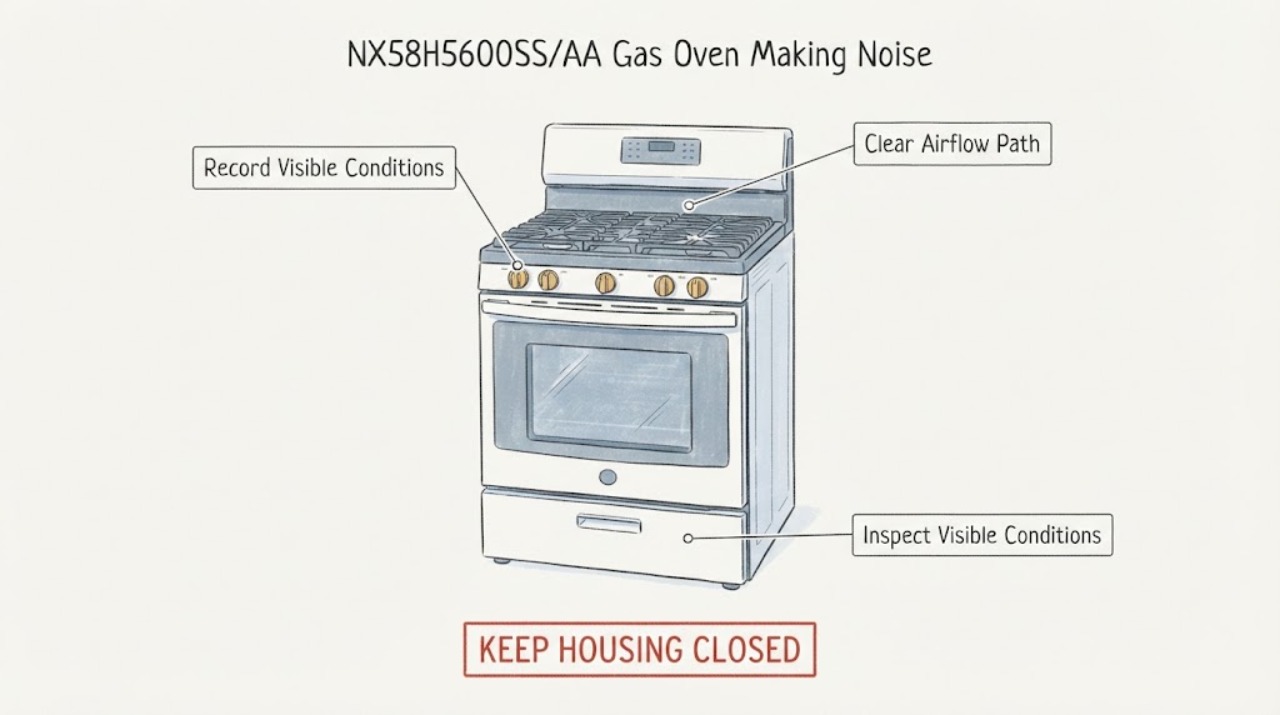
Work through in order
Diagnostic checks
Use only checks that match the exact appliance or system and its official guide.
-
Check 1
From a safe distance, record when the sound occurs: during the cleaning cycle, immediately after it ends, while the oven is cooling, during a later bake, or while all controls are off. Note whether the oven door is still locked and whether the sound fades as the range cools; do not touch the door or open the hot oven to listen closer.
Expected result: The sound is a brief ping or pop only during heat-up or cool-down, a low blowing or humming sound that fades, or a loud, irregular, persistent, or worsening sound while the oven is cool and off.
Next step: Allow the range to cool completely without another cleaning or cooking attempt. If the sound remains abnormal after cooling, arrange qualified Samsung appliance diagnosis and provide the timing and a safe recording.
Stop if: Stop immediately for smoke, burning odor, sparks, a loud bang, visible damage, or excessive heat; do not force the door or remove a cover.
Why this matters
Why: A brief sound tied to heating or cooling is consistent with Samsung's description of expanding and contracting metal, and a cooling fan can continue after use. A changed, loud, grinding, or persistent noise is not established as normal by its timing alone.
-
Check 2
Classify the sound without placing hands near the burners or vents: distinguish a short click, a light ping or thump, a quiet fan or airflow sound, a steady hiss, and scraping, squealing, grinding, or rattling. Note whether the gas oven or a surface burner is intentionally operating and whether the sound stops when that operation ends.
Expected result: The sound is a mild thump during cooling, a quiet fan that ends as the range cools, a soft hiss only while gas is on, or an abnormal mechanical sound, continuous click, or hiss while gas should be off.
Next step: For the clearly brief and phase-matched pattern, document it and compare it with the exact AA-series manual. For an unexplained or abnormal pattern, keep the range out of service and request qualified appliance or gas-appliance diagnosis.
Stop if: Do not reach through a vent, touch a hot surface, remove a fan guard, clear a burner, or repeat ignition tests to identify the sound.
Why this matters
Why: Samsung describes heat-related thumping, cooling or convection fan noise, and gas-flow hissing as possible operating sounds. Continuous clicking without an ignition command, a hiss with gas off, or a grinding or squealing fan sound needs service rather than a guessed part.
-
Check 3
Once the range is fully cool and the controls are off, make only a cold external inspection. Look for smoke residue, melted or discolored material, a visibly displaced door gasket, damaged outer surfaces, or an object touching an accessible exterior vent. Do not remove racks, insulation, the door, or any panel to reach the noise source.
Expected result: There is no visible damage and the sound has stopped, or there is residue, a damaged gasket or surface, a loose exterior item, or evidence of heat or smoke.
Next step: Remove only a loose item that is plainly outside the appliance and safe to lift; otherwise leave the range unused and give the technician photographs and the exact phase when the sound occurred.
Stop if: Do not continue using the range with smoke residue, heat damage, a damaged door seal, exposed insulation, or an unexplained change after cleaning.
Why this matters
Why: A clean cold exterior with a sound that has ended supports monitoring of a possible cooling or thermal sound, but it does not prove the appliance is safe if the event included smoke or an ignition bang. Visible heat damage or a damaged seal needs professional assessment.
-
Check 4
From outside the closed, cool range, note whether any fuel-gas odor is present and whether a flame was delayed, unstable, yellow, lifting, or outside its intended burner area during the event. Do not use a flame, switch appliances in the area, or restart the oven to check for another ignition.
Expected result: There is no gas odor or abnormal flame and the sound matched an intended operating phase, or there is gas odor, a hiss while gas should be off, delayed ignition, an abnormal flame, smoke, or a bang.
Next step: For any gas odor or suspected leak, leave immediately without operating switches or flames and contact emergency or fuel-gas professionals from a safe location. For a delayed ignition, abnormal flame, smoke, or unexplained hiss without an odor, keep the range off and arrange qualified gas-appliance service.
Stop if: Never search for a leak with a flame, relight repeatedly, adjust gas pressure, or turn the gas back on after a suspected leak.
Why this matters
Why: A soft sound during intended gas flow can be a gas-flow noise, but timing alone cannot clear a leak or combustion problem. Gas odor, unexplained hiss, delayed ignition, and abnormal flame are safety conditions rather than ordinary cleaning-cycle noise.
-
Check 5
If there was no hazard and the sound ended after complete cooling, save a safe-distance recording and note whether the oven later heats normally, the controls respond normally, and the noise returns. Do not run another cleaning cycle just to reproduce the symptom.
Expected result: The noise does not return and the oven behaves normally, or the noise returns, the oven overheats or fails to heat, an error appears, or a gas, smoke, flame, or electrical symptom develops.
Next step: If the symptom recurs or heating/control behavior changes, leave the oven unused and request service with the full model, cycle, timing, sound description, and recording. Do not order an igniter, fan, burner, or control component from the sound alone.
Stop if: Stop operation for any smoke, odor, sparks, abnormal flame, loud bang, repeated breaker trip, or uncontrolled heating.
Why this matters
Why: A one-time brief cooling sound may be monitored, while recurrence or a related operating fault means the normal-sound explanation is insufficient. A new hazard overrides any decision to monitor.
Use your observations
Decision map
Find the observation that best matches what you see, then follow the next safe action.
-
PATH 01Next step
What you see
The sound is brief, mild, and limited to the hot range heating or cooling after the cleaning cycle; there is no odor, smoke, spark, abnormal flame, visible damage, or control problem.
Do this next
Let the range cool fully, record the pattern, and monitor without running another cleaning cycle solely to test it. Request service if it becomes louder, returns while cool and off, or affects heating.
Why this path and its safety boundary
Why it matters: This pattern is consistent with Samsung's documented heat-related metal movement or a cooling sound, but the exact model manual remains the authority for the range's operating behavior.
-
PATH 02Next step
What you see
A quiet blowing or humming sound continues after the cycle while the range cools and then stops, with no grinding, squealing, overheating, or smoke.
Do this next
Keep vents externally clear and allow cooling to finish. If the fan never stops, becomes abnormal, or the range overheats, leave it unused and request qualified service.
Why this path and its safety boundary
Why it matters: Samsung distinguishes an internal cooling fan from the visible convection fan and says cooling can continue after use; a quiet phase-matched fan sound is not by itself a failed fan.
-
PATH 03Next step
What you see
The sound is loud or mechanical, persists with a cool oven and controls off, or is accompanied by poor heating, an error, visible heat damage, or a changed door seal.
Do this next
Stop using the range and arrange qualified Samsung appliance service. Provide the exact NX58H5600SS/AA identity, cleaning-cycle history, sound recording, timing, and visible cold-exterior observations.
Why this path and its safety boundary
Why it matters: A normal thermal or cooling explanation does not account for a changed or persistent fault, and the noise does not identify a safe replacement part.
-
PATH 04Next step
What you see
There is a gas odor, a hiss while gas should be off, delayed ignition, an abnormal flame, smoke, sparks, or a loud delayed bang.
Do this next
Do not relight or operate the range. Leave the area for a suspected leak or fire and contact emergency or fuel-gas professionals from a safe location; otherwise arrange qualified gas-appliance service before any use.
Why this path and its safety boundary
Why it matters: This is a gas, fire, or combustion safety event, not an ordinary post-cleaning noise branch.
Helpful context
Understand the symptom
This is a timing-and-safety diagnosis for the Samsung NX58H5600SS/AA gas oven, not a way to name a replacement part from a sound. Samsung identifies this exact model and AA variant on its support page. After a cleaning cycle, the cavity and surrounding metal are still cooling, so a short series of pings or pops can be consistent with thermal movement, and a quiet fan may continue while the range cools. That explanation is not enough if the noise is loud, irregular, worsening, or paired with a combustion, gas, smoke, or electrical warning.
Keep every check external and wait until the range is cool. Samsung warns that the range and escaping air can be very hot after cleaning, that the cleaning door lock must not be forced, and that a cleaning malfunction requires qualified service. Do not open the rear or control panels, probe wiring, adjust gas pressure, clear internal burner ports with a tool, or try another ignition cycle to reproduce a bang.
When checks do not resolve it
Need a professional?
Call qualified Samsung appliance service for persistent or abnormal noise after the safe external observations. Call qualified gas-appliance service for ignition, flame, or unexplained gas-sound symptoms. Treat odor, fire, smoke, sparks, or uncontrolled flame as an emergency rather than an appliance-parts diagnosis.
Safety scope: Do not force the self-clean door, open the rear or control panels, reach through vents, probe energized wiring, adjust gas pressure, clear internal burner ports with tools, bypass an interlock, or repeatedly ignite the oven to diagnose a noise. Do not select a fan, igniter, burner, valve, or control part from the symptom alone.
Have this ready
- Provide Samsung NX58H5600SS/AA, the market or rating-label suffix, whether the event followed Self Clean, the exact phase and sound type, whether the oven was hot or cool, whether the controls were off, any heating or error change, and a recording made from a safe distance.
Common questions
FAQ
Is a popping sound after Self Clean normal on the Samsung NX58H5600SS/AA?
A brief, mild ping or pop while the very hot range is heating or cooling can be consistent with metal expanding and contracting, which Samsung lists as a normal source of range thumping. It should not be dismissed if it is loud, worsening, persistent while cool, or paired with smoke, odor, sparks, abnormal flame, or a delayed bang.
Why does the Samsung gas oven keep humming after the cleaning cycle?
The cooling fan can continue while the range's internal components cool, and Samsung describes quiet fan or blowing sounds as possible operation. Allow the range to cool without opening panels. A fan that grinds, squeals, never stops, or accompanies overheating needs qualified service.
Should I run Self Clean again to see whether the noise returns?
No. Do not repeat a high-heat cleaning cycle as a diagnostic test. Wait for the range to cool, document the sound from a safe distance, and arrange service if it was abnormal or returns. Samsung warns that the range is very hot after cleaning and that a malfunction should be handled by qualified service.
Read the exact guide
Official sources
- Samsung oven fan is making a noise or will not turn offSamsung · Opened Samsung's official oven-fan troubleshooting page; applied only to external observation and service boundaries for abnormal fan noise.
- How to clean your Samsung ovenSamsung · Opened Samsung's official oven-cleaning guidance; used for hot-surface, locked-door, no-repeat-test, and qualified-service boundaries after a cleaning cycle.
- Samsung cooktop and range: common sounds and operational noisesSamsung · Opened Samsung's official range-sound troubleshooting page and used it for conservative sound classification, not as a substitute for the exact model manual.
- NX58H5600SS | Soporte Samsung LatinoaméricaSamsung · Opened Samsung's exact model support page; it identifies NX58H5600SS/AA and lists the AA-series installation guide and user manual.
Community feedback
Share a repair observation
Share a plain-text repair observation. Accepted observations are published automatically; this page may take a moment to update.