
On this page
Start here
Quick answer
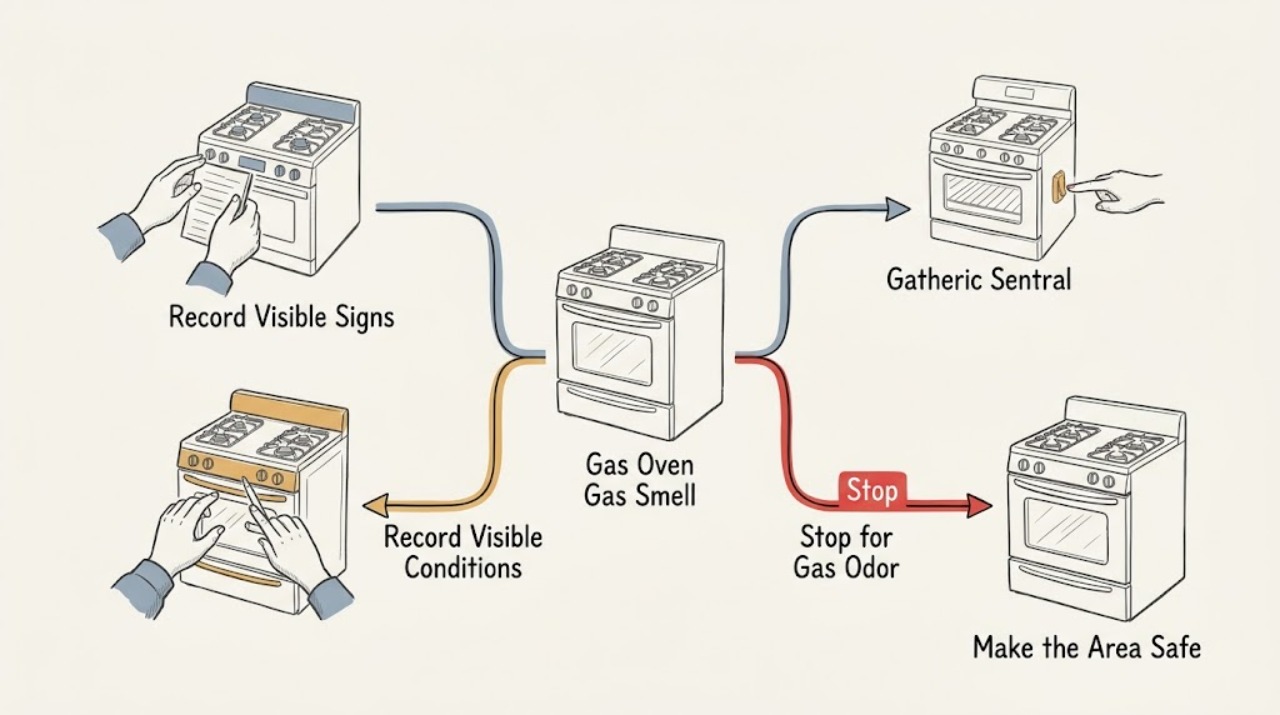
Treat a persistent, strong, or unexplained gas smell from a Samsung gas oven as a safety event: stop using the oven, do not ignite anything or operate electrical switches, get people away from the area, and follow local gas-emergency guidance. Do not keep trying to ignite the burner or open the door to look for a flame. A faint odor on first use can have a different explanation, and Samsung also distinguishes self-clean and food-residue odors, but that context does not excuse a continuing gas odor during normal use. Once the area is safe, record the exact model, fuel configuration, when the odor began, any delayed pop or abnormal flame, smoke, alarm, or error code, and arrange qualified gas-appliance service.
Work through in order
Diagnostic checks
Use only checks that match the exact appliance or system and its official guide.
-
Check 1
From a safe position, classify the event without approaching the oven: note whether the odor is strong or persistent, whether it began during ignition, preheating, cooking, or after shutdown, and whether there is a hiss, smoke, abnormal flame, visible damage, alarm, or anyone feeling unwell. Do not operate a control or create a flame to identify the smell.
Expected result: The smell is strong or continuing, appears outside a normal ignition moment, is paired with a hiss or abnormal flame, or is paired with smoke, an alarm, or symptoms.
Next step: Stop using the range, avoid flames and electrical switches, move people away from the area, and follow local gas-emergency or emergency-service instructions. Do not return to inspect the oven until the area is declared safe.
Why this matters
Why: Those observations cannot safely be separated from an active fuel or combustion hazard at home. CPSC testing describes delayed ignition as a way gas can accumulate before a flare-up, so timing is evidence for responders, not a reason to repeat ignition.
-
Check 2
If the odor is present now or its source is uncertain, leave the oven and range off. Do not turn knobs to relight, start another cycle, use a hood control, switch lights, unplug the appliance, or open a gas connection while in the affected area; follow the gas utility or emergency instructions for your location.
Expected result: The odor clears after people leave, remains present, returns near the appliance, or cannot be assessed without entering the area.
Next step: Stay out until the relevant emergency or gas professional says it is safe, then arrange qualified Samsung gas-appliance service. Do not perform a home leak search or repeat ignition to reproduce the symptom.
Why this matters
Why: A clearing odor does not prove that the appliance is safe, and an odor that persists or returns needs qualified evaluation. Samsung's gas-appliance warning treats gas smell and smoke as reasons to clear occupants and avoid appliances or electrical switches.
-
Check 3
After the immediate hazard has passed and only from a cool, safe location, record whether the appliance is new, whether packaging or shipping material was removed, whether the odor occurs only during self-clean, and whether a visible food spill or residue could explain a non-gas smell. Do not run self-clean or a bake cycle to confirm the theory.
Expected result: The appliance is new, the odor is limited to an allowed self-clean context, residue is visible, or the cavity is clean but the odor occurs during ordinary gas-oven use.
Next step: If the odor is not clearly a one-time non-gas residue event, keep the appliance off and arrange service. If the smell was clearly from food residue and no gas warning occurred, follow the model manual's cool-down and cleaning instructions rather than using high heat as a test.
Why this matters
Why: Samsung says first-use, self-clean, and normal-use odors have different explanations. A new-appliance or residue context may explain an odor, but a clean oven with an unexplained odor during normal operation needs support and should not be tested by another cycle.
-
Check 4
Once there is no active gas odor and the exact manual permits a visual check, record whether the oven burner ignites normally, cycles off and on during temperature control, never ignites, ignites late, or shows a flame outside the intended burner area. Do not relight or observe a suspected gas fault if any odor, smoke, pop, or abnormal flame is present.
Expected result: The flame is stable and contained, there is no ignition, ignition is delayed, a pop or boom occurs, the flame is weak or abnormal, or the oven does not maintain heat.
Next step: For no ignition, delayed ignition, a pop or boom, or an abnormal flame, stop the appliance and arrange qualified gas-appliance service without another attempt. For a stable flame with poor temperature behavior, provide the mode and model to service rather than adjusting gas pressure.
Why this matters
Why: Samsung notes that a gas oven may ignite and turn off during cooking to maintain temperature, but no ignition, delayed ignition, or abnormal combustion cannot be diagnosed from a generic visual check. CPSC documents that delayed ignition can allow gas to accumulate and flare.
-
Check 5
After the gas-safety decision is complete, identify the exact Samsung model and check the model manual for fuel type, Demo mode, door behavior, and error-code meaning. Do not assume a displayed tESt, tE 5t, d, D, or other code has the same meaning on every Samsung range.
Expected result: The oven is in Demo mode, an error or door code appears, the door is not fully closed, or the manual does not match the appliance.
Next step: If a code persists or the manual cannot be matched, keep the oven off and request Samsung service. Never use a reset or Demo-mode change as a response to active gas odor, smoke, delayed ignition, or abnormal flame.
Why this matters
Why: Samsung says Demo mode prevents oven heating and that codes and remedies depend on the model. These control states can resemble an ignition or heating fault, but they do not explain away an odor during normal gas operation.
-
Check 6
Once the oven is confirmed safe to handle from outside, note whether the range is newly installed or recently moved, whether the gas supply has changed, whether the odor follows one mode, and whether a vent hood or downdraft system was running. Do not change gas fittings, pressure, venting, or installation clearances yourself.
Expected result: The symptom began after installation or movement, occurs only with a hood or one oven mode, or has no clear relationship to installation or airflow.
Next step: Give the installation history and hood status to a qualified installer, gas professional, or Samsung service technician. Keep the appliance off when any gas odor or abnormal combustion has occurred.
Why this matters
Why: Samsung directs newly installed gas-range concerns to a professional installer or gas company, and CPSC testing found that certain hood and oven combinations can interfere with combustion and contribute to delayed ignition. This is installation evidence, not a home adjustment path.
-
Check 7
Separate a gas odor from a burnt or electrical odor only after the appliance is off and the area is safe: record whether the smell resembles fuel, scorched food, plastic, insulation, or hot metal, and whether smoke, sparks, a hot connection, or a breaker event occurred. Do not use a household test or cleaning product to mask the smell.
Expected result: The smell is clearly tied to food residue or first-use residue, resembles fuel, is electrical or burnt, or cannot be identified confidently.
Next step: For fuel-like, electrical, burnt, or uncertain odor, leave the appliance off and arrange appropriate gas, electrical, or appliance service. Do not resume cooking because the smell faded.
Why this matters
Why: A burnt or electrical odor can signal a separate fire or wiring risk, while an uncertain smell from a gas appliance should be treated conservatively. Samsung separates normal-use odor context from support escalation, and its gas-appliance warning treats gas smell or smoke as an emergency.
Use your observations
Decision map
Find the observation that best matches what you see, then follow the next safe action.
-
PATH 01Next step
What you see
The smell continues, spreads, returns, or cannot be confidently attributed to food or first-use residue.
Do this next
Do not ignite anything or operate electrical switches. Move people away, follow local gas-emergency instructions, and wait for qualified help before re-entering or using the range.
-
PATH 02Next step
What you see
The oven lights late, pops or booms, fails to ignite, or has a weak, unstable, or misplaced flame.
Do this next
Stop using the oven and do not try another ignition. Arrange qualified gas-appliance service; do not adjust pressure, valves, or burner hardware.
-
PATH 03Next step
What you see
The appliance is new or a cool, visible food residue is the only plausible source, with no fuel odor, smoke, delayed ignition, or abnormal flame.
Do this next
Follow the exact Samsung manual's first-use or cleaning guidance only after the appliance and area are safe. If the odor occurs during ordinary use or the source is uncertain, keep it off and request service.
-
PATH 04Next step
What you see
The oven shows a Demo indicator or a code while the fuel symptom is not active.
Do this next
Record the complete code and model, use the matching manual, and request Samsung support for a persistent code. Do not treat the code as permission to ignore gas odor or abnormal combustion.
-
PATH 05Next step
What you see
The problem began after installation, movement, gas-supply work, or use of a hood or downdraft system.
Do this next
Keep the oven off and provide the installation history to a qualified installer, gas professional, or Samsung technician. Do not alter the gas path or venting.
-
PATH 06Next step
What you see
The smell resembles scorched insulation or plastic, or there is smoke, a hot connection, spark, or breaker event without a clear fuel odor.
Do this next
Stop using the range and arrange qualified electrical or appliance service. Treat smoke, arcing, or a hot connection as an immediate stop condition even if the gas supply seems normal.
Helpful context
Understand the symptom
A gas smell is not a normal troubleshooting invitation
The first decision is safety, not diagnosis. If the odor is strong, persistent, spreading, or accompanied by a hiss, smoke, flame outside the intended burner area, dizziness, or an alarm, stop using the range and move people away. Do not operate switches, create a flame, or keep opening the oven to inspect it. Follow the emergency instructions used in your location and wait for qualified help.
Context can explain some odors, but not dismiss a gas leak
Samsung's oven support material separates first use, self-cleaning, and normal cooking as different odor contexts. Packaging or protective residue on a new appliance and food residue can smell unpleasant, while a gas-fuel odor during ordinary operation needs a more cautious interpretation. If you cannot confidently identify the odor as a non-gas residue and the appliance is safe to leave, treat it as gas-related and stop.
Keep model and fuel details for the professional
Samsung sells gas and dual-fuel ranges, and controls, ignition, Demo mode, error displays, and burner arrangements vary by model. Find the model information only from a safe location after the immediate hazard has passed. Do not use a generic code list, adjust a regulator, open a gas connection, or remove a panel to identify a fault.
Carbon monoxide is a separate invisible risk
A gas odor is not a carbon-monoxide detector. If a carbon-monoxide alarm sounds or anyone has concerning symptoms while a fuel-burning appliance is in use, leave the building and use local emergency guidance. Never use the gas oven as a room heater, and do not re-enter to run a test cycle.
Safety boundary
Stop conditions
- Stop immediately for a strong or persistent gas odor, delayed ignition, pop or boom, abnormal or misplaced flame, smoke, visible fire, electrical arcing, burning insulation odor, a hot plug or connection, a carbon-monoxide alarm, or anyone feeling unwell.
- Do not operate electrical switches, create a flame, repeatedly ignite the oven, open gas fittings, adjust pressure, remove panels, bypass an interlock, or use a cleaning cycle to mask or reproduce the odor.
- Do not resume cooking because the smell fades. Leave the range off until the relevant gas, electrical, emergency, or qualified appliance professional has assessed the hazard and given a safe next step.
Only after diagnosis
Potential parts
- gas oven ignition component
Consider this category only after qualified diagnosis links delayed or failed ignition to an ignition component rather than gas supply, venting, control, or installation.
Ignition systems differ by Samsung model and fuel configuration. Confirm the complete model and manufacturer fit information; do not handle gas or ignition parts as a user test. - gas valve or burner assembly
Consider this category only when a qualified gas-appliance technician confirms a valve or burner fault after the gas-safety hazard is controlled.
Gas valves and burner assemblies are model-specific and require safe gas-appliance procedures. Do not adjust, open, or replace gas-path components based only on odor timing.
When checks do not resolve it
Need a professional?
Arrange qualified Samsung gas-appliance service for any persistent or unexplained fuel odor, delayed ignition, pop or boom, abnormal flame, failure to ignite, recurring odor during ordinary use, or a code that returns. Contact the local gas emergency service for an active or strong odor and an electrician for smoke, arcing, a hot connection, or an electrical smell. Provide the exact model, fuel configuration, installation history, mode, timing, flame observation, code, and whether a hood was running.
Common questions
FAQ
Is a gas smell from a Samsung oven ever normal?
Samsung distinguishes first-use, self-clean, and normal-use odors, but a strong, persistent, or unexplained fuel-like smell during ordinary use is not a home troubleshooting opportunity. Stop using the range and follow local gas-emergency guidance.
What should I do if I smell gas while the Samsung oven is running?
Do not ignite anything or operate electrical switches. Move people away, follow local gas-emergency instructions, and wait for qualified help. Do not keep trying to ignite the oven or open a gas connection.
Could a delayed oven ignition cause a gas smell?
A delayed ignition can allow gas to accumulate before a flare-up. If the oven lights late, pops, booms, or has an abnormal flame, stop using it and arrange qualified gas-appliance service without another attempt.
Why does my Samsung gas oven smell but the cooktop works?
Cooktop operation does not clear the oven's ignition, burner, pressure, venting, or control path. Samsung provides model-specific gas and temperature checks, but a continuing odor or abnormal ignition needs qualified service.
Can Demo mode cause a Samsung gas oven problem?
Demo mode can prevent the oven from heating while a gas cooktop may still ignite, according to Samsung. Check the exact model manual after the gas-safety issue is resolved; Demo mode does not explain away a fuel odor.
What if the smell is burnt plastic rather than gas?
Treat an electrical or burnt odor, smoke, a hot connection, or sparks as an immediate stop condition. Leave the range off and arrange qualified electrical or appliance service; do not mask the smell or run another cycle.
Read the exact guide
Official sources
- Samsung dryer smells or smokesSamsung US · Samsung gas-appliance odor and smoke emergency boundary
- Samsung range or wall oven error codesSamsung US · Samsung range and wall-oven code recording, Demo mode, door status, reset, and service escalation
- Gas Range Delayed Ignitions - Tests and Examinations of RangesU.S. Consumer Product Safety Commission · Gas-range delayed ignition, accumulated gas, combustion, and range-hood interaction safety context
- Odor or smoke from Samsung ovenSamsung US · Samsung oven first-use, self-clean, normal-use odor context and service escalation
- Samsung oven temperature issuesSamsung US · Samsung oven no-heat, Demo mode, gas ignition, gas supply, door, reset, and service guidance
Community feedback
Share a repair observation
Share a plain-text repair observation. Accepted observations are published automatically; this page may take a moment to update.