
On this page
Start here
Quick answer
A Samsung gas oven can make normal clicking as relays switch, a low fan sound while the cooling or convection fan runs, and occasional thumping as metal expands or contracts. A gas range can also make a soft hiss while gas is flowing. The important clues are when the sound occurs, whether it stops when the cycle or gas control is off, and whether there is a flame or odor with it. A delayed boom, repeated failed ignition, continuous hiss after the oven is off, abnormal flame, smoke, sparks, visible damage, or a gas smell is not a sound to test repeatedly: stop using the oven, avoid flames and electrical switches for a suspected gas leak, leave if needed, and contact emergency or qualified gas service from a safe location. For a normal-sounding fan, relay, or heat-expansion noise that is unusually loud, persistent, or accompanied by poor heating, record the model and phase of operation and arrange Samsung appliance service.
Before you begin
Safety first
- This article permits listening and ordinary external observation only. Do not operate switches in a suspected gas leak, relight repeatedly, adjust gas pressure, disassemble gas components, open panels, test energized parts, or continue use after smoke, odor, sparks, abnormal flame, or delayed ignition.
Work through in order
Diagnostic checks
Use only checks that match the exact appliance or system and its official guide.
-
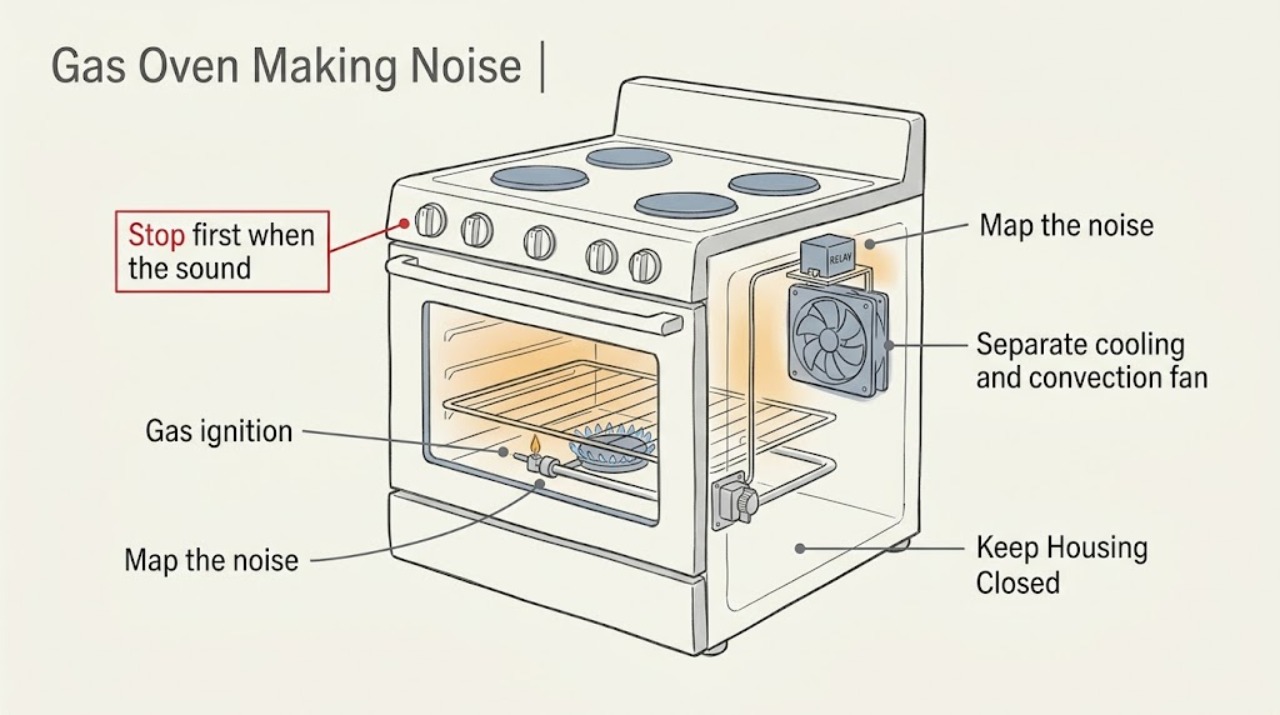
Stop first when the sound may involve gas or fire
If there is a fuel-gas odor, a loud delayed bang, flame outside the intended burner area, smoke, sparks or arcing, an uncontrolled flame, or a sound accompanied by a hot or damaged control or cord, stop operating the range. Do not open panels or try another ignition attempt.
Expected result: There is no gas odor, smoke, spark, abnormal flame, visible damage, or immediate danger, or one of those hazards is present.
Next step: For a suspected gas leak, avoid switches, appliances, phones, and flames in the area, leave, and contact emergency or fuel-gas professionals from safety. Otherwise continue only with the controls off and the oven safe to observe.
Stop if: Do not relight, repeatedly test, search for a leak, adjust gas pressure, or return to the area until qualified responders say it is safe.
Why this matters
Why: A clean, hazard-free observation can distinguish ordinary operating noise from a safety event. A gas, fire, or electrical warning is not a troubleshooting branch.
-
Map the noise to the oven phase
From a safe distance, record the exact Samsung model and whether the sound occurs during preheat, temperature maintenance, a cooktop ignition, convection use, cooling after shutoff, or while all controls are off. Note whether the oven reaches temperature and whether the sound stops when the relevant control is turned off normally.
Expected result: The sound is a brief click during operation, a low fan or blowing sound, a mild ping or thump during heating or cooling, a hiss while gas is on, or a sound that is loud, irregular, or present while idle.
Next step: Use the sound category below and keep the timing log; do not remove racks, burner parts, panels, or insulation to locate the source.
Stop if: Stop for odor, smoke, sparks, abnormal flame, a loud bang, metal scraping, a burning smell, or any sound that coincides with uncontrolled heating.
Why this matters
Why: Samsung lists relay clicks, cooling or convection fan noise, heat-expansion thumps, and gas-flow hissing as possible operating sounds. A sound that is unusually loud, irregular, persists with controls off, or does not match the operating phase needs service assessment.
-
Separate cooling and convection fan noise
If the sound is whirring, blowing, or a low hum, note whether it starts during oven operation or continues for a while after shutoff. From ordinary external access, check that no loose item is blocking an accessible vent; do not insert tools, remove covers, or touch hot surfaces.
Expected result: The fan sound is quiet and begins or ends with the expected cooking or cooling phase, or it is grinding, rattling, unusually loud, present indefinitely, or accompanied by overheating.
Next step: Allow normal cooling to finish and compare the sound with the exact manual. If the noise remains abnormal or the oven overheats, leave it out of service and request appliance diagnosis.
Stop if: Do not reach through vents, remove the fan guard or rear panel, run with exposed parts, or continue operation with smoke, burning odor, sparks, or excessive heat.
Why this matters
Why: Samsung describes an internal cooling fan and a convection fan that can run at intervals; cooling can continue after use. Grinding, rattling, unusual loudness, or persistent operation outside the model’s documented behavior is not established as normal.
-
Distinguish relay, ignition, and heat-expansion sounds
Listen from outside the closed oven without placing hands near burners or hot surfaces. Record whether clicking is brief and synchronized with oven operation, whether a ping or thump occurs as the range heats or cools, and whether any click is accompanied by a prompt visible flame only when the exact manual calls for that observation.
Expected result: The click is brief during operation, the ping or thump is mild and tied to heating or cooling, the clicking continues after controls are off, or a loud bang follows a delayed or failed light-off.
Next step: For a normal pattern, follow the model manual and monitor whether it changes. For continuous or abnormal ignition noise, stop use and arrange qualified gas-appliance service without repeated ignition tests.
Stop if: Do not open the burner assembly, clear ports with a tool, adjust the regulator, test ignition repeatedly, or continue after a delayed ignition bang.
Why this matters
Why: Brief relay clicks and mild heat-expansion sounds can be normal. Continuous clicking, a large bang, delayed ignition, or a sound with gas odor or abnormal flame indicates an ignition or gas-safety concern rather than a normal relay or metal sound.
-
Treat hissing, puffing, or abnormal flame as a gas decision
If the sound is a hiss, whistle, puff, or blow, note only from a safe distance whether it occurs while gas is intentionally flowing, whether a burner or oven is supposed to be operating, and whether there is any fuel odor, delayed flame, yellow or lifting flame, smoke, or repeated failed ignition. Do not use a lighter or other flame as a test.
Expected result: A soft model-documented hiss occurs only during intended gas operation with a stable flame and no odor, or the hiss continues when gas should be off or accompanies odor, delayed light-off, abnormal flame, or a bang.
Next step: For a clearly normal documented pattern, record it and monitor. For any odor, delayed ignition, abnormal flame, persistent hiss, or explosive-sounding puff, stop using the appliance, leave if needed, and contact emergency or qualified gas service from a safe location.
Stop if: Never search for a leak with a flame, relight repeatedly, adjust gas pressure, disassemble gas tubing, or operate switches in a suspected gas leak.
Why this matters
Why: Samsung says gas-flow hissing and certain model-specific puffing can be normal, but the safe interpretation depends on timing and the absence of gas-leak or combustion warnings. A persistent or unexplained gas sound cannot be cleared by listening closer.
-
Escalate an abnormal sound or heating result
If the sound is unusually loud, has changed from the prior pattern, remains while the oven is cool and controls are off, or comes with poor heating, an error, a door or control problem, or a visible change, stop operating the oven and save the model number, sound timing, cooking mode, and a safe-distance recording for service.
Expected result: The noise disappears with normal cooling and the oven heats and controls normally, or the noise returns, the oven overheats or fails to heat, or another unsafe symptom appears.
Next step: Arrange qualified Samsung appliance service for persistent abnormal noise or heating. Use emergency or fuel-gas response for gas odor, fire, smoke, or suspected leak, and do not supply a guessed replacement part.
Stop if: Do not continue cooking, remove panels, bypass a safety control, measure live electrical parts, or perform gas-system work as a user test.
Why this matters
Why: A normal operating category does not prove that a louder or changed sound is harmless. Samsung directs users to service when a documented operating sound is significantly louder than normal; persistent gas or fire symptoms require the higher-risk gas boundary.
Use your observations
Decision map
Find the observation that best matches what you see, then follow the next safe action.
-
PATH 01Safety boundary
What you see
A brief click occurs during oven operation, or a mild ping or thump occurs only as heated metal expands or contracts, with normal heating and no odor or flame abnormality.
Do this next
Record the pattern, follow the exact model manual, and monitor whether its volume or frequency changes.
Why this path and its safety boundary
Why it matters: Samsung identifies relay switching and heat-related metal movement as possible normal operating sounds.
Safety stop: Stop if the sound becomes loud, sharp, irregular, or is accompanied by smoke, odor, sparks, abnormal flame, or uncontrolled heating.
-
PATH 02Safety boundary
What you see
A quiet low hum or blowing sound follows the expected convection or cooling phase and fades as the range cools.
Do this next
Allow the documented cooling period and request service only if the sound becomes abnormal, persists unexpectedly, or affects temperature.
Why this path and its safety boundary
Why it matters: Samsung describes cooling and convection fans that can run during operation or after shutoff on applicable models.
Safety stop: Do not reach into vents or run with a removed cover; stop for smoke, burning odor, sparks, or overheating.
-
PATH 03Safety boundary
What you see
Clicking continues when no gas control should be in an ignition position, or the sound is accompanied by moisture, failed ignition, an abnormal flame, or a bang.
Do this next
Stop using the range and arrange qualified gas-appliance service; do not open the burner or ignition system.
Why this path and its safety boundary
Why it matters: The normal ignition or relay explanation is not established; repeated ignition can create a gas or fire hazard.
Safety stop: For gas odor, leave and avoid switches and flames; do not relight or test repeatedly.
-
PATH 04Safety boundary
What you see
A fuel-gas odor or suspected leak is present, or a hiss continues when gas should be off.
Do this next
Avoid lights, appliances, phones, flames, and other ignition sources in the area; leave immediately and contact emergency and fuel-gas professionals from a safe location.
Why this path and its safety boundary
Why it matters: This is an emergency gas-safety condition, not an appliance-noise diagnosis.
Safety stop: Do not return, restart, search for the leak, or turn gas back on until qualified responders determine it is safe.
-
PATH 05Safety boundary
What you see
A loud puff or bang follows a delay before ignition, or the flame is abnormal, unstable, outside its intended area, or accompanied by smoke or odor.
Do this next
Stop using the gas oven, keep people away, and arrange qualified gas-appliance service; use emergency response for fire, heavy smoke, or suspected gas leak.
Why this path and its safety boundary
Why it matters: The sound may indicate an unsafe ignition or combustion condition; it should not be classified as normal thermal expansion.
Safety stop: Do not relight, adjust pressure, clear internal ports, remove panels, or repeat the ignition test.
-
PATH 06Safety boundary
What you see
The noise is significantly louder than before, persists with the oven cool and controls off, or coincides with poor heating, overheating, an error, or a control fault without a gas emergency.
Do this next
Leave the oven out of service and request qualified Samsung appliance diagnosis with the model, mode, timing, and recording.
Why this path and its safety boundary
Why it matters: A normal sound category does not explain a changed or persistent fault; the cause may involve a fan, control, ignition, burner, or another model-specific part.
Safety stop: Do not open panels, bypass interlocks, measure energized wiring, or order a part solely from the sound.
Helpful context
Understand the symptom
The sound’s timing is more useful than its volume alone
Record whether the noise occurs during preheat, after the set temperature is reached, when the oven is turned off, during a cooktop burner ignition, or while the oven is otherwise idle. Samsung describes relay clicks during oven operation and a low cooling or convection fan sound as normal on applicable models. The exact model manual controls which fan, burner, ignition, and control arrangement your range has, so do not assign a sound to a part by appearance alone.
Normal heat sounds must not be confused with delayed ignition
A single light click, a quiet fan, or a mild ping as heated metal changes temperature can be expected. A loud bang or puff after gas has been flowing without prompt ignition, repeated failed light-off, a persistent hiss, an abnormal flame, or a gas odor changes the decision from observation to stop-use. Do not open panels, adjust gas pressure, clear an internal burner passage, or relight repeatedly.
Gas odor is an emergency boundary
If you smell fuel gas or hear a gas-leak-like hiss, do not operate switches, appliances, or phones in the area. Keep away from flames and ignition sources, leave with everyone else, and contact emergency responders and the fuel-gas professional from a safe location. NFPA says not to return until qualified responders determine it is safe. This article does not provide a leak-finding or relighting procedure.
Use service when a normal category becomes abnormal
If the sound is clearly tied to the fan, relay, or heat cycle but is much louder than before, continues with the oven cool and controls off, or accompanies temperature or flame problems, preserve a short recording from a safe distance and arrange model-specific service. A recording and timing log are more useful than removing a cover or ordering a part from a sound description.
Safety boundary
Stop conditions
- If you smell fuel gas or suspect a leak, do not operate lights, appliances, phones, or flames in the area. Leave immediately and contact emergency and fuel-gas professionals from a safe location.
- Do not relight repeatedly or test a delayed bang, persistent hiss, abnormal flame, smoke, spark, or ignition failure. Do not search for a gas leak with a flame.
- Stop for smoke, burning odor, visible flame outside the intended burner area, uncontrolled heating, electrical arcing, a hot or damaged cord or control, or a breaker that trips again.
- Do not adjust gas pressure, disassemble gas tubing, clear internal burner or ignition passages with tools, open panels, test energized parts, or bypass a safety interlock.
- Do not touch hot surfaces or use a hand near a vent to identify a sound. Use only ordinary external observation and the exact Samsung manual’s model-specific guidance.
- Do not return to a suspected gas-leak area or turn the gas back on until qualified fuel-gas professionals or emergency responders determine it is safe.
Only after diagnosis
Potential parts
- cooling or convection fan assembly
Consider this category only after service confirms that an abnormal fan sound or persistent fan fault is present on the exact model.
Confirm the complete Samsung model and fan arrangement with qualified service; do not remove covers or order from a noise description alone. - gas oven igniter or ignition assembly
Consider this category only when qualified diagnosis confirms failed or delayed ignition on the exact model after the appliance is made safe.
Confirm fuel type, exact model, and installation compatibility with a qualified gas-appliance technician; do not repeatedly test or install an unverified igniter. - gas burner or burner-control component
Consider this category only when service identifies a burner or control fault causing abnormal flame or combustion behavior on the exact model.
Confirm the model-specific assembly and safe gas-service procedure through qualified service; do not clear ports, adjust pressure, or disassemble the gas path as a user check.
When checks do not resolve it
Need a professional?
Request qualified Samsung appliance service when a fan, relay, thermal, or gas-flow sound is unusually loud, persistent, changed from its prior pattern, present with controls off, or accompanied by poor heating or an error. Request qualified gas-appliance service for continuous clicking, repeated failed ignition, delayed ignition, abnormal flame, or an unexplained hiss. For a gas odor, suspected leak, fire, heavy smoke, or uncontrolled flame, leave immediately and contact emergency and fuel-gas professionals from a safe location.
Safety scope: This article permits listening and ordinary external observation only. Do not operate switches in a suspected gas leak, relight repeatedly, adjust gas pressure, disassemble gas components, open panels, test energized parts, or continue use after smoke, odor, sparks, abnormal flame, or delayed ignition.
Common questions
FAQ
Is clicking from a Samsung gas oven normal?
Brief clicking during operation can be relay switching or ignition activity on applicable models. Timing matters: continuous clicking with controls off, repeated failed ignition, a loud delayed bang, gas odor, or abnormal flame is a stop-use condition, not a normal sound to test repeatedly.
Why does my Samsung oven make a thumping or pinging sound?
Samsung identifies thumping or banging as possible expansion and contraction of metal parts as the range heats or cools. If the sound is significantly louder than before, irregular, or accompanied by heating or safety problems, request service.
Why does my Samsung gas oven hiss?
A soft hiss can be gas moving through the system while gas is intentionally on, but a persistent or unexplained hiss is not something to investigate with a flame. Any gas odor, delayed ignition, abnormal flame, or hiss while the controls are off requires immediate stop-use and fuel-gas safety response.
Is a Samsung oven fan supposed to run after it is turned off?
Samsung says the internal cooling fan may continue until internal components cool, and a convection fan can run at intervals. A quiet, expected cooling sound is different from grinding, rattling, unusual loudness, or persistent operation with overheating.
What does a loud bang during gas-oven ignition mean?
A loud bang after a delay, a repeated failed light-off, or a bang with gas odor or abnormal flame should not be classified as normal heat expansion. Stop using the oven and arrange qualified gas-appliance service; leave and contact emergency help for a suspected gas leak or fire.
Can I relight a Samsung gas oven to see if the noise goes away?
Do not repeatedly relight an oven after a delayed ignition, abnormal flame, persistent clicking, gas odor, or loud puff. Repeated testing can increase risk. Preserve the timing and model information for qualified service instead.
What should I do if I smell gas near the Samsung oven?
Do not operate lights, appliances, phones, or flames in the suspected area. Leave immediately with everyone else and contact emergency and fuel-gas professionals from a safe location. Do not return or turn the gas back on until qualified responders say it is safe.
When should a noisy Samsung gas oven be serviced?
Request service when the sound is significantly louder or changed, persists with the oven cool and controls off, affects heating, or comes with an error, fan fault, or abnormal flame. Gas odor, smoke, fire, sparks, delayed ignition, and uncontrolled heating require immediate stop-use escalation.
Read the exact guide
Official sources
- Samsung cooktop and range: common sounds and operational noisesSamsung Support · Official Samsung range guidance used to classify sound timing; exact Samsung gas-oven model manual and qualified service control applicability.
- Samsung oven temperature issuesSamsung Support · Official Samsung oven temperature guidance used only for the distinction between normal cycling and heating or gas-supply faults; exact model instructions govern.
- Samsung oven fan is making a noise or will not turn offSamsung Support · Official Samsung oven guidance used for fan-sound classification; exact model fan count and behavior vary.
- CHAPTER 19 - Ignitible Liquids and GasesNational Fire Protection Association · General fuel-gas safety guidance used for emergency stop conditions; local emergency instructions and the fuel-gas professional control the response.
Community feedback
Share a repair observation
Share a plain-text repair observation. Accepted observations are published automatically; this page may take a moment to update.